
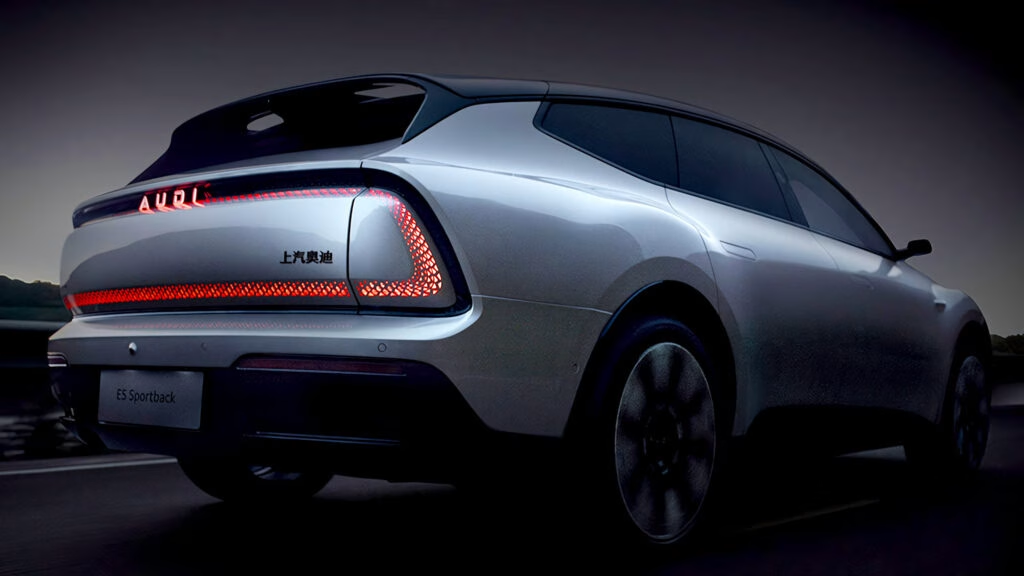
Why Is the Audi E5 Sportback Generating So Much Buzz in China?
When Audi announced its new China-exclusive EV brand—AUDI, all caps, no four rings—industry watchers were skeptical. Would Chinese buyers, already spoiled for choice with local EV startups, really flock to a German badge that looks nothing like the Audis they know? Turns out, the answer is a resounding yes. Within just 30 minutes of opening pre-orders for the E5 Sportback, Audi racked up over 10,000 reservations. That’s the kind of hype you usually see for a hot new smartphone, not a car from a legacy automaker.
But here’s the kicker: those reservations aren’t binding. There’s no hefty deposit locking folks in. Still, the sheer volume sends a message—Chinese drivers are hungry for something fresh, and the E5’s blend of German engineering and local flair seems to hit the sweet spot.
How Does the E5 Sportback Stack Up on Price and Value?
Let’s get straight to the numbers. The entry-level E5 Sportback Pioneer starts at just 235,900 yuan—roughly $33,000. For context, that’s less than what you’d pay for a mid-range compact SUV in the US or Europe. Yet you’re getting a 76 kWh battery, 295 horsepower, and a claimed range of 384 miles (618 km). That’s not just competitive—it’s disruptive.
Move up the ladder and the value proposition gets even more interesting. The Pioneer Plus, with a beefier 100 kWh battery and 402 hp, starts at 269,900 yuan ($38,000). There’s also a dual-motor, all-wheel-drive version with 518 hp for the same price. At the top sits the Flagship Quattro: 100 kWh battery, 776 hp, and a whopping 402 miles (647 km) of range, all for 319,900 yuan ($45,000). For comparison, similar performance EVs from Western brands often cost twice as much—if not more.
What’s Behind the E5’s Impressive Range and Performance?
Chinese EV buyers are notoriously demanding when it comes to range, and Audi’s new E5 doesn’t disappoint. Depending on the trim, you’re looking at anywhere from 384 to 402 miles on a single charge. That’s thanks to a combination of large battery packs (up to 100 kWh), efficient powertrains, and the latest in battery management tech.
Performance is another area where the E5 flexes its muscles. Even the base model offers a lively 295 hp, while the top-tier Flagship Quattro delivers a staggering 776 hp. That’s supercar territory, wrapped in a practical sportback body. Real-world acceleration figures haven’t been widely published yet, but with those specs, you can bet the E5 will leave plenty of gas-powered rivals in the dust.
How Does the E5’s Interior Compare to Other EVs?
Step inside the E5 Sportback and you’ll notice it’s a world apart from the Audis sold in Europe or North America. The dashboard is dominated by a 59-inch screen that stretches from pillar to pillar—think more spaceship than sedan. Digital wing mirrors, soft-touch leather and Alcantara, and wireless charging pads round out the tech-forward vibe.
This isn’t just a nod to luxury; it’s a direct response to what Chinese consumers expect. Domestic brands like NIO and Xpeng have raised the bar on in-car tech, and Audi’s clearly paying attention. The result? An interior that feels both premium and futuristic, without the button overload of older German models.
Why Is Audi Taking This China-Only Approach?
Audi’s decision to launch a separate EV brand for China is bold, but not without precedent. The Chinese auto market is the world’s largest and fastest-evolving, especially when it comes to electric vehicles. Local players move fast, iterate quickly, and aren’t afraid to take risks with design and tech.
By creating AUDI as a standalone brand, the company can tailor its products to local tastes without being shackled by global brand guidelines. That means more daring interiors, aggressive pricing, and features that might not fly in other markets. It’s a calculated gamble, but early numbers suggest it’s working.
What Does This Mean for the Global EV Market?
The E5 Sportback’s launch is a wake-up call for Western automakers. If a legacy brand like Audi can deliver this much range, performance, and tech at such a low price—at least in China—it raises the bar for everyone. It also highlights the growing divide between what’s available to Chinese consumers and what’s offered elsewhere.
Industry analysts predict that lessons learned in China will eventually shape EVs sold worldwide. Features like massive dashboard screens, advanced battery tech, and aggressive pricing are likely to trickle into global models. According to a 2024 report from the International Energy Agency, China now accounts for over 60% of global EV sales, and its influence on design and technology is only set to grow.
What’s the Real-World Impact for Shoppers?
If you’re shopping for an EV in China, the E5 Sportback is hard to ignore. It undercuts rivals on price, matches or beats them on range, and offers a cabin that feels genuinely next-gen. For buyers in other regions, it’s a glimpse of what’s possible when automakers really lean into innovation and local market demands.
The big takeaway? The E5 Sportback isn’t about perfection—it’s about smarter adjustments. Start with one change this week, and you’ll likely spot the difference by month’s end. Whether you’re a car enthusiast or just EV-curious, keep an eye on what’s happening in China. It’s where the future of electric mobility is being written, one bold move at a time.