
Is the New BMW 1 Series Still the Go-To Premium Hatchback? Here’s What Living With One Really Feels Like
Why Does the Entry-Level BMW 1 Series Now Feel So Pricey?
If you’ve always thought of the BMW 1 Series as the “affordable” way into BMW ownership, you’re not alone. But the latest generation might surprise you. Even the entry-level 120 now falls under the UK’s so-called “luxury car tax”—a threshold that hasn’t kept up with inflation, making the 1 Series feel less like a bargain than it used to.
The price jump isn’t just about taxes. The new F70 generation has slimmed down the range, dropping both diesel engines and manual gearboxes in the UK. That alone bumps up the starting price by around £2,000. And if you want the sportier M Sport trim (which, let’s be honest, most buyers do), you’re looking at another £2,000. Add in a few tempting options—like the panoramic sunroof, upgraded sound system, and the must-have Technology Plus Pack—and it’s easy to tip over £43,000. That’s a hefty sum for a car that’s supposed to be the “entry point” to the brand.
Does the BMW 1 Series Still Look Like a BMW?
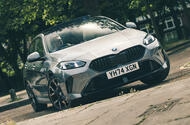
Here’s where things get divisive. Some folks glance at the new 1 Series and grumble that it looks more like a Kia than a BMW. But let’s be real: modern Kias look sharp, and the 1 Series’ styling is arguably a step up from its predecessor’s awkward proportions. The switch to front-wheel drive back in 2019 changed the car’s stance, moving away from the classic long-nose, rear-drive look. Still, the F70’s design is more cohesive and, dare I say, handsome than the outgoing F40.
Color choices? You’ll mostly see shades of grey on UK roads, but there’s a bold purple if you’re feeling adventurous. The M Sport trim brings bigger wheels and sportier details, which most buyers seem to love.
How Does the Mild-Hybrid Engine Actually Perform?
Under the bonnet, the 120 uses BMW’s familiar 1.5-liter turbocharged three-cylinder petrol engine, now paired with a 48V mild-hybrid system. On paper, it churns out 154bhp and claims up to 53mpg—both solid improvements over the old 118i. In real-world driving, it feels punchier than you’d expect from a three-cylinder, especially with the seven-speed dual-clutch automatic and paddle shifters.
BMW touts improvements in chassis rigidity and handling, and with the optional M Sport Package Pro (including adaptive suspension and beefy brakes), the 1 Series does feel agile and composed. The ride is on the firm side—especially with the 19-inch wheels—but it’s never harsh enough to spoil the fun.
Is the Interior Still a Step Above the Competition?
Step inside, and the 1 Series feels every bit the premium hatch. The Curved Display dominates the dashboard, blending a digital instrument cluster with a crisp infotainment touchscreen. The Technology Plus Pack adds even more tech, and the cream-colored Veganza faux leather (with optional Alcantara) gives the cabin a light, airy vibe that’s a welcome change from the usual sea of black.
Ambient lighting, M Sport stitching, and clever safety touches—like door panels that flash red if you’re about to open into traffic—add to the sense of occasion. One quibble: there’s no adjustable lumbar support for the driver, which seems like a strange omission in a car that’s otherwise so focused on comfort.
What’s It Like to Live With Day-to-Day?
Living with the 1 Series isn’t all sunshine and open roads. There are a few quirks that take getting used to. For example, the key fob only unlocks the driver’s door by default. Want to change that? You’ll need to create a BMW ID and hand over your personal data. It’s a small thing, but in an era where privacy is top of mind, it feels unnecessarily complicated.
Parking is a breeze thanks to a suite of cameras and sensors (part of the Technology Plus Pack). The car can even park itself, though trusting it to do so takes a leap of faith. The stop-start system can be a bit intrusive when maneuvering at low speeds, but it’s easy enough to disable via the touchscreen.
How User-Friendly Is the Infotainment System?
The latest 1 Series has gone all-in on digital controls, moving climate and audio functions to the touchscreen. While purists might miss physical buttons, the digital instrument cluster is highly configurable and integrates seamlessly with Apple CarPlay. The touchscreen is responsive, but some icons are a bit small to hit accurately while driving.
BMW’s iDrive OS9 is refreshingly glitch-free, though some users have reported oddities with Apple CarPlay—like Siri going silent when reading texts. The steering wheel retains physical audio controls, which helps keep distractions to a minimum.
Are Paddle Shifters Worth Using in the 1 Series?
If you’re a die-hard manual fan, the paddle shifters might feel like a compromise. They work well enough, but the dual-clutch automatic is so good at its job that you’ll rarely feel the need to intervene. For most drivers, letting the car handle gear changes is the way to go.
How Does the 1 Series Stack Up Against Rivals?
After several months and thousands of miles, the 1 Series leaves a strong impression. It may not have the razor-sharp handling of pricier BMWs, but for a front-wheel-drive hatch, it’s right up there with the best. Compared to rivals like the Mercedes-Benz A-Class, Audi A3 Sportback, Volkswagen Golf, and Cupra Leon, the BMW holds its own—especially in terms of driving enjoyment and interior quality.
Performance is more than adequate for daily driving and the occasional spirited run. The mild-hybrid system delivers real-world fuel economy in the mid-40s mpg, which is impressive for a petrol-powered hatch of this size.
What Are the Downsides?
No car is perfect, and the 1 Series has its flaws. The ride can be overly firm on larger wheels, especially on rough UK roads. The move to touchscreen controls won’t please everyone, and the lack of lumbar support is a surprising oversight. Loading up on options quickly sends the price skyward, pushing the 120 M Sport into territory where you might expect more luxury features as standard.
Is the BMW 1 Series Still a Practical Choice?
Practicality has actually improved with the switch to front-wheel drive, freeing up more space in the back. The boot is a decent size for the class, and the split-folding rear seats add flexibility. The airy cabin, especially with the optional sunroof, makes it feel less claustrophobic than some rivals.
What’s the Real Cost of Ownership?
Here’s a snapshot of the numbers for the 120 M Sport as tested:
– List price new: £32,775 (now £34,290)
– Price as tested: £43,190
– Claimed economy: 41.3mpg (test average: 45.2mpg)
– Real-world range: 487 miles
– Contract hire rate: £385 per month
– Running costs (including fuel): 13 pence per mile
– Faults reported: None
Final Thoughts: Who Is the New BMW 1 Series Really For?
The latest BMW 1 Series isn’t for everyone—and that’s okay. It’s pricier than before, and the digital-first interior won’t suit every taste. But if you want a premium hatch that’s genuinely fun to drive, practical enough for everyday life, and packed with the latest tech, it’s hard to beat.
For those who value driving enjoyment and a sense of occasion in their daily commute, the 1 Series still delivers. Just be mindful of the options list—and maybe budget for a good back cushion if you’re sensitive to a firm ride. In a crowded field of premium hatchbacks, the BMW 1 Series remains a standout, even if it’s no longer the budget-friendly choice it once was.