
How Did BMW’s Neue Klasse Transform the Company’s Fortunes?
If you’re a fan of automotive history—or just curious about how iconic brands survive tough times—BMW’s story in the early 1960s is a masterclass in reinvention. Back then, BMW was teetering on the edge of financial collapse. The company’s lineup was a patchwork of small, quirky cars and expensive luxury models, but nothing that really hit the sweet spot for mainstream buyers.
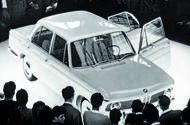
Enter the Neue Klasse saloon. When the wraps came off at the 1961 Frankfurt Motor Show, the reaction was electric. Designed by Giovanni Michelotti, the 1500 saloon was sleek, modern, and—crucially—affordable for the growing middle class. Priced at £760 (which would be about £14,650 today), it offered a blend of style, performance, and practicality that BMW desperately needed. The Neue Klasse didn’t just sell well; it redefined what BMW stood for, laying the groundwork for the company’s future as a maker of sporty, premium cars.
What Made the 1961 Frankfurt Motor Show So Pivotal for German Automakers?
The 1961 Frankfurt Motor Show wasn’t just about BMW’s comeback. It was a showcase of Germany’s postwar economic boom, with automakers unveiling cars that would shape the next decade. Volkswagen, for instance, introduced the Type 3 1500—a car that marked Wolfsburg’s first all-new model since the legendary Beetle. While it was cleverly engineered and boasted a high standard of finish, some critics wondered if its air-cooled engine could really compete with the refinement of rivals from Ford and Opel.
Mercedes-Benz also made waves with a new cabriolet version of its 220 SE coupé and the debut of the 190 (W110) and 300 SE (W112) saloons. The 190 was praised for its value and refinement, while the 300 SE, though pricey, was packed with luxury features that would appeal to buyers looking for something special.
How Did Other German Brands Respond to the Changing Market?
It wasn’t just the big names making moves. Auto Union, the precursor to today’s Audi, didn’t have a new car to show but generated buzz with a Bosch-developed oiling system that made two-stroke engines less of a hassle for owners. Ford of Cologne, still a separate entity from its American parent, celebrated the success of its Taunus 17M P3 and introduced a sportier TS version. Opel countered with a coupé version of its Rekord P2, though its styling drew mixed reviews.
Smaller companies like NSU and Glas were also hustling to keep up. NSU’s updated Prinz saloon offered more space and less engine noise, while Glas tried to revive its fortunes with the S-1004 coupé, moving away from the ultra-budget Goggomobil.
What Role Did International Brands Play in Germany’s Booming Car Scene?
Germany’s rapid economic growth—often called the Wirtschaftswunder, or economic miracle—drew plenty of attention from foreign automakers. British, French, and Italian brands all wanted a slice of the action. The British Motor Corporation (BMC) made a splash with the Mini-Cooper, which wasn’t just a hit in showrooms but also proved its mettle by racing to Frankfurt from Aachen and Hamburg at an average of 70 mph. That kind of publicity stunt, featuring future F1 champion Graham Hill among the drivers, captured imaginations and showed just how competitive the market had become.
Why Did Some Once-Popular German Brands Disappear?
Not everyone survived the shake-up. Borgward, once a major player and producer of the stylish Isabella, had recently gone bankrupt in a highly publicized case. In 1960, Borgward had actually built almost twice as many cars as BMW, but financial mismanagement and changing market dynamics spelled the end. This left a gap in the market that BMW’s Neue Klasse was perfectly positioned to fill.
How Did the German Car Industry Become a Global Powerhouse?
By the early 1960s, Germany’s car industry wasn’t just recovering—it was dominating. According to period reports and data from the German Association of the Automotive Industry (VDA), West Germany had become Europe’s largest car producer and was leading the world in exports. The days of small, family-run carmakers were fading fast. Instead, the industry was consolidating, focusing on innovation, quality, and scale.
This shift wasn’t just about making more cars; it was about making better cars. The Neue Klasse’s success inspired a new generation of vehicles that combined engineering excellence with mass-market appeal. The result? German brands like BMW, Mercedes-Benz, and Volkswagen became synonymous with quality and performance worldwide.
What Can Today’s Automakers Learn from the Neue Klasse Era?
Fast-forward to today, and BMW is once again betting big on a new Neue Klasse—this time, a family of electric vehicles like the iX3 SUV. The parallels are striking: just as the original Neue Klasse rescued BMW from the brink, the new lineup is designed to secure the company’s future in a rapidly changing market.
The lesson for modern automakers is clear. When the world shifts, you can’t just tweak what you’ve always done. Sometimes, you need to reinvent yourself from the ground up. BMW’s bold move in the 1960s didn’t just save the company—it set a template for innovation and resilience that’s still relevant today.
Looking Back, Looking Forward
The 1961 Frankfurt Motor Show was more than just a parade of shiny new cars. It was a turning point that set the stage for decades of German automotive dominance. BMW’s Neue Klasse proved that the right car at the right time can change everything—not just for a company, but for an entire industry. And as the next generation of Neue Klasse EVs rolls out, it’s a reminder that history has a way of repeating itself—especially when bold ideas meet the needs of the moment.