

Elon Musk’s Empire Faces Scrutiny After Major Shareholder Meeting Delay

Porsche Cayenne EV Blends Electrifying Speed with SUV Power on Goodwood’s Iconic Hillclimb
 We go up Goodwood's famous hillclimb in one of the most important cars out of Weissach in modern times
It’s fairly tall. And quite large. Not quite Range Rover large, maybe, but on the way. The new Porsche Cayenne EV – in which I’m about to take to the Goodwood Festival of Speed's hillclimb at full speed – is the biggest Porsche they make.
We’re sitting high. You might imagine that cars with three-second 0-60mph potential ought to be squeezed right down onto the road, but not this one. From my vantage point I look forward along the track, down the tree-lined avenue to the first double-apex right-hander, wondering what this Cayenne’s body roll will feel like when we get there at full noise.
Actually, I guess I’ve already got an idea. This is a Porsche, and a fat-tyred Porsche with latest-gen active dampers at that. I’ll back it to stay planted in a 1g corner.
There are other good reasons for this Cayenne’s height. For one, we’re sitting on top of a 100kWh-plus traction battery. And despite what I understand to be an output of more than 1000 horses from its two-motor set-up, this machine is also claimed to be a competent off-roader, which means it needs ground clearance.
My driver is Gabriela Jilková, a successful GT racer from the Czech Republic who does a lot of development driving for Porsche, especially in fast stuff. She’s keen to move up the ranks from GT4 racing if the chance comes. Which it’s bound to do.
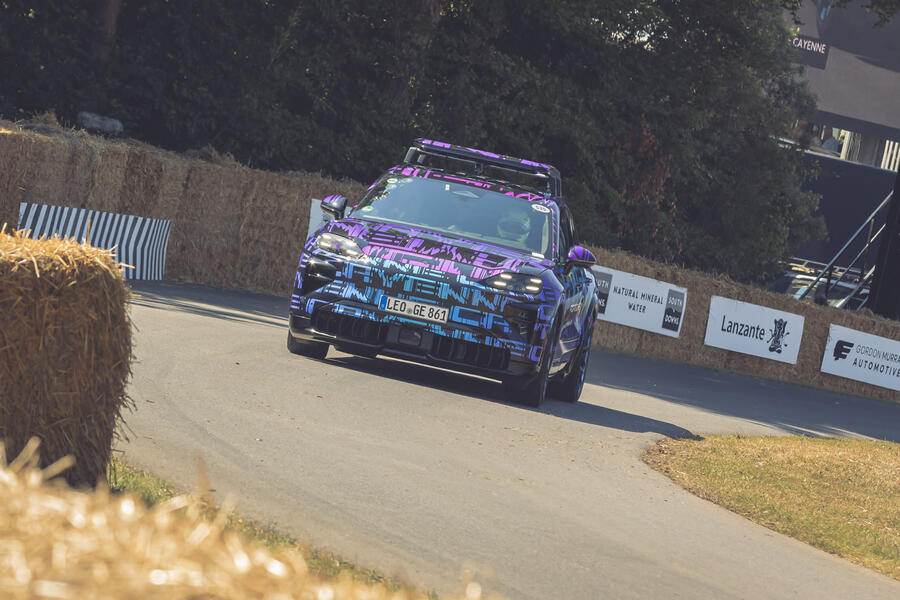
'Quick Gabi', as she’s known, looks small yet very much at home in the Cayenne EV’s big, bolstered seat, but as we ease quietly up to the line, she’s already wearing that expression of calm concentration you see on the faces of serious racing drivers accustomed to the tension of a full-on start.
Suddenly we’re at the head of the queue. The Taycan ahead disappears around the track’s double right-hander and now it’s our turn. This may be an EV but we’re hearing the Cayenne’s optional synthesised V8 burble at proper volume. And here, it seems entirely appropriate.
The Goodwood starter gives us the thumbs-up. I expect extremely hard acceleration but what I get is an explosion. My head hits the restraint behind, I’m depressed several inches into upholstery that previously felt firm and my innards are rapidly rearranged. The loads are all instant, yet it’s surprisingly quiet in here.
Nobody will yet tell me how much torque this thing has, but it’s got to be four figures of foot-pounds. Even though it’s all deployed at once via four fat 22in Pirelli P Zeros, there’s barely a squeak of wheelspin. That’s what electronics can do.
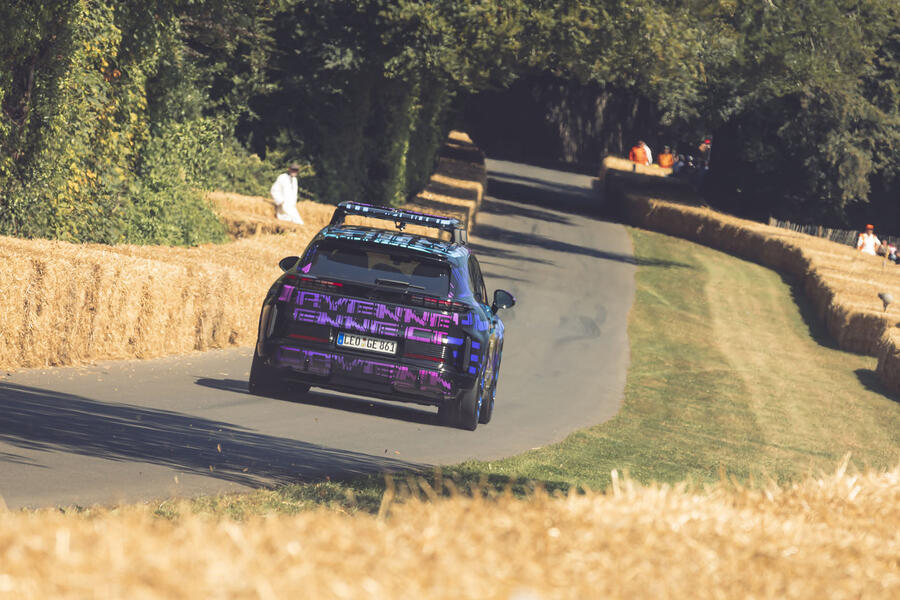
The trees either side are a blur, and we’ve got to be doing 90mph when we turn in to that first double-apex. Gabi dabs the brakes – I think – though retardation probably comes as much from this EV’s powerful regenerative braking. We clip the grass apexes twice and then the awesome acceleration begins again.
Out of the trees, the track straightens and widens. I glimpse thousands of blurred faces either side as our Cayenne bolts past the big house on the left and under the bridge at a speed that in other hands might seem deeply crazy.
There’s time for a lightning glance at Gabi – still ice cool, making tiny, timed steering movements – and then we’re approaching Molecomb, the reverse camber left-hander hidden beyond a little brow that has been the ruin of many a worthy Goodwood entrant over the years.
Not this time. We storm through it as if on rails, my body pinned into the seat. As we burst into sunlight, I’m aware again of crowds in stands on either side. Then we see the famed Flint Wall straight ahead.
It looks like a serious obstacle at first sight, but when you get there, it’s a fast, precise, right-then-left jink, easy for Gabi and the Cayenne. Transitions like that can upset high-riding cars, but the Porsche is planted like a sports car. This is a sports car.
The rest of the run is easy, a big left and right, and then we’re back under the shade of the trees. Up a shaded tunnel we go, flashing across the finish line. This may well be the quickest electric minute of my life.
I’ve made an agreement with myself to glance at the speedo as we finish, but of course I forget. It's hard to remember stuff in an environment like this but our speed has got to be 100mph-plus. Gabi says 115mph. I see the blurred face of the finish-line marshal and then it’s over.
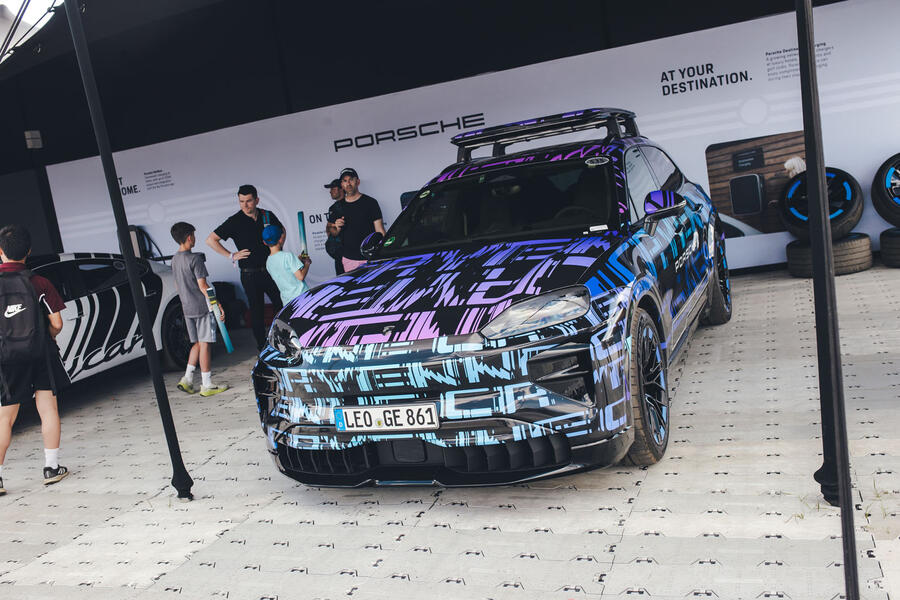
Speed bleeding away, we ease up to the marshalling loop at the top of the hillclimb, where you wait for other runners in your batch to congregate for the dog-slow return to the pits. “Good,” says Gabi with a contented smile. “Fantastic,” say I.

Subaru Uncharted Revealed as Powerful All-Wheel Drive Electric SUV Twin to Toyota C-HR
How Audi’s Lighting Visionary Is Shaping the Future of Electric Car Design
Christoph penned the lights for both A6 e-tron and Q6 e-tronLighting chief talks inspiration, Vorsprung durch Technik, and Audi's slimmest headlight yet
Welcome to part three of our exclusive four-part interview series, where we’re looking to find out what Audi’s iconic slogan – Vorsprung durch Technik, or progress through technology – means on a more personal level to the people at the forefront of Audi design and engineering.
Here we sit down with Christoph Häußinger, the mastermind behind the groundbreaking lighting design for the new all-electric Audi A6 e-tron and Audi Q6 e-tron.
Also in the series: Exterior design extraordinaire Frank Lamberty; head of aerodynamics and aeroacoustics, Dr. Moni Islam; and interior designer Ramon Bäurle.
Discover the all-electric Audi e-tron range
Introduce yourself and what you do…My name is Christoph Häußinger and I'm a lighting designer at Audi. This means I'm responsible for creating front and rear exterior light designs.
There are many steps in the process of lighting design. We start by creating the overall light graphic itself – how the light will look, a bit like a graphic designer. Then we have to find the right character for the car – sporty, sleek etc. Then we move on to the materials and the hardware. Then, finally, on the A6 e-tron in particular, we focused on creating the welcome scenarios, the animations, the digitalisation, which is something totally new. It’s a really interesting and challenging job.
What’s your personal interpretation of Vorsprung durch Technik?My interpretation of Vorsprung durch Technik is never stop exploring. It's about being curious and always questioning what's next.
Where do you find inspiration for your work?
I think I find inspiration mostly in good product design, so in high-quality products. I'm really looking into it and try to find solutions to bring this in our cars.
Also, I'm inspired by faces of people and of animals. The humans are always looking for faces. If you're looking somewhere, you always see faces. And this is the same with cars.
Why is light, and lighting design, so important?
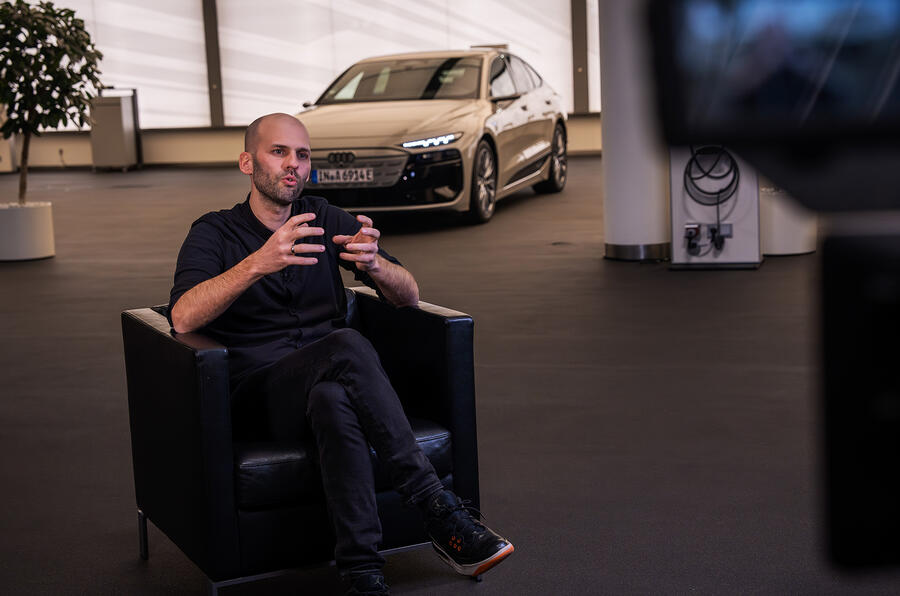
This is a big question! I mean, without light there is no life. Humans have always been connected to light. Without fire, for example, we wouldn’t have evolved into what we are today. Light is a crucial part of our life.
In terms of light design, it’s so important because it gives the car the right look. It underlines the character. As light designers, we’re always talking about the eyes of the car. How is the car looking at you? With lights, with the eyes of the car, you can fundamentally change how a car looks, so I think it’s very important.
Light design has always been a core pillar of Audi’s Vorsprung durch Technik ethos. Which models from Audi’s history stand out as milestones?
For me, a standout car in terms of lighting was the Audi A8 from 2013. It was the first model where we integrated the Matrix function, and I think it’s the perfect example of how to combine technology and design. If you look at the headlight, it doesn’t even look like a light you’d find on a car. It was really important for us to find a new look, a new feeling for this new technology, and we did.
I would also point out the third-generation Audi TT (2013). For me, this is a really iconic light graphic with its two vertical lines. It was a really sporty touch – perfect for the car.
Light design and exterior design go hand in hand. How do the two teams work together to reach a common goal?
It’s certainly a challenge! But it’s fun. First I’ll just walk around the car with the exterior designer when they’re developing the volumes and the outline of where the lamp will go, to get the essence of what the car is all about, what they’re trying to achieve.
For example, with the A6 e-tron they wanted to extend the shoulder of the car all the way to the lights, so you think about how you can help achieve this goal with the light design. The Q6 e-tron is a very good example of this where we’ve stretched the lines of the car seamlessly to the headlight. It’s good fun working with the exterior designers.
The Audi A6 e-tron treads new ground for lighting design and technology. Let’s start at the front – what are the highlights?
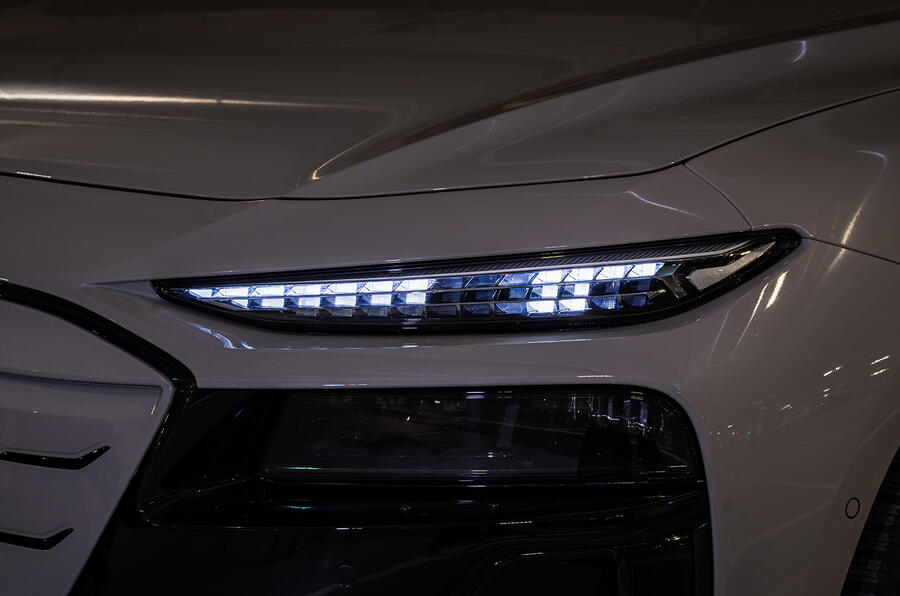
For the Audi A6 e-tron, the main goal was to have a really, really slim headlight to give a truly focused and sporty look to the face of the car. To do that we took out some functions you’d usually find in the headlight, like the high and low beam bulbs, and put them lower down in the bumper and hidden by a kind of black mask.
And that left us with just the daytime running lights and indicators where the headlight would usually be. We also wanted them to be horizontal rather than vertical to really show off the width of the car. The result is the slimmest, sleekest headlight design we’ve ever created at Audi.
And then there’s the digital content, the welcome scenarios. The A6 e-tron and the Q6 e-tron represent the first time ever that the driver has full customisation over the lighting graphics at the front of the car. Through their smartphone or the MMI touchscreen system they can choose from a number of different lighting signatures which allow them to subtly change the character of the car, while still retaining that Audi look.
But what was also really important for me with the A6 e-tron was how the lights look even when they’re switched off. As light designers, we’re always talking about light. When the lights turn on there’s always this 'Wow!' effect, but for me when you switch the car off it has the same importance. It still needs to have the same elegant, high-tech feeling. When the car is off and parked in a space, you need to be able to walk around the car and see all the little details, almost like jewellery. That’s my passion, creating the product, not just the light.
And what about at the back?
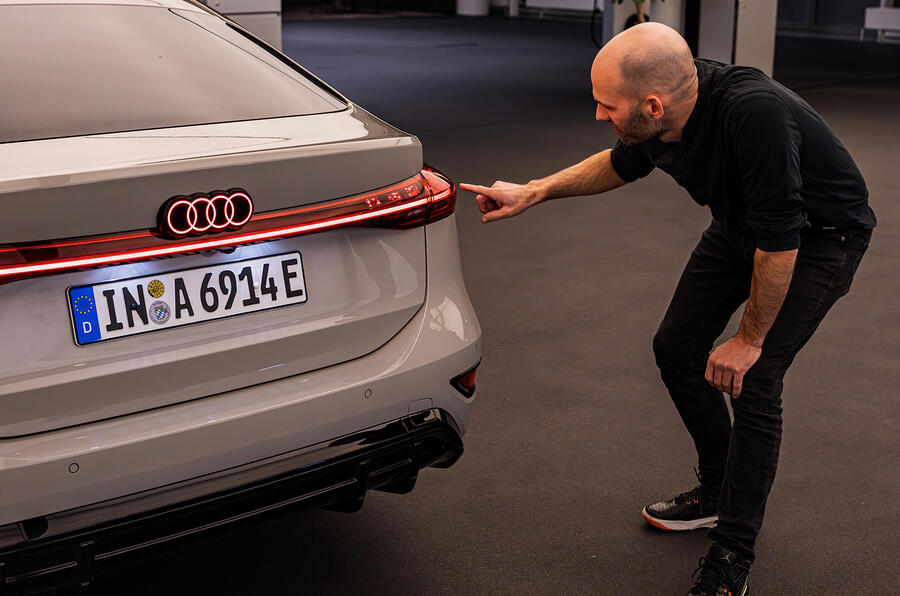
The rear of the A6 e-tron is really exciting. First you notice the big wraparound lightbar which is designed to make the car look wider and more elegant, but also futuristic. This slim, homogeneous red light gives this really high-tech and science fiction feel.
And then if you look closer you can see the OLED 2.0 technology we’re using for the digitalisation of the rear lights. This technology was first used on the Q6 e-tron, but now it’s using more pixels and a higher resolution to create these incredibly vivid, fluid light graphics at the back.
At Audi we always wanted to bring light into motion. We started with the swiping indicators, and now with this new technology the lights on the back of the A6 e-tron are always moving, always in motion. It’s something that’s never been seen before on other cars. It’s an amazing feature.
Finally, and most importantly, we come to the safety features. Light has always been a safety topic, because you have to use the indicators to turn, see where you’re going, and show other people that you’re stopping. It’s always been about light communicating with other drivers. Now, the A6 e-tron takes that to the next level with the triangle warning signal at the back of the car.
When you put the hazard lights on, warning triangles will appear in the rear lights to warn drivers behind you. Equally, if the car detects a crash in front of you it will activate the triangles to warn others. And they’ll also activate if the car behind gets too close. It’s really clever technology.
Where do you think Vorsprung durch Technik will take Audi in the future?
It’s hard to say exactly because so much can happen in the future! But what I can say is I’m incredibly excited and curious to see where Vorsprung durch Technik will take Audi next, and I know there’s a lot to come in terms of light design and light technology.
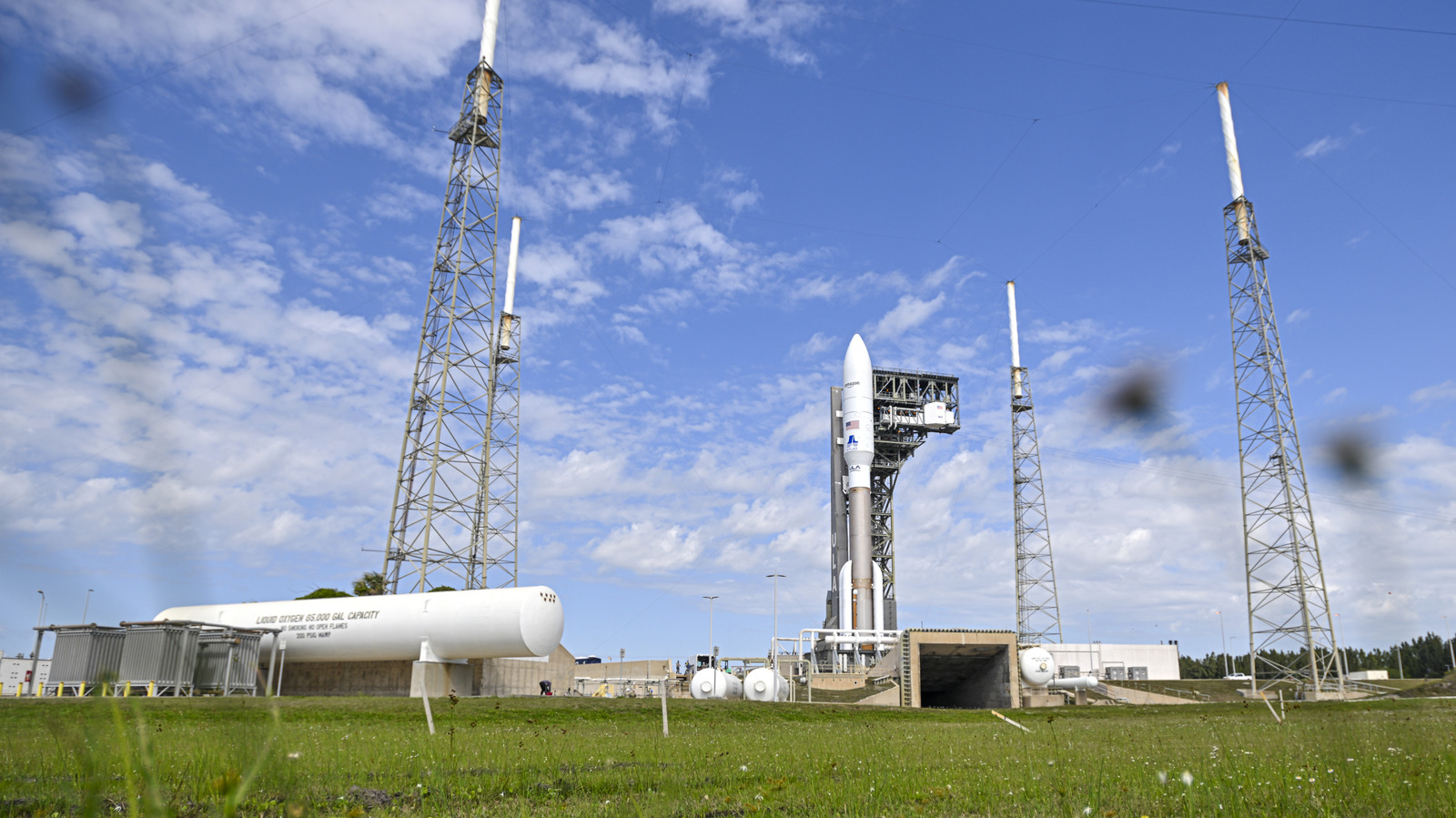
Satellite Safety at Risk as Congress Faces Pressure Over Critical Funding Cuts
Bugatti Mistral Bids Farewell with Legendary W16 Power and Unmatched Performance
 Mistral is the final outing for Bugatti's mighty W16 quad-turbo engine. And what a way to bow out The Bugatti W16 Mistral is the final outing for Bugatti’s W16 engine after 20 years in production.It's a fitting end for an engine that made its debut in the 2005 Veyron, back when the Volkswagen Group had its hand on the tiller and Ferdinand Piëch’s decadent hubris had him setting new standards and breaking records that nobody else would ever be inclined to approach.He wanted a car that was as easy to drive as a Volkswagen Golf, met or exceeded VW’s existing or newly created quality and durability standards and, at the same time, you could climb into at the start of one of the straights at VW’s Ehra-Lessien test track and be doing 253mph by the end of it.He and his boffins specified a W16 engine to do it. Four banks of four cylinders, eight litres in total, four turbochargers and a four- figure horsepower number when such things were unheard of at the time. The Veyron’s W16 made 1001 metric horsepower – 987bhp – and it only went north from there. Faster versions since have knocked off various round metric horsepower milestones to end up, here, with 1578bhp – a round 1600PS and the same as a Chiron Super Sport 300+.
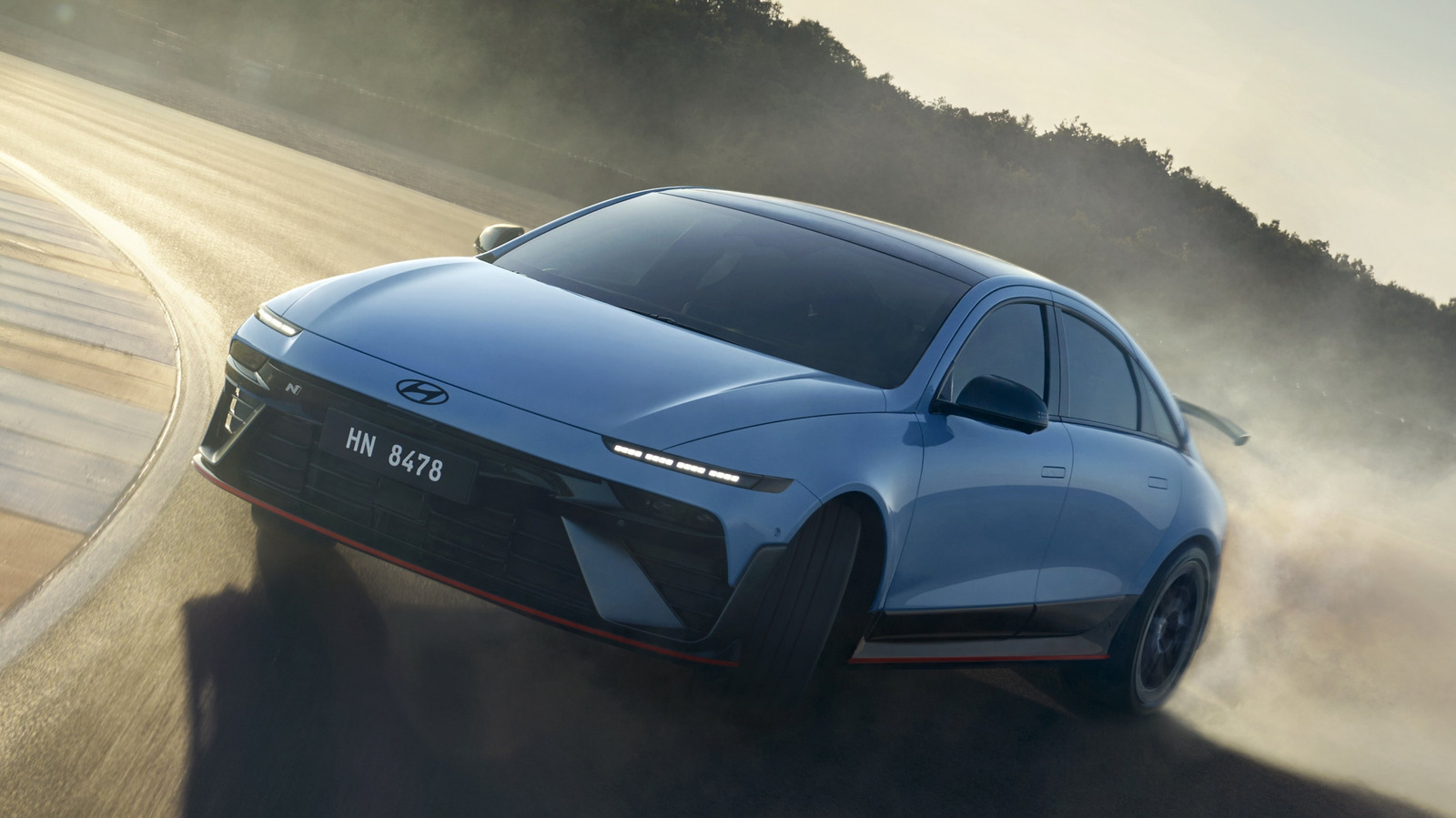
Hyundai Ioniq 6 N Unleashes 641 Horsepower to Challenge Electric Performance Rivals
Jaecoo 5 Launches in the UK to Challenge Premium Crossovers with Style and Versatility
 The crossover joins the larger 7 as the second car in Chery-owned Jaecoo's line-up; will get ICE and EV variants
The Range Rover Evoque-rivalling Jaecoo 5 will go on sale this year - and it will arrive first with petrol power.
Making its debut Goodwood Festival of Speed, the crossover is the second car in the Chery-owned Jaecoo's UK line-up, joining the larger Jaecoo 7, a car that has quickly gained popularity here after amassing almost 6000 sales since it went on sale at the start of the year.
The Jaecoo 5 is based on the same T1X platform as its stablemate, as well as sibling brand Omoda’s similarly named 5, 7, 9 and recently revealed 3 – the 3 being its most closely related cousin.
Unusually, the Jaecoo 5 will not be launched first with an electric or electrified powertrain. Instead, it will be powered by a 1.6-litre turbocharged petrol engine. While exact technical details have yet to be confirmed, its state of tune is likely to match the same capacity unit in the Omoda 5: 187bhp, 203lb ft, and paired with a seven-speed dual-clutch automatic gearbox.
Like its siblings, an electric variant will follow soon after. It is expected to offer the same technicals as the Omoda E5, meaning 201bhp, 61kWh battery, and 257 miles of range.
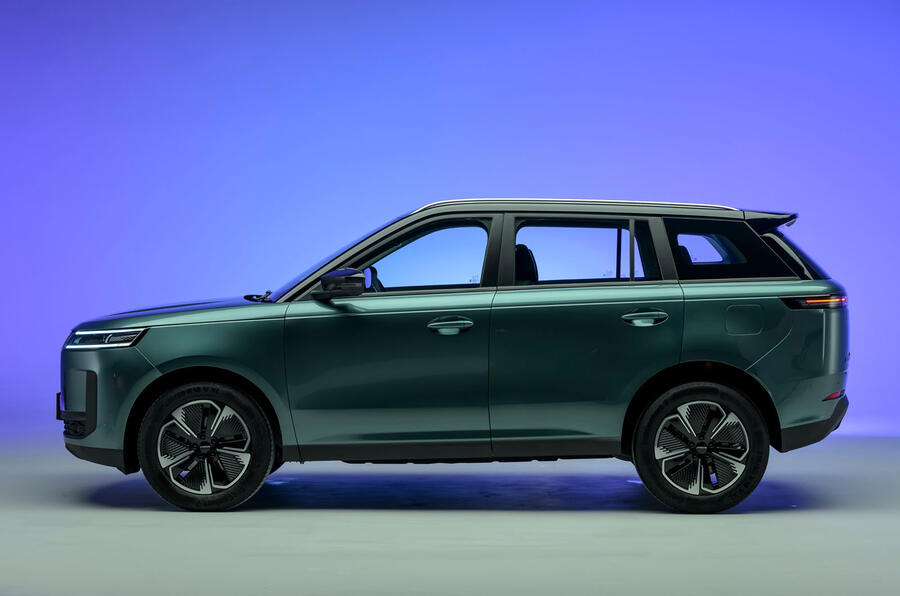
Visually, the Jaecoo 5 is a shrunken version of the 7, with near-identical front and rear end designs, but with a shorter wheelbase and a more raked roofline.
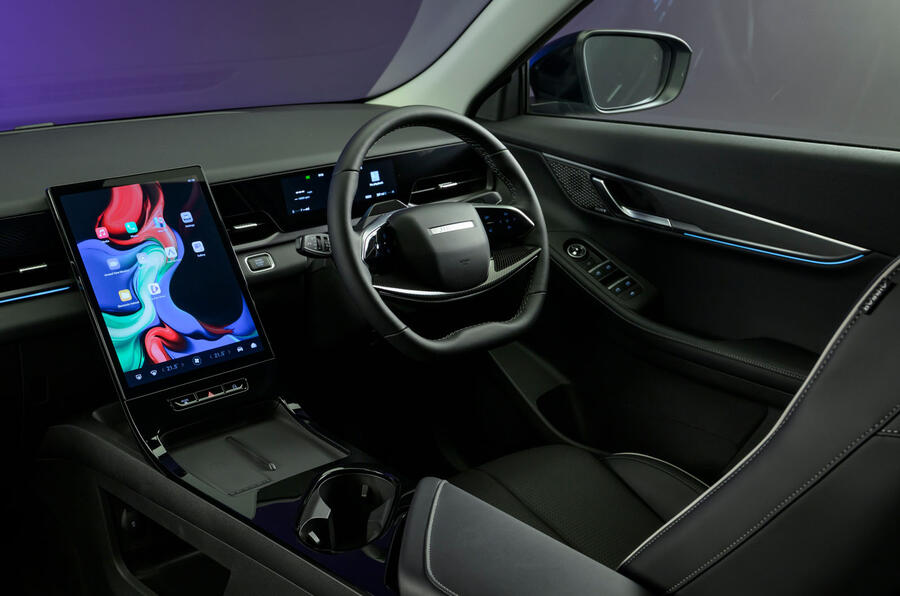
Inside, however, the 5 receives a smaller infotainment screen (its exact size has not yet been disclosed) than the 7’s 14.8in unit, and the larger car’s 10.25in floating driver’s display has been replaced by a screen housed within the dashboard.
The 5 will be sold in two trim levels: Pure and Luxury. Entry-level equipment includes a six-speaker audio system, six-way adjustable seats, and wireless Apple CarPlay and Android Auto. Luxury trim adds a panoramic roof, wireless phone charging, and heated and ventilated front seats.
Further details, including pricing, exact delivery dates and complete technical spec, will be revealed next week.
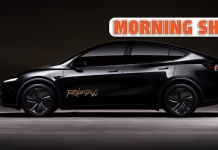
Tesla’s Robotaxi Ambitions, Ram’s Self-Rolling Trucks, and Nissan’s Production Pause Unveiled
Denza B5 Hybrid SUV Unveiled in UK to Challenge Defender with 677bhp Power and...
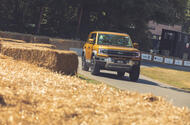 Goodwood debut for BYD's new premium 4x4, which will be its second Denza model in the UK
BYD is going after the Land Rover Defender in the UK with the new B5 – a premium plug-in hybrid 4x4 with competitive off-road stats and supercar levels of power.
Launched in China last year as the Bao 5, the Defender 110 rival has made its UK debut at the Goodwood Festival of Speed ahead of a showroom launch early next year.
It is one of three models from BYD's new SUV sub-brand Fangchengbao, but will be badged Denza in the UK and positioned as a sibling to that premium brand's Z9 GT shooting brake - also headed to the UK.
Denza was founded in 2010 as a joint venture between BYD and Mercedes-Benz but is wholly owned by the Chinese firm.
The move to import the B5 confirms Autocar's previous report that BYD would launch its Fangchengbao cars here in a bid to diversify its powertrain offering and tap into new market segments.
The company's president, Stella Li, told Autocar at last year's Festival of Speed that she predicted the SUVs "will be very popular in the UK".
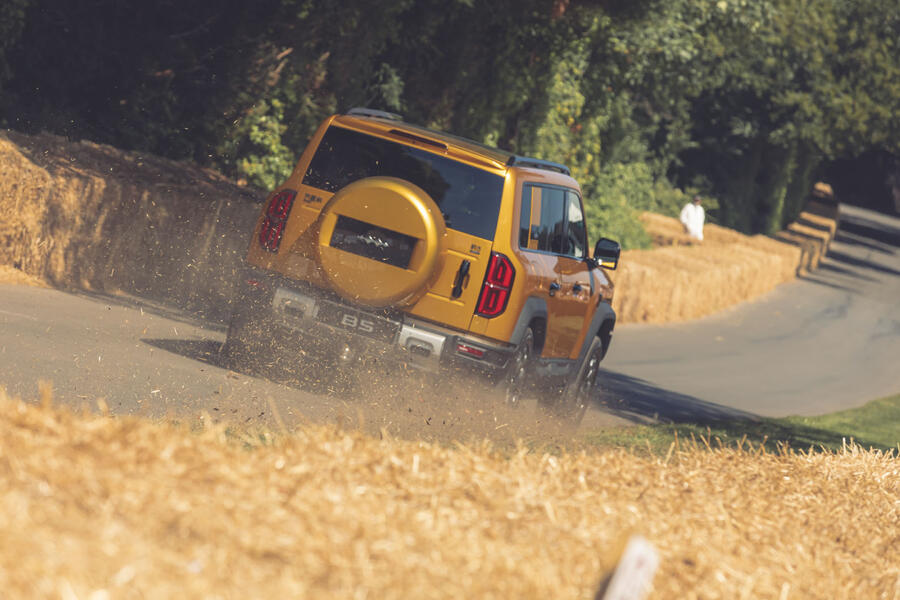
“In the UK, the roads are narrow but we love these big SUV off-road cars, so Fangchengbao will be here,” she said, referencing the popularity of large premium SUVs in this market, a sector in which BYD has until now been absent.
The company has not confirmed any specification details for the B5, but it is expected to be largely unchanged from the car in China, which uses a 'DMO Super-Hybrid Off-Road' ladder-frame platform and takes its power from a plug-in hybrid system centre around a 1.5-litre turbo engine with an electric motor on each axle.
The system pumps out up to 677bhp and 561lb ft - more than any Defender, including the new V8 Octa.
Meanwhile, a sizeable 31.8kWh battery (which serves as a structural element) supplies enough power for a claimed EV range of up to 78 miles on China's CLTC cycle - though that's likely to be nearer 50 miles in practice.
The B5 forms part of BYD's push to dramatically increase its hybrid car offering in the face of wavering EV uptake in Europe. The core BYD line-up is set to be boosted next year with the arrival of the Seal 06, a plug-in hybrid saloon/estate in the mould of the BMW 3 Series.
The Denza Z9 GT will also be available as a PHEV with a "colossal" combined range, or with pure-electric power.
Also starring on BYD's stand at Goodwood will be Denza's new D9 MPV, a "business-class" people carrier in the mould of the Lexus LM.