Unleashing Power: The 2026 BMW M2 CS Redefines Performance and Style
Hyundai i10 Review: A Stylish City Car or Just a Budget Option?
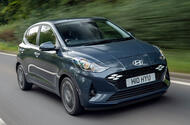 South Koran supermini touts frugality, style and a low starting price - is it a bargain or just plain cheap? Is now the right time to buy a small city car like the Hyundai i10?After several years on sale, the formula for these increasingly rare beasts has been refined, the mechanicals updated and the interiors tweaked to make almost all of the established ones conduct themselves as though they were from the class above.The i10, having received a facelift with some meaner, more assertive looks, a revised range of engines and the promise of 'big-statement' design cues and new on-board tech, appears, on paper, to be a very well-rounded product. It helps, too, that it finds itself with precious few rivals left in the supermini segment, including the MG 3, Toyota Aygo X, Dacia Sandero, and technically-related Kia Picanto.Relatively speaking, that isn’t an extensive list - and the i10 appears to be in a better position to beat them now than ever before. It’s worth bearing in mind, though, that each of them have also been sufficiently updated to make the climate into which this third-generation i10 emerges a cut-throat one. Time to see if Hyundai’s commitment to its small car formula has been worth it, then.The Hyundai i10 range at a glanceThe i10 range is broken up into three main specifications: Advance, Premium and N Line. Entry-level Advance cars come with cruise control, an 8.0in touchscreen with Apple CarPlay and Android Auto, as well as a rear-view reversing camera, cruise control and a digital instrument cluster, while Premium adds ambient lighting, voice commands, heated front seats and wireless mobile charging. N Line is treated to meaner front bumpers, red accents, 16in alloys and racier trim pieces inside.There are three engines available: a 1.0-litre naturally aspirated three-cylinder with 62bhp and 68lb ft, a 1.2-litre four-pot with 83bhp and 87lb ft, and a turbocharged version of the 1.0-litre producing 89bhp and 124lb ft. The 1.0-litre turbo is only available on N Line cars mated to a five-speed manual gearbox, while the naturally aspirated (N/A) 1.0-litre and 1.2-litre engines can be had on Advance or Premium cars, sending power via a five-speed manual or five-speed automated manual gearbox.As for its suspension, the i10 doesn’t deviate from the established class formula. MacPherson struts are employed at the front axle and a torsion beam sits across the rear. The rear torsion bar is now U-shaped as opposed to triangle-shaped to improve stability, while a stronger steering torsion bar and quicker steering gear should help to sharpen steering response.
Starship’s Bold Journey: A Space Triumph Turned Tumultuous Return
Ford Focus ST Bids Farewell as Production Winds Down in the UK
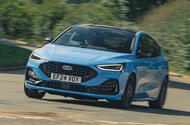
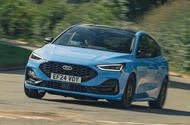
Around 170 new Focus STs remain in UK dealers, some 30 of which are the Edition model picturedHot hatch is removed from Ford's UK price list before Focus production comes to an end in November
The Ford Focus ST has been taken off sale in the UK ahead of production of the hot hatchback ending in November.
The Focus ST had been open for orders as recently as April but disappeared from dealer price lists in an update issued on 26 May, despite remaining on Ford's online configurator.
It means the Focus can now be had only with the turbocharged and mild-hybridised 1.0-litre three-cylinder Ecoboost engine, with outputs of 123bhp or 153bhp. Trim choices are limited to Active X Edition, ST-Line and ST-Line X Edition.
All are set to go in the coming months as Ford winds down Focus production. The company has courted buyers for the plant in Saarlouis, Germany that has housed assembly of every Focus but has yet to find a buyer.
Ford has committed to keeping the plant open with 1000 workers (down from a previous 4600) until 2032 if no sale can be made.
Ford UK told Autocar: “There are no new factory orders available for the Focus ST at the moment, but there are around 170 built and unsold currently available within the UK dealer network. This includes 30 of the special ST Edition variant in Azura Blue.”
Asked for clarification on whether that wording means Focus ST orders could be taken again before the end of production, Ford suggested that the situation could change but nothing was confirmed.
This leaves the door open to the order book reopening if there is a sudden influx of demand, or for a special edition sending the hot hatch into retirement.
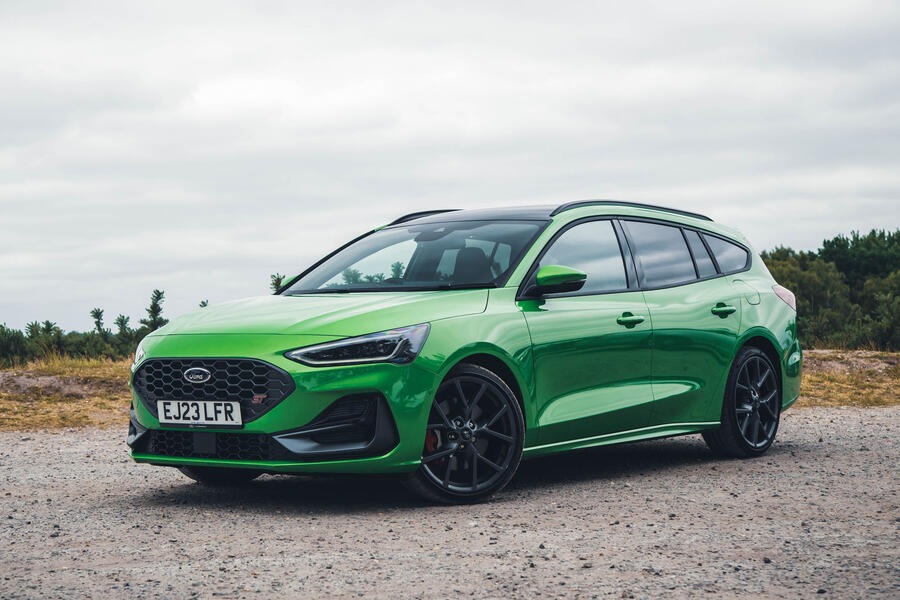
The disappearance of the Focus ST is representative of a wider market trend, with the traditional mass-market hot hatch having all but died out in recent years.
The business case for such cars has been sullied by the shift to more profitable (and ultimately less dynamic) SUVs, as well as tightening fleet emissions regulations that have pushed manufacturers towards EVs and low-emission hybrids.
Hyundai pulled its i30 N and smaller i20 N from Europe last year, the Peugeot 308 GTi didn't survive more than a single generation and Toyota has yet to launch the GR Corolla in the UK.
Of the hot hatches that live on, many have either spiked in price – the Volkswagen Golf GTI now starts north of £40,000 – or remain strictly limited in number, as is the case for the Honda Civic Type R and Toyota GR Yaris.
Indeed, Ford recently turned down the temperature on the Focus ST’s smaller sibling, the Puma ST. Its 197bhp 1.5-litre powerplant and manual gearbox were discontinued, leaving only an uprated version of the regular Puma’s mild-hybrid 1.0-litre powerplant with 158bhp and an automatic gearbox. This is the only ST model to survive the cull of the past few years.
This doesn't spell the end for fast Fords, though: design director Amko Leenarts last year told Autocar that there was “definitely” a future for the brand’s performance cars, referencing the popularity of Formula 1, the Dakar and the World Rally Championship, among others. “If we’re not doing that, we are making the wrong investments,” he said. “So it’s got to transition to our normal car lines globally.”

Revving Up History: Discover the Ultimate Racing Museum Experience


Electric Battery Industry at Risk: New Bill Threatens U.S. Growth

Racing Against Time: How Western Automakers Can Match China’s Lightning-Fast Development Speed
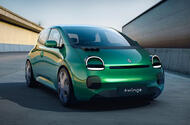
Renault believes it has already cracked China Speed – the new Twingo will take just 21 months to developMuch faster development times are giving Chinese newcomers the edge, but global giants are learning fast
A senior member in the development team of a Chinese car maker told Autocar the story - on condition of anonymity - of when a storied German engineering consultancy visited earlier this year to offer their services. “They told me we can cut vehicle development times from five years to three years and I said 'we can’t work to those speeds'”. He paused for effect. “'That electric car we picked you up in, we developed that in 18 months'.”
The problem of how to keep pace with the Chinese has been gnawing away at Western car makers as they strategise how to avoid getting left behind in the race to build modern, electrified cars.
Many of these car makers have a ringside seat on the pace of development as they watch their joint-venture partners in China go from being essentially contract manufacturers to fully fledged automotive powerhouses with desirable brands of their own.
Now those Chinese cars are coming here, with the likes of MG, BYD and Chery (parent of Omoda and Jaecoo) all posting phenomenal sales gains across Western Europe for high-tech models that undercut the price of incumbent cars at a quality close enough for buyers to make the leap.
To avoid the same market-share erosion, established car makers must learn to adopt the same nimble approach. “They need to do a lot,” Eric Zayer, head of autos for Europe at consultancy Bain, told Autocar.
Bain research shows that 20 to 24 months is considered a regular development time for a new vehicle in China, compared with between 36 to almost 50 months for Western car makers.
Moving faster has lots of obvious advantages, including the one most prized by car makers faced with financial pressures on a level rarely experienced before. “A difference in speed directly translates into a difference in cost,” Zayer said. The longer a car takes to develop, the longer engineers are tied up on a project that can’t be monetised and might be using out-of-date tech when it finally arrives.
There are other benefits too. Those who develop faster can more quickly react to trends and in China those trends manifest themselves incredibly fast: witness the craze for camping developed during Covid that led to the explosion of chunky off-roaders such as the iCar V23 and MG Cyber X at this year’s Shanghai motor show.
But how does China manage it? And how can Western car makers follow their lead?
One way is to develop more of a software mindset. “Western manufacturers create a generation one, put that aside and start with generation two,“ said Klaus Stricker, global head of automotive at Bain. “But the Chinese are continuously developing things further. That comes from the software world as compared to car world, where development processes are centred around the start of production.”
If something goes wrong, for example on software, “they have to pause the car and cannot launch,” Stricker said.
He didn’t name examples, but a good one might be the slow roll-out of Stellantis’s Smart Car platform, due to software issues, which delayed the launch of crucial cut-price EVs such as the Citroën ë-C3 and Fiat Grande Panda Electric.
The Chinese are also helped by the fact they essentially started from scratch, meaning many platforms are optimised for a modern software age, rather than carrying over previous architectures.
Chinese development teams also tend to be younger, Bain research shows. They lack the experience of say, a German team, but what experience they do have is in future technologies such as the battery, the electric drivetrain and the software.
“These are disciplines where the Western manufacturers typically are not so strong, meaning that they have to educate and reskill their team, which is very hard if your team is of a certain age,” Stricker said.
One obvious difference is the hours clocked. “To be very honest, in terms of speed, it's not only great technology; sometimes Chinese people just work harder,” said Volkswagen Group CFO Arno Antlitz on his company’s first-quarter earnings call.
Everyone in the automotive industry has a story about their Chinese counterparts working unfeasibly long hours. “Our China team got 10 days holiday a year, but they rarely took it, because it was frowned on,” one industry executive told Autocar.
The standard working pattern is ‘996’, meaning 9am to 9pm six days a week. High levels of competitiveness in the market means the boss is likely to be working just as hard, if not harder, helping to engender a loyalty among staff keen to see their company succeed.
Replicating that work rate is difficult in Europe – but not impossible. The Volkswagen Group is looking to copy the Chinese two-shift R&D system by using its global network, for example.
“We could develop things in Wolfsburg and then push it in the evening to our development headquarters in Mexico and Brazil, use the time there and get it back the next morning,” Antlitz said.
Another way is to just develop cars in China. “We are basically ramping up a local R&D centre in China with global responsibility,” Antlitz said.
The Volkswagen Group is changing its working strategy by collaborating with its Chinese manufacturing partners SAIC and FAW on development and bringing in Xpeng as well.
Volkswagen unveiled three concept cars at the Shanghai show, previewing new Chinese-market models coming next year that utilise the country’s faster development speed and cheaper supply chain.
That ‘China speed’ thinking is then being applied to the new ID 2 and ID 1 small electric cars going on sale next year, of which the ID 2 at least is promised to be the first VW EV to deliver margin parity with an equivalent ICE model, specifically the T-Cross.
Renault meanwhile thinks it has already cracked the secret to fast development, promising that development of the new electric Twingo due in 2026 will take just 21 months under a programme it calls Leap 100, named for the target number of weeks for development.
“I think we've just moved to Chinese speed,” Renault CEO Luca de Meo told investors back in February. A new Twingo-based Dacia model will be developed even faster in just 16 months, he promised. “I defy any competitor in the world to do that, including the Chinese when they come to Europe,” he said.
Almost all car makers are promising faster development times. Nissan, for example, says the first model based on its new ‘family’ platform (which will spawn a new global compact SUV) will be developed in 37 months, down from 55 months now. Subsequent models will bring that time down to 30 months.
The tricky part is to raise the speed without losing the quality.
“Western manufacturers have a tendency to be lax on deadlines. If they feel that the performance is not there, then they will just go back and repeat one step. They will try different things in an attempt to develop the perfect product,” Zayer at Bain said. “Whereas the cost discipline and the process discipline is just much higher for some of the new players that value speed and cost over maybe the perfection in the product.”
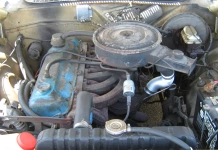
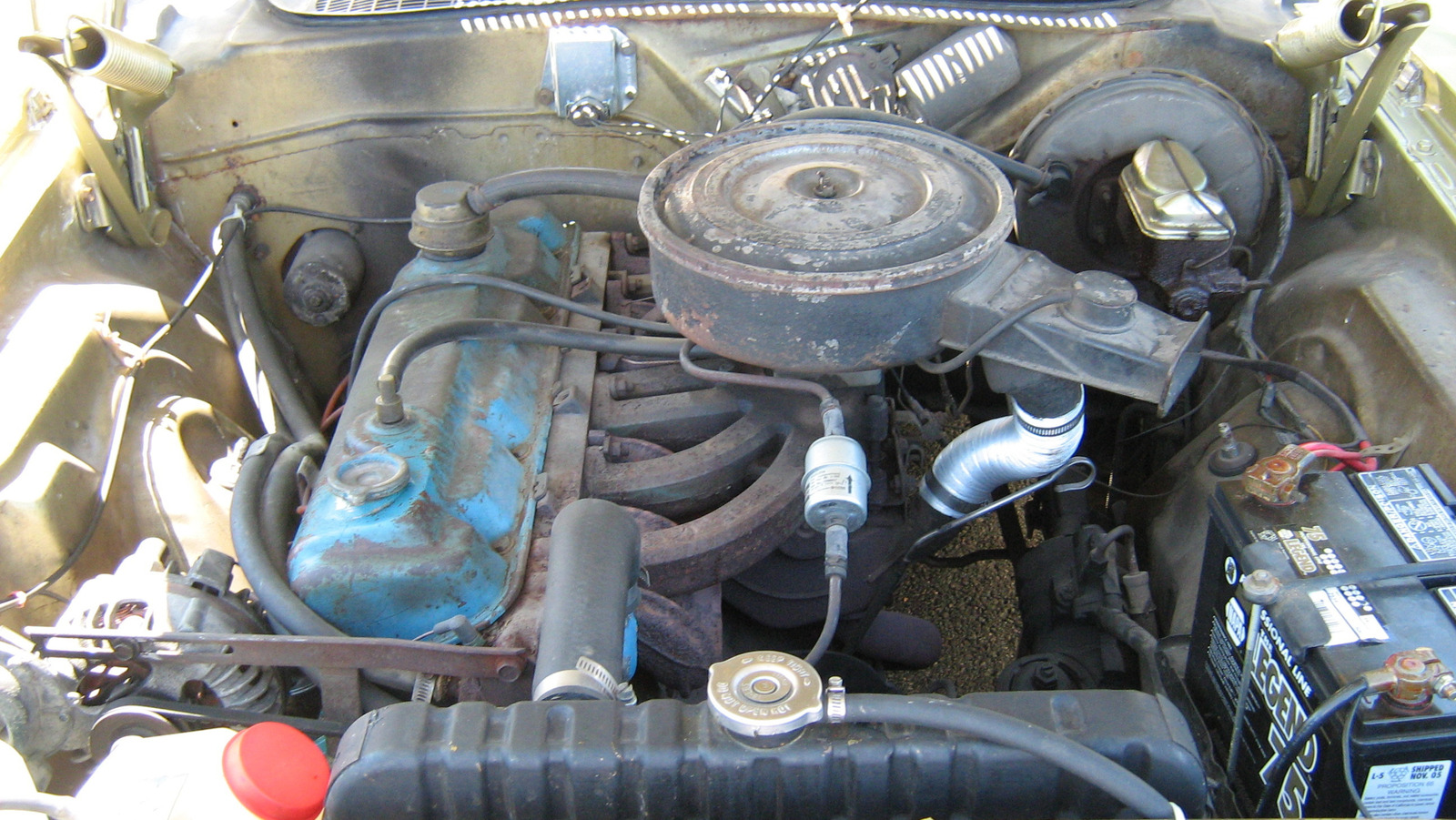
The Heart of Motion: Celebrating the Best Engines Beyond Cars
Audi Q5: A Bold Diesel Hybrid Redefining the Mid-SUV Experience
 Mid-sized SUV packs a rare powertrain: diesel hybrid. Does it stack up? It can seem like cars are getting homogenised, with a new skateboard-platform EV being launched every other week. But a few intrepid engineers are still toying with concepts that their colleagues have long since abandoned. Mazda has brought back the rotary engine, Suzuki has revived the automated manual gearbox and Audi is betting on the diesel hybrid with cars like the Audi Q5.Following the related Audi A5 saloon and estate replacing the old A4, the Q5 enters a third generation. Going up against the BMW X3, Mercedes GLC and Range Rover Velar, it’s an incredibly important car for Audi, because while EV quotas make the Q6 E-tron the one that Audi needs to push, the combustion-engined mid-size premium SUV is still the car that customers want.To make the piston-powered Q5 a bit more palatable to the regulators, every version is a hybrid with the capacity to drive with a dormant engine. Plug-in hybrids will follow later this year, but the Q5 arrives with a four-cylinder petrol, a four-pot diesel and, in the Audi SQ5, a V6 petrol. Here, we’re testing the diesel.
Revving into the Future: The A110 EV’s Game-Changing Sports Car Platform