

Unveiling the Least Reliable Car Brands: What to Avoid for a Smooth Ride

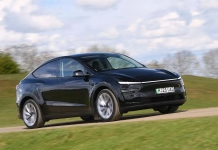
Is the Tesla Model Y Still the Top Electric Car After Its Major Refresh?
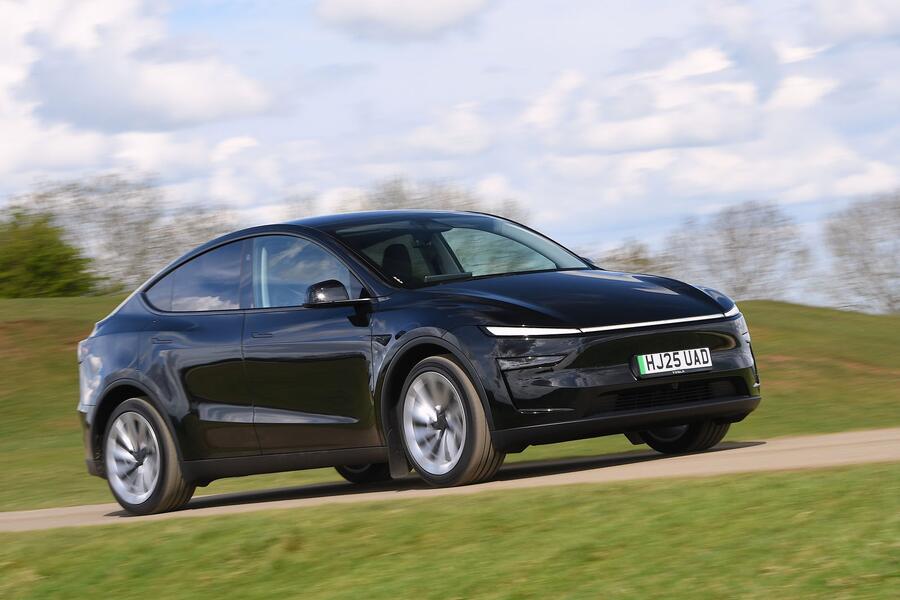
Shall we talk about you-know-who? Actually, let’s not. Whatever you think of the company’s figurehead, the Tesla Model Y is an influential car that has topped a bunch of best-seller lists over the past few years. When such a significant car gets a major update, we’re curious what it’s like, and we assume you are too.
The Model Y has been around since 2021 (2020 in the US). It getting facelifted after five years could almost make you believe that Tesla is a normal car company. The car’s had various updates to its battery and specification in smaller model year updates, but this is the one that you can actually see. The headline news of the Model Y ‘Juniper’ are the styling changes and some comfort upgrades. Let's take a look in the video above:
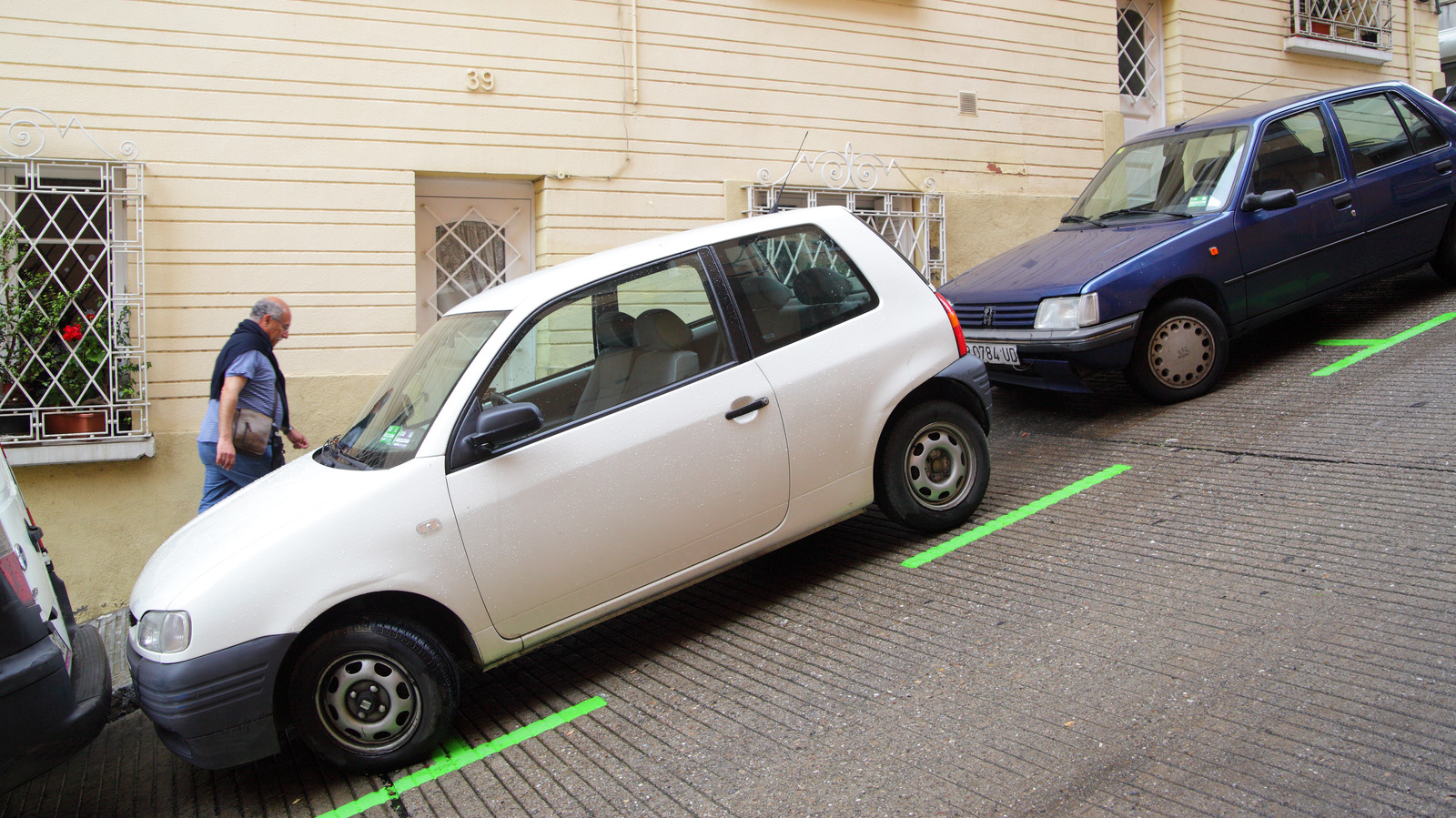
Mastering Incline Parking: Protect Your Transmission with These Simple Tips

Exploring the Mission of the U.S. Space Force: Defending Our Cosmic Frontier


Stay Safe on the Road: Mastering Semi-Truck Blind Spots

Smart EV Choices: Models That Depreciate Faster Than the Tesla Model 3

The Evolution of Ram: Unpacking the Split from Dodge and What Lies Ahead

The Rise of Digital Dials: Are Analogue Instruments the New Luxury?
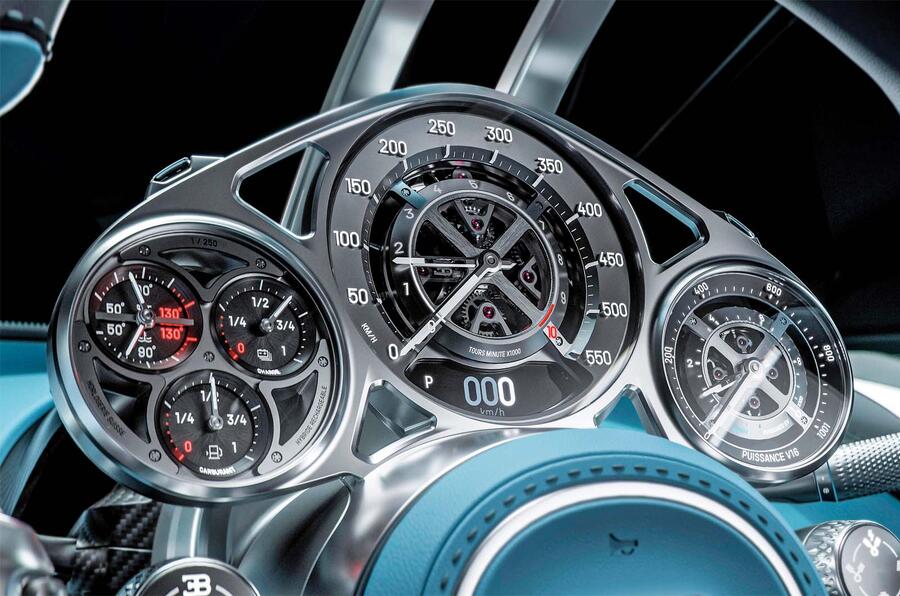
 Digital dials have become the norm, with only luxury cars like the Bugatti Tourbillon using an analogue speedo
This week, the screen I will mostly be looking at is the one pictured below, after a hire car lottery ran out of Kia Picantos and provided me with a Volvo XC60. I’m not unhappy about this.
The XC60 is a comfortable car and this is mostly a comfortable screen to look at. It’s easy to be critical and plenty (including me) have been of the direction Volvo has taken with its interior functionality lately, with mass migration of controls to a touchscreen – including essentials like the foglight switches – at the expense of separate-button usability.
Speculation, of course, but this may be one of the reasons the pragmatic Håkan Samuelsson was restored as interim CEO. He’s a steady hand who understands that cars are not smartphones.
The XC60 has been around since 2017, and while its digital instrument cluster has been updated in that time, there’s still a lot to like about the simplicity of its graphics and fonts. It doesn’t overburden a driver with information;
I could turn off the map if I wanted. And I should also find myself pleased about the fact that it retains two dials, one for the speedo and one for the rev counter, because the genius of a dial is just how much it tells you in such short order.
At a glance, you can see a facet’s upper and lower limits, with a needle that shows how far along that range you are, the direction of travel and the rate of change. Numbers alone can’t do this: they can only tell you where you are right now.
There’s a reason that when film directors want to show an aeroplane in distress, they show a needle spinning anticlockwise very rapidly. We all know what it means.
That should make this Volvo’s dials preferable to use than the numerical script for the speed. Should but, I’m finding, doesn’t.
With dials nestling perhaps too discreetly around the edge of the screen and with a bold numerical font front and centre showing the speed right next to a graphic that apes roadside speed limit signs (usually but far from always, of course, getting the limit correct), I find myself looking at the numbers more frequently instead.
This is down to the size of the digits, but so glacial is the normal rate of change in daily driving anyway that going by the numbers isn’t too much of a drag.
And with a mildly hybridised engine, an automatic gearbox, busy traffic and New York state’s typical upper speed limit of 55mph, it’s not like I’m paying the slightest bit of attention to the rev counter either.
Were the rotary dial bigger and the supposed speed limit a small red telltale needle, I think the display would be more useful. As I find myself nearing a speed limit from above or below, it would be better to have a needle showing how quickly I’m closing in on it, but the instrument has been relegated to minor or cancelled status.
And this is the case all over the car business. Of the new cars I’ve tested recently, only in a Caterham Seven and a Morgan Supersport have I been overtly aware of a speedo needle spinning around a dial – and the Morgan had a supplementary digital numeric display too.
Even in Porsches and Ferraris, where you would expect the needle to move quickly, you find numbers for the speed, alongside, thankfully still, dials for the revs.
I think there’s an inevitability about this. Two large numerals take up less space than even a small dial, and it’s not like one can do away with a digital screen entirely, because modern legislation requires that the driver is presented with ample – often too much – information.
But is there a limit to how good a digital display can look? That in my XC60 is of high resolution, and even if the fonts do date, they will do so with Scandi-cool vibes.
It’s hard to imagine a display looking much more luxurious. I don’t remember the dials in the Rolls-Royce Spectre or Bentley Bentayga looking much better, and I’m not sure that should be the case.
There is talk, then, that analogue dials – such as the speedo that features in the new Bugatti Tourbillon – will become a mark of luxury, in the way that, while the digital or smart watch has in most practical terms replaced the analogue one, the posh watches still have hands.
If it does, I’m for it, because well-presented dials aren’t just for show: they also tell you something that two digits can’t.
Chinese Cars on the Horizon: A Threat to U.S. Auto Market Share?
Designing Speed: The Art and Science Behind the Hennessey Venom F5
Hennessey Venom F5 is aiming to reach a top speed of 310mph-plusDesigner of one of the world's fastest cars explains how designs can bend the laws of physics
Ever wondered why so many supercars claim a ‘217mph-plus’ top speed? The McLaren P1, LaFerrari and Lamborghini Revuelto are just a trio of heavy-hitting examples.
An easy, clean conversion to a mite under 350kph is one possible reason. Another explanation, however, is aerodynamics.
“There’s an exponential increase in difficulty and complexity beyond 220mph,” says Nathan Malinick, Hennessey’s director of design. “Most hypercars can do that no problem, but 250mph and above remains very, very difficult. You have to know what you’re doing.”
His most dramatic work so far is the Hennessey Venom F5, its target to be the fastest production car in the world.
Its theoretical 310mph-plus top speed (itself a neat 500kph) will outstrip Bugatti and Koenigsegg should it come to fruition, but Malinick is only too familiar with the soaring aerodynamic challenges as you try to surpass the triple-ton – at which point you’re covering a mile every 12 seconds and pushing tyre technology to its very margins. Handily, his CV includes work in the aerospace industry.
“We are a comparatively small company and we have to be extremely efficient. If our target was closer to 200mph then the requirements would be totally different. That’s still fast, but it’s nothing like 300, which is getting more into the aerospace side of things versus automotive,” he says.
“There is quite a bit of crossover. From an aesthetic and philosophical standpoint, the F5’s interior is relatable to some of the cockpits that I was working on in my previous role. Simplicity drives a lot of what we do; on the exterior, it drove things in maybe unusual ways.
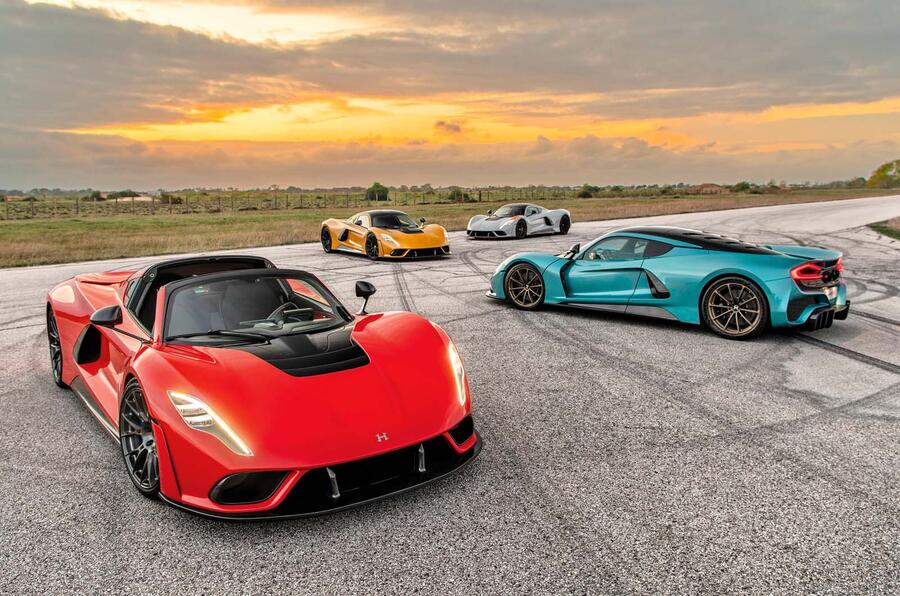
One instance would be a lack of active aerodynamics, because we didn’t want to have an aspect of the car that would be susceptible to a failure at such high speeds.
“You’re not going to see the flicks and blades of an F1 car on an F-35 or F-22 jet. Likewise, you’re not going to see them on our car because they contradict its purpose of top speed.”
Supercars mostly sell on glamour, so how easy is it for Malinick to ensure his team’s designs are beautiful enough to be coveted by the collectors with the requisite millions to buy one?
“We’re lucky to have creative engineers who recognise the value of design and want to support it, because ultimately people buy with their eyes,” he says. “The kind of people we’re talking to already have one of everything. Our car needs to pull on their heartstrings.
“Our design and engineering teams work hand in hand. It’s not like we progress a design element and then say: ‘Hey engineering, take a look and see what you think.’ Feedback is in real time. We might need to stop and take something into CFD [computational fluid dynamics], or rapid-prototype something in the wind tunnel to ensure there’s no time lost.
“The engineers are helpful in saying ‘this area of the car is not as significant, so do whatever you want here’. But sometimes our design will be dictated by function. Some of that is neat: a purely engineering-driven detail underneath the car that you’re not going to see unless it’s jacked up on a lift.”
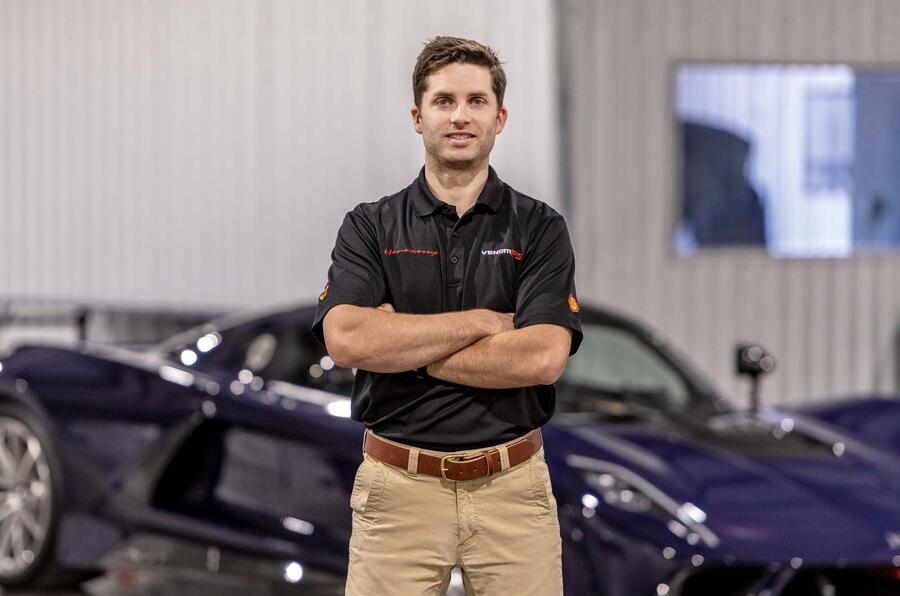
Despite its lofty goals and Malinick’s aerospace past, the Venom F5 can still thank pencil and paper for its design. “I do a ton of sketching,” admits Malinick. “It’s my favourite part of the process. I probably have thousands and thousands of sketches, whether it’s F5 or what we’re moving onto next.”
It’s bait I can’t resist taking: what is coming next? He says: “If the F5 is all about performance, the next car is about driving interaction. It’s not going to be as powerful; it doesn’t need to be.
"The feedback we’ve had from customers and dealers has been really strong. It’s very much the antithesis to the digital age of cars we find ourselves in.”
Does that mean it’s a manual? “If the customers come back and say ‘we want a DCT’, okay, that’s fine,” he says. “But as of now, I’d say it’s analogue to the nth degree.”
Which suggests it will be free of the Venom’s turbocharging. “We’re still determining that,” says Malinick, “but we’re leaning towards something free of forced induction for the purity of it all.
"We want something very, very high-revving.” Sounds like a noble target to us.