Unveiling the True Cost: Insuring Your Cybertruck Adventure

BMW Teases Exciting New Shooting Brake Inspired by Iconic Concepts
 New creation appears to be a rakish shooting brake based on last year’s Skytop convertible concept
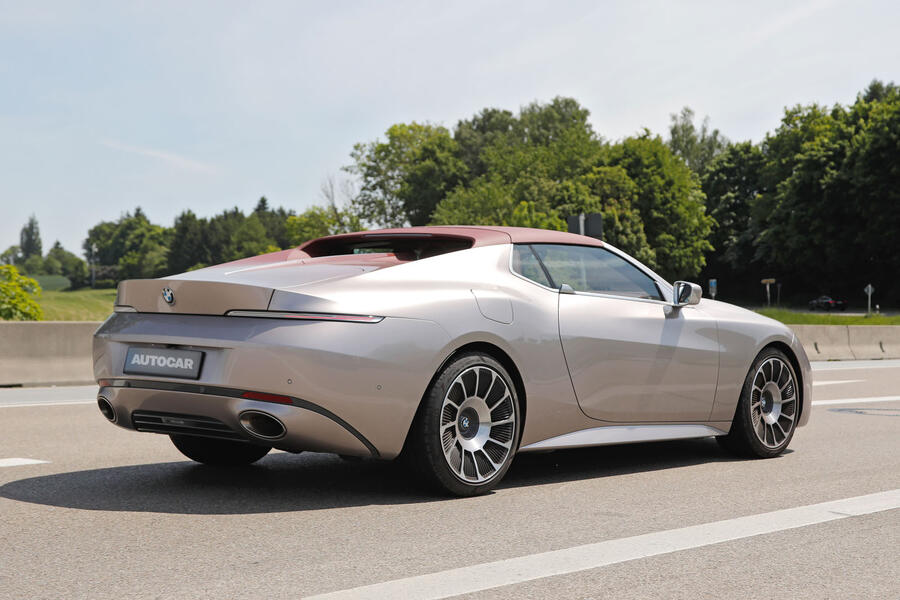
BMW has released the first images of a new model set to be revealed at the upcoming Villa d’Este Concours, seemingly fusing last year’s Skytop concept with the famed ‘Clownshoe’ Z3 M Coupé.
Images posted to social media show the silhouette of a model with the same rear lights as the Skytop, a rakish open-top GT unveiled at last year's Villa d’Este Concours, but a reworked tail section.
Rather than a long deck housing a convertible roof panel, it appears to be a shooting brake with a rakish glasshouse and a prominent ducktail-style roof spoiler.
Its form appears to reference the Z3 M as well as the Z4-based Touring Coupé concept that BMW revealed at Villa d’Este in 2023.
The Touring Coupé never made it to production but the Skytop, on the other hand, is being readied for a limited run of 50 road-going cars.
Testing of these cars – based on the CLAR platform that underpins every BMW from the 3 Series upwards and packing a 4.4-litre twin-turbo V8 – recently ramped up ahead of this year’s Villa d’Este Concours, which opens on 23 May.
Discussing the impact of Villa d’Este, BMW M chief Frank van Meel last year told Autocar: “It is a little bit like a test balloon: you show the cars and, if there's enough demand, it can be built.
“I think the demand is quite high, so [the] probability is quite high. We will see over the next few weeks if that interest translates into purchasing orders.
“The probability is there. It shows [that] we always want to try new things and see if there is a demand. Even though we’re a big company, it’s not the main purpose to build a small series.
“But if you listen to your customers and they say every now and then to do something like this and we do it, I think it’s a nice gesture, to show that we aren't only into, let's say, the cars we build everyday, but we can also do something special if demand is there.”
BMW design director Adrian van Hooydonk added that “there’s no need to turn [the Skytop] into a big series production car” and that it is “maybe an instant classic”.
Reviving the Supercar Dream: Which Automaker Should Join the Race?
The Epic Journey of the Bugatti Veyron: From Concept to Iconic Supercar
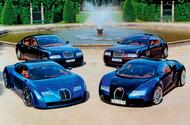
Anti-clockwise from top right: the EB118, EB218, 18/3 Chiron and 18/4 Veyron conceptsAfter several concepts and €1 billion, the fastest and most powerful production car finally hit the road
In 1998, Volkswagen bought the rights to the Bugatti brand from the bankrupted Italian firm that had given us the V12-engined EB110 supercar.
Seven years and more than €1 billion later, we drove a Veyron for the first time. It was the fastest and most powerful production car the world had ever seen, by quite some margin, and it hit, if not exceeded, all of the targets that had been set – except for cost, because there was no constraint on that, and, despite it retailing for €1 million, Volkswagen allegedly lost €5m on each one. Or rather company supremo Ferdinand Piëch lost it, because the Veyron was his car through and through.
The idea only came to fruition because his attitude was: “You will get it done, and if you can’t, you will be replaced by someone who can,” according to Chrysler chief Bob Lutz. But then the Veyron was never meant to be a money-making exercise.
In our final issue of 1998, Peter Robinson commented: “Without Piëch’s astonishing assault into car territories once beyond the wildest fantasy of staid old VW, the task of writing Autocar’s weekly Grapevine column in 1998 would have been much harder.”
Indeed, Piëch had tried to buy Rolls-Royce, Volvo Trucks, BMW, Cosworth, Lamborghini, Bentley and Bugatti all in that year, succeeding with the last four and setting about planning a sprawling new model range using monstrous engines.
The world had its first glimpse of Veyron madness at the 1998 Paris motor show: the EB118, an ostentatious coupé concept with a 555bhp 6.3-litre W18 engine that “arose from a simple sketch [Piëch had] made on a serviette during a dinner”.
Enjoy full access to the complete Autocar archive at the magazineshop.com
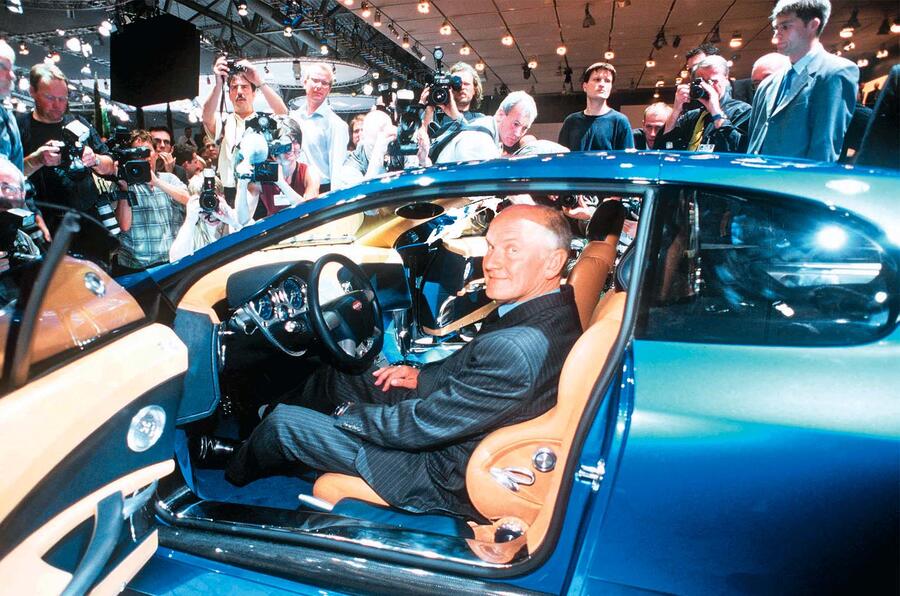
At the 1999 Geneva motor show, even while Volkswagen’s W12-engined Syncro supercar was still on the cards, Bentley revealed an 8.0-litre W18 supercar of its own and Bugatti the EB218 concept, a saloon version of the EB118.
The intention was for the brand to return to the market position it had enjoyed in its original pre-war form, so “Volkswagen insiders were buoyed that the Mercedes team developing their own limousine, the Maybach, awarded the EB218 ‘benchmark’ status after visiting Bugatti’s stand”, we reported.
This was shortly followed by the 18/3 Chiron and 18/4 Veyron supercar concepts, which were much closer in style to what we know today.
In 2000, though, it emerged that development of the W18 had slowed. “It seems the cost of having both 16- and 18-cylinder engines frightens even Piëch,” we suggested.
Soon after we sampled the 18/4 Veyron on condition of silence, and the big boss told us: “We have the technology under control.” Clearly they didn’t, though, because only a few months later, the supercar evolved into the 16/4 Veyron. Instead of three banks of two three-cylinder engines in line, it had VR8s grafted together into a W16 – much simpler.
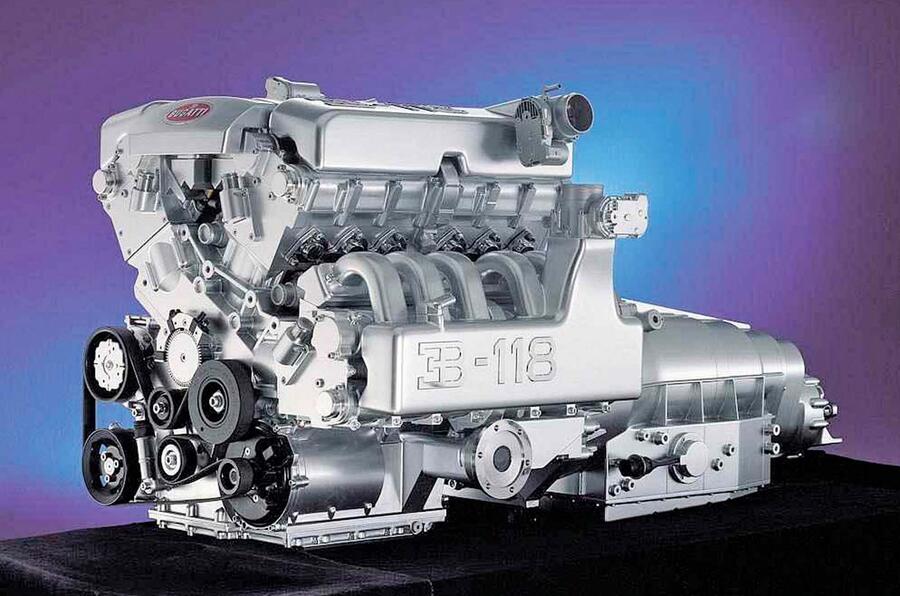
Nevertheless, there were fears that the Veyron project had become too expensive, even for Piëch and even after all the other planned Bugatti models had been canned.
Brand president Karl-Heinz Neumann, who was also in charge of the entire group’s powertrains, reassured us: “Volkswagen has the money. From the end of 2003 or the beginning of 2004, we plan to build 50 Veyrons a year – a total of 200.”
But by August 2003, Neumann had been “given his marching orders”.
“Despite the upheaval,” we said, “Bugatti officials deny the supercar’s performance claims will be scaled back. They say the four-wheel-drive Veyron will hit 60mph in just 2.9sec and top 252mph.”
And upon launch in September 2005, the Veyron did so. In fact, it was even quicker, hitting 60mph in 2.5sec. We were delighted and quite relieved to be able to at long last experience “a peculiar cacophony that sounds a bit like two TVRs on full reheat plus an industrial-strength air hose” being “accompanied by mind-bending, heart-stopping acceleration, the like of which has never been felt before in a road car”.
Custom Vector Wheels: Tailored 80s-Inspired Designs for Every Car Enthusiast

Reviving the Thrill: Discover the Best Affordable Sports Cars for Every Budget
 The demise of the affordable sports car has been lamented too early. Here are the best routes to fun on a budget
With the ever-increasing number of SUVs on our roads, finding proper, dependable sources of driver entertainment isn't quite as easy as it once was.
It's especially hard to find a sports car on a real-world budget, but our list of the best affordable sports cars will help you find a phenomenal drive without breaking the bank.
They may not be as numerous as before and many don’t seem as affordable in these inflationary times, but they exist, and they’re cars that demand to be seized and cherished.
Despite their price, some of them are the best sports cars you can buy, and among them are mid-engined two-seaters, front-engined roadsters, big-engined muscle cars and lightweight specials.
Some of these cars could easily serve as daily transport; for others, that would be the case only for the genuinely enthusiastic.
They share an affordable asking price – £50,000 or below in some cases, and quite a long way below in some - and the capacity to light up your motoring as often as the mood takes.
Our top pick is the Alpine A110, which is one of the most engaging, dynamic and enthalling cars money can buy today.
But what other models make it into our top ten list? Read on to find out...

Are Your Tires Expiring Before They Wear Out? Here’s How to Tell

2026 Toyota RAV4: A Bold Evolution with Enhanced Tech and Hybrid Power
Behind the Wheel: The Reality of Driving Concept Cars
 Concept cars are great for showing a brand's vision and potential – but driving them is a different story altogether
"You don’t want to know. It would ruin the illusion, wreck every appealing reverie that those bright motor show lights and cooing onlookers once inspired."
"Did you like it? Think it a shame that it never got built? Great. Let’s not let the facts ruin a lovely, wistful idea.”
As criminally jaded as it must undoubtedly make me seem, this has become the stock response I give when asked what driving a concept car is like. It is, apart from anything else, also a great privilege, a singular opportunity and a huge vote of trust and faith. Any drive like this always feels special one way or another.
But honestly, concept cars are for looking at; for exploring ideas, capabilities and potential. I find them fascinating, especially when they’re technically bold or innovative.
But as far as driving them goes… well, a seafood lasagne might look quite nice once you’ve topped it with sauce and grated cheese, but you wouldn’t actually eat it until it had spent a good three-quarters of an hour at gas mark five, would you?
The thing is, once it has been finished at the very last minute, delivered to the show stand still glistening with tacky paint and then admired by all and sundry, the initial fervour around the unveiling of a concept car soon passes.
From there on out, they don’t often get a lot of coverage. That’s only one of the reasons why hacks like me can end up driving one.
They’re usually rather unsatisfying stories to write, funnily enough, as much as these are often disobliging cars to drive in the first place – principally because how they actually drive is wildly irrelevant.
They can be slow, awkward, noisy, smelly, unpleasant and uncomfortable – but it doesn’t matter. Don’t write it, for God’s sake. Nobody really wants to know. Just pick out the interesting bits.
Filter out and expand on what might just survive to any production version or indirect descendant. Be a journalist.
I began learning how all this works back in 2006, when a chance to drive a brand-new Mazda sports car came along. If you remember the Kabura, give yourself a goldfish.
It was a cool-looking, 2+1-seater, MX-5-engined coupé with a fantastic asymmetrical layout, concocted by the company’s then design boss, American Franz von Holzhausen (who now runs the colouring-in department at Tesla). It was a fantastic idea: a kind of half-an-RX-8.
I loved it. As I remember, it rode like a go-kart with only chassis flex for suspension, steered like an HGV with a knackered assistance pump and spent most of my test drive rubbing its enormous wheels against its arch liners.
Not that I troubled anyone with details like that in the report I wrote, because I desperately wanted that, whatever it might be worth, to give the Kabura every chance against Mazda’s bean-counters. Look how that turned out.
Two years later, I drove Audi’s 12-cylinder diesel-engined R8 show car (the R8 V12 TDI Le Mans) on a specially closed length of Miami highway. That felt like quite the occasion.
This was the supercar supposed to have 738lb ft of torque – but because it was a show car built in a matter of weeks, it actually had a six-speed manual gearbox from an Audi A4 and an ECU that would in fact dole out only 369lb ft.
Among other concept cars that have flattered to disappoint over the years, I’m fortunate to count Peugeot’s 2010 EX1 electric endurance racer (“kindly sit in the door pocket, if you would, sir, and then, as it were, close yourself”).
But then there was the awesome Jaguar C-X75 in 2013 and the incredible Ariel Hipercar in 2022. Those, I’m pleased to report, were very different experiences.
But that’s because they weren’t show cars but prototypes – and those are another story entirely.

Stop Topping Off Your Tank: The Hidden Risks to Your Car’s Health