
Is Your Motor Oil Failing? Key Signs to Watch For

Jarren Duran’s Ride: The Standout Car That Turns Heads Off the Field

Protect Your Engine: Common Mistakes You Might Be Making
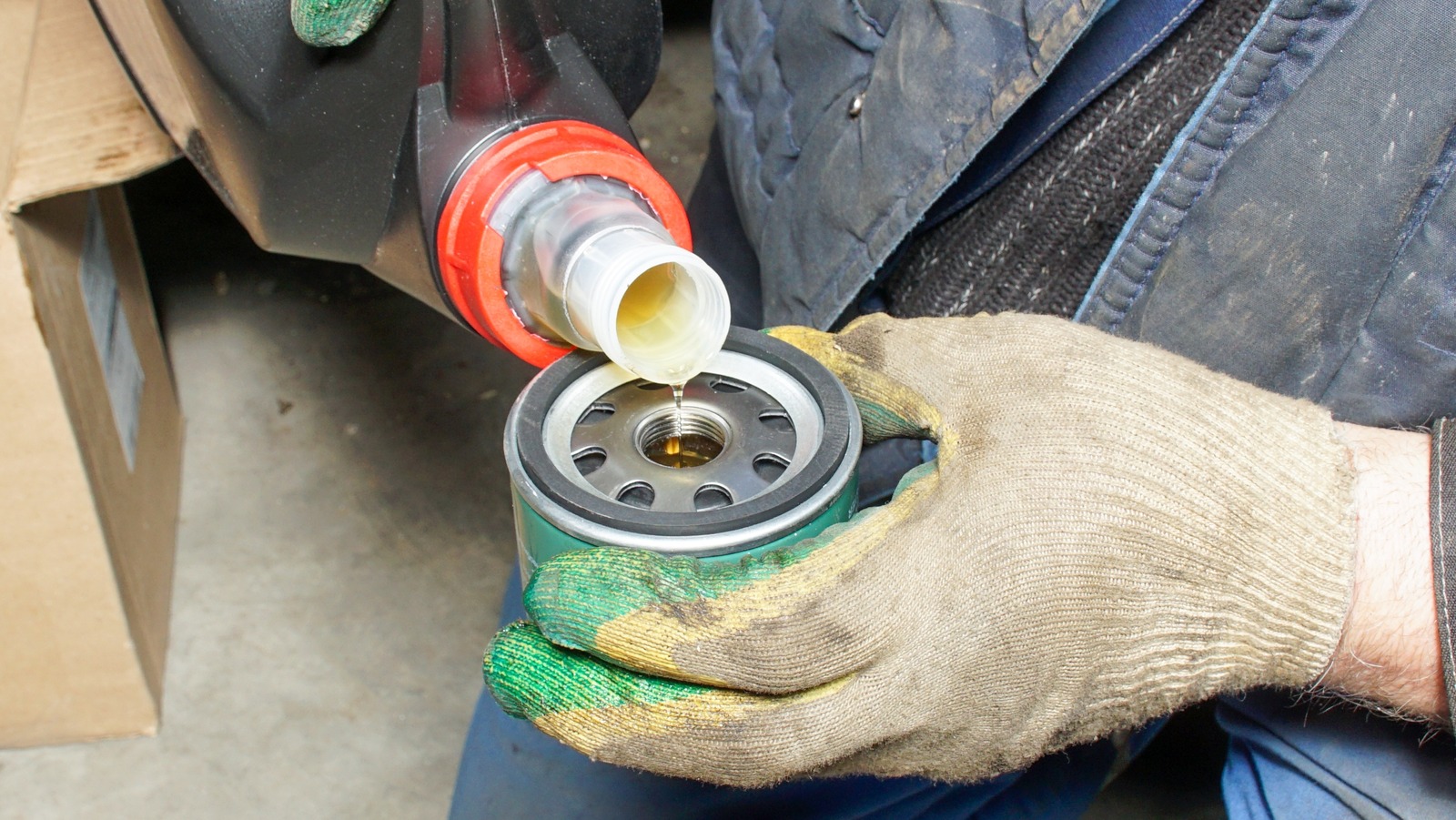
Is Pre-Filling Your Oil Filter Still Necessary? Unpacking the Latest Insights
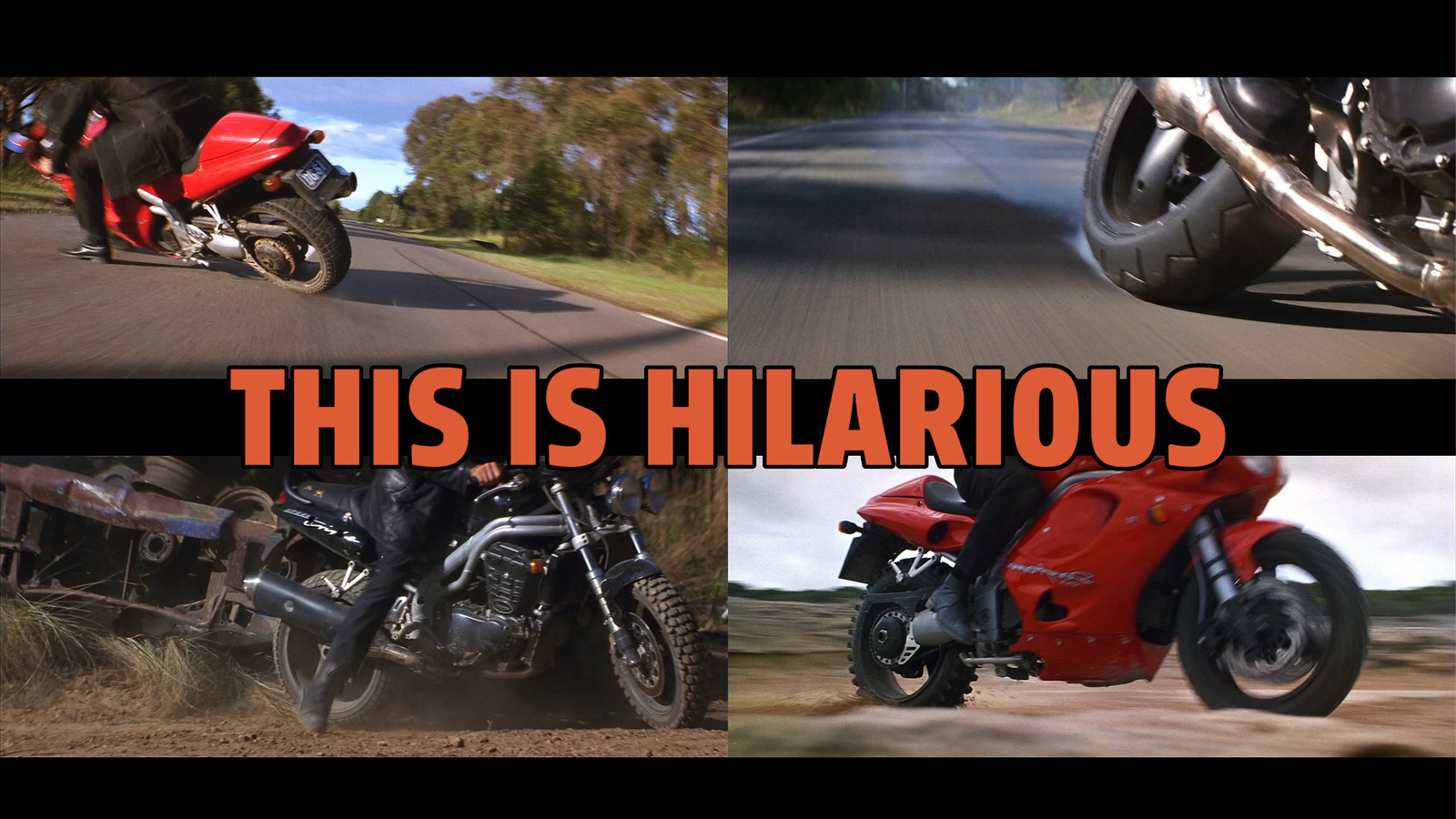
Hilarious Tire Change: The Unexpected Twist in Mission: Impossible 2’s Motorcycle Chase
UK Car Exports Get Boost as Trump Cuts Tariff to 10% for First 100,000...
 Tax applies to first 100,000 cars exported from UK to US; reduced from a previously announced 25% rate
UK-made vehicles imported into the US will be hit with a reduced tariff of 10%, president Donald Trump has announced, but only for the first 100,000 cars exported.
It follows more than a month of negotiations between British and American officials after Trump announced sweeping import tariffs on foreign-made products, including a 25% tariff on new cars.
All tariffs were due to start on 1 April, but a 90-day reprieve was given so that negotiations could take place.
Details on the new deal are currently sparse, but the US confirmed that the 10% tariff - which brings it in line with the levy on other foreign goods – will apply to "100,000 cars", suggesting that anything over that number will be hit by the higher 25% rate. Previously, before Trump's March announcement, the tariff was 2.5%.
Prime minister Keir Starmer said the 10% rate represented "a huge and important reduction" and confirmed that "we have scope now to increase that quota; this is not final".
Last year, the UK sent some 102,000 cars to the US. The US is the British car industry's second largest export market, behind the EU. It received 27% of all UK-made vehicles in 2024, accounting for some £9 billion a year.
No details were given on the proposed 25% tariff on car parts, which was due to begin in the coming months.
While details have yet to be fully confirmed, new deals on food, chemicals, machinery and industry have been struck. Tariffs on steel and aluminum have been reduced to 0%.
The UK is the first nation to reach an agreement with the US following president Trump's tariff announcement in March. China will be the next, according to American officials.
Announcing the deal from the White House, Trump said: "I’m thrilled to announce a breakthrough trade deal. The agreement with one our closest and most cherished allies.
"Final details are being written up and will be detailed in the coming weeks."
He added that the deal gets rid of many unspecified UK tariffs that “unfairly discriminated” against US, saying: “They are opening up their country. Their current is a little closed."
Starmer said: "This is a really fantastic, historic day – a real tribute to the history we have of working together. This [deal] is going to boost trade."
In response to the news, Society of Motor Manufacturers and Traders boss Mike Hawes said: "The agreement to reduce tariffs on UK car exports into the US is great news for the industry and consumers.
"The application of these tariffs was a severe and immediate threat to UK automotive exporters, so this deal will provide much needed relief, allowing both the industry and those that work in it to approach the future more positively."
The news marks a major step down from Trump's March announcement, when he signed a bill that penalised all car makers importing cars into the US market.
At the time, Trump said the decision was made because of the imbalance of American-made car sales in other markets and claimed the move would lead to "tremendous growth" for the US automotive industry.
Around eight million cars were imported into the US last year, approximately half the total sold in the market. Most were from Mexico, Canada, Germany and Japan.
The news will offer relief to the UK’s car makers, especially JLR (Jaguar Land Rover), which counts the US as its biggest market, having sent 130,000 cars there in 2024. It last month paused shipments to the US as it worked to “address the new trading terms”.
Speaking today, JLR CEO Adrian Mardell said: “The car industry is vital to the UK’s economic prosperity, sustaining 250,000 jobs. We warmly welcome this deal which brings greater certainty for our sector and the communities it supports.
"We would like to thank the UK and US Governments for agreeing this deal at pace and look forward to continued engagement over the coming months.”
Mini will also welcome the news, given that the Mini Cooper hatchback, which has recorded a near-doubling in US sales so far this year, is made at Oxford.
However, the Countryman SUV, made bigger in its most recent generation as part of a US market push, is made in Germany, which remains subject to the 25 tariff.
Tariff negotiations between the EU (of which Germany is a member) and US are still ongoing.

The Shift from Cars to Code: Do Drivers Really Care?
 Many car companies are becoming 'software-defined', but that won't necessarily resonate with their customers
When is a car company not a car company? There are a couple of paths into this way of thinking.
One – and this is among my least favourite topics, but I suppose we must delve into it – is the idea that car makers are gradually becoming software companies that just happen to also make cars. Eek.
Volvo’s Jim Rowan, several weeks ago uninvited from being Volvo’s Jim Rowan, spoke positively about this trend in March.
He talked of ‘cloud architecture’ and ‘full-stack software’ and, I know, I know, I should actually understand what those things mean and what the implications of them are, but even though I’m skinny and bald and my spectacles are thin-rimmed, I’m just not tech bro enough to get my head around it all.
Software is essential: I do understand that much. And I get that if a car can talk to other cars and a base some distance away, if it can send and receive reports on incidents and accidents, that will make for safer and easier journeys. But as a driver/owner/user, I don’t need to know and honestly don’t care how any of this is happening.
Then there are the user-facing parts of software, which I do care about and which some important people clearly believe are going to be deciding factors in what defines their company’s characteristics and what separates it from a competitor.
I think the user interface and user experience are really important, but I also don’t buy into the theory that software will define a car company.
I used to put this down to the fact that I’m increasingly an old man yelling at clouds, but the more I hear from younger drivers, the more I think they feel the same way. There’s only so much software you can use in a car. I just don’t believe people are going to fall in love with a car brand because it has the best software.
It’s not like shopping for furniture or the choicest ingredients to make a great dinner. There I’ll pick my favourite things. I don’t, though, have a favourite shopping website, which is what car software most reminds me of: it’s not a thing in itself but a conduit to get to a thing.
I just want the easiest conduit, the least bad version, something that works every time and is deliberately designed to be unannoying.
For me, this is the optimum that user-facing car software can be. I’m not convinced it’s enough reason alone to buy a car, although I am 100% sure that it’s enough reason to not buy one. Does that amount to the same thing?
Which brings me to part two of how not to be a car company: for want of a less cringey phrase, be a lifestyle company.
In the past month, I’ve driven new cars from, and spoken to the bosses of, Rolls-Royce and Morgan. They’re different companies in that one makes uber-luxury limos and the other makes driver-focused sports cars, but in so many ways they’re the same.
They sell you a beautiful object and also an experience, and while both make cars, a buyer isn’t necessarily contemplating a new vehicle as an alternative place to put their money.
Anything from an old Land Rover to a house extension or a boat or a small island is a rival to what these companies make.
From time to time, I think about buying an old Caterham. Competing for my money is not what one would consider a direct Caterham rival but an Indian motorcycle or a new greenhouse.
Rolls-Royce, Morgan, Caterham: these are luxury companies as much as car companies, and that’s a formula that does work. It requires no reinvention and no trying to convince buyers that they should want something they’ve never wanted before.
And as and when new tech or new interfaces are needed, companies and buyers want them to be as stable and unintrusive as is possible.
Of these two car-making-but-not-car-company approaches, I know which I find more compelling and whose cars I would ultimately rather spend more time in.
It’s the ones that let me feel and enjoy the tangible, dynamic parts of vehicle technology and otherwise leave me alone.
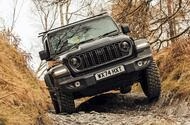
Explore the Great Outdoors: Jeep’s Green-Laning Adventure in the Lake District
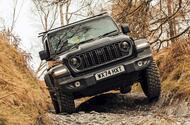
4x4 Wrangler makes light work of rocky lanes in the Lake DistrictJeep has a reputation for treading its own, unique path – and its UK boss is keen to leverage that more
Kris Cholmondeley has packed his wetsuit and says he’s happy to take a dip in Windermere if we’d like some photos of that. Clearly, the boss of Jeep UK is up for demonstrating an on-brand adventurous lifestyle – and it’s not just for show.
He’s a keen runner and has tackled events such as the Celtman!, an ‘extreme triathlon’ so brutal you’ll need a lie-down after simply reading the course profile. “I’ve always been an outdoor type and I’m really focused on mental health,” he says. “Getting outdoors into the countryside has multiple benefits. It’s good for the body, good for the mind.”
For this Lake District outing, though, the wetsuit can stay packed away. Our day does start by crossing Windermere, but instead of swimming we take the cable ferry that forms part of the B5285. On board is a small convoy of Jeep Wranglers, including Cholmondeley’s own company car.
Since being named Jeep’s UK managing director in late 2023, Cholmondeley has introduced a number of initiatives to help the brand reinforce its go-anywhere, off-road roots.
These include partnering the Green Lane Association (GLASS) to encourage Jeep owners to responsibly take to the UK’s 6000 or so miles of legal unpaved byways. As part of that, Jeep dealers will help direct buyers to accessible green lanes nearby.
In case you’re concerned, especially as motorised vehicles aren’t always a popular sight on byways, he insists the scheme will be done “respectfully”. He adds: “It’s not about going and rinsing the car at 30mph down a trail. It’s about adventure and freedom, and respecting all forms of it.”
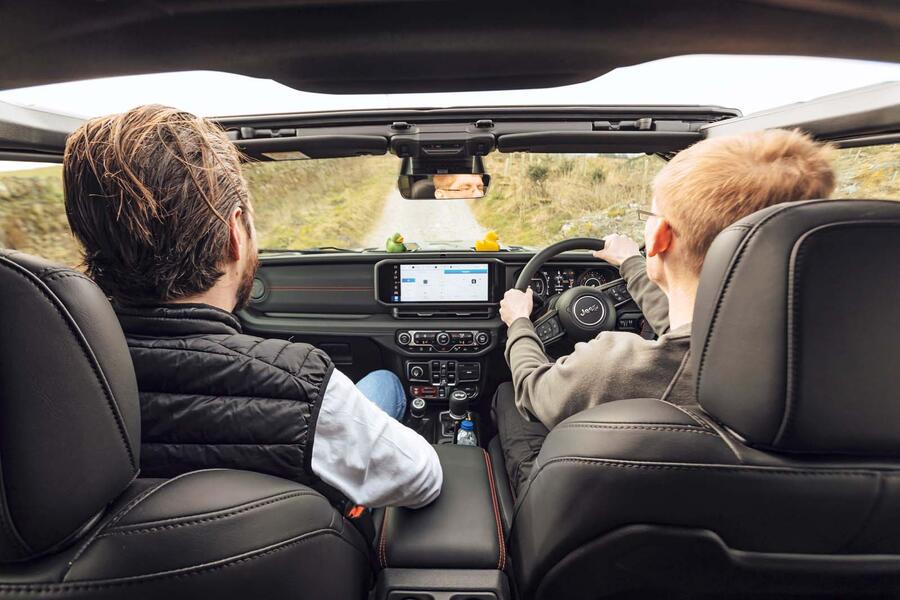
Cholmondeley first outlined this concept to me last year, but sat in a windowless meeting room above the multi-brand Stellantis & You Bristol dealership located next to the M5 motorway, it was hard to make the concept feel real.
So I joked that he should show his commitment to the idea and take me green-laning. And, well, a few months later, as the cable ferry docks in Far Sawrey, Cholmondeley passes me the keys to his Wrangler and jumps into the passenger seat.
The focus for today is on a different type of BOAT: we’ll be taking to Byways Open to All Traffic, unpaved roads that remain open and legal for motorised vehicles to use. The need to understand the various different types of byway can be a factor in making green-laning feel a little impenetrable to newcomers. It’s one ofthe problems Jeep is out to solve.
We’re being led by professional 4x4 expedition leader Russell Dykes. That’s partly because he’ll save us from having to scour OS maps to find the lanes but also because the green lanes we’ll be tackling today are a little bumpier than some.
Many byways can be traversed by any vehicle with four-wheel-drive capability; some of the paths we’ll be taking today will showcase the Wrangler’s remarkable off-road abilities.
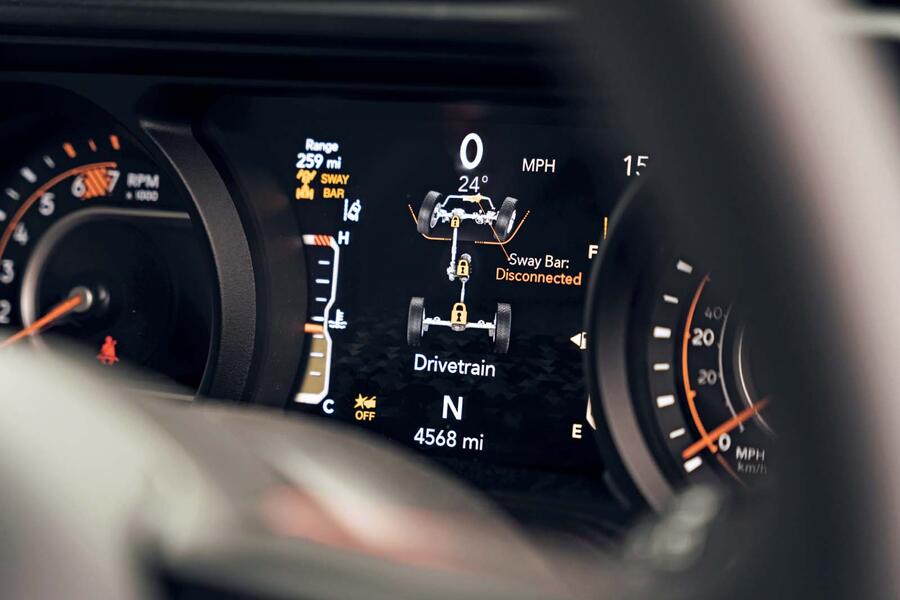
As we turn off the paved road onto The Fox, a byway that leads up through Grizedale Forest, Dykes comes on the radio with instructions to switch into four-wheel-drive low mode, enable the diff locks and detach the sway bar of our Rubicon-spec cars.
That feels quite extreme for a byway, but the path ahead is essentially a stone trail, with some fairly large jagged rocks sticking up. Dykes says the biggest risk is sidewall damage to the chunky 32in tyres and the best way to avoid that in a car with the Wrangler’s capability is to drive over big rocks, rather than go round them.
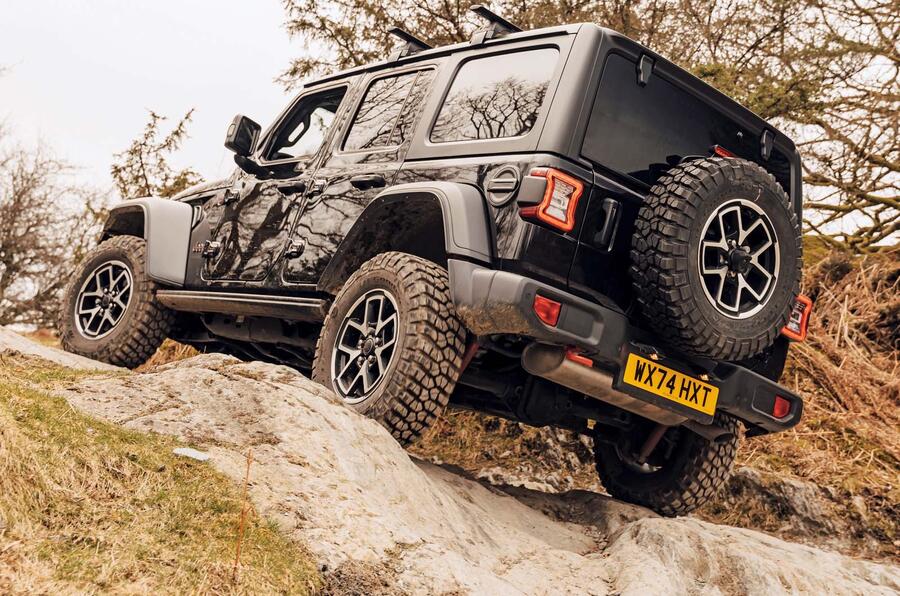
Of course, he isn’t driving a car belonging to the boss of Jeep UK, who is rather hoping to drive it home undamaged later. “Don’t worry: you won’t damage it,” shrugs Cholmondeley, with enviable confidence in his product but perhaps excess confidence in my ability. Still, the Wrangler’s four skid plates and side rails should help.
Cholmondeley is an unlikely figure to be running Jeep UK. He openly admits he didn’t grow up a massive car fan, for one thing. “I’m passionate about people,” he says. “The reason I’m in this industry is because it’s been good to me and I can make a big impact on the quality of a lot of people’s lives.”
He arrived in the car world almost by accident, doing a placement year with Peugeot while studying marketing at university. “After I graduated, they invited me back,” he says. “Well, I’m a lazy 20-year-old and I’ve done a job I quite like, so of course I go back.”
In the two decades or so since then, he’s worked his way through a variety of roles within PSA/Stellantis: sales and marketing, customer care, media and PR, dealer relations, product planning and more.
He reached the level of UK marketing director for Peugeot when “the stars aligned – or you could call it a lack of talent succession planning”, and now former Stellantis UK boss Maria Grazia Davino offered him the role of Jeep UK managing director. He praises Davino for “trusting her instincts” but it’s clear his broad experience has given him a well-rounded set of skills.
I reckon that includes a friendly demeanour and ability to keep calm under pressure, given Cholmondeley is able to talk eloquently about his job while I’m steadily bouncing his Jeep over a series of rocks.
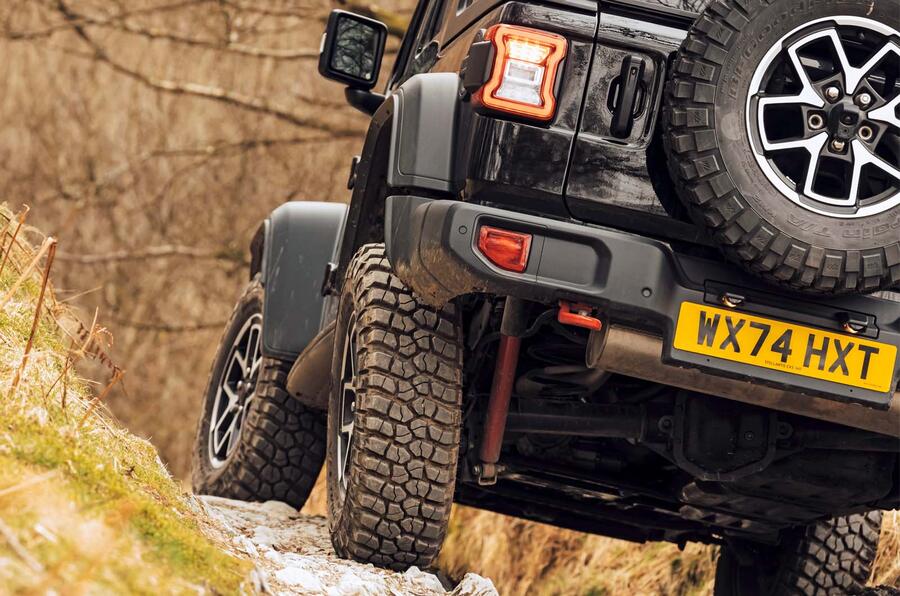
There’s a certain dissonance behind the wheel: the Wrangler’s suspension is so impressive that you barely feel a ripple when clambering over large bumps.
It’s only when snapper Max Edleston shouts to me to stop so he can get photos of the Wrangler with every wheel in a different alignment that I start to grasp exactly what we’re taking on.
It helps that I can follow Dykes’ lines rather than having to pick out my own, but the Wrangler is remarkably confidence-inspiring. My job has given me several chances to drive off-roaders on a variety of trails and test tracks but, as Cholmondeley notes, you gain a better appreciation of the Wrangler’s ability on a natural byway such as this rather than an artificial venue.
Later sections of The Fox are smoother, in part because sections of Grizedale are used for stage rallies, before we drop back onto paved roads for a bit and then turn onto Nibthwaite.
Green-laning is a slow-speed activity (the GLASS code of conduct recommends a top speed of 12mph and the fastest we go today is accelerating into a water splash so that Edleston can get a more dramatic shot) but even over a short distance it’s notable how quickly the scenery changes.
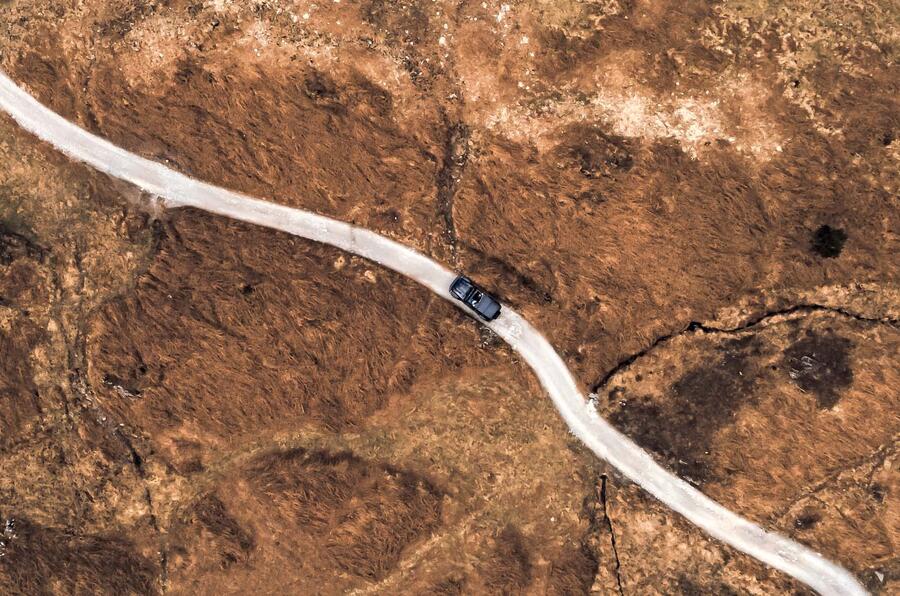
Nibthwaite runs steeply uphill onto open moorland, where there are stunning views in all directions. We’ve passed two cyclists and two dog walkers in the last hour and a half (all greeted with a courteous wave and a hello) and there are no signs of life as far as the eye can see.
On a bright spring day, it’s hard to think of anywhere you would rather be. We pause here while Edleston deploys his drone, and as Cholmondeley takes in the views, he reflects: “I’m privileged to work for a brand that encourages enjoying the great outdoors.”
One of his focuses – and a key reason for the green-lane test drive initiative – is for Jeep to “play to our strengths”. He adds: “There are too many brands that are too similar. I’m always saying ‘be less beige, be more Jeep’.”
Cholmondeley has commissioned a series of ‘campfire tales’ booklets for dealerships highlighting the brand, and with more composure than you would expect from someone watching a journalist drive his car perilously close to the edge of a trail, he rattles off tales about the origins of the seven-slot grille, Jeep’s Purple Heart medal and a string of Wrangler-owning celebrities.
He notes that Jeep is the only car brand in the dictionary and adds: “We’ve got a brilliant brand that people are aware of, but you have to remind people about Jeep’s history.”
"That’s where his marketing experience comes in. “It’s the importance of clarity and narrative,” he says. “You can have a great PowerPoint, but you need to be able to shape a clear vision and strategy.”
Clear vision and strategy are also useful when navigating green lanes, especially when another short road section brings us to Hodge Close. The byway here passes some old farm buildings before working its way past an old slate quarry.
It’s another stone track and illustrates, Dykes is quick to point out, that perceptions of motor vehicles tearing up and damaging byways are misplaced: there’s no mud or dirt to tear up.
The track is nothing the Wrangler can’t handle, but we have to brush past some scenery – I wince more than Cholmondeley whenever I hear some branches thwacking the side of his Wrangler – and there are plenty of sharp-edged stones that could easily take out a tyre’s sidewall. Following Dykes’ advice, I aim straight for them.
One particularly challenging section involves a tight double hairpin while running over some especially big boulders. It looks dramatic but again, from inside the Wrangler, it’s remarkably smooth.
Dykes warns that some of the bigger rocks might just tap the Wrangler’s underbody, which makes me a little nervous, so I’m pleased to make it up to the top without any real drama.
Behind us, Jeep PR Manesh Taank is following in a third Wrangler, and despite being a born-and-bred south Londoner, he shows a remarkable natural aptitude for traversing countryside byways, making the section look ridiculously easy.
Hodge Close is stunning. Just after the byway rejoins the road, we stop briefly to stare down into a flooded section of the quarry. It’s hugely popular with both climbers and divers, the sort of place that really encapsulates enjoying the natural world responsibly.
You would have to be a pretty serious diver to take on some of the flooded mine tunnels, much as tackling the byways we’ve traversed today was easier for being in a pretty serious machine.
But many green lanes are accessible for more standard 4x4s and Jeep’s hope is that it can use the GLASS partnership to help cement the capability link between the Wrangler and road-biased sibling models such as the Avenger, which will soon gain a four-wheel-drive hybrid variant.
That remains a big challenge. Jeep’s recent history in the UK has been as uneven as the terrain we’ve been clambering over today. There have been sales hits, but they’ve been inconsistent, and Jeep has long struggled to leverage the strength of the Wrangler’s reputation onto more road-biased models.
Cholmondeley’s broad experience should help. His most recent role was in marketing but stints in dealer relations, strategy and pricing mean he’s equally comfortable talking about dealer network growth and margins. He admits the latter doesn’t sound too exciting but is absolutely key to customer confidence.
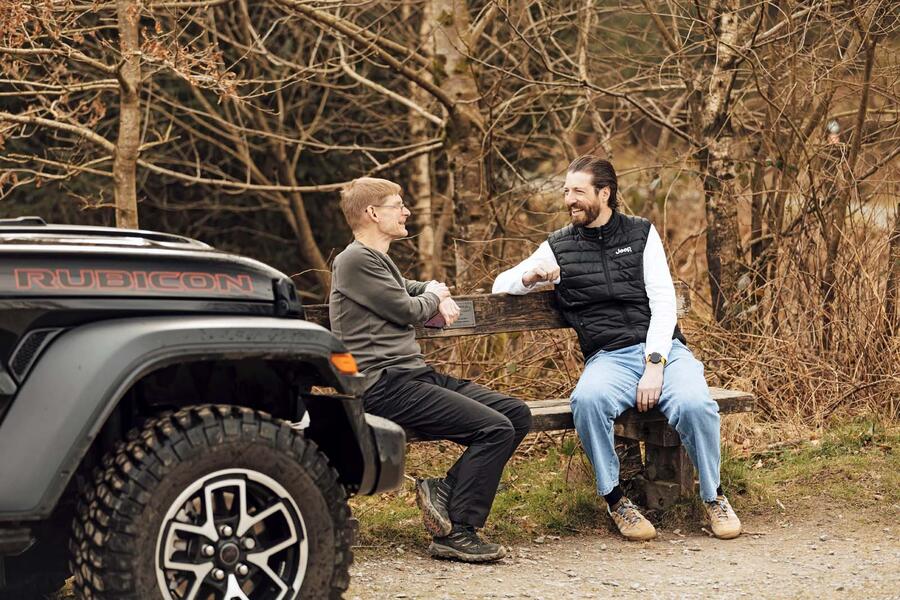
“What we’ve lacked in the past is a consistent cadence of new models – it’s been feast or famine – and when we’ve had good products, we’ve been greedy in trying to grow too much too soon and we haven’t looked after residual values,” he says.
He notes that the Avenger, the brand’s current best-seller, is above the class average for residuals “because of how we’re selling it in a controlled way” and insists that sets Jeep up for growth with its forthcoming line-up expansion.
“We’ve got a huge amount of products coming, which is really exciting,” says Cholmondeley. The next-gen Compass will arrive first, and sitting in one of the biggest market segments represents a massive growth driver. That will be followed by two potential brand shifters: the upmarket Wagoneer S large SUV and the Recon, a sort of EV version of the Wrangler.
The Recon is the future model that Cholmondeley is “most excited about” because it will “take everything that’s enduring about the Wrangler and modernise it.
The best example is to look at the old Defender and new Defender.” He’s excited about the prospect of electrification in off-roaders, for both the instant torque and the extra tranquillity silent propulsion could offer in beautiful countryside.
But experiencing that will have to wait for another green-lane outing in a few years. As for now, we’re back on the Lake District’s main roads and there’s just time to take in the stunning scenery as we round the lake and return to Bowness-on-Windermere.
Cholmondeley drops me off here, because he’s got important back-to-back meetings to dial into while he drives south, and he needs to be home in time to take his son to a sporting event.
Thankfully, I’ve left his Wrangler unscathed, which probably says more about the vehicle’s capabilities than my own.
Still, if the aim of Jeep’s green-lane initiative is to encourage people to head to the countryside more often, consider me hooked.
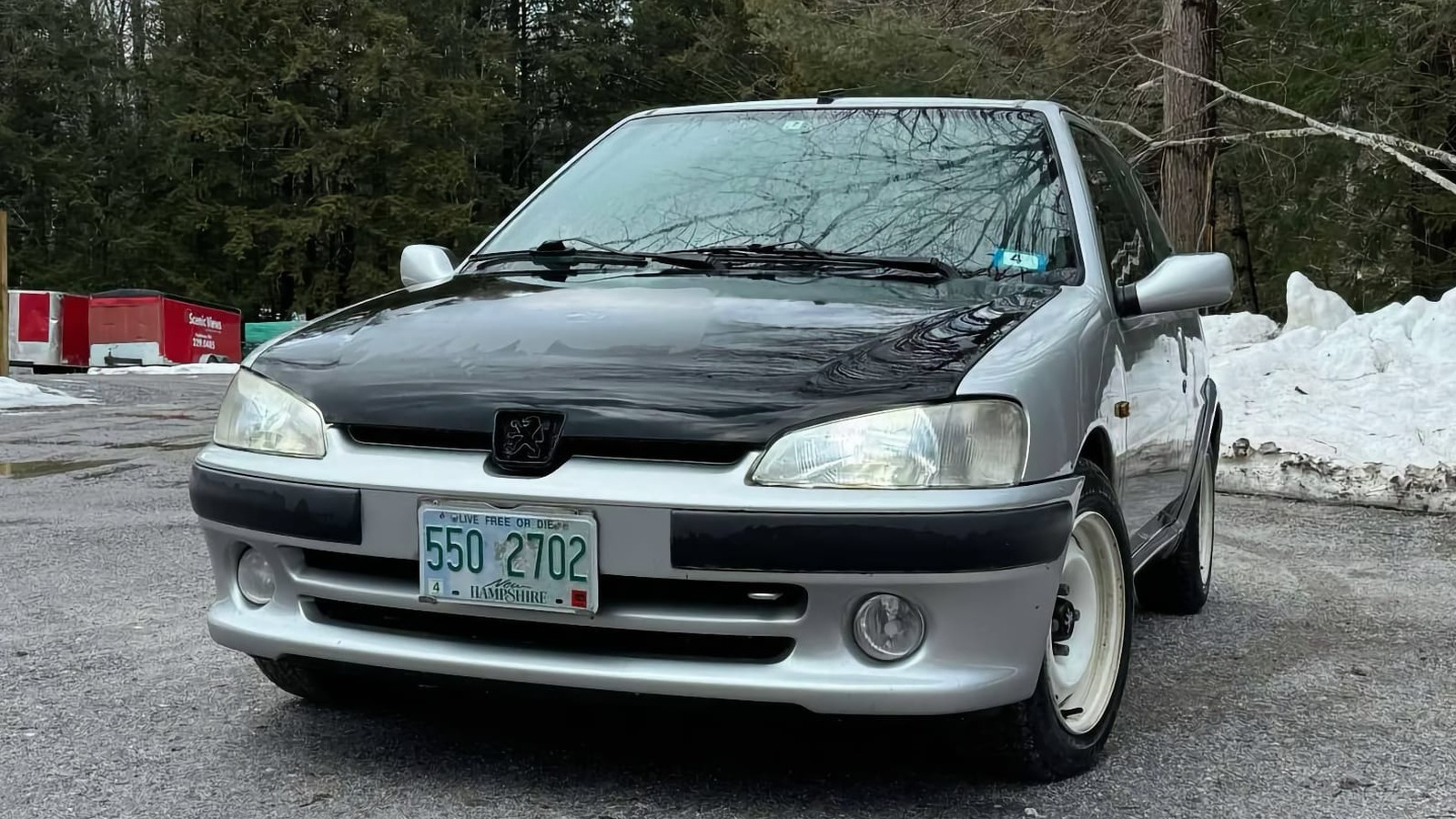
Discover the Allure of the 1998 Peugeot 106 Rallye: A French Classic Worth Your...

Reviving the Classics: Mignatta Rina Unveils a V8 Speedster Tribute to 1960s Italian Racing
 Italian company's new carbonfibre-bodied speedster harks back to nation's classic racers
Italian company Automobili Mignatta (AM) has unveiled the Rina, a V8-powered tribute to the nation's sports cars from the 1960s.
It is a speedster based around a carbonfibre monocoque, with curved haunches and a long bonnet headlining a design that echoes contemporary race cars from the likes of Alfa Romeo, Ferrari and Maserati.
Its cockpit is devoid of any digital displays – described by AM as "superfluous" – and is designed instead to immerse the occupants in their drive. The rev counter, oil and temperature dials are placed front and centre of the driver, for example, while the speedometer is offset, placed high on a carbonfibre spine that splits the interior into two halves.
In a further hint at the car's sporting intent, each doorcard features a storage slot for a helmet, in similar fashion to the Lancia Stratos.
Under the bonnet lies a naturally aspirated 5.0-litre V8. AM has yet to confirm a supplier, but several of the unit’s specifications – four valves per cylinder, four camshafts and a 92.7mm stroke – suggest it is a derivative of the Ford Mustang’s Coyote engine.
This has been breathed on by engineering firm Italtechnica, which was previously responsible for the Kimera Evo37’s 2.1-litre four-pot engine. The changes, AM said, are focused on maximising air intake and reducing weight.
It has yet to disclose power and torque figures but said the car has a power-to-weight ratio “close to 2 [kg per bhp]” and a weight of around a tonne, suggesting an output close to 500bhp.
This is sent to the rear wheels via a six-speed manual gearbox and a limited-slip differential.
AM said it will build around 30 examples of the Rina annually at its base in Piedmont, northern Italy. Each will be offered with extensive customisation and presumably at great cost, although the company has yet to announce a price.