Reviving a Classic: The Versatile New Renault 4 Electric Crossover
 The R4 is back after a 30-year hiatus as a no-nonsense and practical electric crossover Renault reckons the new Renault 4 is a thorough reinvention that retains all the versatility of the old model. And in some respects the french manufacturer is right. This new car is versatile. It’s longer than the new Renault 5 it shares a platform with and has more occupant room. Boot space - at 420 litres - is 100 litres larger than that car and it’s larger than most of its rivals too, plus it has an underfloor compartment for the cables. Good bit of ground clearance too.Yet. In some respects, this new R4 is a world away from the old model in terms of versatility. The old R4 sold more than 8 million units, was made in 18 countries and earned the nickname of ‘blue jeans car’ because of its ubiquitousness.It is a car that gave a good deal of the world personal mobility, much like the Mini or Fiat 500. It is a car with a simple range of robust four-cylinders that can survive 30,000 miles without a service and easily nudge past the 500,000-mile mark. If you go to North Africa it is still one of the most common cars on the road.Whereas the new car will only be built in France - with a lot of its parts also being assembled there too. And while there are plans to sell in Europe, South America and Japan the lack of electric infrastructure hinders its sales elsewhere in the world. So it’s pretty different from the original.
Revving Through the 80s: Discover the Ultimate Car Lineup of the Decade

Rediscovering the Charm of the First-Gen BMW Mini: A Collector’s Dream
 Now is finally the time to pull the trigger on the first generation of BMW Mini
R50. Y-reg. Preferably with a plate ending in ‘OBL’. Eh? To decode, the R50 is the codename of the original BMW Mini, co-developed with Rover.
Y-reg is a car from 2001. And if its registration number ends with ‘OBL’, then it was very likely owned by BMW and used as a demonstrator, a press car or a promotional vehicle.
In classic car collecting circles that gives it provenance, even if it means that this Mini may well carry some of early bugs exorcised in later models, such as front seat backrest mechanisms that fight back, a rattling accompaniment to your journey and, as the cars age, oil leaks too.
But there are some desirable items too, just as there were with the original Mini. The early, 1959-built examples of these are coveted as much for their age as an assortment of features soon modified in production, such as the addition of drain holes in the roof gutter, two-piece road wheels welded rather than riveted together and hubcaps with differently shaped ventilation cut-outs.
Those who revel in such pedantic details (who, me?) will be delighted to hear that there are similarly arcane variations peculiar only to the very earliest of R50s too. One is the longitudinal indentations moulded into the seats, a design flourish soon considered unnecessary.
Another is the embossing of the pedals with an ‘M’. The upshot is that there is now a register for these Y-registration Minis, and a website detailing the differences is apparently on the way too. I won’t be looking at that, of course.
Now you may be healthily unbothered by such collectors’ trivia, and simply like the idea of an early new-generation Mini. And why not? These cheerfully individual cars can now be had for under £1000 with an MoT, although they will likely have covered six-figure distances.
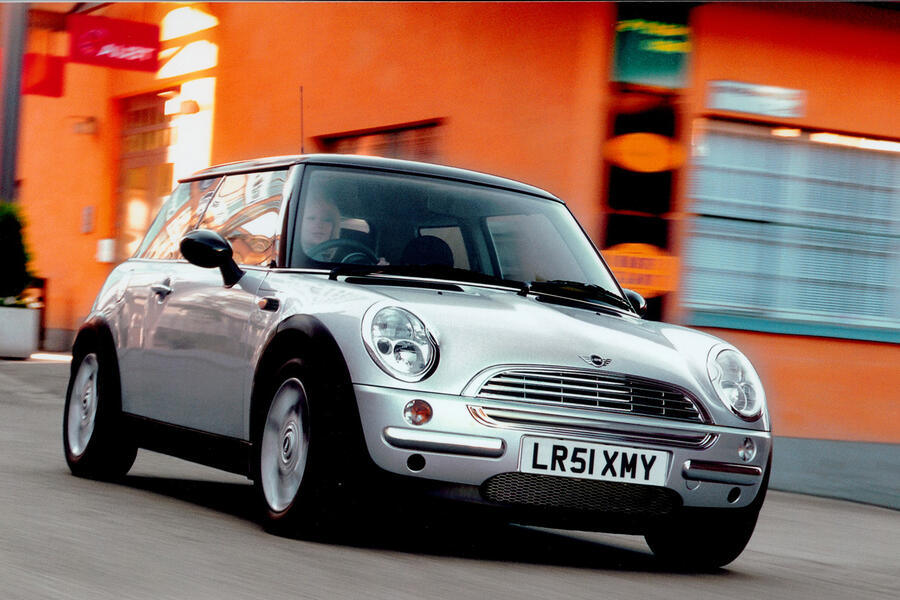
But they seem to be pretty durable too, making a 100k-plus odometer reading something to be less fearful of than it once was. That said, noisy gearboxes are a potentially expensive hazard. One reason why these Minis wear well is that they are not your average supermini. This was the first premium supermini (Lancia’s Ypsilon is a city car, in case you’re about to finger-punch a keyboard), and the quality ran more than skin-deep.
Although BMW’s 2000 sale of Rover prompted a Viking-expunging rewrite of corporate history, development of the R50 Mini was largely a Rover-led project, to a BMW brief and with full-fat BMW funding. That allowed quality to penetrate to the core, from the super-stiff bodyshell to suspension that included BMW’s advanced Z-axle.
The Chrysler-sourced Tritec engine was less impressive, but it’s gratifyingly tough. More obviously striking was an interior furnished to standards far higher than you’d find aboard a Ford Fiesta or Renault Clio. And in rather startling style, too. The dashboard was dominated by an enormous speedometer that didn’t so much pay homage to the original ’59 Mini as prostrate itself before its memory in spasms of self-flagellation.
There were many more references besides, from the shape of the interior light to the toggle switches to the flashing light at the tip of the indicator stalk. The exterior was still more recognisably Mini, even if this reimagined economy car had swollen substantially without offering a lot more space inside.
The floating roof, the wheel-at-each corner stance, the short overhangs, vertical taillights, big headlights and trapezoidal grille all referenced the original, as did the faux chrome bumperettes and the cutline of the expensive clamshell bonnet.
And its just-so proportions are only highlighted by the ant-eater nose of an overhang disfiguring the current version, fine drive though that car is. All these things, and all those Chili, Salt and Pepper option varieties, made the R50 Mini hugely desirable then, and make it so now. It’s a car so much more interesting than a used Vauxhall Corsa or Volkswagen Polo. Expect it to outlive them.
This column first appeared as an email to subscribers in 2017.

Ride the Dream: Own a Real MotoGP Race Bike Today


BTCC 2026 Calendar Unveiled: Key Dates Shifted for World Cup Excitement

BTCC will stage races over 10 weekends in 2026Britain's top motorsport championship keeps same events but dates get shuffled due to World Cup
Next year’s Kwik Fit British Touring Car Championship will retain the same 10 events next year but it will undergo a minor reshuffle because of football's FIFA World Cup.
The 2026 calendar for Britain’s leading motorsport championship has been revealed less than a week after the season-opening event for the 2025 season, held at Donington Park.
The Derbyshire circuit will again host the first round of the season in 2026, followed by trips to Brands Hatch and Snetterton.
The calendar will then undergo a minor shuffle, with the BTCC’s traditional summer break being brought forward from July to June. This is to account for UK television partner ITV4’s commitment to screening FIFA World Cup games during that period.
As a result, Oulton Park retains its traditional June date but becomes the fourth event of the season, with the visit to the high-speed Thruxton circuit moving to late July.
The Autocar-backed championship then visits Knockhill, the Donington Park Grand Prix circuit, Croft and Silverstone before again concluding on the Brands Hatch Grand Prix circuit on 10/11 October.
BTCC boss Alan Gow said: “It is a very busy summer in the sporting calendar, particularly with the football World Cup, which presents ITV with some clashing commitments. However, it also gave us an opportunity to make some tweaks to the schedule, which includes the shift in dates to the likes of Thruxton and Croft.
“Once again, releasing the calendar to our teams, support races, stakeholders and the public this early is advantageous for all in forward-planning, whilst it also benefits the rest of the motorsport pyramid in the UK as they can also schedule their events with these dates in mind.”
2026 British Touring Car Championship calendar
18-19 April Donington Park National
9-10 May Brands Hatch Indy
23-24 May Snetterton
6-7 June Oulton Park
25-26 July Thruxton
8-9 August Knockhill
22-23 August Donington Park Grand Prix
5-6 September Croft
26-27 September Silverstone
10/11 October Brands Hatch Grand Prix
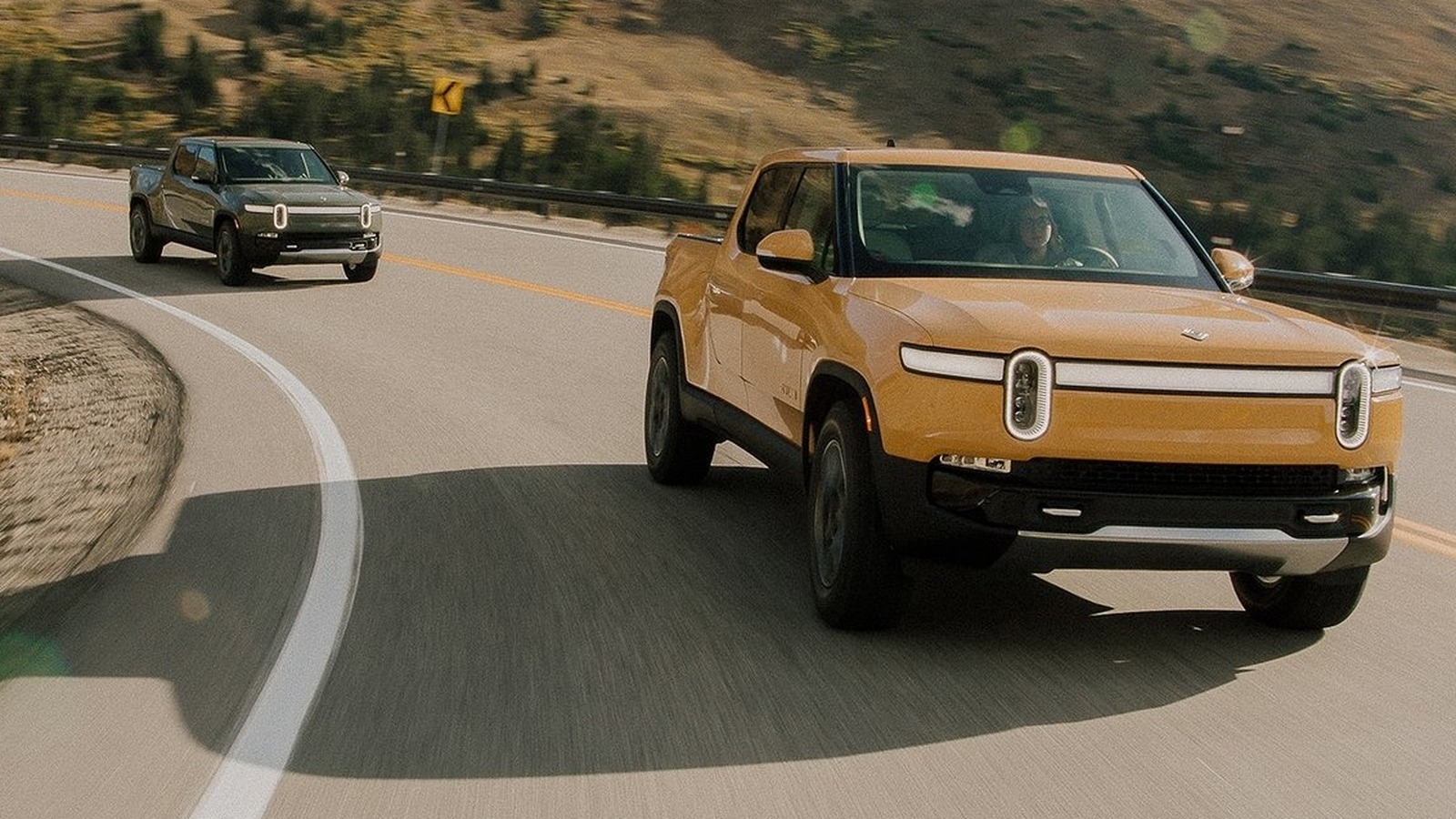
Rivian’s Smart Move: Stockpiling Batteries Amid Rising Auto Prices

Lotus Emira Clark Edition: A Tribute to Racing Legend Jim Clark’s Legacy
 New £115k variant of V6 sports car commemorates 60 years since Jim Clark’s final Formula 1 world title
The Lotus Emira Clark Edition has been revealed as a celebration of legendary racing driver Jim Clark.
Based on the range-topping Emira V6, it features the ‘Clark Racing Green’ and yellow-striped livery used by the Scotsman’s race cars in his famed 1965 season, when he won the Formula 1 World Championship and the Indy 500, as well as other global series.
The exhaust pipes are painted in the same yellow, referencing the design that was applied to the Lotus 38 in which he won at Indianapolis.
Inside, the Clark Edition Emira gets two-tone black and bright-red upholstery, with the latter shade applied only to the driver’s side of the cabin, in reference to the interiors of Lotus’s historic race cars.
A piece of the Clark family tartan (from Lochcarron of Scotland) can be found in a commemorative plaque in the seat’s headrest.
The metal gearknob found in the regular Emira has also been replaced by a wooden item.
Meanwhile, the sill treadplates are now carbonfibre items that reference the car’s position in the production run of 60 Clark Editions – a number chosen to reflect how many years have passed since that 1965 season.
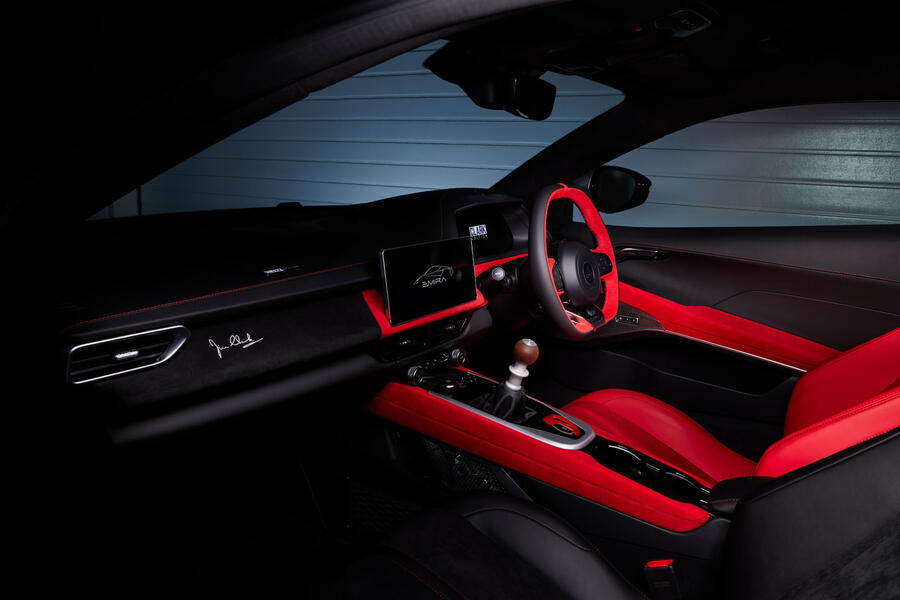
The Clark Edition is mechanically unchanged from a regular Emira V6, so its 3.5-litre supercharged powerplant sends 399bhp to the rear wheels via a six-speed manual gearbox and a limited-slip differential. The special edition is also fitted with the Lotus Driver’s Pack, which is optional on the regular Emira and brings firmer sports suspension, switchable exhaust and a Track driving mode.
Prices start at £115,000.
Clark’s 1965 season is considered among the greatest ever individual seasons for a driver, having also won titles in the Tasman Series and British and French Formula 2 championships, and overall wins at Brands Hatch and Oulton park in the British Saloon Car Championship (forerunner to today’s BTCC). The Scotsman was killed three years later in a crash at Germany's Hockenheimring and is remembered as a sporting legend.
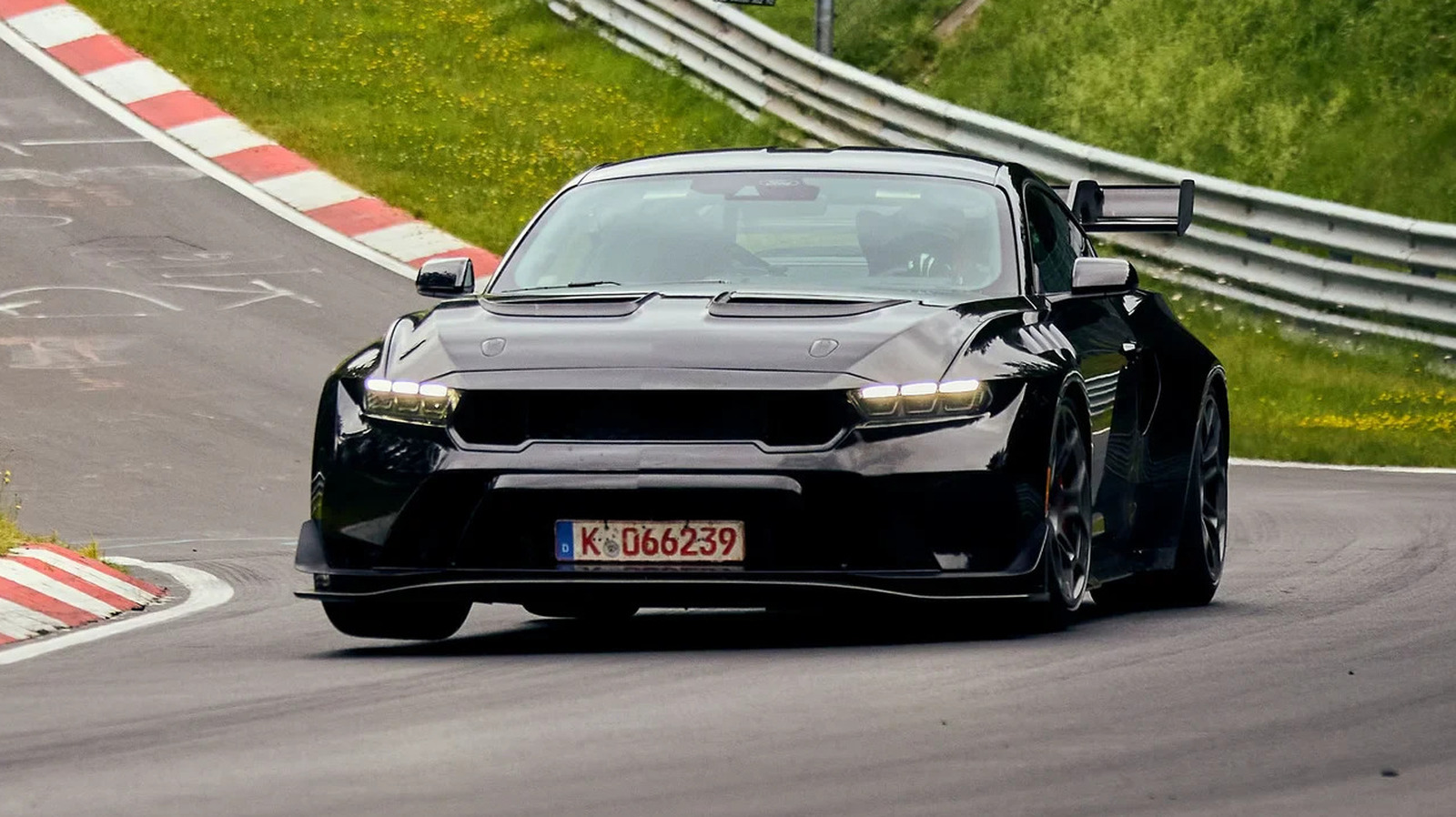
Mustang GTD Shatters Nürburgring Record with Unmatched Speed

Revitalized Adventure: Discover the 2024 Land Rover Discovery Sport’s Upgrades and Innovations
 Land Rover's old stager has been given a refresh with new technology and revised styling Launched at the end of 2019, the second-generation Land Rover Discovery Sport brought significant changes to what was already a successful package, and helped to bolster the baby Disco’s position in the family SUV segment. The second-gen car brought with it a revised platform that would later allow for the introduction of the P300e plug-in hybrid variant, a much reduced weight and a fleet of new engines with 48V mild-hybrid assistance for better fuel economy and reduced emissions. It also gained JLR’s Pivi Pro infotainment system alongside some extra safety features to bring it right up to date with the freshest rivals on sale. Even since its original launch in late 2014, the Land Rover Discovery Sport has been a key player in the premium compact SUV segment, not least for its upmarket appeal but for its unrivalled off-road capability.Its commanding driving position, suite of go-anywhere modes and Discovery aesthetic means it certainly inspires confidence, and has the character of a bigger, more capable car. For 2024, the Discovery Sport has received another update, with the new version sporting a slightly tweaked exterior design, new interior technology and revised engine line-up.
Embracing the Quirky Charm of the Fiat 500L: A Standout Choice for Fun and...