

Leapmotor C10 Revamped: Enhanced Power and Range for the Future of EVs

Leapmotor C10 currently offers 263 miles of range and 84kW chargingChinese EV brand’s Skoda Enyaq rival is updated in its home market, bringing 800V electricals
The Leapmotor C10 has been updated in China, gaining more range, extra power and an upgraded infotainment system.
Chief among the updates is a switch from 400V electricals to a more powerful 800V system.
Leapmotor has yet to confirm specifics, but this should bring a significant increase in the car’s maximum charging speed – currently capped at 84kW, behind the 100kW or greater offered by many rivals.
Meanwhile, it has uprated the rear-mounted electric motor from 215bhp to 295bhp, cutting its 0-62mph sprint time from 7.5sec to 5.9sec.
The reworked C10 also gets a new LFP battery pack with 5kWh more capacity (74.9kWh total), boosting its range from 329 miles to 376 on the Chinese CLTC test cycle.
Leapmotor has yet to publish figures for the new C10’s performance from Europe’s WLTP range test, but given that it currently stands at 261 miles, the new C10 is expected to nudge the 300-mile mark.
The range-extender EV powertrain of the C10 REEV is unchanged, according to Chinese media reports.
Both versions’ infotainment systems now run on a more powerful Qualcomm Snapdragon 8295P processor and their arrays of ADAS sensors now include a lidar.
The C10's design remains the same as before, but the fully electric car can be had in a new purple paint colour.
Leapmotor has yet to announce when the revised C10 will land in British showrooms, but it comes as the Stellantis-backed brand positions itself for rapid global expansion.
Having already launched the C10, C10 REEV and T03 city car, it will soon follow that with the B10 crossover, a Volkswagen Golf-sized hatchback named the B05 and a Renault 4 rival named the A10.
That will be joined with an entry-level model – possibly priced below £20,000 – dubbed A05.

Tesla Leadership Rumors and the Struggles of American Automakers Amid Tariff Challenges


Affordable Electric Cars: Discover the Top 10 Budget-Friendly EVs in the UK
 Cost-effective EVs are rare but growing in number. Here are the 10 cheapest on sale in the UK today
For years, the barrier to electric car entry for many drivers has been their high list prices, but it's fair to say that EV prices are becoming more accessible than ever in 2025.
Cheaper options are becoming more commonplace. Prices are gradually lowering to a point where the cheapest electric cars on sale today are now priced as low as some of the most affordable internal combustion models.
Several models on the market don't require a luxury-sized wallet, with brands including Dacia, Citroën and Renault all introducing entry-level, affordable EVs over the last couple of years.
Some electric cars dropped below £30,000 a few years ago (which is still pretty expensive), but prices are improving further. Some new options cost under £25,000, and a few are below £20,000.
Today, the cheapest electric 'car' in the UK is the Citroën Ami, priced at £7695. We say 'car' in inverted commas here because it's not quite a car - it's a quadricycle. The cheapest full-size electric car is the Dacia Spring, at £16,995.
But which other EVs fall into the top ten of the cheapest on sale today? Read our continuously updated list here. If you're keen on electric cars but want a bit more information before taking the plunge, head to our best cheap electric cars article.

Navigating the Chaos: Auto Tariffs and the Uncertain Future of EVs


SUVs and Pick-Ups: The Hidden Dangers to Pedestrians Revealed
 High-riding vehicles increase the risk of fatal injury by 44% for adults and 130% for young children
Pedestrians hit by SUVs and pick-ups are significantly more likely to be killed than those hit by lower-riding hatchbacks and saloons, according to a new study.
Conducted by Imperial College London and the London School of Hygiene and Tropical Medicine, the review compared data from collisions involving SUVs and ‘light trucks’ (pick-ups and small vans) with those involving saloons and hatchbacks.
Its analysis of 682,509 collisions found that the risk of an adult pedestrian dying in a collision is 44% higher when they are hit by an SUV or light truck compared with a regular passenger car. For a child aged 0-9, that risk increases to 130% higher.
The study estimates that 17% of adult pedestrian and cyclist fatalities could be avoided if drivers swapped their SUVs for lower-riding cars instead. That translates to 620 lives per year, it said.
However, it should be noted that the study primarily focuses on collisions in the US, where vehicles are typically larger and heavier than in Europe. Four-fifths of the study’s comparisons between crashes involving SUVs and regular passenger cars were from America.
European data is also influenced by the lower proportion of SUVs driven, compared with the US. As such, the study estimates that 8% of adult pedestrian and cyclist fatalities in Europe could be avoided by switching to traditional passenger cars.
Despite the findings, the report cautions against a blanket ban on ‘SUVs’, noting there is no universally accepted or legal definition of what constitutes an SUV.
It instead urges action against the biggest risk factor: the high beltlines and blunt front ends that are typical of SUVs and pick-ups.
“The key mechanism underlying this increased risk appears to be the taller and blunter profile of the front end of SUVs and [light trucks],” the study states.
“This means that the victim is initially struck higher up on their body (eg, the pelvis not the legs for an adult, or the thorax not the pelvis for a child).
“It further means that the victim is more likely to be thrown forward into the road, rather than carried on the vehicle’s hood [bonnet].
“These and other crash dynamics are associated with a higher proportion of upper body injuries (including to the head, thorax and abdomen) and with a more serious injury profile.”
Indeed, according to a 2024 study published in journal Economics of Transportation, a 10cm increase in a car's front-end height increases the risk of pedestrian fatality by 22%.

Embrace the Fun: The Buggy Version of the Ami Goes Mainstream


Revolutionary Battery Tech Halves Charging Times for Renault Megane EV
 New battery tech has improved Megane EV’s range and charging times
Total Energies Lubrifiants, the lubricants arm of French energy giant Total, has fitted a Renault Megane E-Tech with an immersion-cooled battery that uses a new fluid called Cell Shield – and is claimed to have halved the EV’s charging times and extended its range by 6%.
Immersion cooling is a conveniently obvious term: reducing the temperature of something by putting it into a fluid.
But where electrical components are concerned, that’s not as simple as it sounds, as introducing water-based fluid to the circuitry of any electrical device causes a short circuit and instant destruction. This is why EV batteries are waterproof.
In a combustion engine, heat is conducted through the walls of the cylinders and combustion chambers into water flowing through channels. That water passes through the radiator (a heat exchanger) and is taken away by cool air passing through it.
It’s a form of immersion cooling in that heat is transferred directly from the hot metal of the engine to the water in the cooling system.
In electronics, heat is either transferred directly to the air or, with components that get very hot, such as a computer processor chip or EV battery cell, transferred to a heat sink that in turn is cooled by either air or a liquid.
Both are effective methods, but immersing the hot component in a cooling fluid is more so.
A special fluid is needed, however. In electronics, a dielectric fluid is one that doesn’t conduct electricity. This isn’t a new concept, having been used in power distribution equipment like transformers for many years, mainly as a special type of electrical insulator.
EV battery cells are usually mounted on a heat sink through which coolant flows but doesn’t actually come into contact with the cells. Submersing them fully or partially in a dielectric fluid is more effective, because it conducts heat away directly from the cells into the fluid.
The complexities lie in developing the right fluid to flow through the cells. Weight is also a consideration, although immersion cooling means other components that carry fluid in liquid-cooled batteries can be ditched.
Total’s Megane battery is the result of several years of work on immersion cooling technology. It hired British engineering firm Ricardo to develop a prototype of such a battery for a Volvo XC60 plug-in hybrid in late 2020.
Apart from superior cooling and faster charge times, Ricardo concluded that immersion-cooled batteries would fit in existing vehicle architectures, cost 6% less and be lighter.
One more important factor is further improved safety. Promisingly, testing has proved Total’s new fluid is “unprecedentedly” good at suppressing thermal runaway and internal fire.
Taxing Electric Vehicles: A Culture War Disguised as Policy

Navy’s $60 Million Jet Takes an Unexpected Dive from Aircraft Carrier

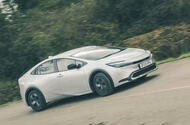
Reviving the Icon: The All-New Toyota Prius Hits UK Streets with Power and Style
 The Prius we were told we couldn't have goes on UK sale after all – and it's good It seemed odd, perhaps even a little bit cruel, when the Toyota Prius was nixed from from its maker's UK line-up just as the model, after decades in existence, was hitting its stride in respect to capability and desirability.Strange timing indeed, even if sales had been cannibalised by the C-HR crossover, to the extent that the Prius was finding only 600 or so buyers annually.That was back in 2022, and the following year Toyota reversed its decision. Result: the fifth generation of the world’s most famous hybrid is now available over here, and anybody who hasn’t been paying attention might need a moment to adjust to its presence.For one thing, the exterior design is now striking enough to turn heads as its glides down city streets – something the outgoing model does too, but only because Uber users are straining to make out the registration plate (with so many Priuses around, it’s the only way to work out if that particular silver Prius is yours).Also, power. In the UK the Prius will be available only in PHEV form, and while the previous generation could also be had with a plug, total output was a modest 120bhp, whereas the new car makes fully 220bhp, which should give it a resolutely un-Prius-like turn of pace, should you boot it.Combine those elements with an official electric range topping 50 miles and chassis modifications that ought to make the Prius a more comfortable and neater-handling prospect than ever before, and you have, on paper, a recipe for success.What we will now learn is how good Toyota has been in the execution.