
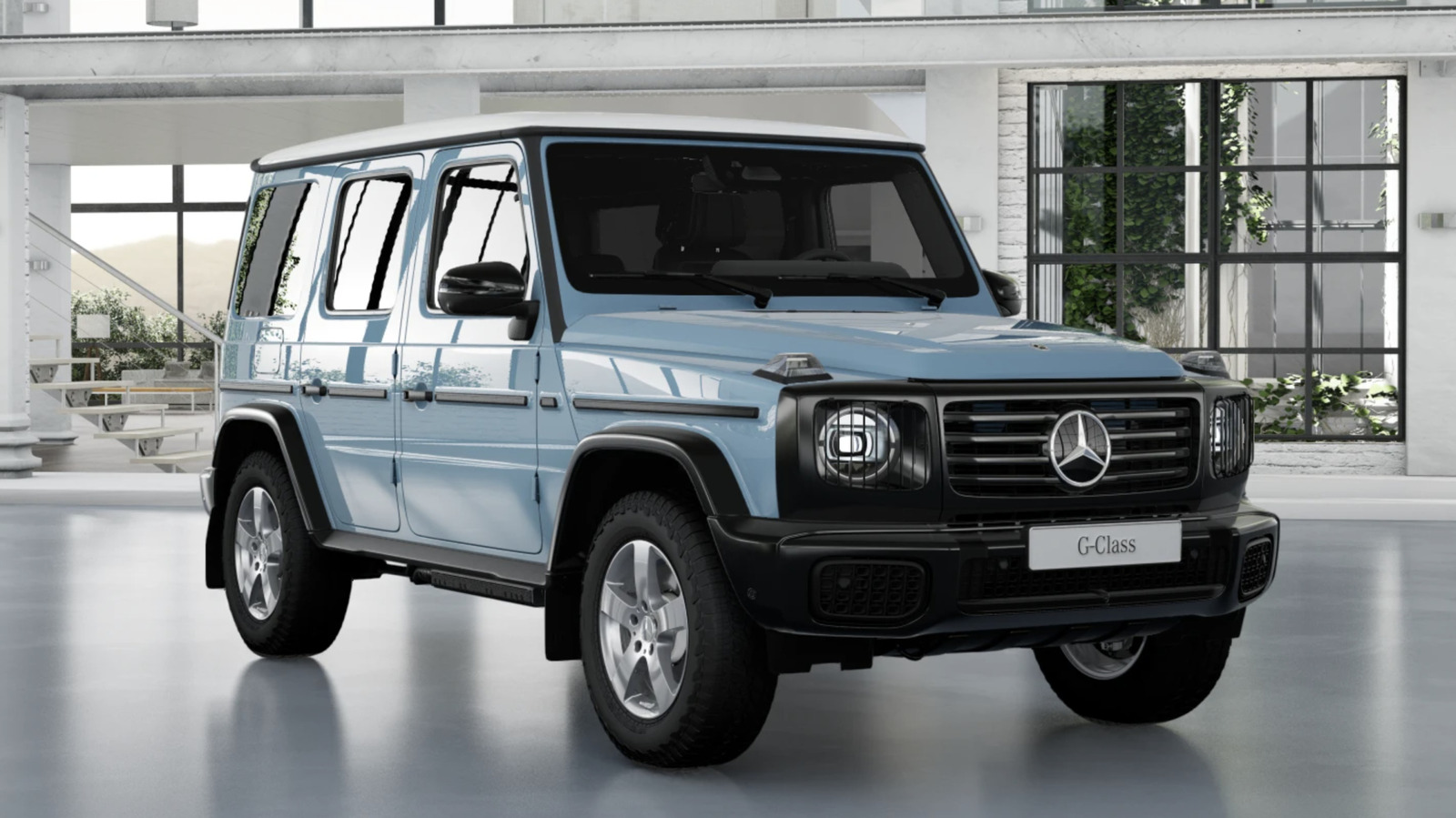
Mercedes G-Class Unveils Retro Styling and Expanded Customization Choices

Epic Road Trip Review How the Audi Q7 Plug In Hybrid Redefines Long Distance...
 We put Audi’s largest SUV through its paces on an epic journey from London to Ingolstadt
What makes the perfect long-distance cruiser? It’s a title that many cars could justifiably stake a claim to. After all, the art of effortlessly covering mile after mile requires just a handful of core qualities – ones that many modern cars offer.
So what are they? Well, plenty of space is a given. Comfort? That’s a non-negotiable. Smart in-car tech? Essential. And everything hinges on the right powertrain – one that blends performance, smoothness and efficiency.
But there’s one more secret ingredient that every truly exceptional continent-crusher needs: the ability for its passengers to arrive at their destination feeling as fresh and relaxed as the moment they left.
So the question is, which car brings all of these disparate traits together into one peerless package? If you ask us, that would be the Audi Q7 TFSI e plug-in hybrid.
Why the confidence? Because earlier in the year we put it to the ultimate long-distance test – driving more than 700 miles from Autocar’s west London HQ all the way to Audi’s hometown of Ingolstadt. Here’s how the Q7 proved its mettle.
Enough room to swing a camera
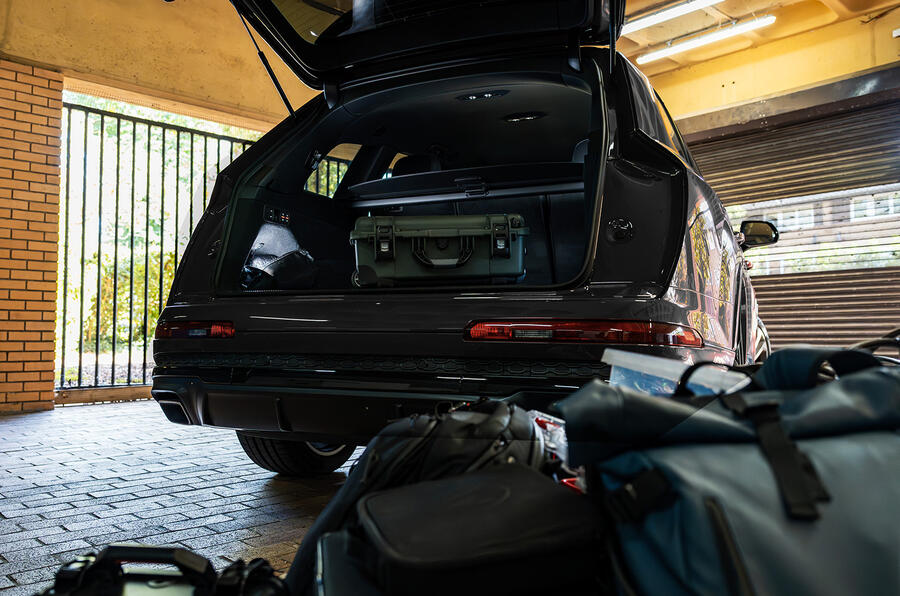
It’s just past 6:30am as we stand round the back of Autocar HQ on this foggy February morning, staring down at a gargantuan pile of bulky, expensive camera and lighting gear.
We – myself, a videographer, and a project manager – share an apprehensive look before flicking our eyes between the pile of stuff and the boot of the Audi Q7 TFSI e plug-in hybrid that will act as our road-trip companion for the next 12 hours. There’s no way this is all going in…
We’re just about to embark on a mega five-country drive to Audi’s headquarters in Ingolstadt to interview some of the brand’s top designers and engineers about the true meaning of Vorsprung durch Technik (which you can read about here), hence the filming gear.
With a sense of trepidation, we begin loading, and almost immediately realise our worries about cargo space – or lack of it – were totally unfounded.
With 563 litres of load room – plus a handy 40:20:40 split-rear ski-hatch to accommodate our tripods and longer kit – the gear slots in surprisingly easily. The flat load lip helps enormously, as does the effortless hands-free tailgate, ideal for the moments when all three of us walk back to the pile together; you can never be too careful these days…
Once packed, we all bundle into the car, and the first thing we notice is that the cabin is every bit as vast as the Q7’s enormous exterior dimensions would suggest. In the back, space is nothing short of palatial, with the three full-size rear seats offering an abundance of leg and head room thanks to sliding and reclining abilities.
And it’s the same story in the front, where our particularly elongated videographer (6ft 2in) gives an approving nod as he extends his legs and pushes back into the sumptuous Valcona leather passenger seat.
With everyone comfortable and everything packed, it’s time to hit the road.
First-class comfort
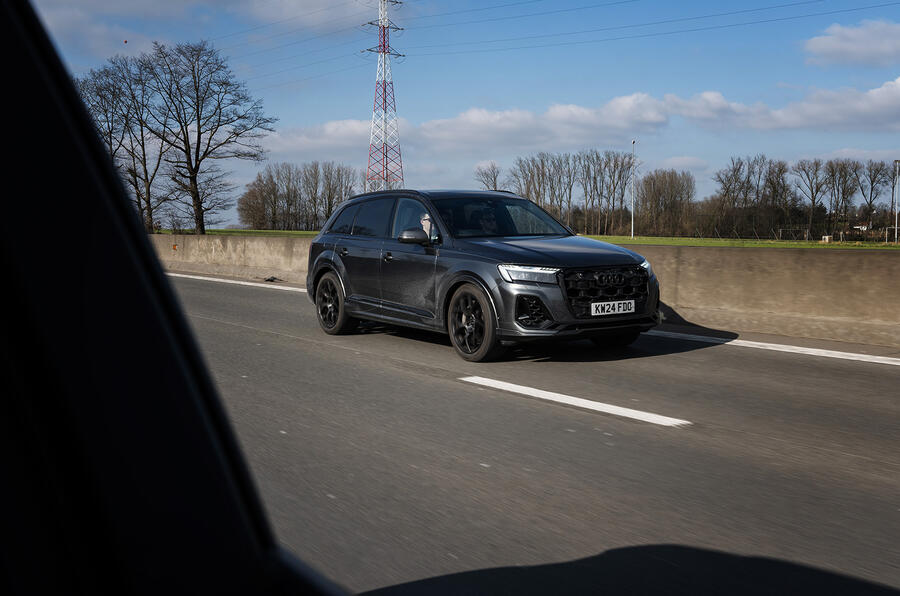
Like many people, I struggle to look at my phone for prolonged periods of time as a passenger, let alone type on a laptop. But in the back of the Q7, I’m finding it remarkably easy.
Part of that is unquestionably due to the earliness of our departure – the M25 isn’t its usual stop-start self this side of 7am – but I’m putting most of it down to the velvety ride afforded by the Q7’s brilliant optional Adaptive Air Suspension.
Those lucky enough to have experienced advanced air suspension set ups like this will attest to their utter brilliance.
Ruts, divots and cracks in the road that would usually send jarring tremors up through the chassis and into the cockpit are smoothed over as if not there at all. Even the notoriously rough concrete section of the M25 is absorbed without a hint of fuss.
So glossy is the ride – complemented beautifully by the near-sound-proof double glazing that transforms the interior of the Q7 into a cocoon of total tranquillity – that before we know it we're 85 miles into our journey and just a few minutes from Folkestone and the Eurotunnel.
After crawling through customs, we eventually slalom our way onto the narrow train, helpfully guided by the Q7’s parking sensors and 360-degree overhead-view camera – we won’t be leaving any paint on the carriage.
Quarter of an hour later we’re halfway to France and 246 feet under the Channel – giving us a bit of time to take a more detailed look around Q7’s lavish interior.
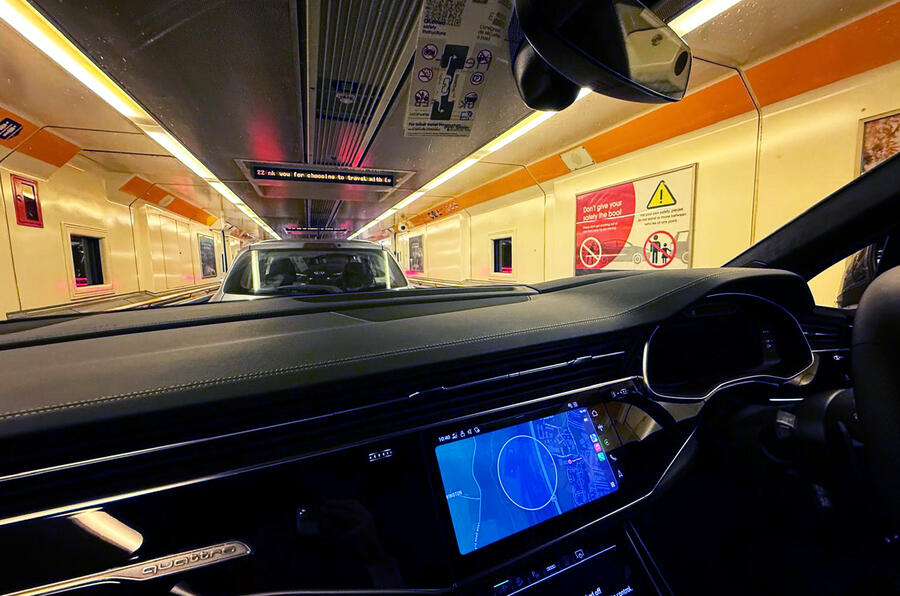
Up front, the modern, minimalist gloss-black dashboard and flashes of aluminium trim ooze opulence, while the LED ambient lighting (currently set to purple) sends a plush, soothing hue throughout the entire cabin.
In the middle of the dashboard sit two 10.1in touchscreens, stacked neatly one above the other. Both are slightly angled toward the driver for a sporty, cockpit-like feel. The upper display houses Audi’s advanced, always-online MMI infotainment system, while the lower screen manages the tri-zone climate control and heated seats. Both screens feature clever haptic feedback for a reassuring, tactile feel.
In the back, the dark headlining, tinted glass, window blinds and deep carpets combine for a truly lavish passenger experience. Le Shuttle doesn’t have a first-class carriage, but if it did, it would look like this.
There’s also plenty of charging ports dotted around to keep devices topped up, while an abundance of useful pockets and cubbies means there’s plenty of space for all our travel snacks – essential for a journey of this length.
After just 35 minutes, we emerge in Calais and continue our drive.
Clever in-car tech to whisk away the miles
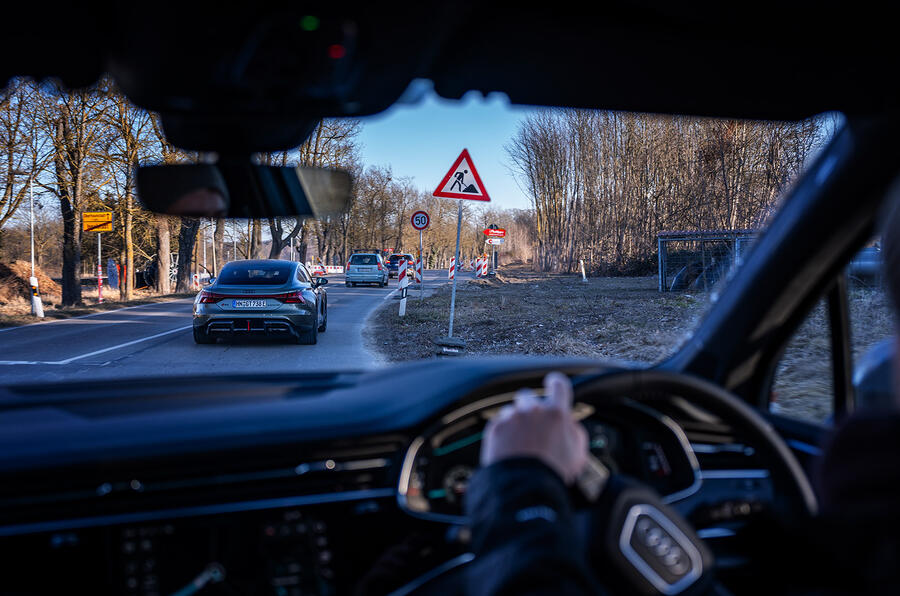
As the flat farmlands of northern France flash by in bursts of green and brown, we can’t help but be impressed by the Q7’s sense of effortless pace. There’s a real purpose to the way it covers miles – it wants to get to the destination just as much as you do.
But, alas, progress is short lived as we soon encounter heavy traffic around Brussels. However, this acts as another crucial test of the Q7’s capabilities. No long-distance drive is ever without congestion, so being able to deal with it well is a must.
Up until this point of the journey, we’ve had the Q7 in ‘Auto’ driving mode, which means the live navigation system has worked with clever predictive sensors to seamlessly blend the electric motor and 3.0-litre V6 petrol engine for maximum efficiency.
But now, as we slow right down, the system switches to full EV mode, which means despite the stunted stop-start traffic, progress is silky smooth and whisper quiet – and it also means we’re saving on fuel.
The Q7’s 26kWh battery offers up to 52 miles of electric-only range* when fully charged – one of the best in class, and topping up from a 7.4kW wallbox takes as little as 3 hours and 45 minutes.
Or, as we’ve been doing on this trip, clever regenerative braking and energy recapture during coasting can pump power back into the battery for later use.
Twenty minutes later we break free of the traffic, and after a whistle stop tour of Belgium and a short flash through the southern tip of the Netherlands, the signs finally switch to German.
Now by this point, almost eight hours into our 12-hour drive, it would be easy for the endless motorway miles and fairly monotone landscape to become tiring for both driver and passengers – but that’s where the Q7 reveals another long-haul strength: its ability to keep you fresh and focused, mile after mile.
As standard, the Q7 comes with a wealth of advanced driver assistance systems that take the sting out of long journeys like this. In our top-rung Vorsprung-spec car, for example, adaptive cruise control keeps you a safe distance from the car ahead at all times, and can even bring the car to a complete stop in traffic, while lane assist will stop you from wandering off course, and traffic sign recognition means you’re never in danger of creeping over the speed limit – particularly useful in continental Europe, where speed limits seem to randomly change every few miles.
And it’s not just safety tech that can keep you alert and attentive. Our Q7’s optional 19-speaker Bang & Olufsen sound system (currently blasting Little by Little by Oasis), is sonorous enough to command your full attention, while the large, high-definition 12.3in Audi Virtual Cockpit instrument cluster and optional head-up display puts vital driving information right in your line of sight, so you can keep your eyes firmly on the road.
With just under four hours to go, we pull into a service station to swap drivers one last time. My turn – and with autobahn country now all around us, it’s time to see what the Q7 can really do…
Continent-crushing performance
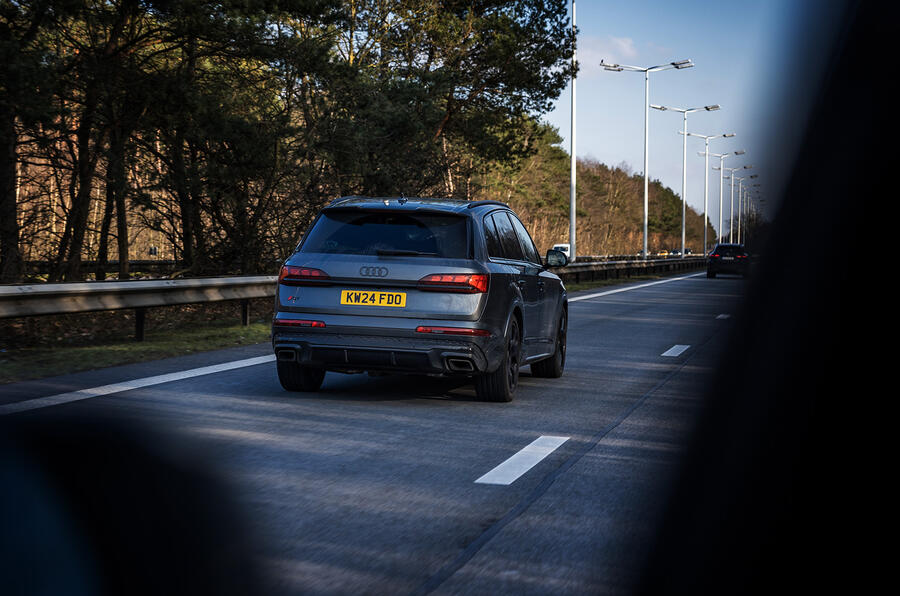
As we rejoin the carriageway and effortlessly cruise up to the speed limit, I take stock of my new surroundings. The driver’s seat, for starters, blends comfort and sportiness beautifully – the side bolsters hugging, but not restricting me.
And in my hands, the flat-bottomed three-spoke leather steering wheel feels fantastically ergonomic, with the small ‘S-line’ emblem at the bottom adding a nice dash of unique Audi flair.
Visibility is great, too. The high-rise seating position gives me a commanding view of the road ahead, while the big windows and large wing mirrors mean I have great all-round awareness. The Q7 is a large car, but it really doesn’t feel it on the road.
An hour or so later, we come across our first stretch of totally clear autobahn. As I flick the driving mode from ‘Auto’ to ‘Dynamic’, we feel the air suspension stiffen and the whole car hunker down. As we pass the derestricted sign, I accelerate hard and the Q7’s 3.0-litre V6 roars into life, the car surging forward with breathtaking urgency.
With 394PS and 600Nm of torque on tap – and confidence-inspiring quattro all-wheel drive to get it all down – the Q7 feels every bit as quick, if not quicker, than its 5.7-second 0-62mph time suggests.
Within just a few moments, we begin to see cars in the distance and slacken off, all mesmerised by the sheer viscerality of what we’d just experienced. The car that has ferried us comfortably, efficiently, near-silently for the last 11 hours had, at the touch of a button, transformed into an entirely different beast – one that truly belies its size and weight.
After a few more stabs at the loud pedal (just to make sure we didn’t imagine it the first time…), Ingolstadt soon hoves into view. We cruise into the city, gently carving our way through the suburban streets before coming to rest at a red light and collectively taking a moment to reflect on our journey.
Five countries. Twelve hours. More than 700 miles. And not once did the Audi Q7 TFSI e put a foot wrong. Comfortable, clever, cavernous – and unexpectedly rapid when it counts – it’s the kind of car that turns the grind of long-distance travel into something genuinely enjoyable.
But more than that, it did what only the very best can: it made the miles disappear. The greatest compliment we can give? We’d happily do it all again tomorrow.
*Range dependent on trim and optional equipment. All vehicles are tested according to WLTP technical procedures. Figures shown are official test values for comparability purposes; only compare fuel consumption, CO2 and electric range figures with other vehicles tested to the same technical procedures. These figures may not reflect real life driving results, which will depend upon a number of factors including but not limited to factory fitted options, accessories fitted (post-registration), variations in weather, road and traffic conditions, individual driving styles, vehicle load, vehicle condition, use of systems like climate control (and, for battery electric vehicles, the starting charge, age and conditions of the battery).
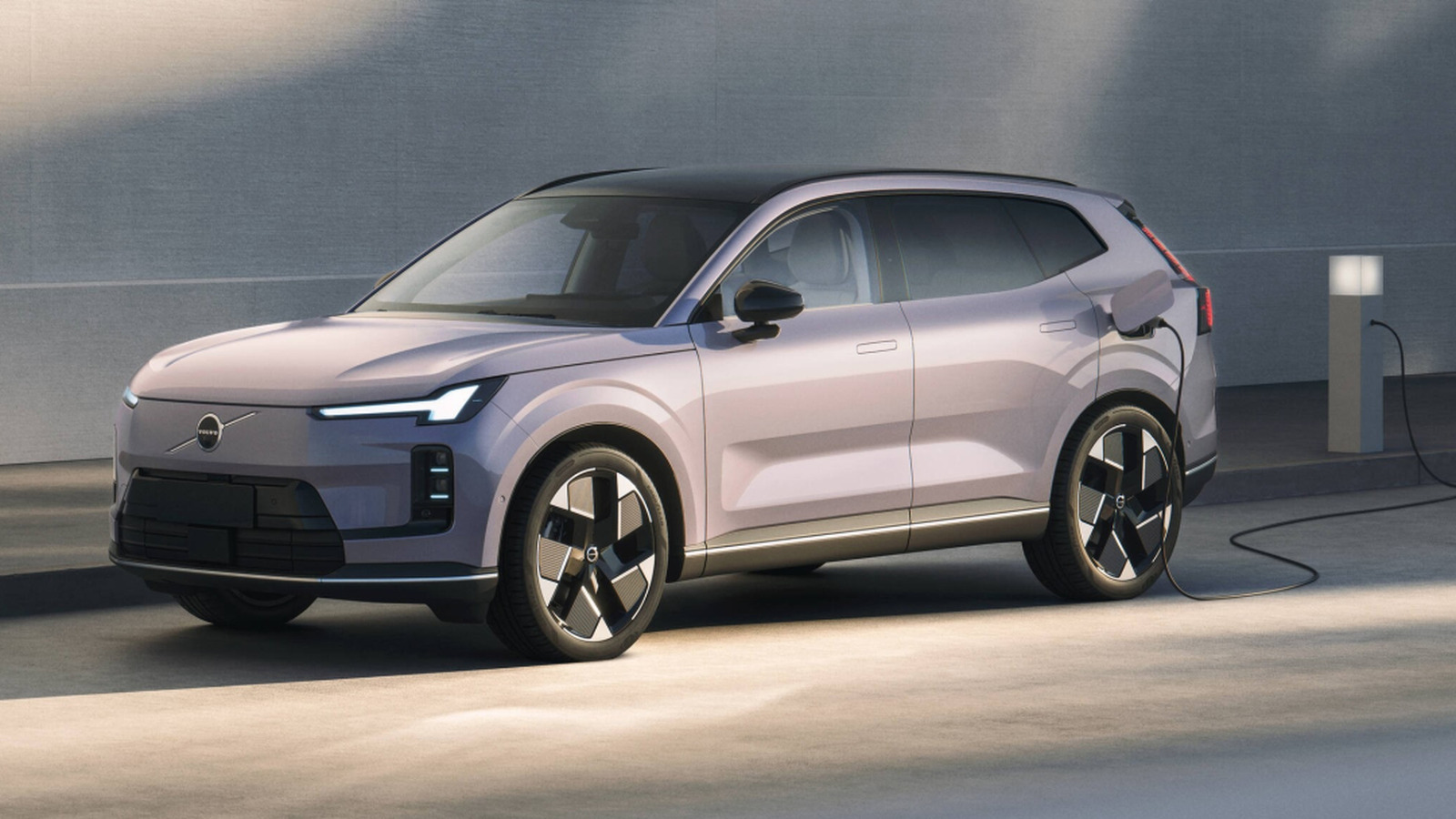
Volvo XC70 Unveiled as a Stylish Plug-In Hybrid SUV with Extended Range
Cupra Ateca Review Is This Trailblazing Performance SUV Still a Standout in a Crowded...
 The SUV that birthed Cupra as a stand-alone brand soldiers on against ever-developing competitors It all started here. In 2018, Seat announced that it was transforming its Cupra model line into a brand in its own right, creating exciting, youthful, sporty versions of Martorell’s family cars – and the Cupra Ateca was the guinea pig.It was guided by a compelling recipe: combine the engine, gearbox and driveline of hot Volkswagens with the fashionable, desirable added-convenience bodystyle of a crossover. It sounds like a winning recipe - and in practice it was mostly delivered.However, the Ateca is now one of the oldest cars you can buy new. Also consider the fact that its rivals include the BMW X1 M35i and Porsche Macan and you realise how hard it will have to work in order to win your favour.Still, with fresh styling touches brought about by a facelift and some upgraded interior technology, Cupra believes the Ateca still a worthy part of the family. Time, then, for us to find out if this era-defining warrior has lost its mojo.The Cupra Ateca range at a glanceFour trim levels are available: V1, V2, VZ2 and VZ3. All cars come generously equipped with a heated steering wheel, LED front and rear lights, a 9.2in infotainment touchscreen, an eight-speaker stereo system and Apple CarPlay and Android Auto. V2 trim grants you a rear-view camera, park assist, an electric bootlid and a wireless phone charger. VZ2 and VZ3 cars add sporting touches such as larger alloy wheels, performance brakes and the choice of four different drive modes.All engines available are petrols. V1 and V2 cars can be had with either a 1.5-litre turbo four with 148bhp and front-wheel drive; or 2.0-litre turbo four with 187bhp and four-wheel drive. VZ2 and VZ3 cars can only be had with a 296bhp version of the 2.0-litre unit.The Ateca features a seven-speed dual-clutch automatic (DSG) gearbox and a clutch-based electronically controlled four-wheel-drive system as standard. Suspension is by the same arrangements of MacPherson struts at the front and multiple links at the rear that four-wheel-drive versions of the regular Seat Ateca use, but the Cupra model gets stiffer suspension springs and anti-roll bars, uprated adaptive dampers, 19in alloy wheels and uprated brakes as standard.
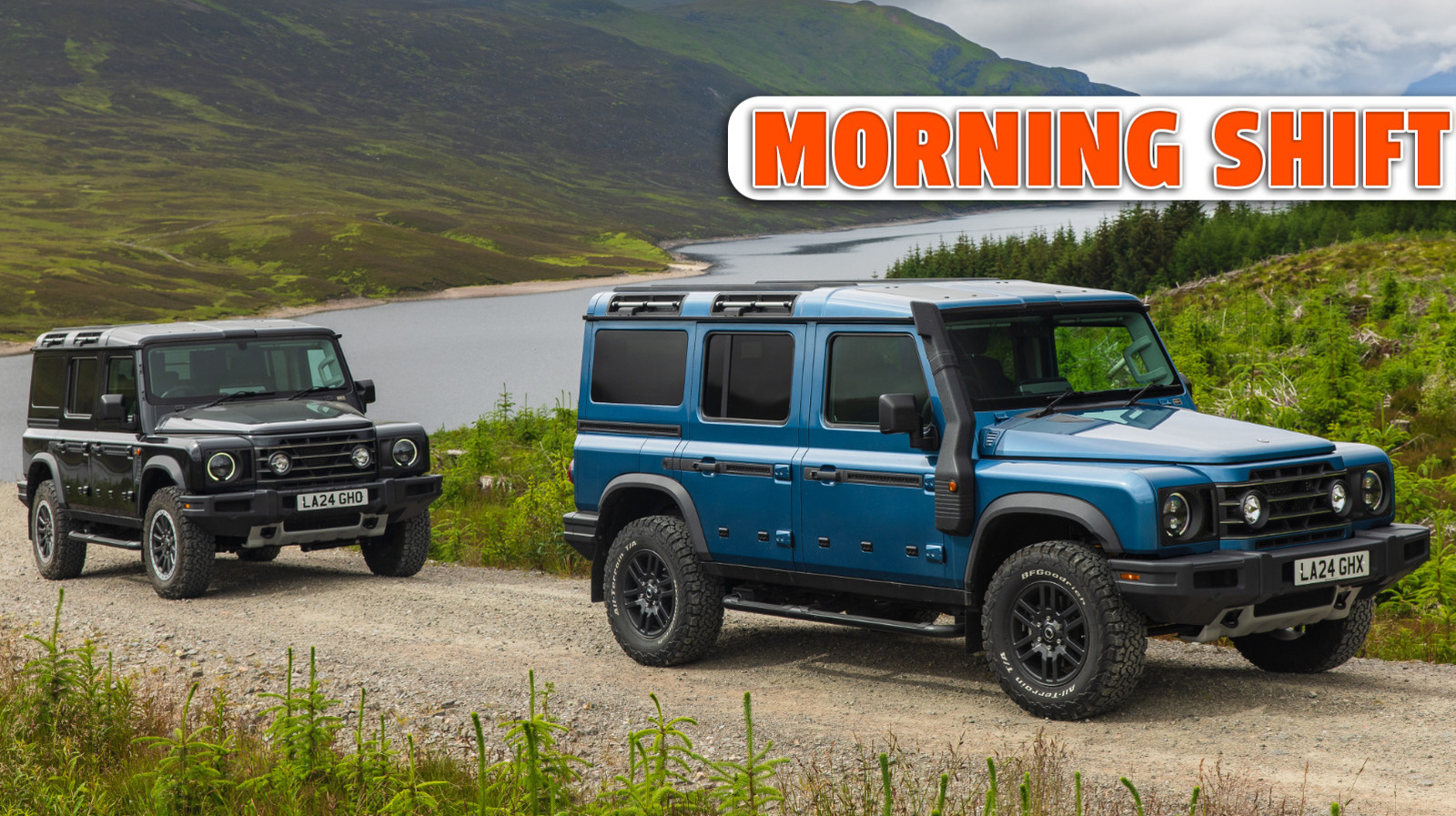
Ineos Slashes SUV Prices Amid Struggle to Attract Buyers

Inside the Record-Shattering Electric Saloon That Drove Around the World in Eight Days
 Mercedes hyper-saloon concept went 25,000 miles in less than eight days – then we climbed aboard
It’s 11:36 on a Monday, 25 August 2025. Not just any Monday but the one after Mercedes-AMG rewrote the electric car record books with its new GT XX concept.
Under leaden skies, the air at Nardò Technical Centre in Italy still hangs thick with the afterglow of automotive history in the making. Barely 12 hours have passed since the sunset-orange super-saloon lapped the high-speed banking for the 3177th time to bring up a total distance of 24,901 miles – the official circumference of the equator – in seven days, 13 hours, 24 minutes and seven seconds.
It’s a record that Mercedes-AMG CEO Michael Schiebe says was inspired by the Jules Verne novel Around The World In 80 Days. “Except we decided to shorten it to eight,” he tells me with a knowing grin, emotion still faintly creasing his voice.
This wasn’t a publicity exercise designed to generate short-term headlines. It was the most ambitious and, arguably, most meticulously planned electric car endurance record campaign ever attempted. In total, 26 world records were set.
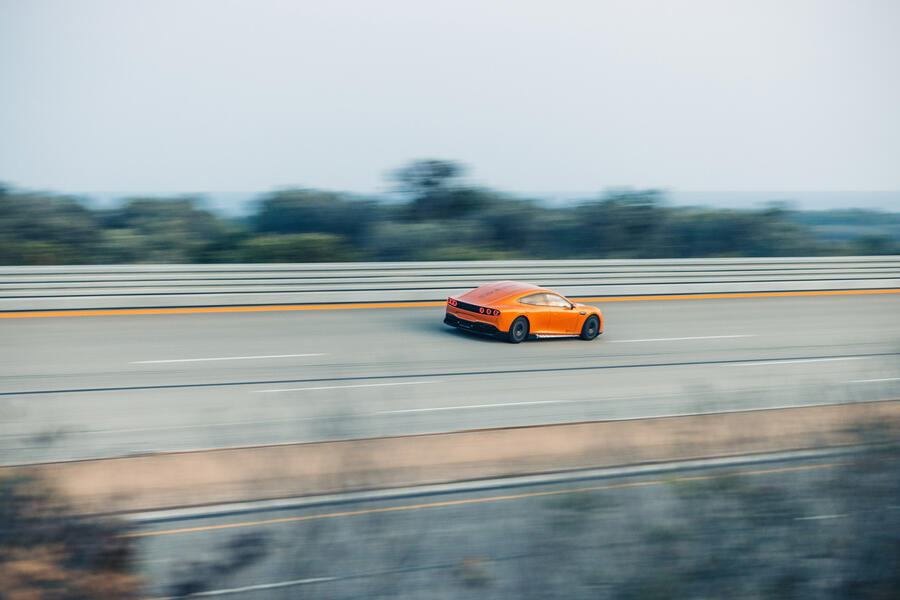
It wasn’t all plain sailing, though. Ambient temperatures soared past 35deg C during the day before plunging to 20deg C overnight, while periods of torrential rain and a brief power cut within Nardò’s electricity infrastructure added a layer of unpredictability that no simulation could fully anticipate.
The new 24-hour electric car distance record is perhaps the most high-profile of all up to now: 3404 miles. That's some 943 miles or 38% farther than the Xpeng P7 managed earlier this month.
To put this into perspective: the GT XX eclipsed the P7’s short-lived 24-hour record of 2461 miles in just 17 hours and 18 minutes, then, with nearly seven hours still on the clock, it continued circulating Nardò, covering the additional 943 miles – roughly the distance between London and Barcelona – with only brief stops to top up its battery and, while doing so, fit new tyres when required.
That alone would have been headline-worthy in itself, but Mercedes-AMG, looking to make a much bigger statement, pressed on in earnest.
The records continued to tumble for a further week, the GT XX establishing additional benchmarks for 48, 72, 96, 120, 144 and 168 hours.
The Porsche Taycan rival also posted new records at 2000, 5000, 10,000, 15,000, 20,000 and 25,000 miles, among others.
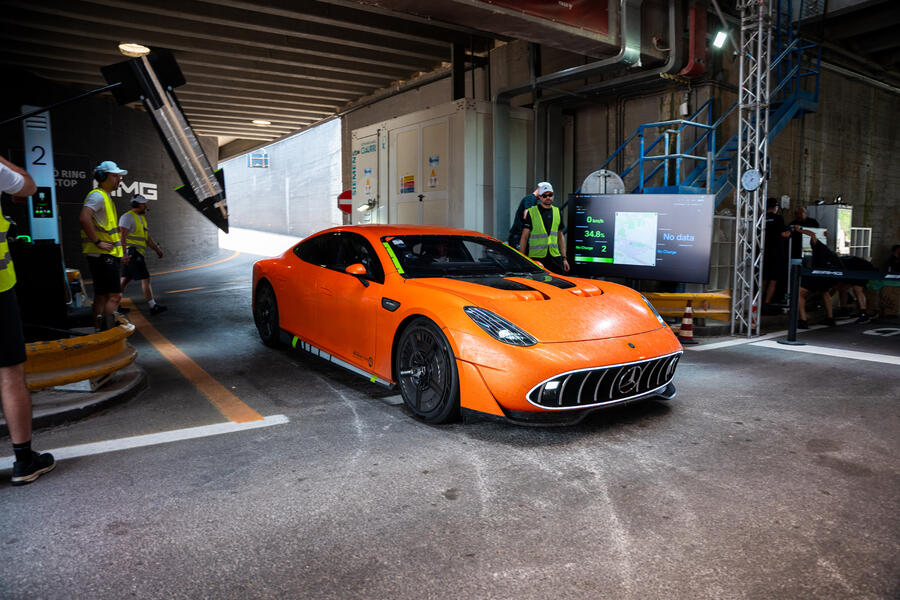
In a clear sign of the depth of its commitment and desire to eliminate any single point of failure, Mercedes-AMG didn’t just employ one GT XX for the task; it ran two in tandem, each with its own dedicated team of engineers, drivers and logistics support. Each was distinguished by coloured markings within the side sills.
“We took a lot of our approach from motorsport,” says Schiebe. “We had team blue and team green. The two pushed each other. It got so intense early on that we had to tell them to slow down.”
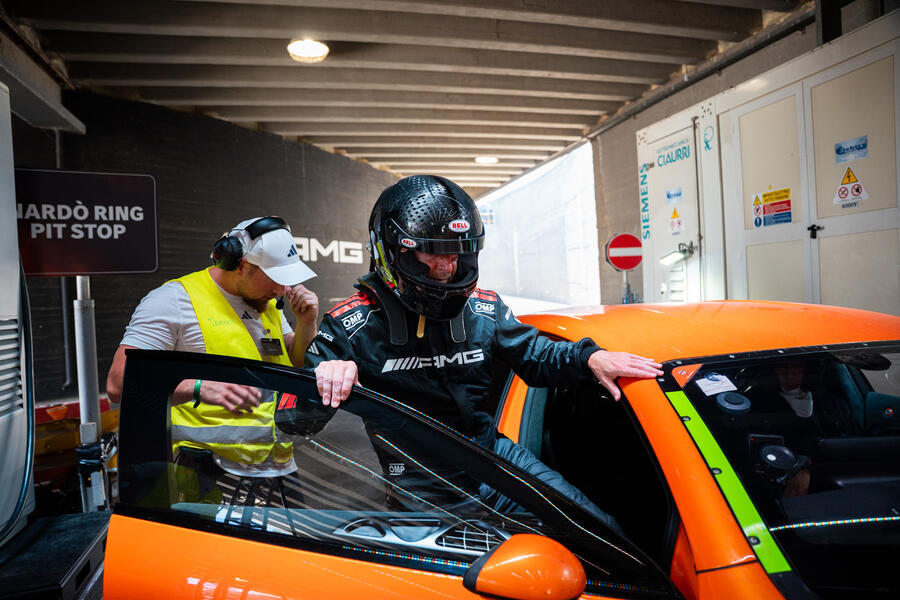
Now, less than half a day later, one of those GT XXs is rolling again, this time with me strapped into the passenger seat.
Apart from a tell-tale film of grime covering its bodywork, the 5204mm-long saloon looks untouched from its debut at Mercedes-AMG’s Affalterbach headquarters in Germany back in June.
Inside, the cabin is even more evocative. Everything is still as it was during the record attempt. The seat is firm. The six-point seat belts are stiff. The cabin is remarkably clean and unspoilt for something that has just travelled over 3000 miles for each of the past eight or so days with barely a breath between stint. It hasn’t had a lot of time to cool down. Neither has the team.
So, this is Nardò, the 7.8-mile circular high-speed test track carved into the heel of Italy’s boot. Once a Fiat proving ground, today it’s owned by Porsche but run as a global engineering centre open to paying customers. There are no corporate walls or rivalry here, just respect and reverence.
Mercedes-Benz has been here before, of course. In 2024, it set a new electric car 24-hour hour distance record with the new third-generation Mercedes CLA saloon at 2310 miles. Back in 1976, the German car maker’s C111 research prototype also set multiple endurance records here, establishing a legacy Schiebe says served as inspiration.
The low and sleek styling of the GT XX, which boasts a remarkably low drag coefficient of 0.19, gives clues to how its production sibling will look.
But it is what lies beneath that makes this a technological milestone, not just a design study. It’s based on Mercedes-AMG’s all-new AMG.EA electric car architecture, the first bespoke electric platform from the company and entirely separate to those used in standard Mercedes-Benz models. The production car that the four-door concept previews, the next GT 4-Door Coupé, is planned to arrive in the UK before the end of next year.
That car will inherit the GT XX’s drivetrain: a triple-motor layout with two axial flux motors (developed in partnership between Mercedes-AMG, Oxford-based Yasa and Mercedes-AMG’s Brixworth High Performance Powertrain division) at the rear and a smaller axial flux booster motor sitting up front. In total, they deliver a combined 1341bhp.
Power is delivered through a single-speed gearbox and supported by an oil-immersed cylindrical-cell battery pack, featuring direct liquid cooling and a theoretical charge rate between 850–900kW. A 249-mile range, Mercedes-AMG says, can be added in less than five minutes.
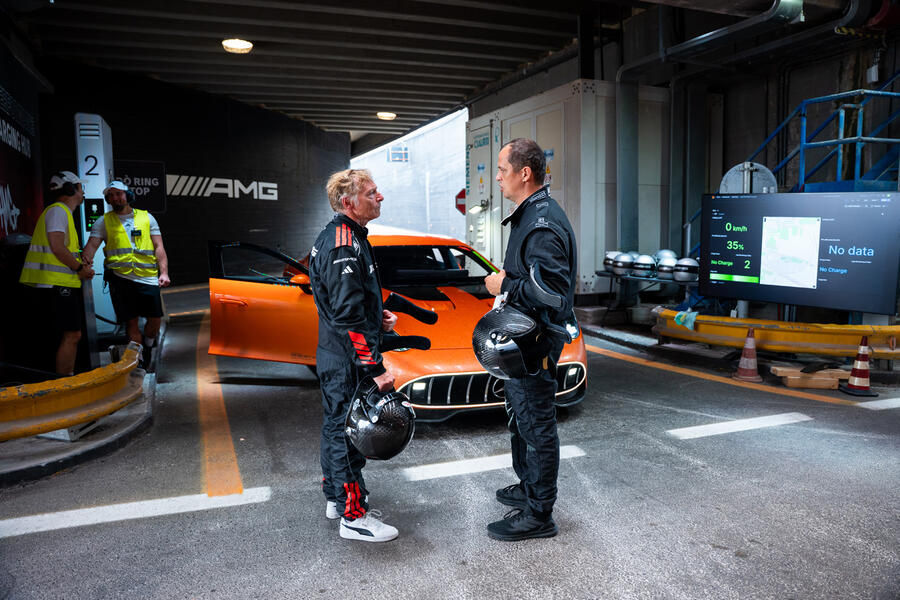
The man at the wheel today - Florian Fröhlich, a veteran from Mercedes-Benz's test and development ranks also heavily involved in the CLA’s record breaking feats - gives a final nod and nudges the throttle. There’s no fuss, no sound, just clean, linear forward movement. Seamless. Smooth. The first half mile or so is silence and serenity.
And then, once we clear the slip road and enter the wide expanse of the Nardò track itself, it hits. Not just typical performance saloon car acceleration, something stronger – much stronger. Supercar-like in intensity but again eerily silent.
That’s when I remember Schiebe telling me the records were set without the assistance of Mercedes-AMG’s new sound generator. “We will offer it to customers, and it will be an integral part of the production car. But for the campaign at Nardò, our team decided to do without it.”
As we leave the pit complex behind us, we are doing 50mph. Then 100mph. And very nearly 150mph before we’ve even crossed the three lanes into the outer banked section. The GT XX settles well, squatting imperceptibly into the groove it has carved for itself over the past week.
Even at this lick, there’s no drivetrain noise at all. Just the sound of the bespoke Michelin tyres on the track surface and a persistent buffeting wind around the outer edges of the windscreen. Today, we’re restricted to 155mph but the swiftness and clarity in how it goes about its business leaves no doubt that it was engineered for vastly more.
This very car held an average of 186mph for eight days straight, excluding charging. A team of 17 drivers, including Formula 1 star George Russell, rotated in eight-hour shifts, supported by over 130 engineers and logistics staff on-site at Nardò. Scores more monitored the car and its identical twin from command centres in Affalterbach and Brixworth. A charging infrastructure with over 1.5 miles of cable was laid across the test facility to support it all. Seven radio channels and more than 8000 transmissions a day kept every detail coordinated. Some 46 tyre changes were made and 300 windscreens washed.
And what a strategy. Mercedes-AMG didn’t just build a fast electric saloon. It also built a predictive performance system derived from its experience in F1 racing, complete with intelligent thermal management and cloud-optimised charging logic. Later we’re shown graphs, heat maps, telemetry overlays and charging profile showing how every second on track was planned and recorded. Each record-breaking stint was meticulously simulated, run, analysed and tweaked in the months leading up to the record attempt. Then rerun again. This wasn’t the setting of endurance marks by brute horsepower. It was more record-breaking by algorithm.
While the GT XX has a claimed top speed of 224mph, Schiebe says his engineering team never considered pushing beyond the 186mph average. “It’s the sweet spot: the point we calculated we could achieve the best possible trade-off between outright speed and aerodynamic drag.”
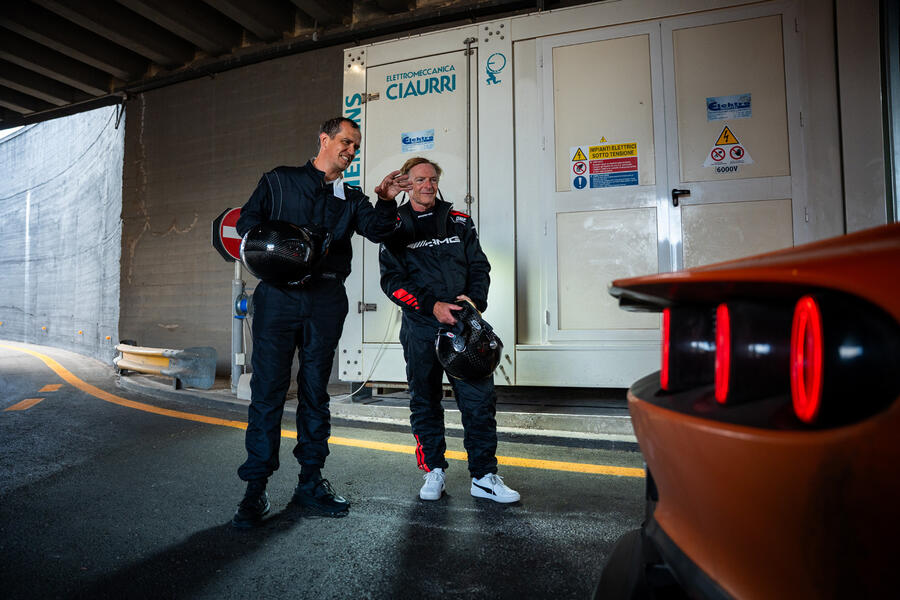
Back in the car, it’s difficult to reconcile the violence of the performance with the calmness of the experience. There’s no twitchiness, no nervousness, only composed, sustained power and uncanny straight-line stability. The sheer effectiveness of the aerodynamics within the underbody, which is shaped to create a venturi effect, means the entire record attempt was run without the need to deploy the GT XX’s rear spoiler. The cooling was another key factor.
The research prototype’s active wheels, which house five separate panels that can open to increase air flow, remained closed during on track running to ensure the lowest possible drag, opened only while charging to dissipate heat. The centre-lock wheels showcased with the car back in June were shelved in favour of more conventional five-bolt wheels.
The view from the outer lane of the high speed bowl is spectacular - at one point the horizon dissolves into a shimmering blue Mediterranean haze of ocean. But the nearby guardrail is a constant reminder of your speed and what’s at stake. The circular nature means there is no defined straights, with the steering wheel always held slightly off-centre to compensate. In the lead up to the record attempt, Mercedes-AMG settled on running in an clockwise direction. “We had the choice but with the prevailing winds and such, we considered it the best option,” Schiebe reveals.
After two unforgettable laps and nearly 15 miles, the radio cackles and we’re called into the pit. Fröhlich lifts. The GT XX coasts without any direct power for almost a mile, a procedure used for each and every charging stop during the record run, he tells me.
As we get to the pit entry marker, there’s an immediate and tangible tug as the regenerative braking system is triggered, scrubbing off speed with smooth, magnetic deceleration. It’s as if the disc-shaped axial motors have turned into huge anchors, yanking the big saloon back from the brink. Mercedes-AMG says it can recuperate up to 600kW of kinetic energy in such conditions. And honestly, it feels like it.
We roll to a halt under the bridge where Mercedes-AMG has set up a makeshift technical bunker for the record run. Banks of computers hum inside a temporary command centre made up of white-painted shipping containers. The pit crew, as focused as at any F1 race, move quickly, lifting the charging flap hidden under the right-hand rear fender and attaching the DC charging plug.
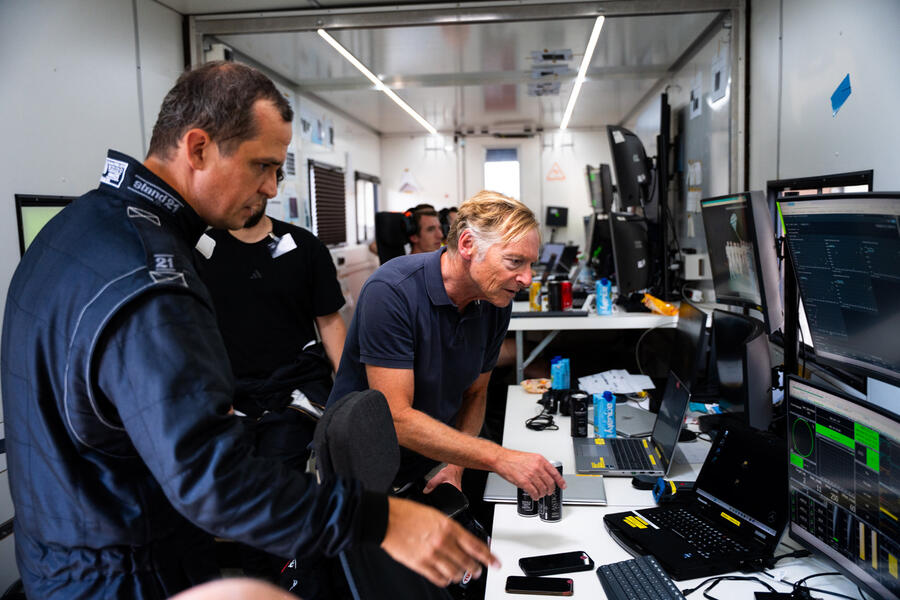
Instantly, a readout blinks to life and the numbers begin to roll on the GT XX’s display like a digital slot machine: 100, 200, 400, 800kW… and still rising. No hesitation, no let-up. By the time it nudges past 850kW, I glance over to the driver. He’s grinning. “That’s part of the secret,” he says, watching the display tick on. “With such rapid charging, our stops during the record run were between two and four minutes.”
And still the numbers continue to climb: 920, 930, 940, 950kW and then, finally, the peak, 965kW. That’s nearly six times the 170kW charging capacity of the existing Mercedes-AMG EQE 53 4Matic+. And we’re witnessing it live in the field using the same Alpitronic charger used throughout Mercedes-AMG’s eight days of record-breaking.
One thing’s clear. The Mercedes-AMG’s record run with the GT XX wasn’t just about lapping a test track quickly. It was about redefining the upper limits of what integrated electric car performance can be, both now and in the future: from drivetrain operating strategy, battery chemistry, aerodynamic control, thermal management to software analytics, energy recuperation, tyre optimisation and much more.
It didn’t just chase records; it created a rulebook for how to break them.
How to Choose the Safest and Most Reliable Car for Your Teen Driver

Skoda Felicia Fun Returns as Bold Electric Beach Cruiser with Retro Flair
 Cult-classic pick-up is reimagined as an electric 4x4 fit for the beach, using Vision 7S concept as a basis
Skoda has reimagined the cult-classic Felicia Fun pick-up as an electric off-roader based on the previous Vision 7S concept.
Designed by Julien Petitseigneur (pictured below), it was devised to capture the “beach vibe” of the 1990s car, ditching the Vision 7S's second and third rows of seats for an open bed.
There is a prominent rear spoiler, similar to that fitted on the original Felicia Fun, and the rear lights are tinted pink in reference to the car’s seaside inspiration.
The pop-out second row of seats that became a signature feature of the original Felicia Fun have not been reprised, although Skoda claimed that the new concept “could certainly accommodate them”.
Petitseigneur’s interior sketches show a digital display that spans the full width of the dashboard, in similar fashion to Mercedes-Benz’s Hyperscreen, with a housing inspired by bulky CRT computer monitors. The graphics are similarly simplistic, appearing to draw on computer operating systems of the period such as Windows 95.
“The original car was pure fun,” said Petitseigneur. “It didn’t take itself seriously and stood out, even by Skoda standards.”
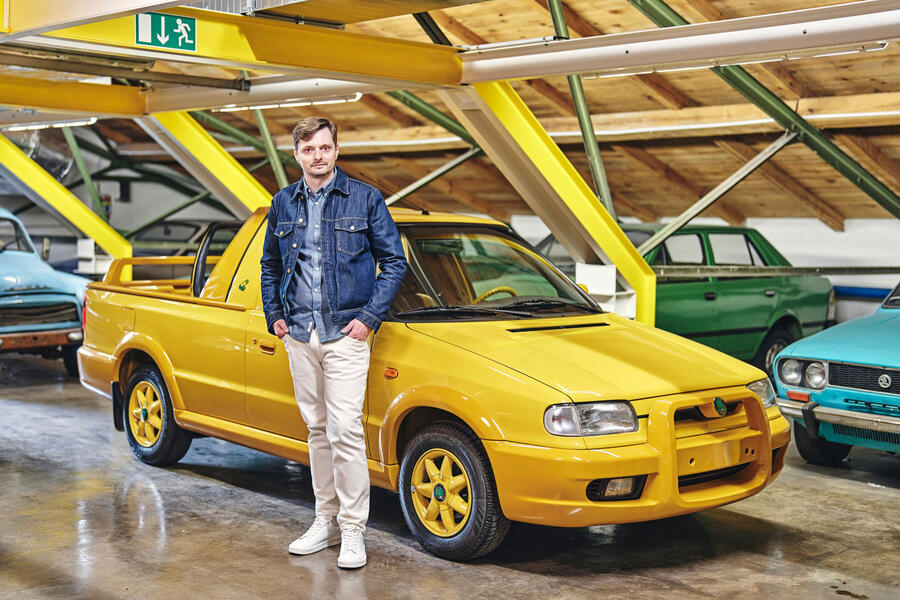
A total of 4216 examples of the Felicia Fun were built between 1998 and 2000, each painted yellow and daisy-style alloy wheels. The car’s exterior cladding could be had in a matching yellow or luminous shades of either green or orange.
The Felicia Fun is the latest in a series of classic Skoda models reimagined by its designers, following the Favorit.
That car, penned by Ljudmil Slavov, was intended to retain the original’s Bertone lines without leaning too overtly on retro cues.
Unlike the Felicia Fun concept, it did not adopt the brand’s ‘Tech Deck’ front fascia, instead remaining closer to its forebear.

U-2 Spy Plane Defies Age with Record-Breaking 70th Anniversary Flight


Why the Third-Generation Skoda Fabia Is the Smart Choice for Affordable, Practical Driving
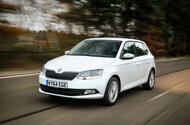 The mk3 Fabia took a pragmatic approach to the supermini segment and eclipsed rivals that once had a tight grip on the market Frugal, friendly and affordable, the third-generation Skoda Fabia is a great little hatchback that puts common sense and usability at the very heart of its driving experience.The Mk3 Fabia doesn’t look particularly dated, yet it was launched more than a decade ago, and prices for this smart supermini are starting to look unignorably attractive.Today, you can pay as little as £1500 for a high-miler with plenty of battle scars but we found several decent mid-rung SE and range-topping SE L cars with reasonable mileage for around £6000. That’s decent value, especially as SE cars get perks like Bluetooth, DAB radio, 15in alloys and air conditioning.SE L cars have an even better roster of kit, with climate control, 16in wheels and cruise control – and if you want a bit of chic, the Monte Carlo with its black alloys, panoramic roof and sporty bodykit is your best bet. Value is the name of the game here, clearly, but we would nevertheless advise steering clear of the basic, entry-level S.The solid fit and finish of the Fabia’s interior is pleasantly surprising at this end of the market. Sure, it doesn’t have the same soft-touch materials as its cousin, the Volkswagen Polo, but it’s well appointed, the touchscreen is a doddle to operate and there’s plenty of buttons and switches to play with – and it’s capacious up front too.This pragmatic approach is applied to the rear, where there’s just enough room for adults for short trips. The real highlight, however, is the segment-leading 330-litre boot, which can house suitcases, pushchairs or a weekly shop without hassle. The lesser-spotted Fabia estate, now sadly departed, ramped up boot capacity to a whopping 530 litres. While you can choose from a wide variety of petrol and diesel engines, you’re likely to end up with one of the more prevalent 1.0 or 1.2-litre petrol engines.The early non-turbo 1.0-litre MPI can be had with 59bhp (a bit too sluggish for daily duties) or 74bhp (punchier but harder to find). So we would aim for one of the turbo 1.2 TSI units, specifically the 108bhp version (there’s also an 89bhp one), which has enough grunt for motorway stints and comes with a six-speed manual gearbox.You will pay around £7500 for a 1.2 TSI with about 50,000 miles, but it will easily do 50mpg and some variants cost just £20 to tax annually.The diesels are all 1.4-litre four-pots (74bhp, 89bhp or 104bhp). We would recommend a diesel only if your mileage is on the high side. You should get 60mpg (more on the motorway) and tax costs are low. Just be aware that they are rarer than petrol and were dropped when the Fabia was facelifted in 2018.Engines aside, the Fabia is a grown-up supermini geared for ride comfort rather than driver engagement. It irons out lumps and bumps well and takes the edge off the sharpest road imperfections around town.It lacks the agility and body control of the best-handling small cars like the Ford Fiesta, but there’s plenty of grip and it drives predictably at real-world speeds.And whether you’re pootling to the supermarket, or heading for the coast for a short getaway, the easy-going Fabia has plenty of ‘big car’ feel to make it a great all-round proposition – and for the price of a year’s PCP on a new supermini, who can grumble with that?