How Toyota Outsmarted High Import Taxes to Bring Trucks to America
Why SUVs Dominate America—And the Two States That Chose Differently
The Surprising Story Behind the Jeep Name and Its True Meaning

Unbiased Tire Comparison Tests Reveal the Best Picks for Your Vehicle

Chasing Aliens and Legends on the Extraterrestrial Highway in a Hyundai Santa Cruz
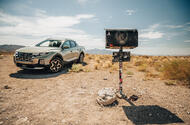
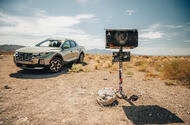
America's most mysterious mailbox is useful as aliens lack internet accessWe drive a Hyundai Santa Cruz to the top secret base – and find the US's most mysterious postbox
A lone black mailbox alongside the Extraterrestrial Highway is stuffed with letters addressed to aliens the American government supposedly keeps captive inside Area 51, the world’s least secret secret military base.
Bathed in the summer heat alongside Nevada’s highway 375 – officially renamed the Extraterrestrial Highway in 1996, because why waste a tourist opportunity? – you can see why the military would pick this part of the country to build a secret airbase, whether for holding aliens or ‘just’ to test new jet technology.
There is mile upon mile of nothing save for a circle of impenetrable hills made for concealment.
In the distance, a vehicle kicks up dust, heading our way. One of the base’s gates, and said to be how most civilian workers arrive for their shifts, bussed in from a town nearby (though distances are relative), is a good 20 minutes’ drive off the highway, along a dirt road.
The indistinct cloud of dust becomes a large white SUV as it nears, and eventually arrives at the roadside mailbox. A large sticker on the side reads ‘Scenic Photographic Tours’. A family emerges and starts taking photos.
The gate is about eight miles away, along two dirt tracks, the tour guide tells us, and if you want to go for a look, “they know you’re coming”. ‘They’ is used in the manner everybody does to describe a faceless, perhaps sinister, bunch of people in authority. Them. They. Not us. Among online Area 51 enthusiasts, base guards are often dubbed ‘camo dudes’.
Anyway, ‘they’ have got “seismic meters and cameras”, the guide says, which seems like overkill given that a camo dude wouldn’t even have to lift his aviator shades to spot the plume my Hyundai Santa Cruz would kick up.
But if we do go to the gate to take some pictures, even simply standing there might leave ourselves open to remote digital interrogation, I’m warned. “I’ve had people who’ve had camera phone pictures automatically deleted,” the guide says.
“I had a woman with a digital SLR camera who got back into the car and found all her images of the gate had disappeared.”
I’m here, and in a Santa Cruz, because I’m looking for a better way to end the historic Route 66 driving tour, which runs from Chicago to Los Angeles, loosely following the passage taken by early pioneers travelling in search of a better life. I drove it a few years ago and enjoyed it but had wondered if there was a more interesting path from one side of the US to another, particularly as local enthusiasm for Route 66 feels like it wanes the further west you get: there’s a bit more going on than in America’s quiet middle, where the road is often the biggest show in town.
I’d been in Santa Fe, New Mexico, to preview the new Hyundai Santa Fe and interview its designer. So I picked up the Santa Cruz, and then picked up Route 66, just down the road in Albuquerque.
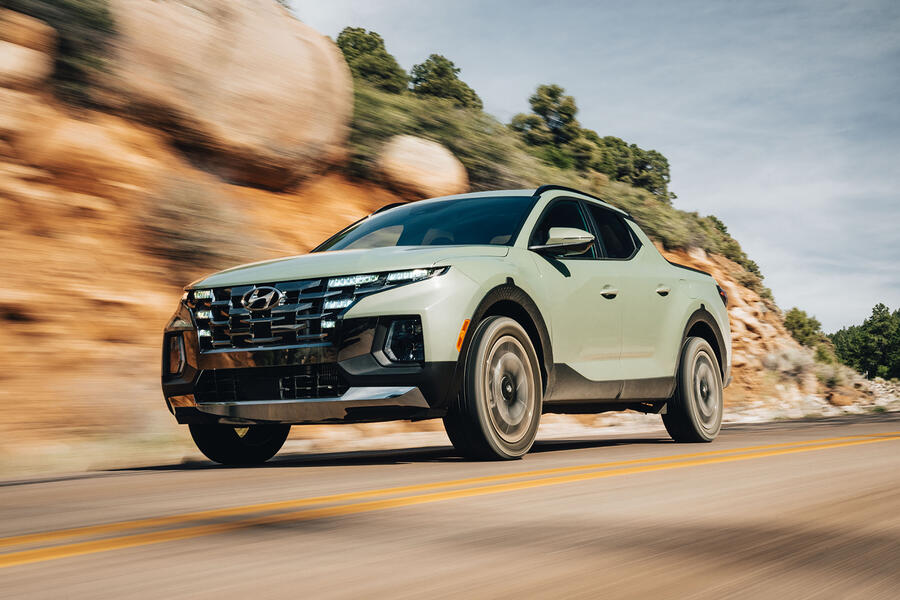
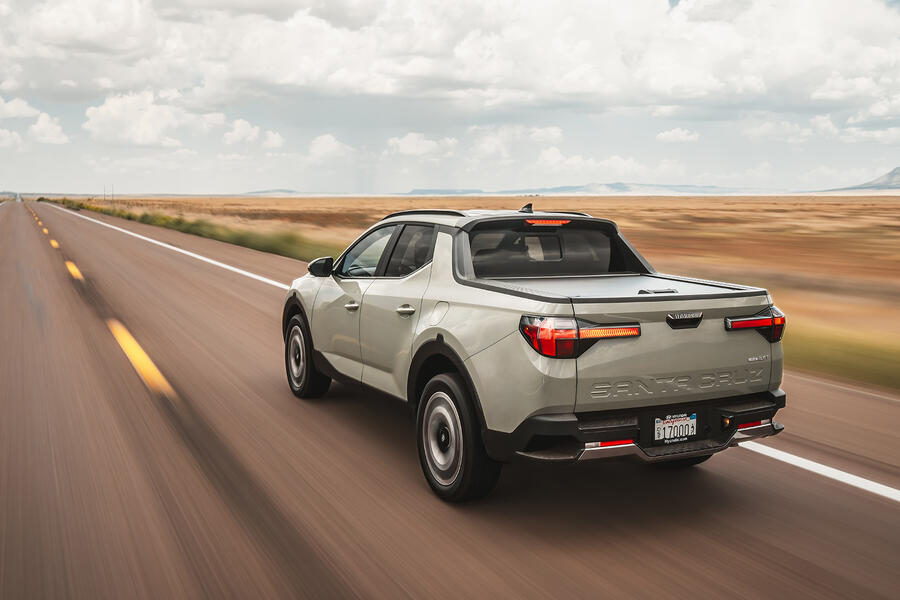
We don’t get the Santa Cruz in the UK, but it’s the car that Hyundai UK most gets asked about importing. I understand the appeal. Based on the Hyundai Tucson, it’s a good-looking lifestyle pick-up truck that is a smidge under 5m long, making it a compact truck in the US. It comes with a five-seat double cab and a relatively short, 1.3m load bay.
And a reputation for not being a ‘proper’ truck, at least in the eyes of those who like their pick-ups bigger, burlier and more separate of chassis and body.
The unitary-bodied Santa Cruz is a family-friendly alternative to an SUV, then, which would be considered perfectly capable if it ever arrived over here. In this upmarket spec, it has four-wheel drive, and a 2.5-litre turbo four-cylinder petrol engine making 281bhp and 311lb ft, which one American review says is “better suited to urban driving” than the non-turbo base model. Different world.
Anyway, it definitely feels more car-like than the brasher, more rugged and much, much larger trucks with which it shares the highway west out of Albuquerque. In large parts, the road that constituted historic Route 66 has been supplemented by four- or six-lane highway parallel to it, because after all there’s plenty of space to keep both.
So if you want to drive the totally authentic original, you can, but it’s no more interesting and most of the time you’d be within sight of it, plus there’s an exit for every town so you can get the full Radiator Springs experience: bypassed ranch towns that, as trains became longer and trucks able to drive faster and further, slowly became forgotten.
At this point on the route, the most interesting things to see are off the highway. The Navajo Nation’s Window Rock. The Petrified Forest. The Grand Canyon. Las Vegas?
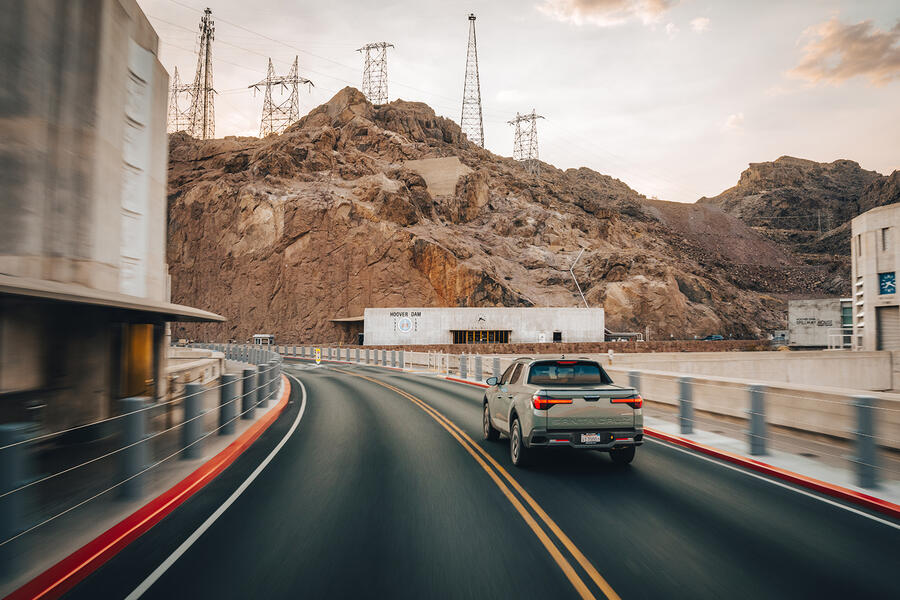
If Vegas isn’t quite your cup of tea, not far before it is the Hoover Dam. What a thing. The numbers are so vast as to be almost incomprehensible. It’s constructed from 3.36 million cubic metres of concrete; the artificial lake behind it stretches for 115 miles; its 17 turbines produce 2.08 megawatts of power; and there are spillways vast enough, with drops tall enough, to make your correspondent feel decidedly queasy. If a train of Santa Cruzes poured one load bay of water into the reservoir every 30 seconds, it’d take 38,860 years to fill it.
It is an astonishing piece of engineering, and from its completion the federal highway drove straight across the top of it. Only in 2010 was it finally bypassed. It feels bonkers, driving over its slow single-lane road now, that this was the main highway.I don’t doubt there’s more concrete in Las Vegas – certainly the city lights use their share of 2.08 megawatts. And there’s a fairly straightforward route to Los Angeles directly from the city, which is packed at weekends, on Fridays with cars heading out of California, with the opposite exodus on Sundays.
Our route, though, is the less travelled northern one, towards empty highways, the tiny town of Rachel, its alien-themed cafe (the Little A’Le’Inn) and the myths of Area 51.
I’m enjoying the Santa Cruz. It’s got a decent ride that doesn’t have the crashy, basic agricultural vibe of even the best separate-chassis pick-ups we get in Europe. For the most part, you can forget it’s a pick-up at all and think of it like an SUV you can take fishing or hunting or surfing without the cabin smelling on the way home.
It steers with heft but accuracy, rides with a firm composure, and has digital dials and a big touchscreen. If it weren’t for radio stations featuring adverts for nasal vacuums (“clean nose, healthy life!”) and ‘prostate secrets’ (.com!), and playing songs like ‘I’m rednecker than you’, you could almost convince yourself it’s a European experience.
The roads, the space and the emptiness are all pure Americana, though. A wide, sweeping set of bends leads downhill towards the Extraterrestrial Highway, whose quirky, digital-font signage is covered in stickers from all parts of the world.
For all of the seriousness of there being an actual secret active military airbase nearby, they ham up the alien mythology with a knowing wink. When, in 2019, there was an “Area 51 Raid” organised online on the basis that “they can’t shoot all of us”, additional policing was drafted in.
But ultimately the event had all the threat of a village fete, the most risky activity being selfie-taking in front of the ‘don’t take photos here’ signs outside the razor-wired gate, to the shrugging permission of by-standing guards.
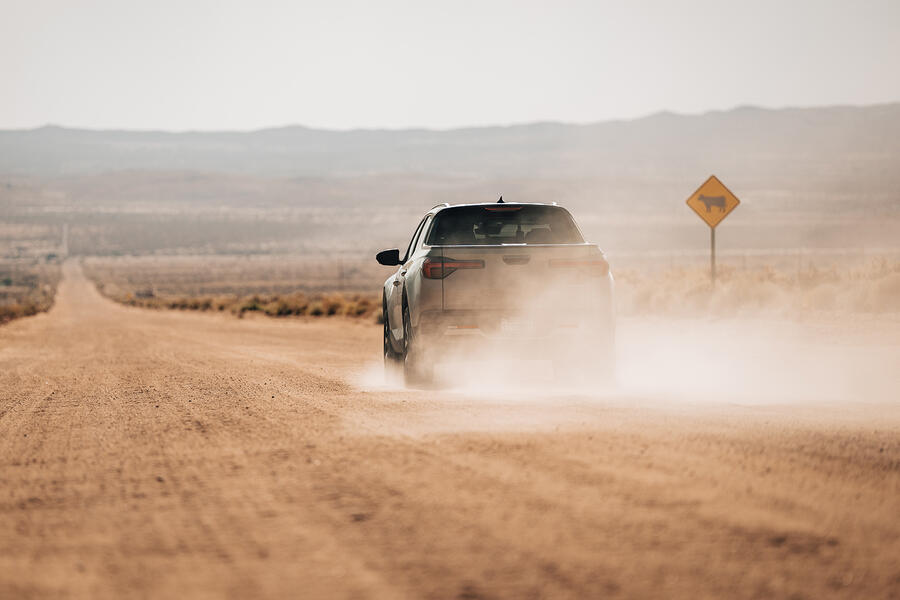
So we go too, off the main highway and onto the dirt track, which you don’t strictly need a pick-up’s 4x4 system to navigate, but which isn’t unhelpful in deeper sand. One suspects this is as hard as most Santa Cruzes will be worked but there’s plenty of terrain like this in the US, and it deals with it nicely, slipping around entertainingly.
Do they notice us with their spy drones and seismometers? We’re probably not worth the trouble. On an average day, there must be a dozen cars and tours that turn up to peer over the gate at a remote sentry camera, which is all overlooked by a white pick-up on a low hillside – ‘camo dude’ presumably aboard.
We stay a few minutes. On the return leg, a white Chevy Suburban with darkened windows passes us but, let’s face it, it’s more likely that a shift manager than Paul the alien is on board.
Back on the road, we swing a left towards the restaurant, and then drive on another six hours towards California, through the desolation of Death Valley, past an aircraft graveyard, and eventually out onto the busy highway that runs down into Los Angeles.
This is a cooler, more intriguing, end to Route 66. And an interesting car to do it in. I check my phone to see if any pictures have been deleted. No. No, they haven’t been.
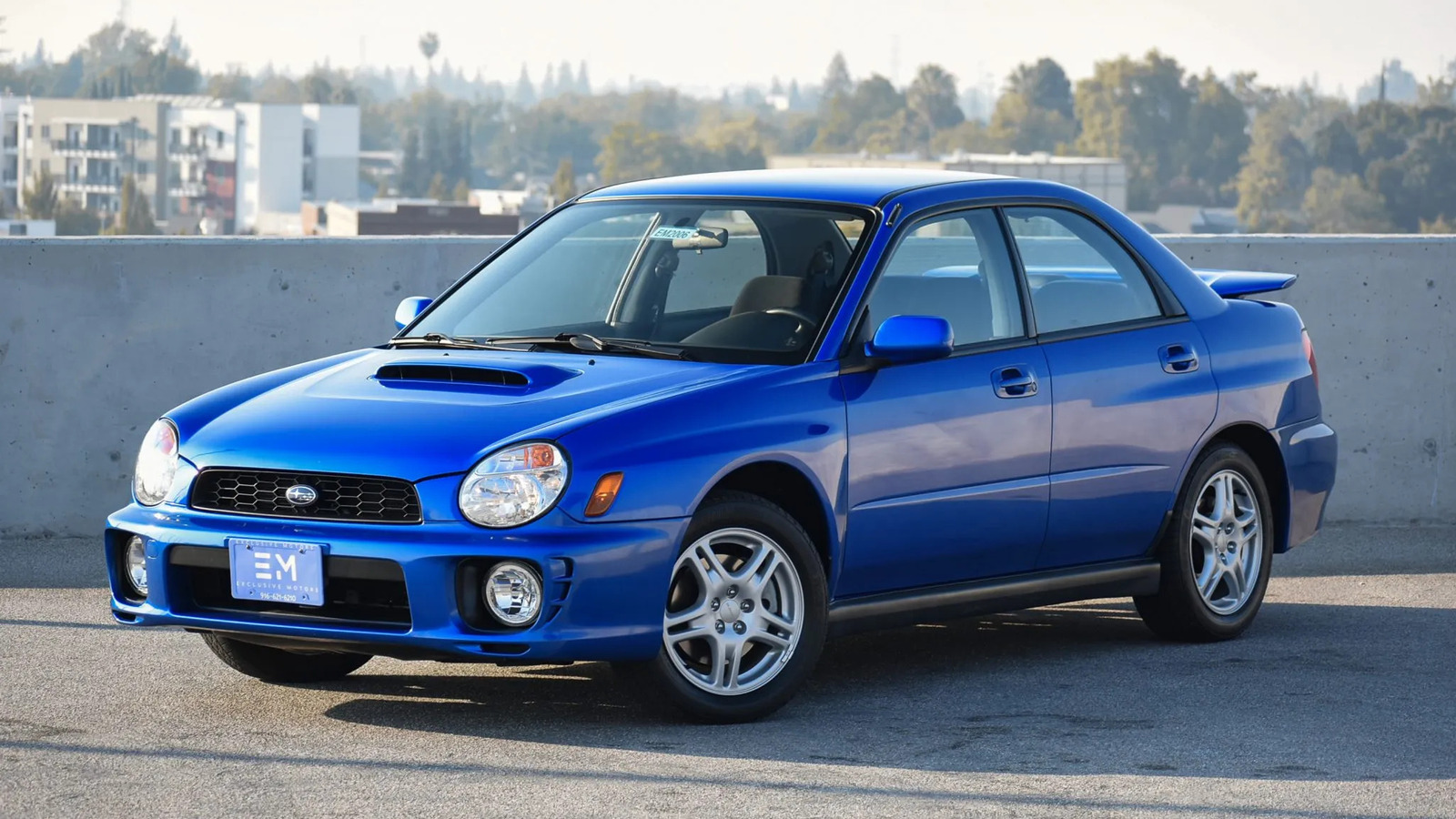
How the 2002 Subaru WRX Outpaced Luxury Rivals in Performance Showdown
How Formula Student Is Forging the Next Generation of Motorsport Innovators
This year was the first in which EVs outnumbered ICE racers in the main Formula Student fieldFormula Student has established itself as a proving ground for motorsport's top engineering talents
It’s April. You’ve been toiling away at university for the past three years, lectures are finally drawing to a close and you’re putting the finishing touches to your home-brewed race car.
To outsiders, that might seem like a distraction from learning. But to land that dream job in Formula 1, you’ve got to prove your worth first – and there’s no better place for doing so than Formula Student, the annual and increasingly high-profile motorsport competition open to the world’s top academic talents.
But then you hear a pop. Your EV battery, itself a year’s work for the master’s student in your team, has just detonated. With it seemingly goes the hopes of your 70-person team making it to July’s big final at Silverstone: years of effort have quite literally gone up in flames.
Yet through sheer determination, you summon all the help you can find and the car is rebuilt days before you’re due on the grid.
It might seem like a tall tale, but that’s what one Formula Student team faced this year. And it’s just one of hundreds of similar stories floating around the paddock, all of them formative experiences for the next generation of top motorsport and automotive engineers. Everyone present is here because, having sacrificed years of study sessions (and perhaps the odd pub night), they desperately feel the need for speed.
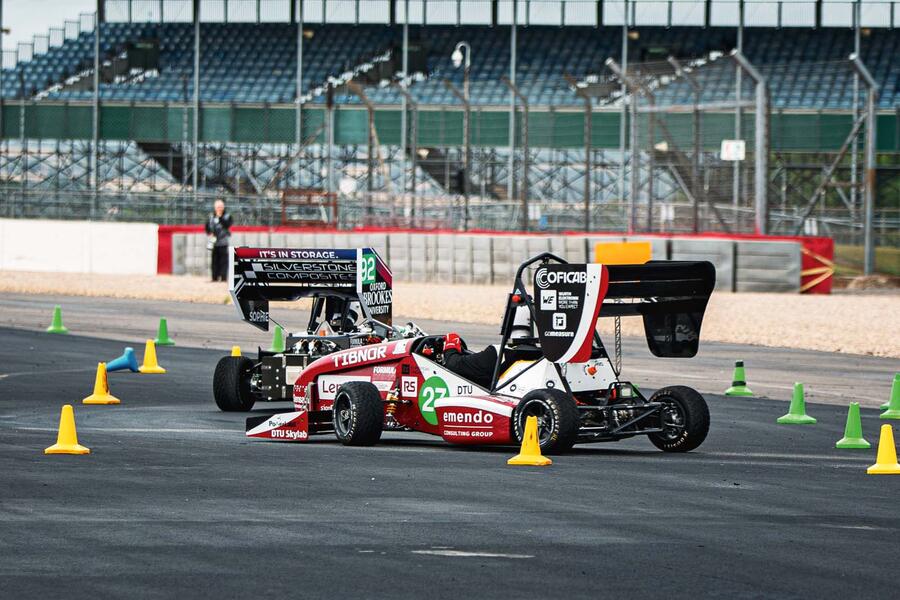
The competition itself is split across three disciplines. The first, Formula Student (or FS), established in 1998, tasks teams with building their own cars. These are put through a series of dynamic tests and are scored accordingly.
The second discipline, Concept, is for those eyeing a future entry, giving them a chance to experiment with new ideas. Competitors are allowed to fabricate components or a rolling chassis without the requirement of designing or building a running vehicle.
Finally, FS-AI is an autonomous class that allows teams to develop either their own self-driving vehicle or a technology stack that is mounted to a shared chassis. These are then tested in similar fashion to those in the FS class.
It’s not all about speed, though. First, teams must pass scrutineering and a series of static tests, plus Dragons’ Den-style business presentations covering the design and cost of their cars – and, in FS-AI, ethical considerations. There are safety tests, too.
This stage alone is brutal. Of the 59 universities in the main competition, just 22 will attempt any of the weekend’s dynamic events, comprising tests for acceleration, endurance and energy efficiency, in addition to timed runs on a skidpan and an autotest route on the Silverstone circuit.
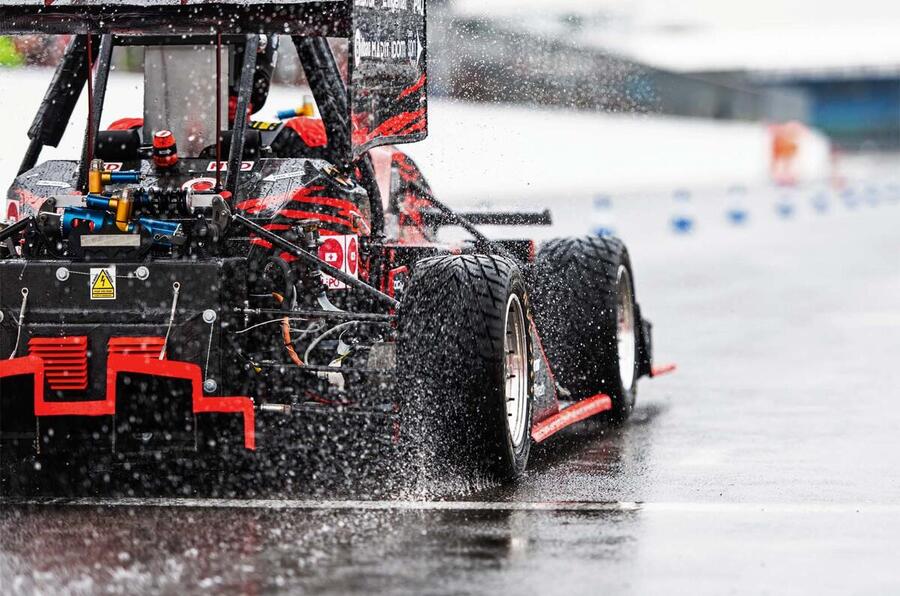
Students get to choose whether to develop internal combustion or electric powertrains, although, as one judge tells me, most teams are now ‘encouraged’ to use the latter by their universities’ bigwigs.
There are Balance of Performance measures for the two powertrains to ensure a fair contest across all aspects of the competition, but the most competitive teams tend towards electric vehicles, whose instant power delivery favours the low speeds involved (they usually top out at around 70-80mph).
The rulebook allows a lot of flexibility on chassis and body development, mandating basic structures and safety measures. The biggest split in the paddock is whether to develop aerodynamic packages. The tight, snaking layout of the sprint circuit means it’s hard to generate much downforce without fitting absurd spoilers and splitters, and there’s a limited window within which any benefit can be gained anyway.
One judge jokes that the easiest way to determine the financial backing behind a team is to see how much carbonfibre it has used and the size of its rear wing – plus the number of sponsors plastered onto it. The big European universities can summon budgets of €1 million, while some of the smaller British outfits are left to raid the back of the sofa.
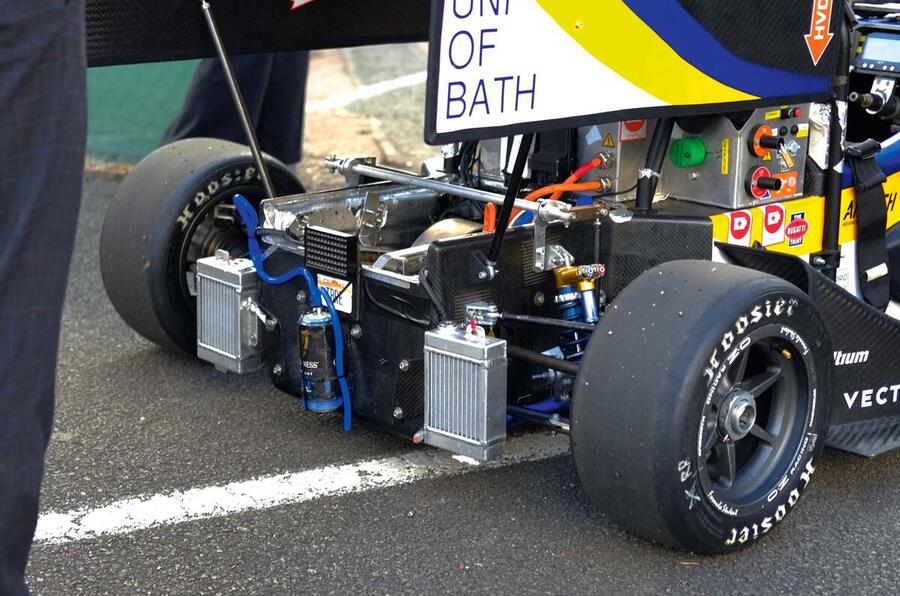
Even the most polished teams still require a bit of Great British Bodgery, though. The University of Bath – one of the best-established teams here – have a can of Guinness Zero strapped to the back of their machine, functioning as a fluid reservoir.
So renowned is Formula Student’s demand for technical excellence, quick thinking and soft skills that this is where big firms are now coming to discover their future engineering stars. Some manufacturers will even outright decline to hire anyone who hasn’t been through the Formula Student programme.
JLR isn’t among those, but it does have a significant presence at the event. “For students to turn up here with their car already prepped, some of them are having struggles, some of them are flying through scrutineering, all of that builds into their determination, their ethos and showing that they are made for industry,” Dan Hammond, an engineering manager at the company, says.
He adds: “It’s that level where you are getting involved outside of the curriculum on an engineering subject. The technical skills can absolutely take you a long way, but those core soft skills, those business behaviours and how they’re able to apply themselves to the engineering and business presentations, all of that builds the kind of engineers of the future that we really want to have. That’s why we come here and canvass them, but also share our experiences.”
Emma Stopps, JLR’s early careers recruitment manager, says a key objective of the firm’s attendance at Formula Student is also to raise awareness of opportunities outside motorsport. “They’re asking about what they can get involved with in engineering, and it’s about filling that awareness gap,” she says. “I’ve already noticed a few gold-star candidates.”
Kyle Hey, a mechanical design engineer for Oxfordshire e-motor powerhouse Yasa and an alumnus of Formula Student with Oxford Brookes, says the competition helped him to develop the attitude required for a job in automotive. “Teamwork is very important, especially on late nights when things aren’t going so well,” he tells me. It’s all about building resilience but, he adds, “there are a lot of entertaining challenges”.
For teams, that opportunity to meet new people and figure out how to get the best out of each other is vital. Mark Byers, a second-year mechanical engineering student at the University of Sheffield and the marketing and comms director for Sheffield Formula Racing, says: “It’s about having those technical skills and also intra-team skills: project management, working with other people and how to deal with stuff when it goes wrong. Sometimes you’re putting them in the hot seat to make decisions and you’ve got to sort things out really quickly.
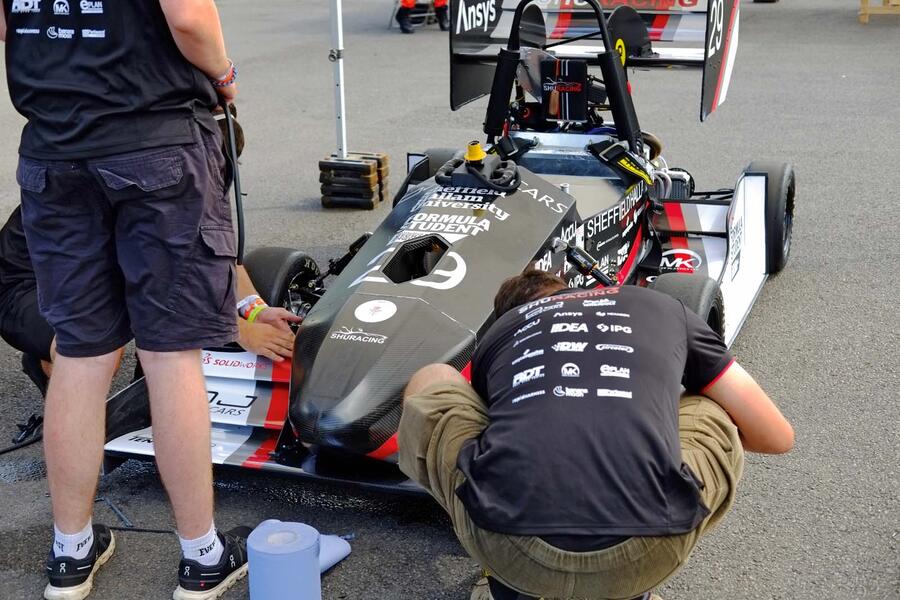
“Some people might struggle to have a really strong team bond, but we’re like one big family. It’s a small team of about 60 to 70 members, and we all know each other, which I don’t think many other teams can say. We all go out to the pub together, and being able to work in a team of people across many different years, in different degrees and cultures, there’s quite a strong sense that we’ve done the best job we can.”
It’s a view that’s echoed by Elliott Atkinson and Varad Kulkarni, head of driverless and head software engineer respectively for the University of Glasgow’s autonomous racing team. Atkinson explains she never planned to pursue a career in automotive, yet still loves “coming out here”.
She says: “The thing that drew me to Formula Student was the teamwork and collaboration behind it. The people you meet are some of the most amazing people ever, and we would never have met if it wasn’t for this society. I’ve met most of my best friends on this team.”
Ultimately, it’s this collaborative spirit that makes Formula Student so special. As I walk past the judging tent for the business briefings, I hear a group of English students bantering with a delegation from one of the several Egyptian universities competing in the Concept class.
The Brits joke that our 30deg C weather must feel cold for the Egyptians. It’s a positivity of spirit that’s rare in top-flight motorsport. It even bleeds out into the liveries of the racers taking part. The University of Birmingham have ‘Where are the wire strippers?’ written on their rear spoiler, while the University of Sheffield’s reads ‘utter wake nonsense’, putting a punny spin on a social media meme.
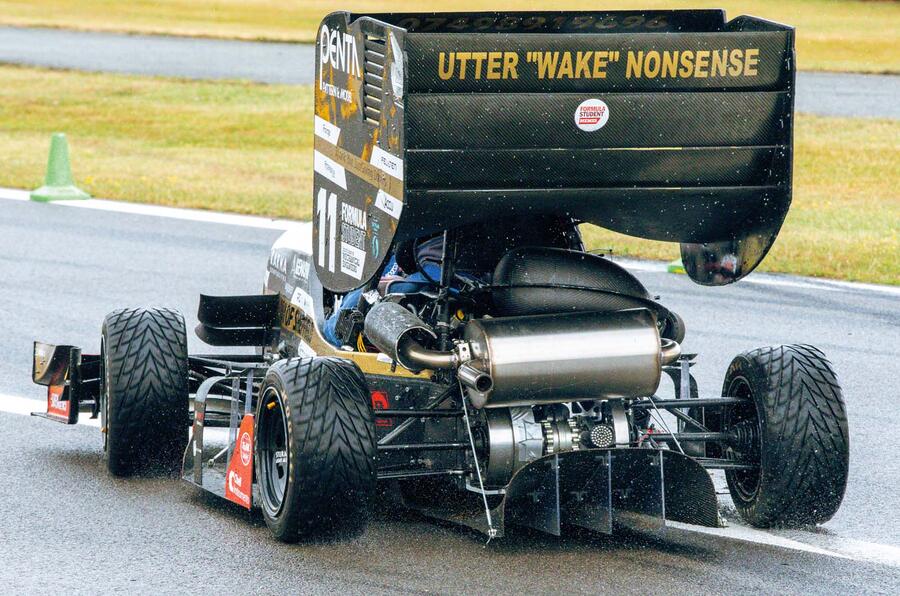
For some taking part in Formula Student, this summer weekend might just be their final foray in motorsport. Nonetheless, those core ideals – engineering excellence, collaboration and enjoying the moment – empower them to do great things, whatever their future holds.
Global Allies Rethink Fighter Jet Purchases Amid Growing Uncertainty
Why the Ford Mustang GTD Is Winning Over Even Its Toughest Critics
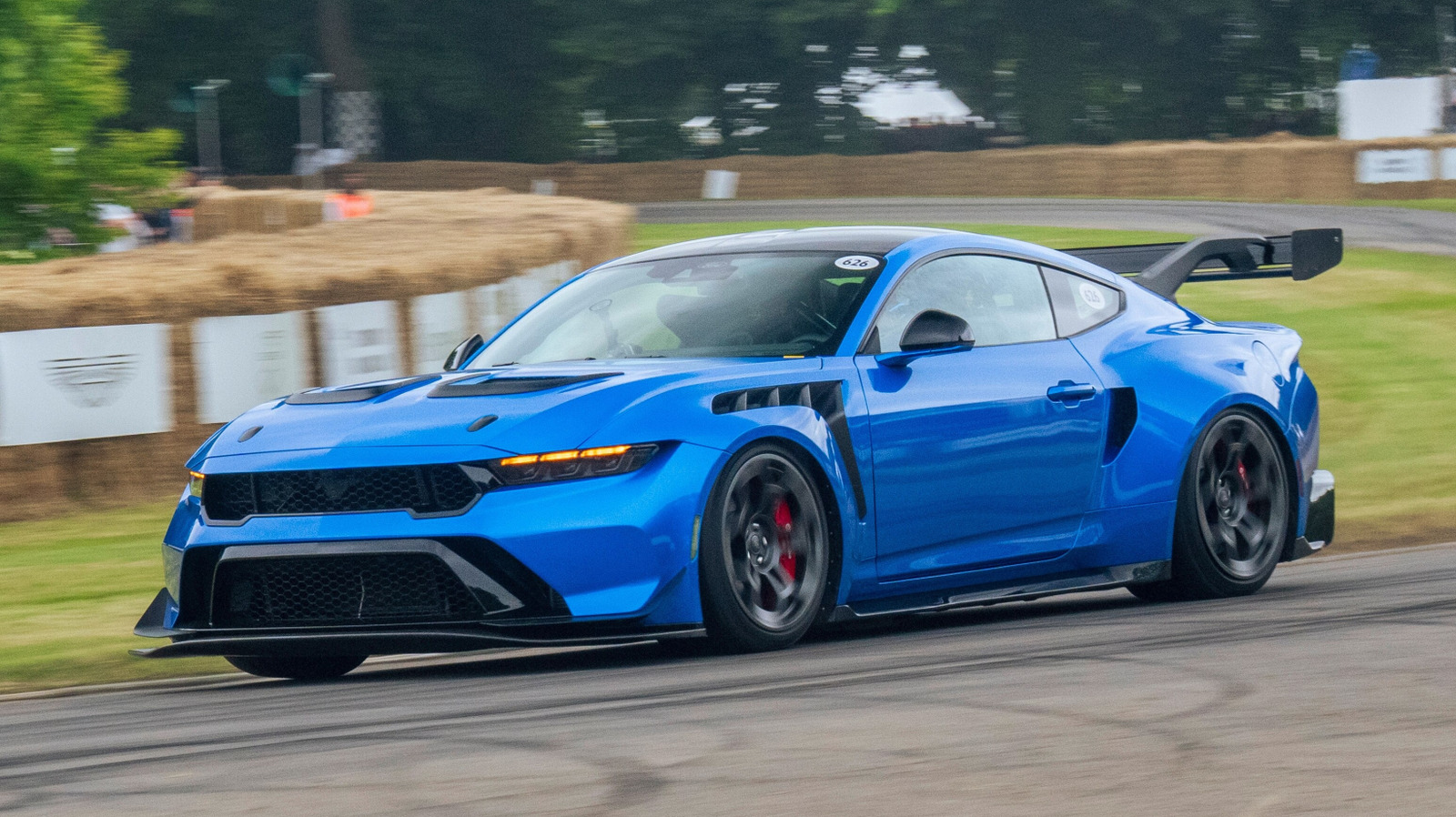

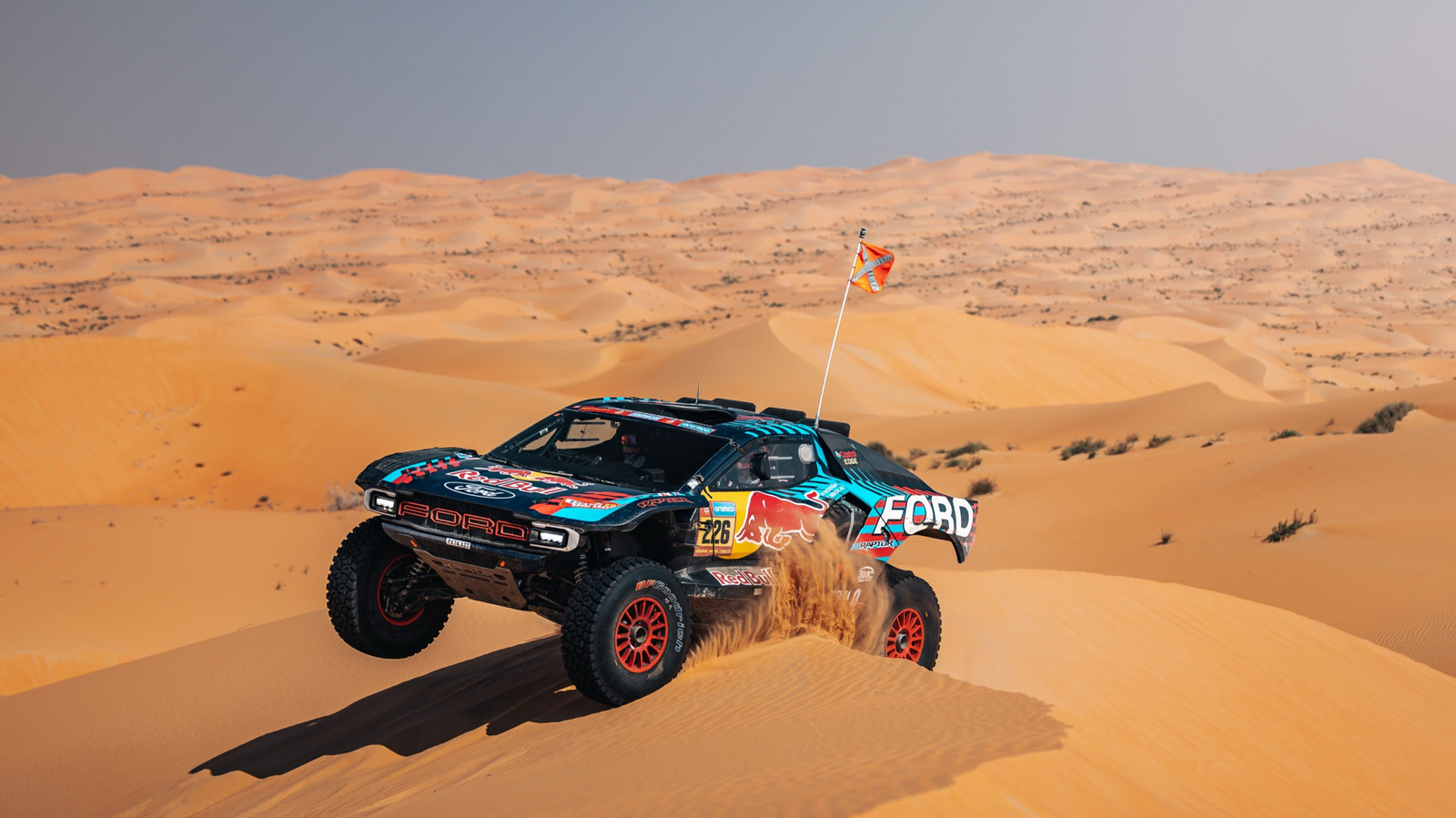
Ford Plots 1000 Horsepower Off-Road Monster for Dakar Rally Glory