Why Used Car Buyers Are Choosing Superminis Over SUVs in the UK
 Top 10 list of best-selling used cars is dominated by hatches, not SUVs
Nine of the 10 best-selling used cars in the UK are still traditional hatchbacks and superminis, in stark contrast to the popularity of SUVs among buyers of new cars.
The greater sales potential and profitability of crossovers and SUVs – together with the arrival of margin-slashing safety and emissions regulations – have threatened the commercial viability of superminis and small family hatchbacks in recent years. As a result, many such models have been withdrawn from sale as their manufacturers focus instead on larger, higher-riding models.
This trend is reflected in the evolution of the top 10 new cars sales chart. In 2015, just two crossovers featured – the Vauxhall Mokka and Nissan Qashqai – and the chart was comfortably topped by the Ford Fiesta, Vauxhall Corsa and Ford Focus.
Ten years later, the Qashqai is one of eight SUVs in the UK’s top 10 list of best-selling new cars, with the Ford Puma and Kia Sportage the two most popular models of 2025 so far. The fourth-placed Vauxhall Corsa and the Volkswagen Golf, at number six, are the only non-SUVs to feature in the top 10.
However, almost the opposite is true of today’s second-hand market, where hatchbacks dominate and the Qashqai is the only SUV to feature in the top 10 best-sellers for the first half of the year.
Superminis remain the best-selling used car by body type and the Ford Fiesta was the country’s best-selling used car in the first six months of 2025.
Despite Ford withdrawing the Fiesta from sale in 2023, almost 1.4 million Fiestas were still registered in the UK at the end of last year, which means it remains the most common car on the nation’s roads.
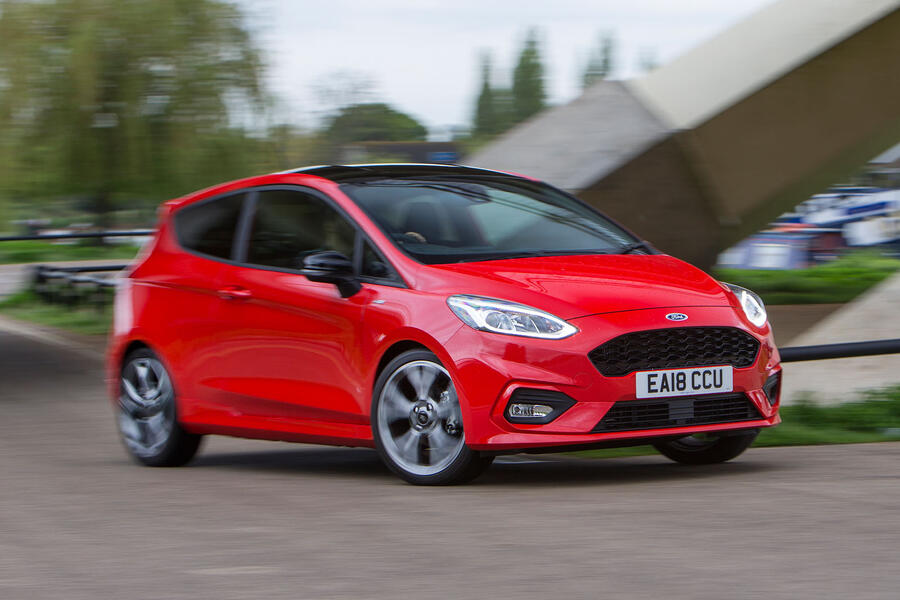
These latest figures suggest there is still strong demand for the sort of small combustion cars that are being forced out of production for legislative and economic reasons – a view that is reinforced by their relatively strong residual values.
A three-year-old Fiesta with 30,000 miles in Titanium trim is worth around £11,500, compared with an equivalent Puma at £13,500. While the Fiesta cost £18,655 when new in 2022, giving a depreciation rate of 38%, the Puma Titanium was £24,940 when new, a 46% decline in value.
As well as naming the UK’s latest best-selling used cars, the Society of Motor Manufacturers and Traders (SMMT) revealed that second-hand car sales rose above four million units for a half-year period for the first time since the pandemic. By contrast, new car sales have yet to recover to pre-Covid levels.
SMMT CEO Mike Hawes said: “Surpassing the four million half-year milestone for the fi rst time since 2019 shows the UK’s used car market is building back momentum. To maintain this trajectory, a thriving new car market must be delivered as well.”
What about used EV sales?
Between April and June, used EV sales grew 40% year on year – the biggest powertrain rise – to 68,721. This accounted for 3.4% of the market. Tesla’s Model 3 was the best-seller.
The SMMT says further growth will hinge on uptake being driven by factors such as the Electric Car Grant, which will result in more EVs filtering through to the used market over time.
Meanwhile, sales of used hybrids and PHEVs also increased by 27.7% (to 100,127 units) and 10.3% (to 24,370) respectively.

How Speeding Fines for Driving 10 Over Differ Across the US

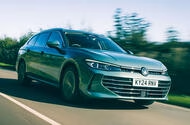
Volkswagen Passat Reinvents the Estate Car with Hybrid Power and Timeless Versatility
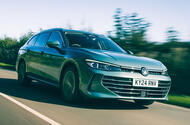 Stalwart family hauler goes estate-only, with choice of petrol and plug-in hybrid powertrains Traditional estate cars like the Volkswagen Passat can feel like something of an endangered species, but look closer and you will see that there are still plenty of new ones entering the market.There's the BMW 5 Series Touring and Mercedes-Benz E-Class Estate (here's how they compare), as well as the Audi A5 Avant, and Volvo even reintroduced the V60 and V90 to the UK after a brief absence.Other markets don’t care for them, but here in Europe the estate car remains very popular.The enduring usefulness and popularity of the estate car, combined with the fact that the Passat is the firm's oldest nameplate (pre-dating the Golf by one year), made it inconceivable that there wasn’t going to be a new generation. And Volkswagen really is going all in on the estate, as the Passat isn't even available as a saloon any more.Still, this ninth generation has had quite a different genesis from previous iterations. It was developed alongside the Skoda Superb, with the project actually led by Skoda. Although it’s unusual for it to be effectively spun off the Superb, it’s not the first time the Passat has used the bones of another Volkswagen Group car: a number of earlier generations were based on the Audi A4.The Superb got the full five stars when we road tested it in diesel form, so it’s a good start. The question is whether the Passat can still justify its existence next to its Czech cousin.
New Guidelines Urge Engineers to Rethink Speed Limits for Safer Roads

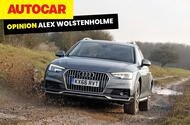
Why Lifted Estate Cars Vanished from UK Roads and Why Drivers Still Miss Them
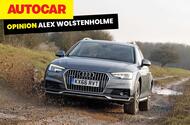 What could be better for tackling the treacherous M2 than an A4 Allroad?
I can’t quite believe it: there are now no lifted estate cars on sale in the UK.
With confirmation that the new Subaru Outback won’t be coming here, they’re all gone. What ever happened to the Seat Leon X-Perience, Vauxhall Insignia Country Tourer and Toyota Corolla Trek? Then there was the Skoda Octavia and Superb Scout duo, Mercedes’ All-Terrains, Volkswagen’s Alltracks, Volvo’s Cross Countrys and Audi’s Allroads.
If they’re seemingly so unpopular, why do I love them? First, a history lesson – and it starts with, of all people, the Americans. A nation of households owning multiple land yachts creating a new segment for practical compact cars.
Enter, in 1979, the AMC Eagle Wagon, with raised suspension and full-time four-wheel drive. It was another original idea from an ingenious company fighting ‘the big three’ on a shoestring. The Eagle struck a chord with buyers in rural and snow-prone areas – before being killed by Chrysler’s purchase and eventual shuttering of AMC.
Spiritual successors followed in the form of the 1994 Subaru Legacy Outback (the model that really kick-started the trend), the 1997 Volvo V70 XC and 1999’s A6-based Audi Allroad. Soon everybody was at it: Peugeot had the 508 RXH, Saab the 9-3 X and Alfa Romeo the 156 Crosswagon, to name a few more.
To me, such cars present themselves as the perfect all-rounders. That is to say, slightly more versatile estates. They combine the benefits of better handling, fuel consumption and styling with the all-terrain ability of an SUV. In fact, most of them could probably outperform the average school-run SUV on the rough stuff.
And yet despite the number on offer, they were never actually that popular. I suppose that sensible estate car customers don’t need four-wheel-drive capabilities (let’s be honest, with modern tyres, pretty much no one does) and SUV buyers like theirs purely because they enjoy sitting higher up than other road users.
As a result, they’re now all gone in this country (bar a few more months of the front-wheel-drive Ford Focus Active Estate and the six-figure Porsche Taycan Cross Turismo), and even in Europe Mercedes and Audi are the only ones still pursuing the idea.
I’m an owner of a low-slung estate who has no real need for four-wheel drive, but on the apocalyptic roads of rural-ish Kent, I regularly find myself wishing for additional suspension travel and a chunk more tyre wall.
It turns out that in today’s Britain, the perfect all-rounder is not a BMW 3 Series Touring but an Audi A4 Allroad (with a diesel V6, obviously). I’m off to Autotrader, then, while praying that Audi will bring the next A6 Allroad here.
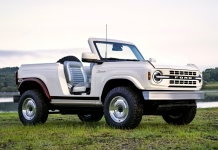
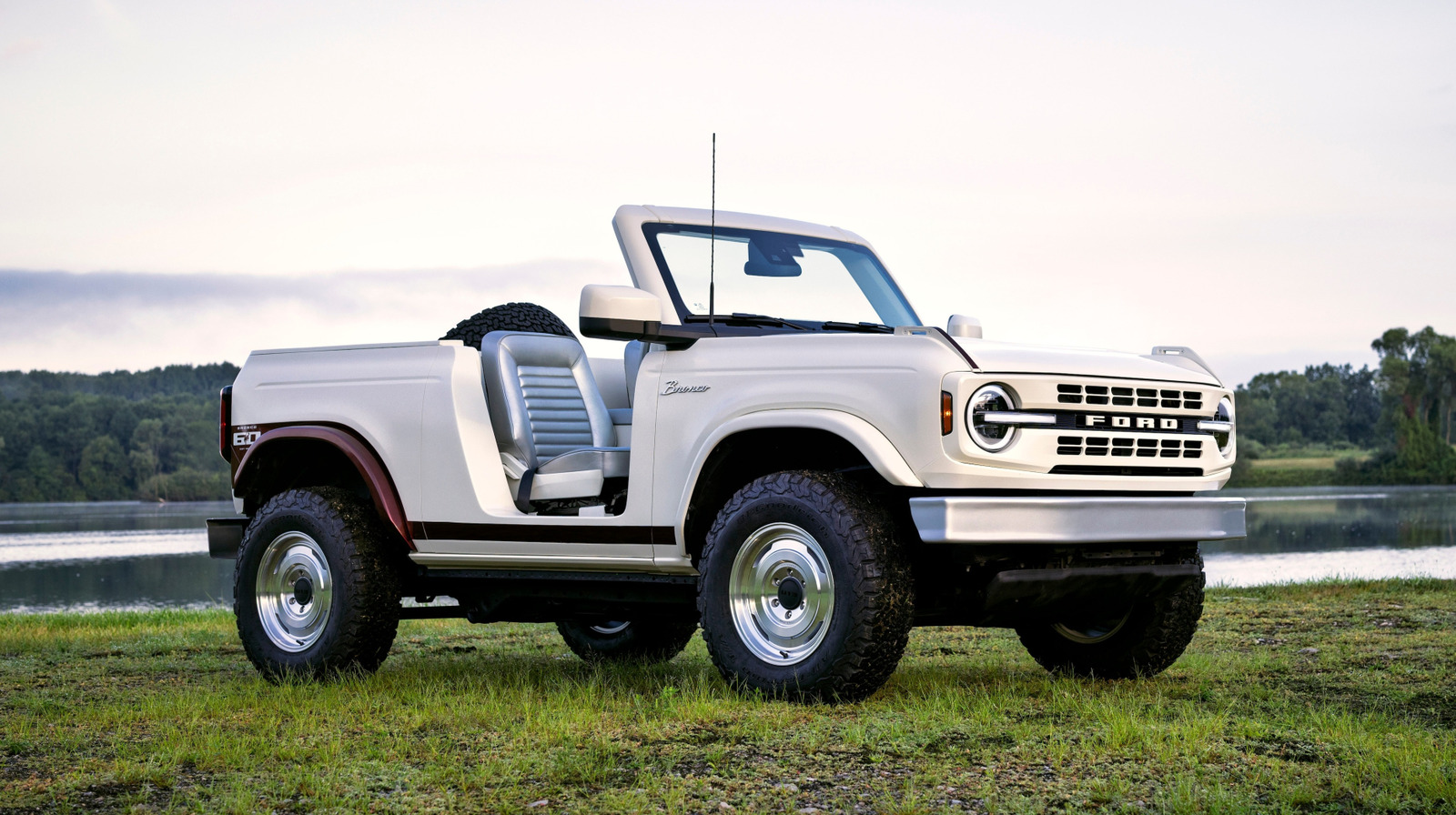
Ford’s Bold Bronco Concept Redefines Open-Air Adventure
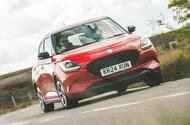
Why the 2025 Suzuki Swift Is the Last Great Fun-Sized Hatchback
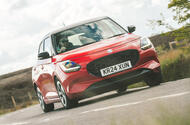 Fourth-generation take on a pint-sized old favourite leaves the fleet
If there was one adjective to describe the vast majority of contemporary cars, it would surely be ‘overcomplicated’ – with ‘big’, ‘heavy’ and ‘expensive’ jostling for position not far behind.
There are myriad reasons for this – safety regulations and consumer buying trends among them – and they’ve been discussed at great length before. But the long and the short of it is that there are relatively few small, light cars compared with 15 years ago.
In fact, if you leave out featherweight track specials from firms such as Radical, Caterham and GMA, or quadricycles such as the Citroën Ami or Mobilize Duo, there are just five sub-tonne cars on sale today: the Toyota Aygo X, the Dacia Spring, Hyundai and Kia’s i10 and Picanto siblings, and this, the 984kg Suzuki Swift.
It’s easy to forget just how long the Swift name has been on the UK scene. We first heard it in 1984 as the export name for the Suzuki Cultus, a three-cylinder, ultra-low-cost hatchback.
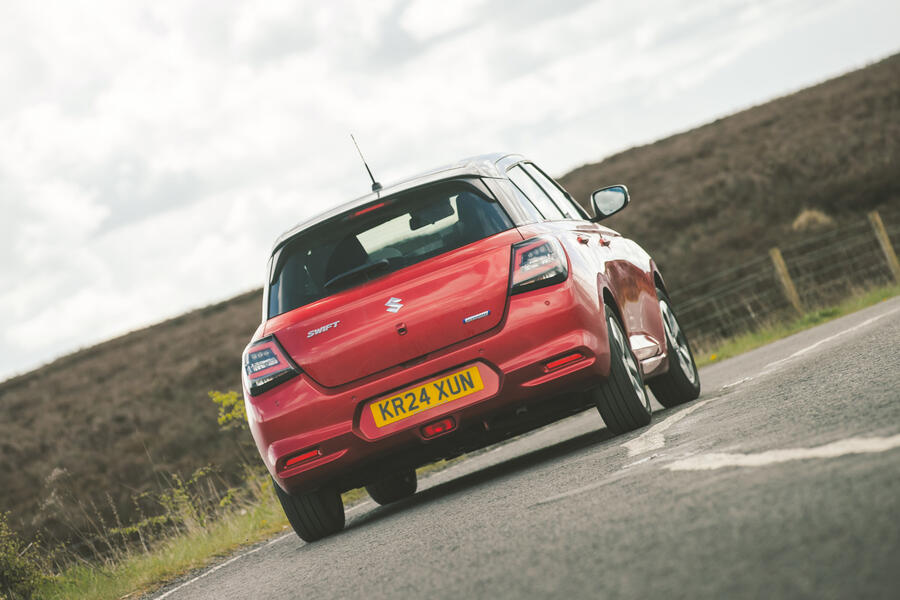
The model proved to be an immediate hit, being sold all over the world under no fewer than nine different names, and in 1988 it was replaced by a second-generation model that took the nameplate all the way through to 2003.
The Swift as we know it today was revealed a year later. It differed somewhat from its predecessor not only by being more concerned with presenting itself as a sporty, stylish supermini rather than simply the most accessible form of motoring around, but also by focusing its aim squarely on Europe.
Four-cylinder engines replaced the rough threepots of the previous generation and it sat on an all-new, albeit heavier, chassis – and we loved it. With its exceptionally well-balanced mix of ride comfort and cheekiness, the Swift always managed to be among the more fun hatches.
But it felt just as well screwed together as anything else, which marked a serious step forward for Suzuki. The Swift got better as time went on, with the introduction of all-wheel drive and continuous updates, and 2010’s second-gen car was even better than the first.
In 2016, the third-generation Swi moved to the stiffer and lighter Heartect platform, which cut weight by more than 100kg despite the three-door option being dropped and the car growing slightly overall.
That’s the platform on which this new fourth-generation car sits, hence the low weight, but more has changed than you might think.
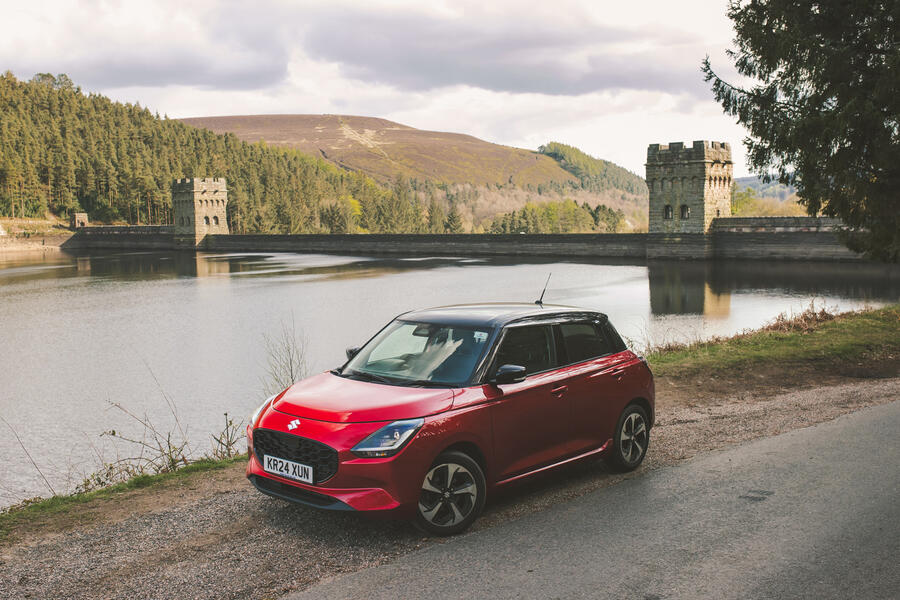
The first thing you notice is the styling, which is sleeker than before despite a somewhat blobby grille. Suzuki says drag has been reduced by 4.6% compared with the previous model, so it’s clearly there for a reason.
Behind that lovable (but somewhat deep-sea-fish-mouthy) face is a new engine, with Suzuki having reverted back to a three-cylinder formula. It’s a little 1.2-litre unit, but unlike most engines of a similar size, this one hasn’t had a turbo bolted on.
It relies instead on a fantastically high compression ratio of 13:1 to provide power. Not that there’s a lot of it, mind you: just 82bhp all the way up at 5700rpm, with peak torque of 83lb ft coming in at 4500rpm.
That’s not to say that it’s completely unassisted, though, because there’s also a 12V hybrid system that’s about as mild as a chicken korma. It’s more or less a glorified starter motor that very occasionally gives a tiny boost to the sweet little three-cylinder up front.
A 0-62mph time of 12.5sec isn’t as swift as the badge might lead you to expect, but you’ll have a fun time getting up there thanks to a proper 1990s throwback in the form of a five-speed manual gearbox.
It’s one of very few cars still fitted with one, and it’s a real peach of a thing with a fairly short throw and a smooth but precise shift. I’d probably go as far as to say it’s among the best gearboxes fitted to anything on sale, making its equivalents from Vauxhall and Volkswagen feel like you’re stirring soup in comparison.
We’ll see how much I’m waxing lyrical about it when I’m stuck in the sub-walking-pace traffic that is the bane of the manual gearbox user’s existence, but from a purely emotional perspective, the gearbox is a thing of beauty.
The gearbox goes hand in hand with the Swift’s light but stiff chassis and reassuringly weighty steering, all of which make it a hoot to drive.
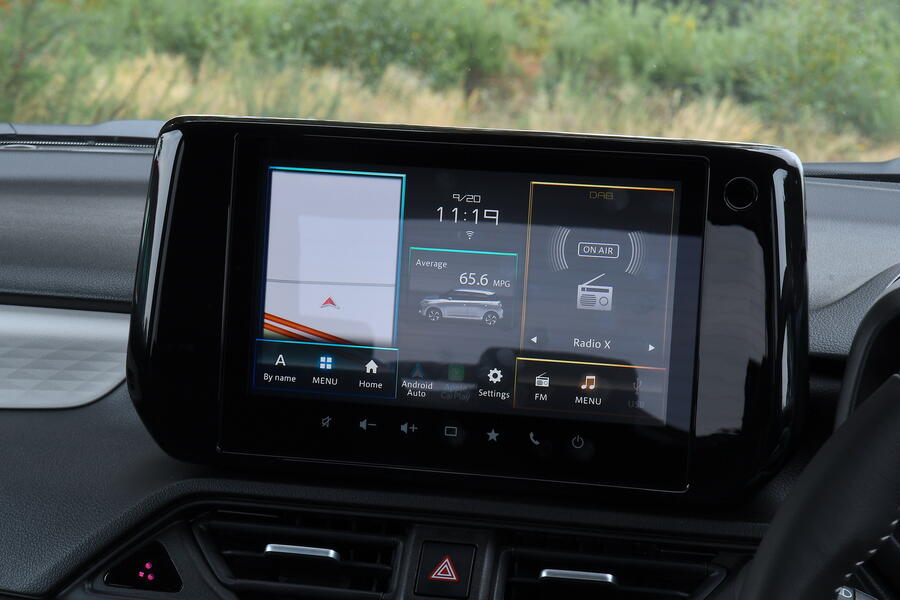
It serves a more sensible purpose, too: with light weight comes low fuel consumption. Suzuki claims an impressive average figure of 64.2mpg, which makes sense when you consider how little weight there is to push around. Light cars, eh? They’ll never catch on.
On initial impressions, the Swift feels reassuringly solid despite that 984kg weight – a gure I keep mentioning because I almost can’t believe it in this day and age.
Another wonderfully simple part of the Swift is the model hierarchy. There are just two trims to choose from: Motion, the base spec we have here, or Ultra.
The former has pretty much everything you would ever need, such as heated seats, cruise control and a reversing camera.
The interior is best described as sparse but comfortable, with a well-sized and well-placed screen in the centre, a bit less road noise than some other small hatches and a delightfully old-school manual air-conditioning system – not to mention some actual physical dials on the dashboard.
It’s so basic yet so charming. Once I work out how to turn off the ADAS, I think I’ll be in danger of getting too attached to this tiny treat.
Update 2
There’s a saying in the automotive journalism world that the first 50 yards you cover in any car are by far the most important, because that walkable journey should tell you what to expect.
And upon picking up my new Suzuki Swift from the Autocar office in the dark heart of suburban driving hell (otherwise known as Twickenham), I knew I was in for a treat as soon as it turned a wheel.
For better or for worse (in my eyes, the latter), a decent, classic-style city car is something of a rarity these days. Finding a manual one is like finding a Hot Wheels model you buried on a beach as a child: not impossible but certainly extremely unlikely and extremely rewarding if you do.
And that’s exactly how this car felt when our garage spat me out onto the mean streets of south-west London: rewarding. It’s such a refreshing experience to drive a car that knows exactly what it’s meant to do, and the Swift is so smart on so many levels.
Let’s start with the obvious. A city car should be small, and the Swift certainly is, coming in at just 3860mm long and 1735mm wide: a whole 424mm shorter and 54mm narrower than the Volkswagen Golf. But the key to the Swift isn’t just this diminutive set of dimensions; it’s how it uses them.
Right in front of you, a gigantic windscreen stretches from the seemingly floor-level scuttle all the way up into what might as well be the heavens for all the good it does, giving you visibility that’s unparalleled in pretty much everything else around these days.
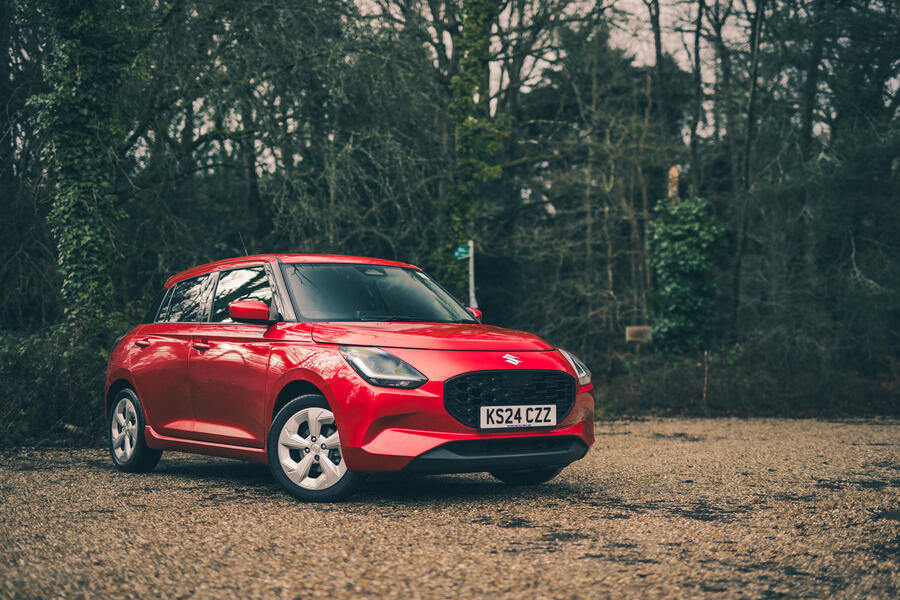
One of the biggest gripes I had with the Swift-rivalling Vauxhall Corsa that I ran before was the appalling front visibility: a small windscreen and a big mirror meant it was like trying to drive around with a handbag on your head, while the front seemed miles off.
None of that here: tour bus drivers look on with envy at the expanse of glass in front of my head and I can always be certain how much distance there is in front of the nose.
What goes hand in hand with these minuscule measurements to make a city car great around town? Light, quick steering, of course, and the Swift’s is exceptional. It simultaneously manages to be more than easy-going enough to make wheeling the car around square junctions a joy while giving enough feedback and having enough weight to ensure that you won’t just be happy going around roundabouts but actively seeking them out.
It avoids the pitfalls of overly light action and complete lack of feel that all too often plague modern cars too. Steering this good is hard to find on anything these days, so for a sub-£20,000 car to have it is really quite special.
Now, the gearbox. On paper and in the (very small) sensible part of my brain, a manual shouldn’t really belong in a city car these days. There are few things in life as irritating as moving with a flow of traffic that’s just fast enough to need drive but too slow for first gear to be of any use.
I would be lying if I said the Swi were totally exempt from that, although the light clutch is fairly well suited for such a scenario. But as soon as a queue clears even a smidge, you will be so glad for the manual.
This ’box is so much fun that I find myself needlessly going through the gears just for the sheer hell of it. Short throw, great action, precise selection: it’s got it all. More manufacturers should think like this, I think.
All of this adds up to give the Swift the featherweight agility of a wasp and the lovable character of a small dog. And the real kicker? It’s just as good outside of city limits. More on that later…
Update 3
It’s safe to say the Swift has earned the affections of much of the Autocar office in a way very few cars recently have. I haven’t been so inundated with people wanting a go in my long-term since I ran a Toyota Corolla Commercial, when it seemed 75% of my colleagues were moving house.
The last time you saw my Swift, it was actually a different, Motionspec car. That was involved in an unfortunate incident with a high kerb, necessitating its replacement by the Ultra model you see here, with its black-painted roof, diamond-cut alloy wheels and – gasp! – automatic climate control.
Anyway, the change of spec hasn’t diminished the Swift’s wonderful about-town ability. Its combination of compact dimensions, outstanding visibility and impressive manoeuvrability makes me wonder why anyone would ever want to drive anything else in a world filled with tiny parking spaces, awkward junctions and an ever-increasing number of people in massive SUVs who can’t handle the size of their own car.
I was genuinely taken aback when I managed to spin it around in a one-and-a-half-lane road in a single fluid movement the other day. That’s what a 4.8m turning radius gets you, I suppose.
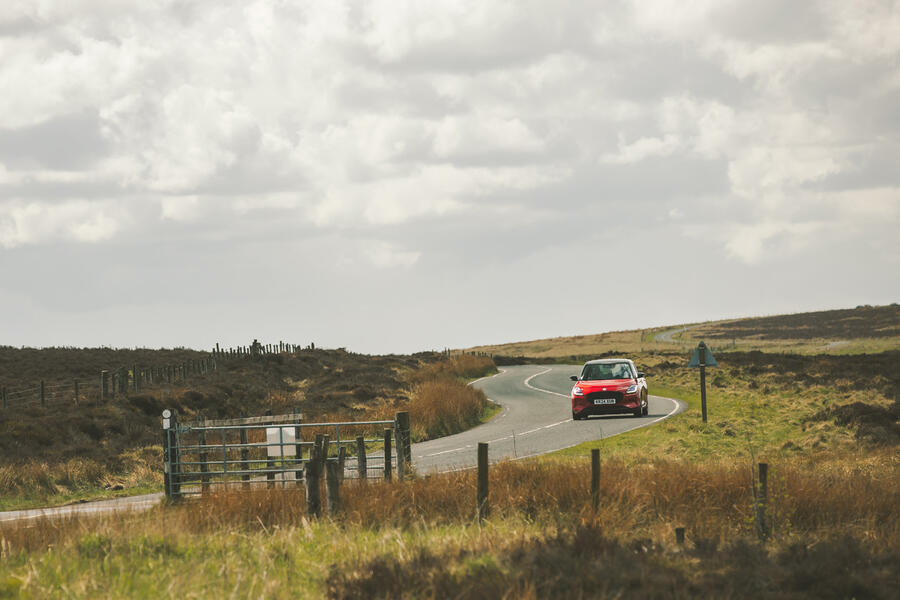
As great as it is around town, there’s another seemingly unlikely place where it excels: on a Great British country road. You know the kind I mean: a flowing B-road that winds its way through the scenery, filled with sharp corners and blind crests.
In other words, the sort of road you would drive down and think ‘phwoar, they could run a rally down here’. I can think of very few cars on sale that are more fun down such a route than the plucky little Swift.
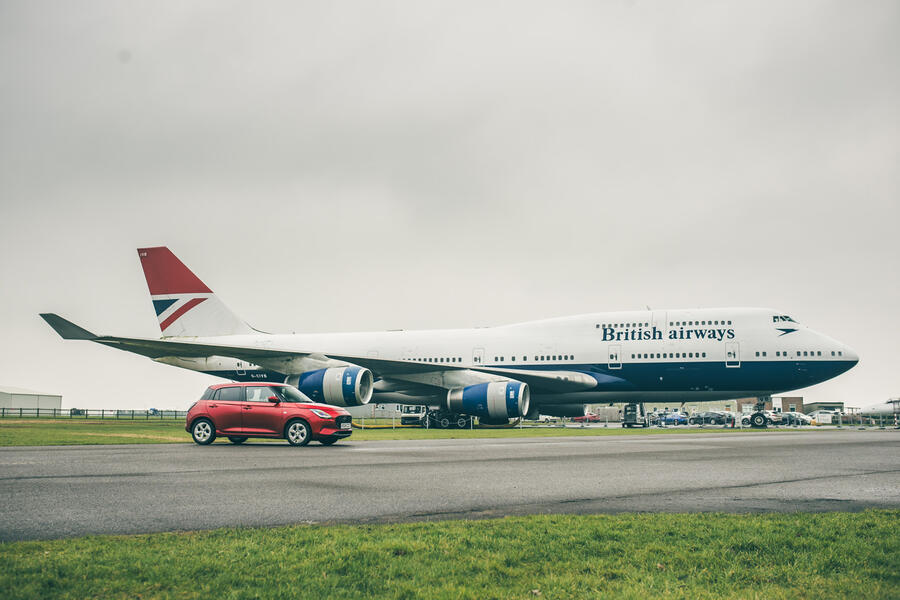
Sure, perhaps part of the reason for that is there are so few cars like it on sale any more. As I’ve noted before, there are now just seven cars on sale that weigh less than a tonne, excluding lightweight specials such as Caterhams, so anything this light will naturally feel a bit out of the ordinary in the sanitised times we live in.
Suzuki’s Heartect platform, devised for the previous Swift of 2016, is highly competent. It isn’t the stiffest, but that’s a good thing to my mind, because otherwise the Swift could have become too firm for Britain’s battered roads.
As things stand, it strikes a pleasing balance between comfort and fun, feeling lively enough on a spirited drive but not rattling my teeth out on a cruise. It’s well damped, with a fantastic primary ride that really flattens out the road without robbing it of agility.
There was always going to be plenty of that, of course, with such squat dimensions and a wheel effectively on each corner. The turn-in response, aided by communicative steering that’s reassuringly weighty at speed, is genuinely impressive.
However, it must be said that the eco-spec Yokohoma tyres are not, running out of grip well before they ought to. Pair this with the understeer bias present in pretty much every supermini you can think of and the Swift’s limits are a bit closer than you would hope for on a wet road.
Still, it really is a joy to thread along a snaking back lane. There’s a saying that it’s far more fun to drive a slow car quickly than a fast car slowly, and that certainly rings true with this.
Its thrummy little atmo threepot has an unexpectedly guttural rawness to it, really encouraging you to take it all the way up to the redline – something you have to do anyway with just 82bhp on tap and peak power not coming in until 5700rpm – and the smooth shift at the end just keeps the fun going.
Best of all? You can rag it as hard as you like and you will still achieve more than 50mpg. Let’s see your Porsche 911 GT3 do that. Or get through a width restriction.
Update 4
I first became acquainted with the latest Swift at a Society of Motor Manufacturers and Traders vehicle test day, where Suzuki was stationed and its entire model range available to be driven. I was besotted.
Its poised, neutral-feeling chassis and tactile steering were a delight, as was its incredibly satisfying manual gearbox. So when photographer Jack Harrison rocked up in his Swift long-termer, I leapt at the chance to drive one again.
And yes, while it is brilliant to have a small, light car with an economical petrol engine and a clutch pedal, I used the Suzuki for something slightly different: getting to know London.
I still don’t know the intricacies of the capital’s tight, complicated and incredibly busy road network. But what better car in which to learn it than one with a light clutch, great all-round visibility and an engine with decent low-down grunt?
The Swift feels made for this sort of thing: negotiating width restrictions, dodging aggressively driven delivery vans and squeezing past buses. There are plenty of obstacles no matter where you go in London.
But like a Border Terrier at Crufts, the Swift negotiates them with a plucky, fun sense of determination and keenness. It also isolates you well from the hubbub. Suzuki added extra soundproofing for this generation, plus extra baffle plates in the A-pillars and thicker carpets.
As a result, the car feels almost as re ned as a Volkswagen Polo or Renault Clio, but with the incisive dynamics typical of a small Suzuki.
Fitting into tight parking spaces is easy, too, aided by good visibility and light steering, and it being narrower than a Clio and Polo means I need not avoid the Hogarth Flyover – a narrow bridge whose width restrictions have claimed many mirrors and layers of paint.
The one problem with these compact proportions is that the 265-litre boot is one of the smallest in the class. In my time with it, I had to decline a friend’s request to take their Labrador to the park.
My time in the car ended with a motorway stint to Kent. Over the one-and-a-half-hour, 60-mile journey, the Swift averaged 63mpg: pretty impressive considering most of it was in stop-start traffic. If you need right-size, economical transport for a tight, congested city, you can do far worse than the Swift.
Jonny Bryce
Update 5
My time with the Swift really is something of a love story.
There are so many things to like, from the practical stuff like the fabulous fuel economy (now approaching 58mpg with gentle pedal use from my feet of lead) and a surprisingly large boot capable of holding far more rubbish than you would think, to elements I’ve mentioned in previous reports such as the impressive turn-in response and one of the greatest manual gearchanges of any car on sale today.
That’s not to say it’s all sunshine and roses, mind. A dashboard-shaped slug has crept into my rose garden, and a starter-generator-shaped cloud has drifted over it.
Regular readers will know that this is actually our second Swi – not through any fault of its own. We just wanted to try out both trim levels from the refreshingly simple model range.
The first one was a base-spec Motion, while our current black-roofed car is the slightly more premium Ultra.
The nice thing about running two examples of very similar cars is that it lets you see whether a problem is simply an outlier, a bit of bad luck thankfully exclusive to a singular vehicle, or something that’s an inherent flaw across the range.
I’ve noted a couple of things that both our cars experienced. The most consistent and irritating one concerns the dashboard itself – something I actually rather like, with it being so low down and intuitive.
It’s not the design of the dashboard that’s the problem, though. It’s the build. The interiors of both our cars seemed well put together when I had a poke around them after delivery, but as the miles wore on some strange noises affected both.
After each car reached around 8000 miles, a rattling sound could be heard from the dashboard.
It’s worth mentioning that the interior of the Swift isn’t exactly library quiet (colleagues often comment that it sounds like I’m speaking from inside a tumble dryer when I’m on a hands-free phone call), so a squeak has to be fairly loud to be noticed, especially at speed.
The noise would normally be set o by the crashy secondary ride, but I couldn’t quite work out where it was coming from. It seemed to be emanating from the left side of the dashboard, but no in-car rattle has ever come from where you thought it would be.
I realised I could pause it by gripping the top of the central touchscreen, so I can reasonably deduce that it’s the source. Not ideal, and slightly concerning that it’s happened to both of our cars.
The other issue is less common but more serious. Several months ago, when the weather was much milder, I left the original Swift out in the cold for two days – not a long time to leave a car to its own devices, and it wasn’t really that chilly (around 8deg C).
Despite this, it had a real struggle to start, with the generator spinning but failing to spark the three-cylinder into life. This went on for maybe 15 seconds, while I was pumping the throttle just in case, before it roared into life.
It happened only once, and I viewed it as just something of an oddity, and the car went back to Suzuki without ever doing it again.
However, several months later I rushed out to the Swift Ultra, ready to start my schlep over to the Aston Martin F1 factory to photograph boss Lawrence Stroll for last week’s Autocar Awards issue, only for it not to start.
This time, it took about four attempts over the course of a minute to resuscitate the engine, which sounded uncannily like a diesel locomotive attempting to splutter into life from a very cold start.
I’d been out in it the day before, though, and had left it for about six days straight with no issues previously. Aside from that, the car has been trouble-free, but it’s the sort of thing that makes me feel like I can’t fully trust it.
Final update
Time and again we’ve seen the humble hatch’s resilience tested. Public desire for two-tonne SUVs and big-name manufacturers’ claims they can no longer turn a profit developing and selling small cars have made sure of that.
The list of reasons why city cars and the like are vanishing goes on – and it makes me sad. Which is why I’m so glad that Suzuki has persevered through the challenges to continue making an excellent small car in the shape of the Swift.
My time with this pint-sized beauty has been wonderful. I wasn’t quite sure what to expect initially, because I’d been running a Vauxhall Corsa Hybrid beforehand, and that hadn’t been a shining beacon of excellence for the small car oeuvre, with its woeful ride, sub-par visibility and hefty price. Thankfully, the Swift turned out to be a breath of fresh air compared with that Corsa.
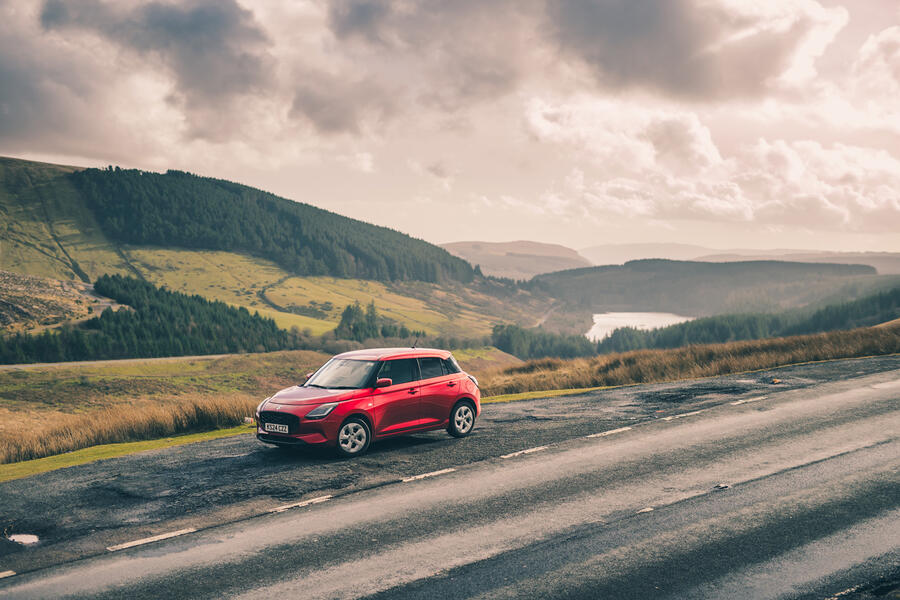
As soon as you get in to the compact Suzuki, you notice that everything is just that bit nicer. The interior materials immediately feel more pleasant to the touch, and the dashboard and control layout is slightly more intuitive.
There is also a plethora of real, physical buttons in an easily accessed place below the central screen. Things continue to improve from there. One of my favourite attributes of the Swift is its (relatively) huge windscreen paired with a very low scuttle and dash.
It has the effect of making this small car feel so much bigger inside by letting in loads of light. Naturally, it allows for great sight lines, too, especially with the A-pillars sited so far back, which provides fantastic mid-corner visibility.
It’s also useful around town. The Swift is far and away the easiest car I’ve ever had to parallel park, with loads of steering lock, tiny overhangs and a really clear reversing camera.
Add in a boot that’s big enough for the weekly shop – thanks to a surprisingly deep floor – plus a cabin that’s comfortable for four and only slightly uncomfortable for five, and you’ve got the perfect city car.
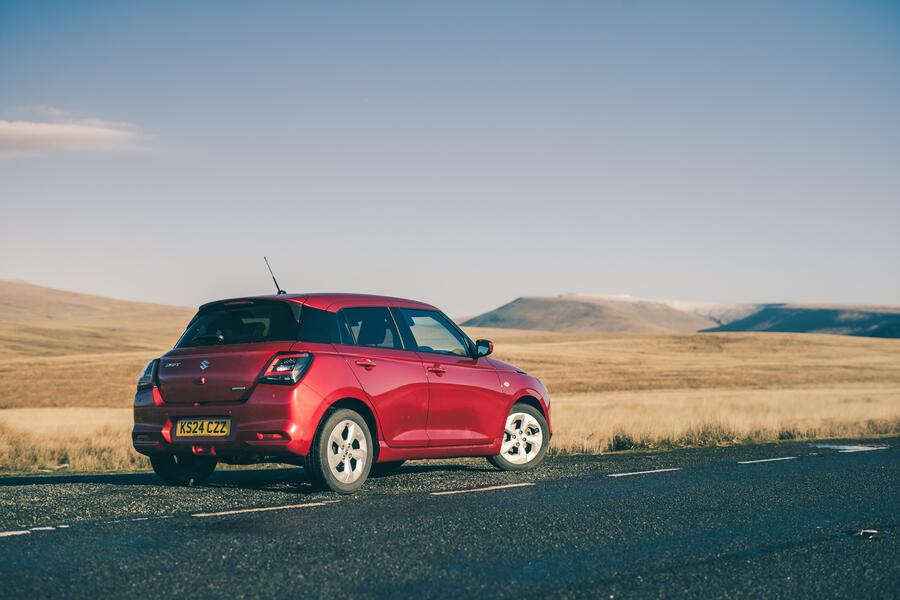
Its diminutive footprint helps with all of this. To put that into perspective, at 3860mm long the Swift is a substantial 500mm shorter than a current BMW 1 Series, and it’s 65mm narrower than that car.
Paired with the well-weighted steering, this size makes it a true joy to whizz around town in. So it’s great in an urban environment, but where I think it really shines is out in the sticks, where it reveals itself to be a secret driver’s delight.
As economical as that three-cylinder engine is, it’s also a characterful motor when pushed. What it wants for in torque it makes up for in sound, emitting a noise like a rally car as it buzzes away up front. And I have to mention the gorgeous gearshift: it slots so smoothly into each gear, and the pedals are perfectly spaced for some heel-and-toe action.
The wheel-at-each-corner layout helps the car to be nimble, with amazing turn-in ability. It makes you feel like François Delecour on a Tarmac rally stage and serves as a reminder of how great the small, light hatchback can be, bringing to mind classics such as the Peugeot 205 GTi.
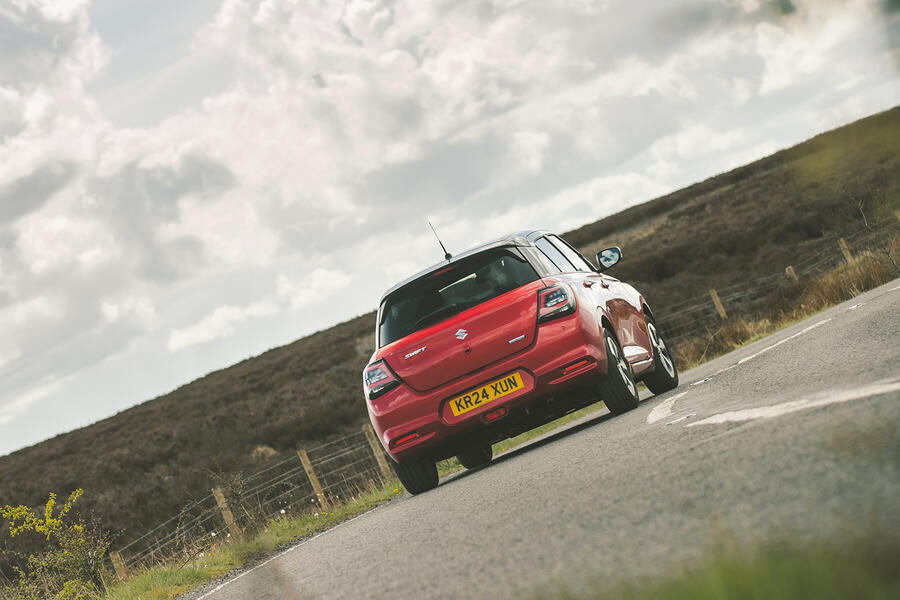
This is where the Swift stands above something like the similarly priced Hyundai Inster. That car is roomier inside, narrower outside and just as cheap, but it’s nowhere near as much fun when you’re behind the wheel.
If it’s the old-school characteristics that make the Swift so great, then it’s the new regulatory features that make it not quite as good as it could be.
In their operation, the ADAS functions are the most infuriatingly poor I’ve yet to encounter, with driver detection that goes off if you look out of the window to see if a roundabout is clear, lane keeping assist that seems intent on dragging you off the road and an ear-piercing speed ‘beep’ that berates you for transgressing over the speed limit, which all too often it has read incorrectly.
That speed setting is hidden in a menu on the central screen, too, and can’t be deactivated on the move. At least the lane keeping assist can be switched off with a small button underneath the ignition switch, although it’s right next to the one for the traction control, and I’ve lost count of the times I’ve hit that instead.
The central screen isn’t a strong point, either. It will interrupt your Apple CarPlay session to tell you it might be cold outside by way of a 1990s-style bar notification slowly loading on the display, and if you get another interruption (usually it’s for low fuel), the bar for that will load on top of the previous one, giving you two irritating distractions that need to be tapped away.
Neither of those nitpicks can detract from the Swift’s compactly proportioned greatness, though. The small hatch has life in it yet.
Swuzuki Swift 1.2 Mild Hybrid Ultra specification
Prices: List price new £20,799 List price now £20,799 Price as tested £21,649 Options: Burning Red and Super Black paint £850
Fuel consumption and range: Claimed economy 64.2mpg Fuel tank 37 litres Test average 56.2mpg Test best 61.7mpg Test worst 52.3mpg Real-world range 456 miles
Tech highlights: 0-62mph 12.5sec Top speed 103mph Engine 3cyls, 1197cc, petrol Max power 81bhp at 57000rpm Max torque 83lb ft at 4500rpm Transmission 6-spd manual, FWD Boot capacity 265 litres Wheels 16in, alloy Tyres 185/55 R16 Kerb weight 949kg
Service and running costs: Contract hire rate £205 CO2 99g/km Service costs None Other costs None Fuel costs £1308.69 Running costs inc fuel £1308.69 Cost per mile 12 pence Faults Dashboard rattle, reluctance to start
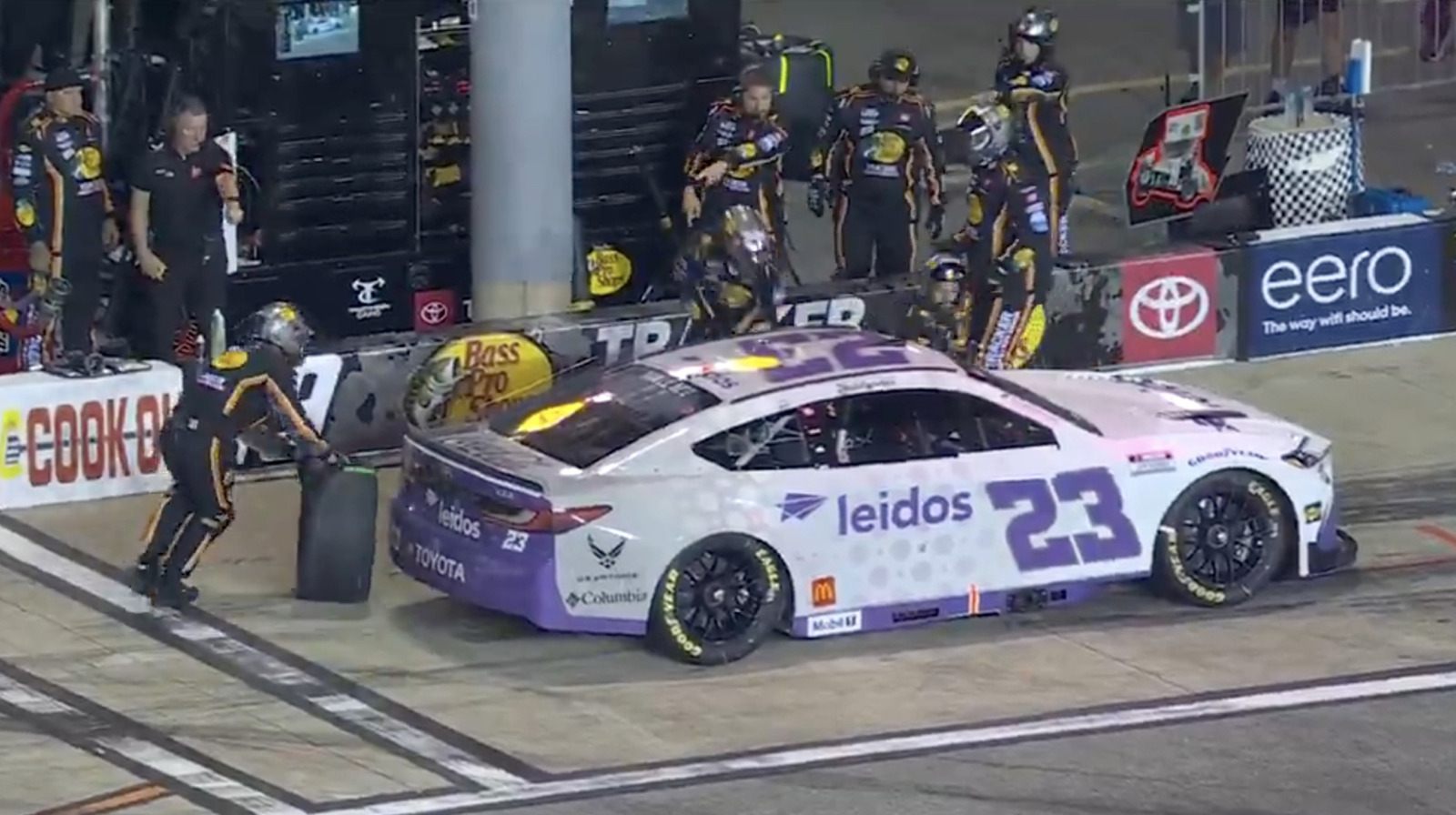
Loose Wheel Drama Unfolds as Wallace’s Car Takes a Hit
Electric 993 Founders Edition Delivers Classic Grand Touring With Modern Power

Boeing’s Supersonic Jet Dream and the Swamp Where It Waited