
Real Cars, Real Stunts: Can You Pull Off Movie Magic on a Budget?
Aston Martin DBX S: The Ultimate Powerhouse SUV Redefining Performance
 New DBX is one of the most powerful pure-ICE SUVs on the market
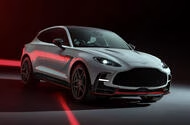
Aston Martin has launched a faster and lighter flagship S variant of the DBX SUV, cranking the power to 717bhp to make it the most powerful non-electrified SUV on the market.
Although the British company has used the S badge for a range of high-performance specials, starting with the Vanquish S in 2004, this is the first time it has been applied to its best-selling SUV.
Aston Martin CEO Adrian Hallmark claimed the new model serves as “a powerful statement of intent”, signalling that lighter, more powerful variants will remain a key part of the firm’s future model plan.
The new DBX S will sit above the current 697bhp DBX 707 - since April last year, the only variant offered in the UK. It retains the same 4.0-litre twinturbocharged V8 but it has been reworked, with larger compressor wheel diameters taken from the Valhalla. Aston Martin has also tuned it to offer more “urgency” at the top end of the rev counter.
While that means the 0-62mph time remains at 3.3sec, Aston claims the 0-124mph acceleration time is cut by 0.3sec.
Meanwhile, a new exhaust system has been fitted to make the V8 louder, the steering ratio is 4% faster and the turning circle has been trimmed by nearly half a metre.
The DBX S’s 717bhp output makes it 2bhp more powerful than its Ferrari Purosangue rival – which draws power from a naturally aspirated 6.5-litre V12 – but still leaves it short of rivals that use electrified powertrains, such as the 729bhp Porsche Cayenne Turbo E-Hybrid and 789bhp Lamborghini Urus SE.
The DBX S retains the 707’s variable all-wheel drive system and nine-speed wet-clutch automatic gearbox, although Aston Martin says the change-up points for the gearbox have been reworked to account for the wider rev range, and the downshifts in Sport and Sport+ modes are more aggressive.
Aston Martin has also significantly reduced the weight of the DBX S by up to 47kg compared with the 2245kg 707. The slimming measures include a new optional carbonfibre roof, which forgoes roof rails and saves 18kg of mass as well as lowering the centre of gravity.
There are also optional 23in magnesium wheels, which are 19kg lighter than the standard aluminium versions, and an optional polycarbonate honeycomb grille.
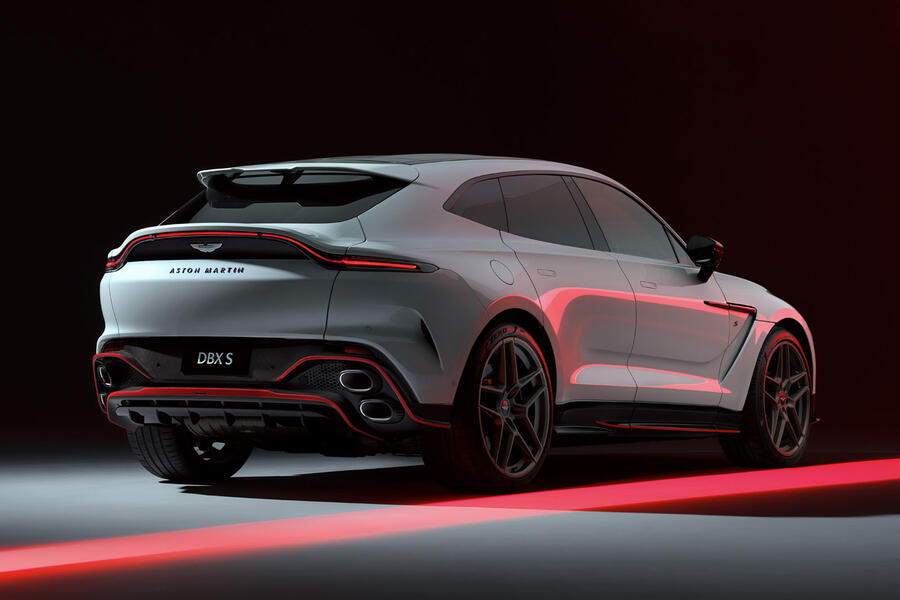
Beyond the weightsaving features, the DBX S gains a number of styling changes, including a new black grille design inspired by the DBS 770 Ultimate, a new splitter and diffuser, and new side sills that help channel airflow around the side of the car.
At the back, the quad exhausts have been vertically stacked, while the rear bumper has been extensively reworked.
Inside, there is a bespoke S design with a herringbone pattern on the seats and this is extended to the headlining if the carbonfibre roof is selected. Alcantara upholstery is standard, while semi-aniline leather and red seatbelts are optional.
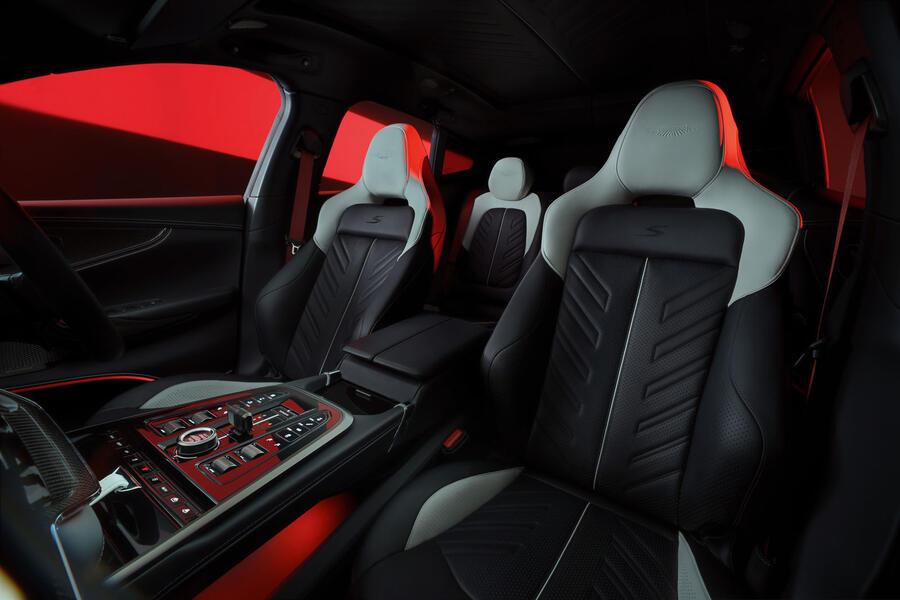
A 14-speaker audio system is standard and a 23-speaker Bowers & Wilkins set-up is also offered.
The DBX S is available to order now and deliveries are set to begin in the final quarter of 2025. Pricing has yet to be confirmed but it will be a step up from the £205,000 DBX 707.
Acura Integra Type R: The $103K Auction Mystery Behind a 10K-Mile Icon
Unveiling the Best Tires for Your Tesla: Consumer Reports’ Eye-Opening Test Results
Roush Nitemare: The F-150 That Turns Corners Like a Sports Car
Trump’s New Trucking Policy: A Threat to Law-Abiding Drivers and an Industry in Crisis
Alpina’s New Chapter: BMW’s Vision for the Future of Performance Luxury
 Renowned German outfit, now part of BMW Group and with its own designer, is poised for new era
BMW will reveal the future of the Alpina next year, as it officially takes ownership of the 60-year-old performance brand and installs a dedicated designer, previously of Polestar, at the helm.
Munich announced it had acquired Buchloe-based Alpina from its founders, the Bovensiepen family, in 2022, but the firm will continue to operate at arm’s length through 2025, having recently launched the B8 GT super-saloon as a swansong for its independent era.
Details of exactly what the future holds for Alpina as it comes under the BMW Group umbrella are unclear, but chief designer Adrian van Hooydonk told Autocar that the company will break its silence in 2026, when the handover is complete.
"Alpina has always been very special to us. We had a very good relationship – and we still do – with the Bovensiepen family who founded that brand," he said. "The Alpina cars are produced in our factory, so there was already a very strong technical tie-up as well.”
"It has been quiet because the agreement that we struck with the Bovensiepen family is such that from next year, we will talk more about it; this year, it is all still under their direction.
"We love the brand and we want it to prosper in the future, but you will see some of that next year."
Historically, Alpina models have been extensively modified versions of BMW models that offer similar power and performance capabilities to their racier M-badged equivalents but put more of a focus on subtlety and touring refinement.
There is no word yet on whether Alpina will maintain that positioning (with dedicated B3 and B5 versions of the next 3 Series and 5 Series, for example), but it's likely that the brand’s cars will henceforth be more obviously differentiated from the cars on which they are based.
Van Hooydonk recently presided over a wide-reaching overhaul of the BMW Group’s design network, with each of its brands swapping design bosses and new dedicated designers for BMW M and Alpina installed.
"I was able to enlarge my team, which is very rare,” he said, “but it's also a token of the confidence that the top management has in our design team. Simply, the workload has grown, so it was actually helpful for me to be able to enlarge my first line.”
Among the significant changes were Mini’s Oliver Heilmer moving across to BMW to replace Domagoj Dukec, who is now leading Rolls-Royce design, and former Polestar design boss Maximilian Missoni joining the German firm to take responsibility for Alpina.
“I feel very good about those changes. It will allow the team to work with more dedication, more attention to detail,” said Van Hooydonk. “I split up the BMW team into two: Max Missoni is taking care of one half and Oliver Heilmer, who was formerly in charge of Mini, is taking care of the other half.”
Asked if that meant there could be more differentiation between Alpina cars, M cars and standard BMW cars, Van Hooydonk said “they are already quite different” but that the foundations have been laid for each brand to take on more of a distinct character.
"It will still remain one design language, but the teams are smaller in size and the workload is now divided over multiple shoulders, and that will simply lead, I believe, to better-quality results, and will set us up for more growth in the near future."

Rebranding from Musk: A Business Owner’s Journey to Align Values and Restore Trust
From Track to Street: The Racing Legacy Behind Everyday Cars
Renault Explores Electric MPV Inspired by the Classic Espace
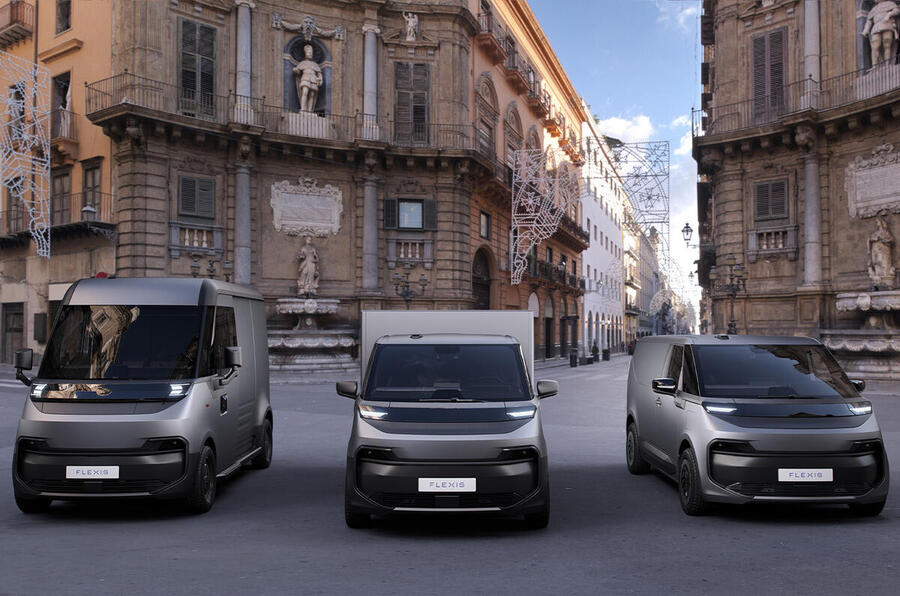
New Trafic E-Tech is smallest of three new electric vans revealed by RenaultRenault’s van-making arm is evaluating an Espace-style people carrier based on new Trafic E-Tech van
Renault is considering an electric MPV to rival the Volkswagen ID Buzz – and it could reprise the radical seating arrangement from the Mk1 Espace.
Unwrapping the new Trafic E-Tech electric van alongside the closely related Goelette and Estafette (below) at The Commercial Vehicle show in Birmingham, Renault van design chief Yannick Bignon told Autocar that a people-carrying version is under consideration: “Today, it’s under study. We have not yet confirmed it, but it's under study.”
Asked whether the skateboard-style EV platform that underpins the trio of vans could allow for more radical seating arrangements, such as the swivelling ‘captain’s chairs’ from the Espace, Bignon replied: “Everything that you say will be the way that we are working on.”
However, he added that it was “too early” to talk in detail about such a version of the Trafic E-Tech, saying: “If we confirm the people mover, it will be [later].”
An MPV is understood to be just one of more than 35 different derivatives of the Trafic, Goelette and Estafette that have been pitched to Renault Group boss Luca de Meo, alongside a camper van and a food truck.
Heinz-Jürgen Löw, senior vice-president of Renault’s van arm, said that such a vehicle “could be a good idea – not yet, but of course we’re looking”.
Hinting at how the van’s design might lend itself to a more conventional passenger vehicle, Löw elaborated: “The beauty of the skateboard is that you can scale it. And we have [prioritised] the manoeuvrability. I think this is the only one-tonne [payload] van with the turning radius of a Clio [supermini].”
The comments reaffirm Autocar’s previous report that a Renault MPV in the vein of the original Espace, after the Espace name was reprised for a seven-seat SUV based on the Austral.
Olivier Brosse, Renault’s global leader for the Ampr Medium EV platform, last year told Autocar that a new model in the vein of the seminal MPV was “something we are contemplating”.
“Technically I think it is possible, but after that we would have to consider if an MPV would be accepted by European customers,” added Brosse.
Notably, Volkswagen has made headway with its ID Buzz since Brosse spoke to Autocar: according to data from analyst Jato Dynamics, it has sold nearly 5000 in Europe so far this year, more than double what it had managed at the same point in 2024.
Kia is also angling for a slice of the market, priming a passenger version of its forthcoming PV5 electric van.
Elsewhere in the world, MPVs are undergoing a revival. They have exploded in popularity in China, for example, where notable recent entrants include the Zeekr Mix, Li Mega and Maxus Mifa 7.