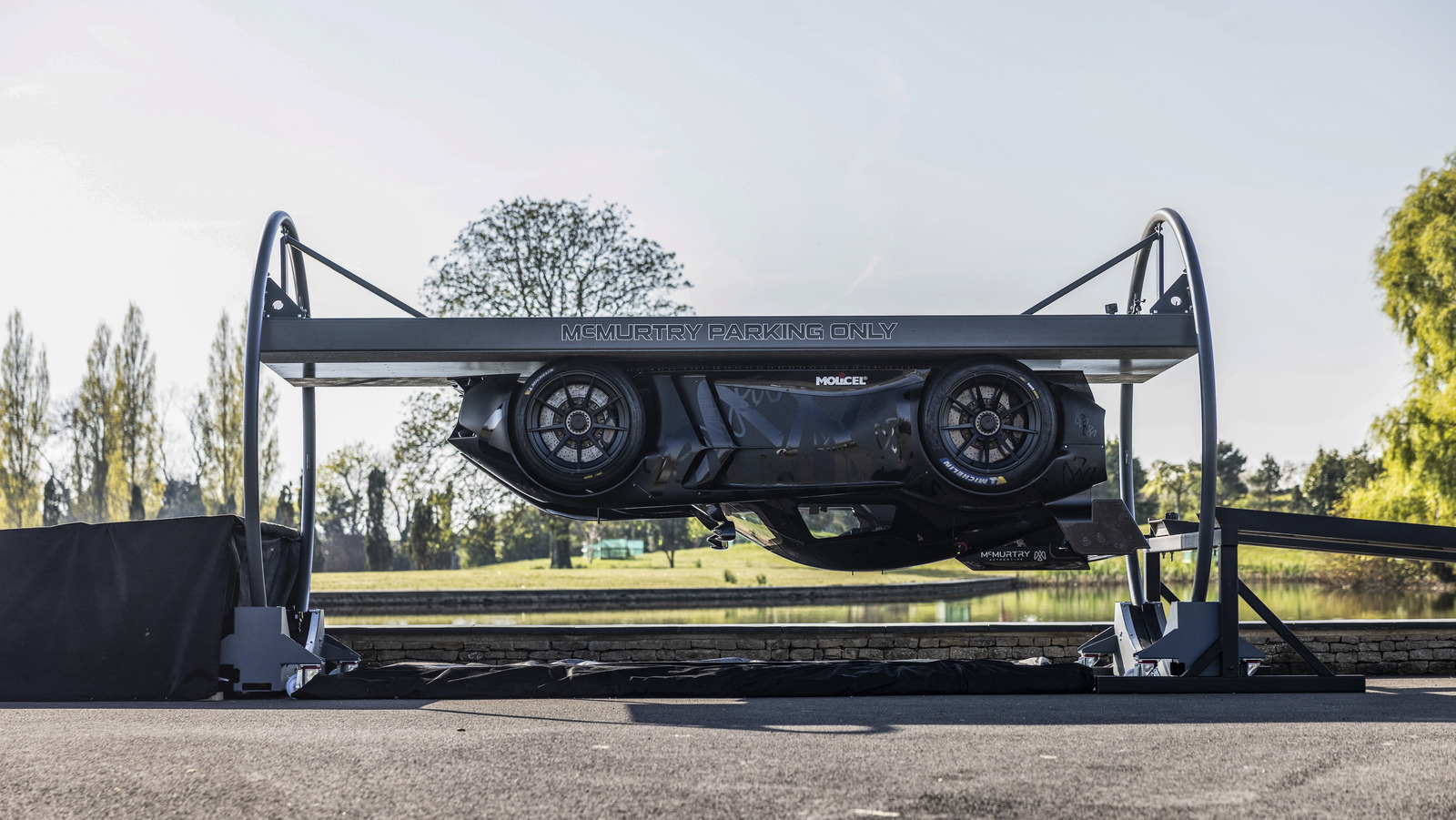
Discover the Magic of the Suction Car: A 17-Minute Journey into Innovative Engineering
Off-Road Legends: Comparing the Willys Jeep and Range Rover’s Capabilities
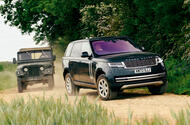
Both of these are unstoppable, but only one gives its driver a full body workoutCan today’s tech-rich, for-the-rich off-roaders tackle the rough stuff any better than the original workhorses?
Ever since God was a child, people have been trying to solve the conundrum of how to get places.
First it was just with our legs. Then we discovered horses and worked out that their limbs were better than ours.
Then, skipping forward a tad, the industrial revolution dropped and the options multiplied tenfold: cars, bikes, trains, planes, scooters, hoverboards and on and on, ad infinitum.
But the fundamentals of getting somewhere tricky have remained remarkably constant in our Autocar world – four bits of rubber shrouding four round bits of metal. And yet, as you can see from the images here, there’s a vast difference across the decades as to how that conundrum is solved.
To the new car, then. It’s the Range Rover plug-in hybrid, and while it’s not ideally suited to out-and-out off-road adventuring (more on that shortly), it is absolutely laden with the latest electronic off-road tech.
You could argue that we should have had the Land Rover Defender on this test, it being the halo off-roader and the ultimate expression of where the capability has got to, but to be honest I’m more interested in where the technology has enabled luxury and mud to mix.
Introducing the Willys Jeep
How far can this tech be pushed? Certainly a chunk further than with the other car here. It’s a Willys Jeep, of the M38A1 variety.
Technically it’s not the oldest of the breed, as this particular one was built in 1955 under licence in the Netherlands (a Nekaf Dutch variant, to be precise), but if Spyker can claim to be the first with a four-wheel-drive passenger vehicle, it’s generally accepted that Willys and the original WW2 Jeep made the genre what it is today. And this car is a successor to that icon of the Second World War.
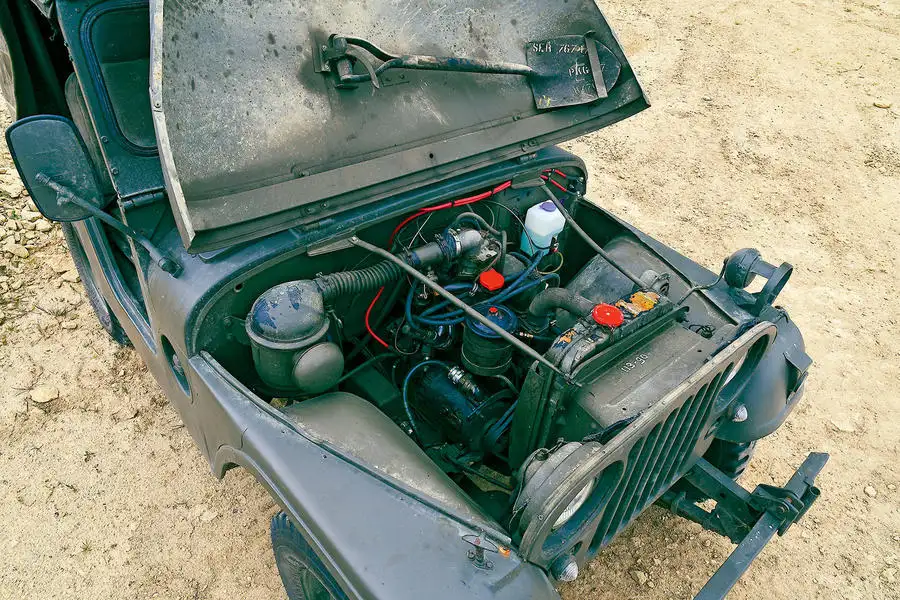
It’s basic in the extreme: leaf spring suspension all round, a choice of four- and two-wheel drive that is switchable by a very long lever, and a high- and low-range gearbox, all powered by a water-cooled, four-cylinder Hurricane engine linked to a three-speed ’box.
There are no doors or heater, and technology is limited to a set of dials, most of which don’t seem to work. If an item isn’t needed in order to fulfil the car’s singular, go-anywhere purpose, it’s not on it.
Introducing the Range Rover
The contrast to the Range Rover is extreme. Here is the car that should be able to drive both to and up the ski slope, with barely a fluster.
Air suspension that can raise the body by 135mm and Land Rover’s first-ever five-link rear axle take care of the comfort, while the six-setting Terrain Response 2, e-locking rear and centre diffs, rear-axle steering with 7.3deg of possible turn and low-speed gearbox mean the off-road box is also ticked.
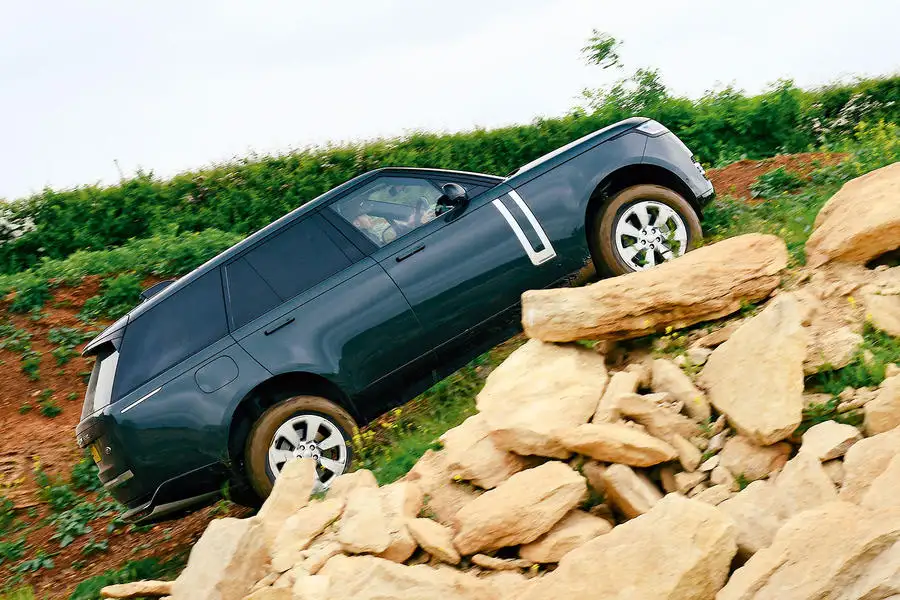
The reason it’s not the ideal Range Rover is because of the PHEV element. While that is enabling us to achieve fuel economy in the mid- to high 30s, the 38.2kWh battery sits low under the chassis, thereby reducing the ramp angle by 2.5deg and the ground clearance by 11mm from a regular Range Rover.
The aim of the day, then, is a simple one. To discover if luxury has blunted ability.
Off-road performance: Range Rover
We start off with a seriously steep drop down into a quarry, where the challenge is not only the angle but also the surface, being a vicious mix of smooth stone and more grippy shale rock.
The four cameras on the Rangie immediately come in handy – although Gerry McGovern’s styling looks good on the King’s Road, it tapers away from the visible edges so the car is difficult to place.
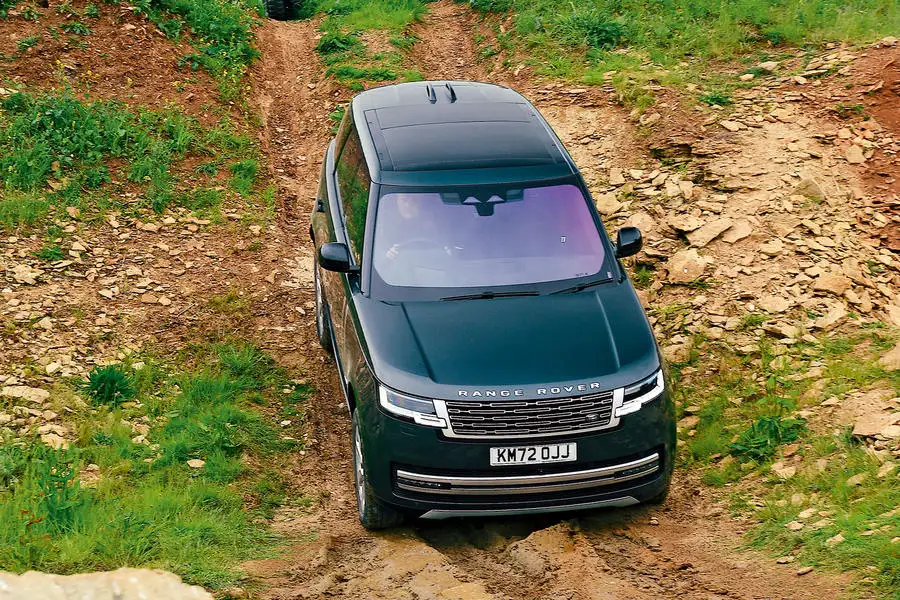
Switch it to off-road mode (max height on the air suspension) and use the ClearSight Ground View mode (essentially a function that allows you to peer through the bonnet) and suddenly it’s clear what’s ahead.
Select hill descent and low range, wind the maximum speed right back within the settings and let the car simply creep down the slope. This isn’t new or unique to Range Rover, but every time it never fails to amaze how damn easy it has all become. Even the change in surface halfway down doesn’t upset it.
Off-road performance: Willys Jeep
The Jeep is just as capable, but not as relaxing. It’s in low range as I head over the edge, but then bounces and careers down the hill with the sort of suspension movement that wouldn’t look out of place in a Benny Hill movie.
You don’t worry about it like you do with the Range Rover (the £130k price difference will do that to you), but there’s never quite the level of faith that tyres/brakes/clutch will do what you need when you need (the car’s 68-year-old age will do that to you).
Where the Jeep does feel happier is on a cross slope. It’s narrow at just 152cm wide but stable, and because it’s so light, it doesn’t pull itself down the slope.
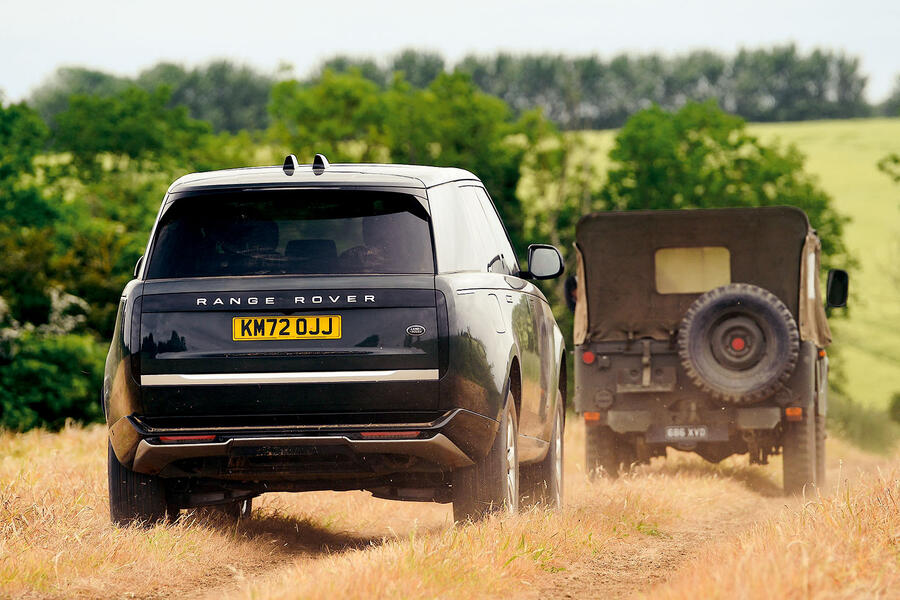
The Range Rover is lucky today in that it’s dry, so the on-road tyres (a set of 20in Michelin all-seasons) don’t struggle to contain the 2695kg mass from slipping with the gradient. If it was wet, it would be a different story.
Still, the four-wheel steer means it navigates through a wood with the same ease as the Jeep, despite being 1.5m longer.
The system also gives traction in unexpected places, allowing the tyres to turn across a slope and keeping the contact patch more stable. It’s impressive stuff.
The downsides
There are some quirks with the Range Rover. It’s very clever, with all the systems talking to each other and sensors measuring every conceivable degree, but sometimes it has a brain-fart moment.
Like reversing back up a slope from a standstill, where the throttle is difficult to control and jerks the car up the hill rather than smoothly climbing. (The second time around it’s much smoother, like it has learned the grip parameters.) Or there’s an occasional random rock that upsets the traction control, sending a thump through the cabin.
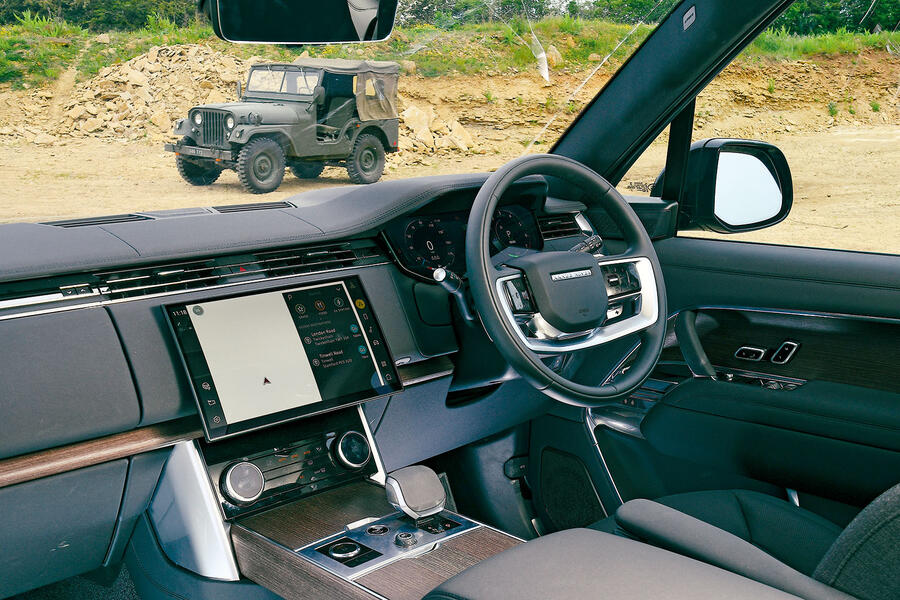
Still, you only get time to reflect on these elements because the experience is otherwise so smooth.
The Jeep could quite easily be doing the same but is so extreme in its lack of comfort that you would never notice. It’s the only car I’ve driven that makes me cast my eyes enviously at early Series Land Rovers as they drive past.
Verdict
Neither car copes well going back up the steep slope. For the Jeep, blame the tyres. The ‘bar grip’ rubber is great in slippery conditions, but on smooth rock it doesn’t have the contact patch.
With the Range Rover, it’s the suspension travel. Being maxed out on the high setting, it struggles to keep its wheels on the floor and can’t use its full 434bhp to drive all four.
These are, though, extreme situations. What all this really demonstrates is how much more multi-purpose the modern off-roader is. And while that may feel like stating the obvious, given the Jeep’s lack of doors, it really is remarkable how capable the Range Rover is.
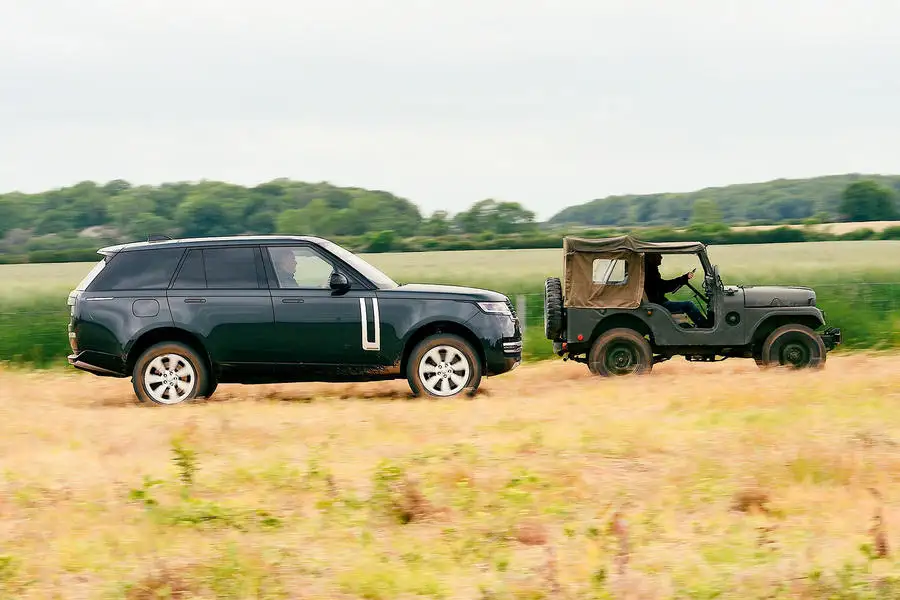
For while there is nothing that the Range Rover can do that the Jeep can’t match, the reverse is also true.
The Jeep was conceived for one purpose: to get soldiers to where they need to be, no questions asked. The Range Rover was conceived with an entire global remit, from LA’s Rodeo Drive to Middle Eastern dunes, and for it to do that as a single entity is mighty impressive.
That breadth of capability and ease of use is not something I expected, even with JLR's (formerly Land Rover’s) reputation.
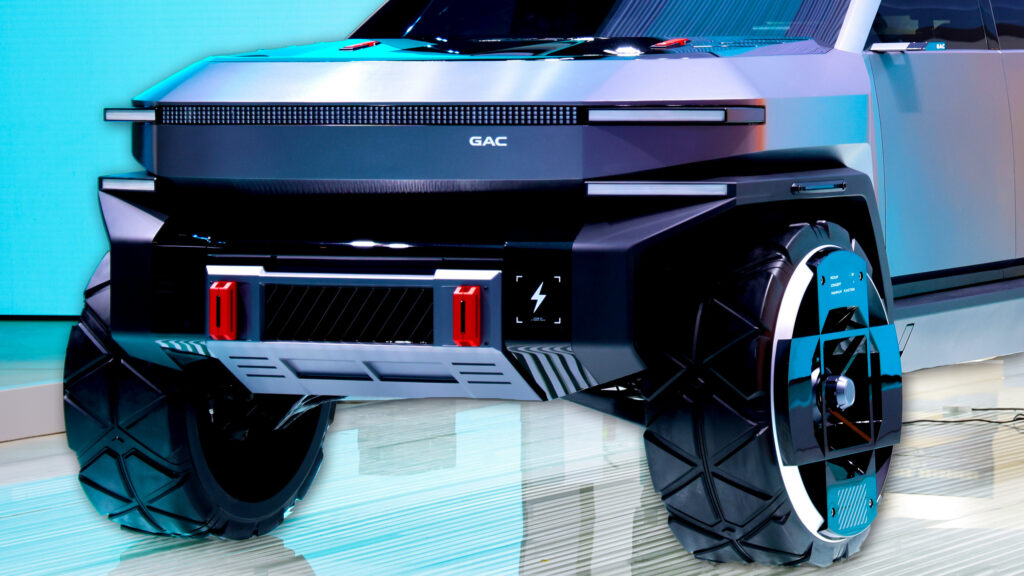
GAC Unveils Bold Pickup Concept Blending Cybertruck and Hummer Styles
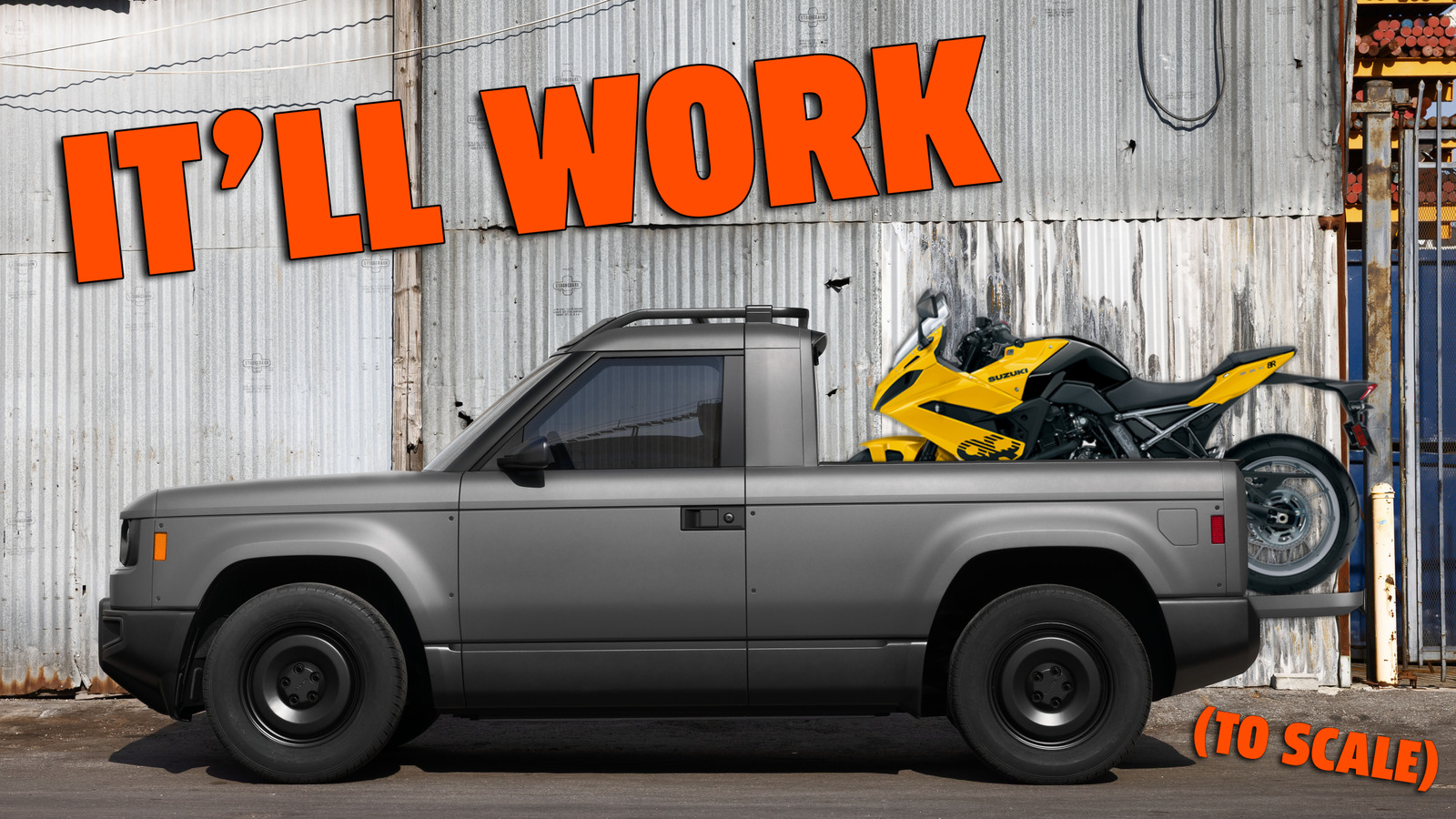
The Ultimate Motorcycle Hauler: Discover the Versatile Slate Pickup Bed
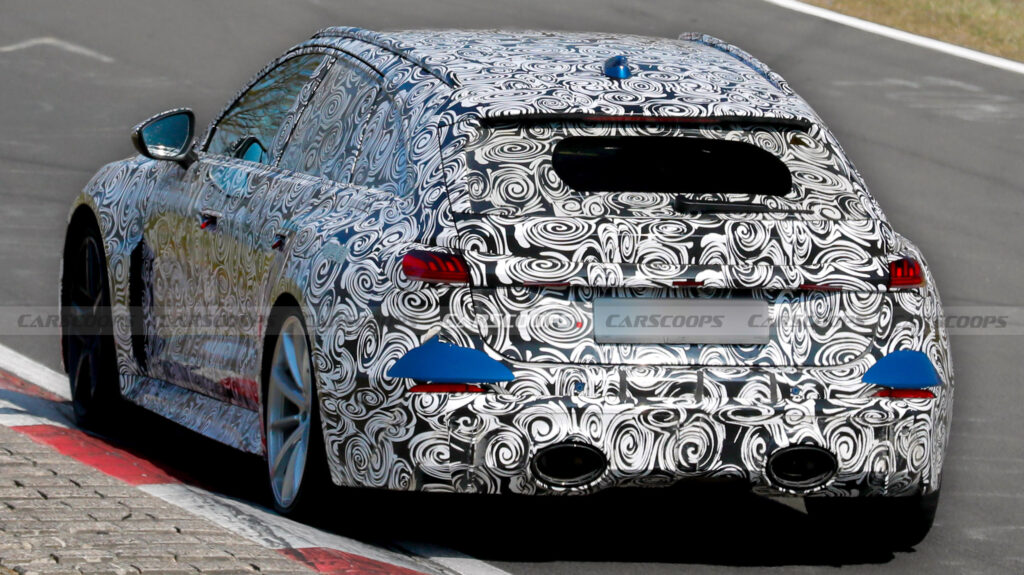
Audi’s Next-Gen RS5: A High-Performance Hybrid Revolution

The Temptation of Free Money: Why Stealing Cash is a Legal No-Go

Discover the All-New Citroën C5 Aircross: A Spacious, Stylish, and Electric Family Crossover
 Second-generation family crossover is bigger than its predecessor, giving it increased interior space
The new Citroën C5 Aircross has been revealed with concept car styling and the option of electric power for the first time, as the French brand renews its assault on Europe's crucial crossover market.
Based on parent company Stellantis's new STLA Medium architecture (like the Peugeot 3008 and Vauxhall Grandland), the second-generation C5 Aircross is the flagship of an overhauled Citroën line-up, sitting above recently refreshed and renewed versions of the Ami, C3 and C4.
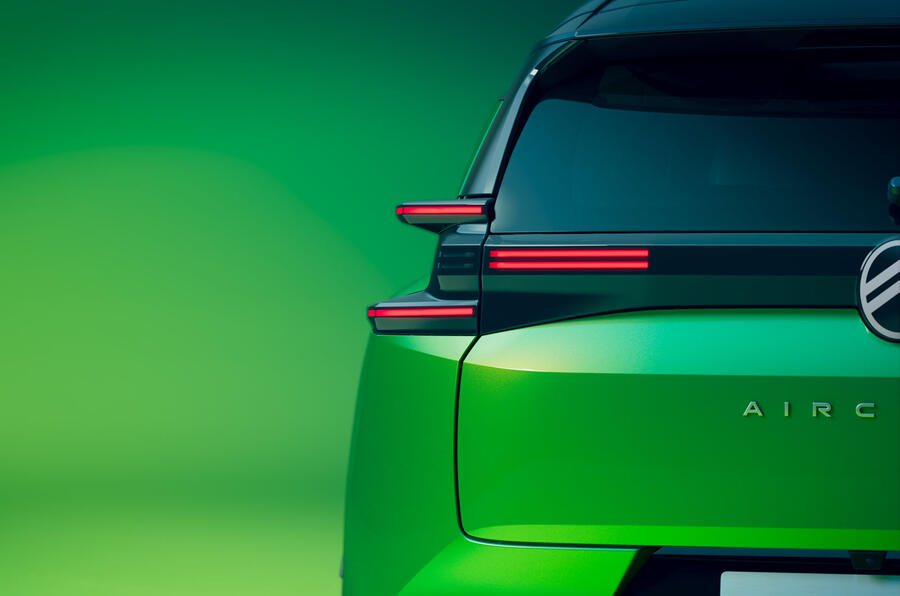
As promised to Autocar by designer Pierre Leclerq, the production version of the new C5 Aircross stays true to the bold concept car revealed last year at the Munich motor show, retaining the minimalistic two-box silhouette of the outgoing C5 Aircross but with a wide-reaching focus on aerodynamics in a bid to increase efficiency.
It's bigger than the Mk1, having grown 150mm in length to 4652mm to facilitate a huge 600mm increase in wheelbase - "almost all of which is in the rear leg room", according to Citroën.
Citroën has exploited the more substantial footprint to create what it calls a 'C-Zen Lounge' inside, where "occupants are seated as if in a living room".
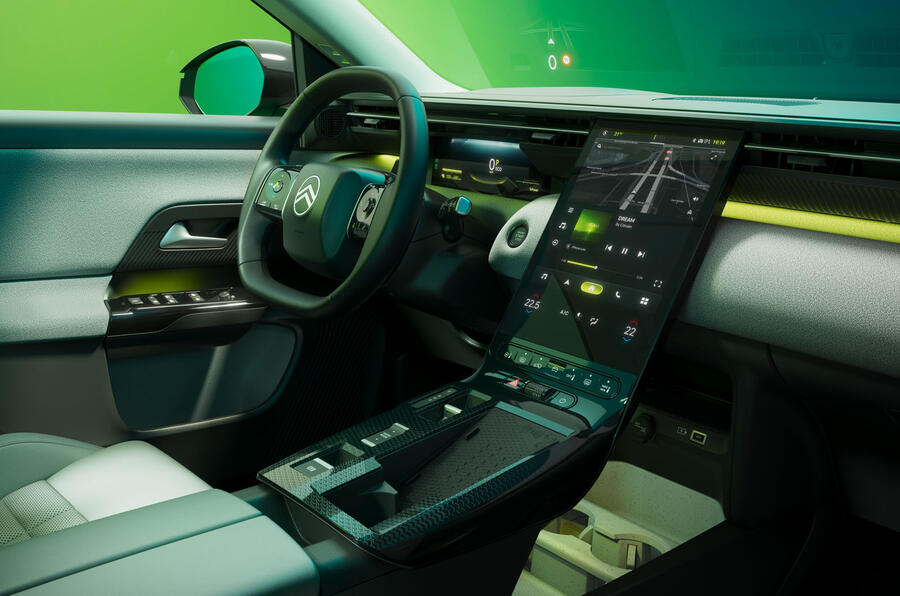
The dashboard in particular has been designed with influence from traditional living room furniture, with distinctive foam fabric padding reminiscent of a sofa and available in a choice of light or dark colours. So too can the ambient lighting be configured in eight colours.
At the centre of this new dashboard is an expansive 'floating' touchscreen that Citroën says is the largest yet fitted to a Stellantis car. It largely replaces physical controls but has been designed for ease of access on the move, with fixed status and control bars, programmable widgets and direct access to the climate control.
Smartphone mirroring and a 10in digital display are equipped as standard, and drivers can use the 'Hello Citroën' voice control function to control various in-car functions - with AI support from ChatGPT.
A head-up display – 30% larger than that of its predecessor – is available as an option.
Meanwhile, the 'Advanced Comfort' seats have been upgraded to give "a level of comfort never seen" in the C5 Aircross, with thick lower padding on the backrest and bolster and an upper portion that "wraps around passengers' shoulders like a shawl". The side bolsters are now electrically adjustable too.
In the back, passengers are said to have 51mm more knee room and 68mm of head room than before, plus extra adjustability courtesy of a backrest that can be reclined between 21deg and 33deg - "adding to the sensation of travelling in comfort class".
Rear passengers can also make use of a pair of cupholders in the centre console, together with a pair of USB-C charging ports.
The increase in footprint also makes for a much bigger boot: there's now 651 litres of load space behind the back seats, almost 150 litres more than in the Nissan Qashqai, rising to 1668 litres with them folded.
There's a 75-litre hidden space beneath the boot floor, too, where the EV's charging cable can be stored.
There are two hybrid options available from launch, one mild and one plug-in. The former pairs a 1.2-litre three-cylinder petrol engine with a small electric motor in a dual-clutch gearbox, powered by a 0.9kWh battery under the driver's seat. The PHEV uses a 1.6-litre four-cylinder petrol engine in tandem with a 123bhp electric motor for a combined 193bhp and a 21kWh battery that's good for an EV range of 53 miles.
The electric C5 Aircross can be had with either a 73kWh battery giving 323 miles of range or a 97kWh pack giving 422 miles and a 207bhp or 227bhp motor on the front axle.
Prices for the new C5 Aircross haven't yet been announced, but it will be cheaper than the 3008, so expect a sub-£35k starting price for the hybrid and to pay around £40k for the EV.
Deliveries will begin in the second half of this year.
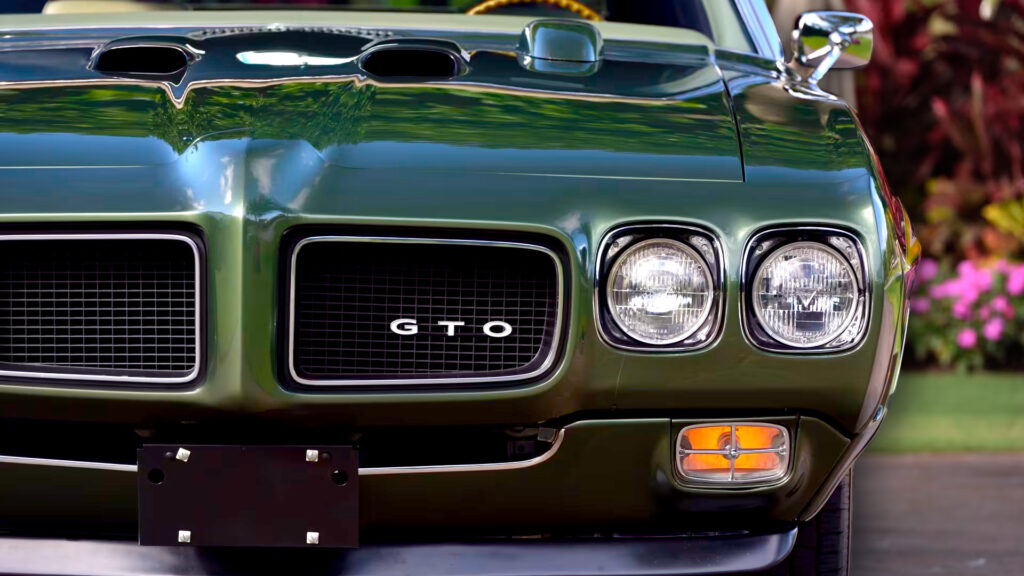
Rare Pontiac GTO Judge Convertible with Only 656 Miles Set for Auction
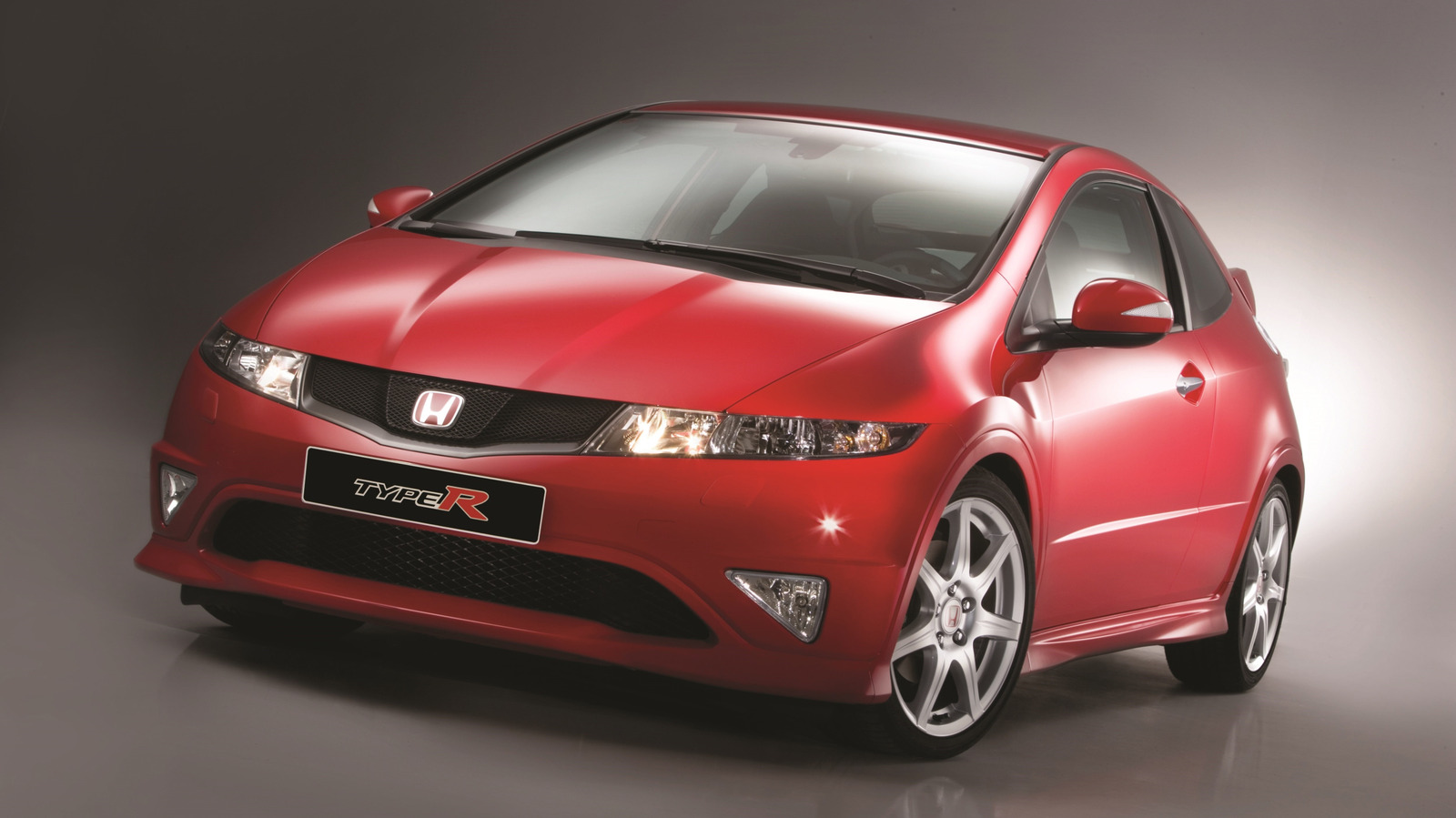
A Twist of Fate: Man Accidentally Buys Back His Stolen Civic Type R
California’s Bold Move: New Rules for Testing Autonomous Trucks and Cars