Tesla Invites Fans to Create Ads for a Chance to Win a Model Y


Fiat’s Bold Move: Five-Minute Battery Swaps Could Revolutionize EV Charging
 Fiat CEO Olivier François said battery-swapping tech will be offered to customers if trial is successful
Stellantis is trialling battery-swapping technology with the Fiat 500e in a bid to offer full EV recharging in just five minutes.
If the trial is successful, this could eliminate one of the biggest barriers to EV ownership: charging time.
Currently taking place in Madrid, the trial involves a small fleet of 40 500es that have been adapted to use a pack (of unspecified size) from battery-swapping firm Ample.
The fleet is operated by Stellantis-owned car-sharing firm Free2Move and being driven by users in the city.
The cars are currently serviced by a single battery-swapping station, but more are planned to be created in the city as part of the trial, which has been supported by a €9.8 million (£8.2m) grant from the Spanish government.
What’s more, Stellantis plans to expand the fleet to 100 cars in the coming months.
If the trial is successful, the technology will be offered to private customers, promised Fiat CEO Olivier François.
“We are dedicated to thoroughly testing and analysing this concept in real-world conditions and aiming to expand it to private customers soon," he said.
“That is why we believe deeply in this project and have chosen our iconic Fiat 500 to spearhead the initiative.
"It will provide invaluable insights for both our brand and the group as we shape the future of mobility.”
It's unclear if the trial will be expanded to other Stellantis EVs, given that the 500e is based on a bespoke platform and not the e-CMP EV platform used by Citroën, Peugeot, Vauxhall et al.
Discover Your Favorite Italian Cars: A Curated Selection of Enthusiast Picks

Trump’s Emission Resolutions Ignite California’s Legal Battle for Clean Air

Peugeot Revives the GTi Legacy with Electrifying e-208 Hot Hatch
 French brand relaunches performance moniker at 24 Hours of Le Mans
Peugeot’s revered GTi badge has returned to appear on its first electric performance car, a hot hatch based on the e-208 that is aimed squarely at compatriot Alpine’s A290.
Its launch at last week’s 24 Hours of Le Mans marks the return of one of the most evocative badges in performance motoring, after the 308 GTi went off sale in 2021. It is also the first hot Peugeot since the 508 PSE was axed in late 2024.
Developed by Peugeot Sport and inspired by the widely admired 205 GTi, the new car represents a dramatic overhaul of the city-focused e-208.
The key to the package is a motor transplant from the 208’s larger cousin, the Alfa Romeo Junior Veloce. Mounted up front and paired with a mechanical limited-slip differential, it puts out 278bhp and 254lb ft – a substantial increase on the power of the regular 154bhp e-208.
These reserves slingshot the 1596kg hatchback to 62mph in 5.7sec – 0.2sec quicker than the 255bhp Mini John Cooper Works Electric and 0.7sec ahead of the 217bhp Alpine A290 GT Performance. Its top speed is claimed to be 112mph.
Alongside that extra pace, it is fitted with hydraulic bump-stops and a rear anti-roll bar. The steering is also said to have been tuned for more direct responses.
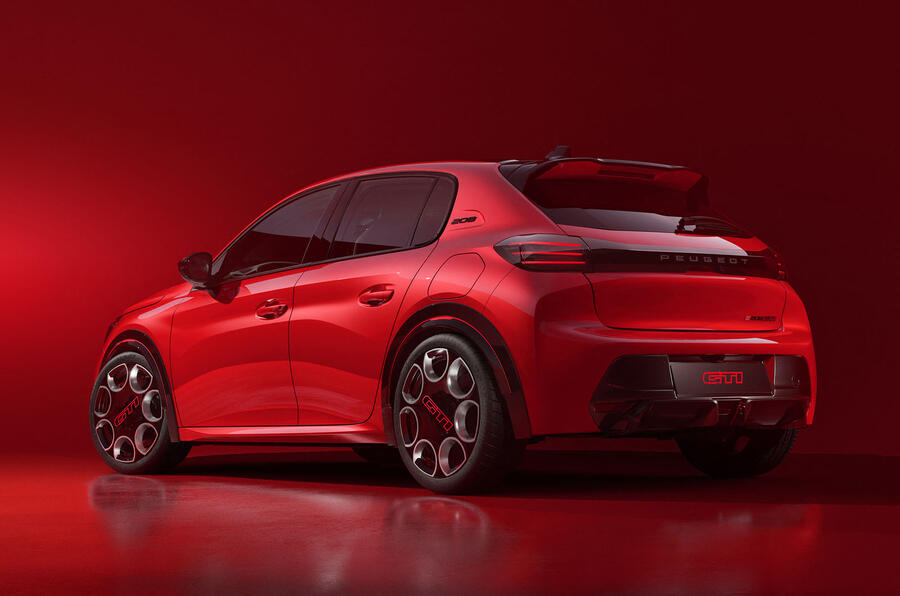
The new GTi gains a look that matches its performance billing. The hot hatch is 30mm lower than the standard car and the tracks have been widened by 56mm at the front and 27mm at the rear to create a muscular stance.
Changes compared to the standard e-208 include a front lip, a new rear spoiler and a chunky rear diffuser – which has a motorsport-inspired integrated rear fog light.
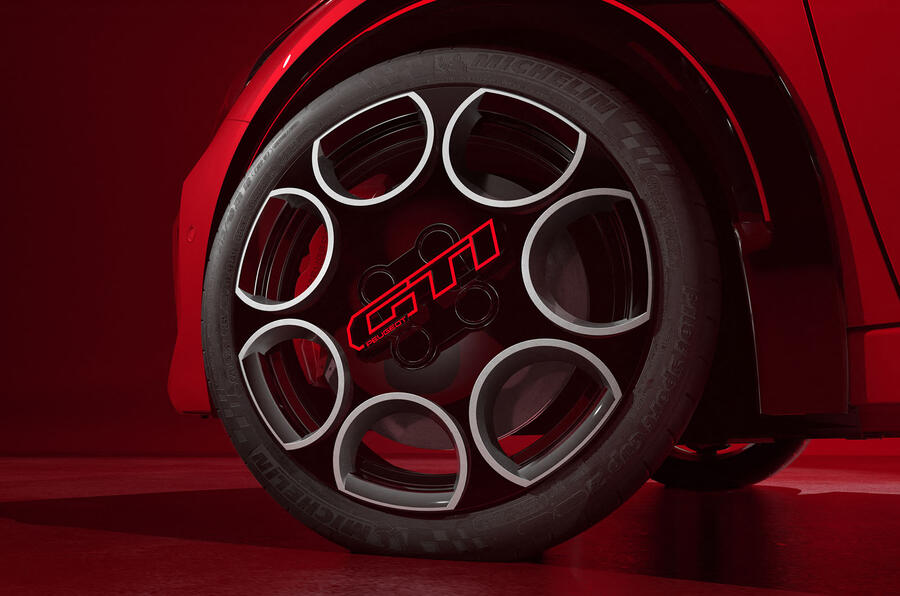
What’s more, it gets bold 18in alloys that are inspired by those fitted to the later 1.9-litre 205 GTi and wear the original GTi typeface. These are shod with track-focused Michelin Pilot Sport Cup 2 tyres; sited behind them up front are a set of 355mm brake discs.
The fitment of such large wheels with the GTi’s low-set stance has required wheel-arch extensions, marked out with bright red stripes that match the body’s paintwork.
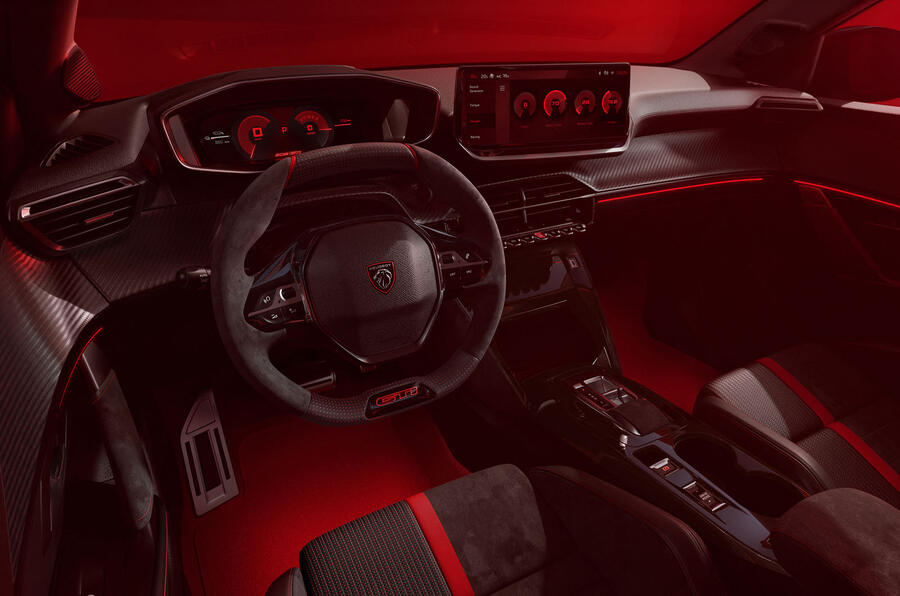
The 205 references continue inside the e-208 GTi: the bucket seats are split between red and black panels, and the floor mats are trimmed in red too. Elsewhere, it's the same cabin as the standard e-208 but with Alcantara added to the seats and steering wheel.
Modifications have also been made to the e-208 GTi’s battery performance. While the 54kWh nickel-manganese-cobalt pack is the same as the standard car’s, Peugeot said it has adapted the software using developments from its hybrid-powered 9X8 endurance racer to reduce temperatures under high loads and improve energy recovery.
The pack yields a range of 217 miles between charges and can be replenished from 20-80% in less than 30 minutes on a 100kW DC connection.
“The new Peugeot e-208 GTi embodies our commitment to performance and innovation, drawing from our extensive race pedigree,” said Jean-Marc Finot, senior vice-president of Stellantis’s motorsport operations.
Finot, previously an engineer involved in the development of the original 205 GTi as well as the later 206 GTi 180, added that the new car will possess “the typical Peugeot GTi agility and steering feeling”.
While the GTi badge returns first on an electric model, new hot combustion Peugeots have not been ruled out – but Peugeot CEO Alain Favey previously told Autocar that any decision would depend on customer feedback. “We will start with the e-208 and [are] definitely listening to your inputs, or what our customers will say as well,” he said. “We don't exclude that there might be other executions of the 208 GTi under the GTi badge, but for today there's absolutely nothing planned in that sense."
Dream Big: What Car Will You Drive When You Hit the Jackpot?

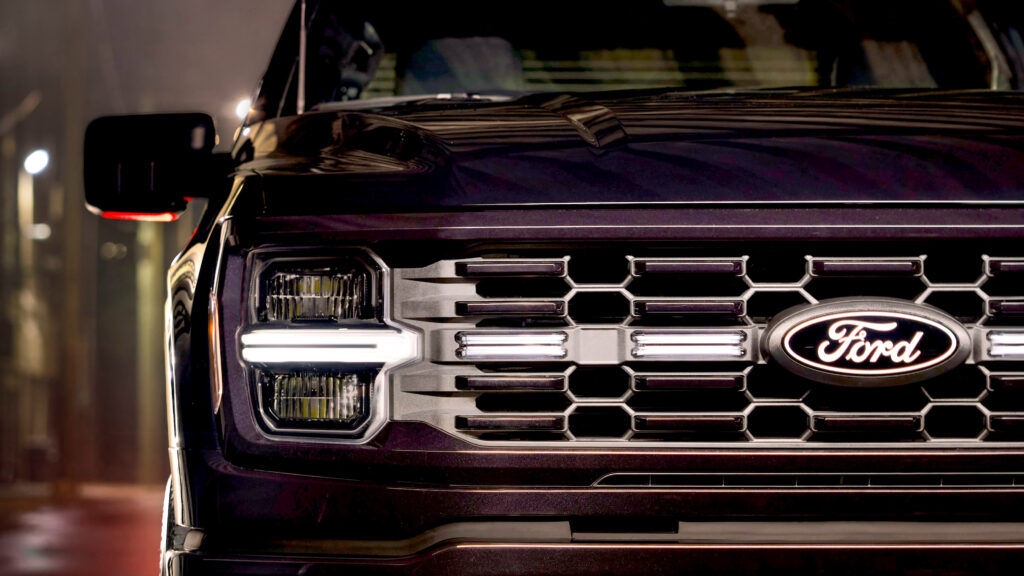
Unleashing the Beast: Ford’s F-150 Lobo Transforms Street Truck Culture

Fiat’s Bold Move: Revolutionizing EV Charging with Five-Minute Battery Swaps
 If successful, Fiat CEO Olivier Francois said the battery swapping tech will be rolled out to private customers
Fiat owner Stellantis is trialling battery swapping technology with the Fiat 500e, in a bid to offer full recharge times in just five minutes.
If successful, the group said, this could eliminate one of the biggest barriers to EV ownership: charging time.
Currently taking place in Madrid, the trial involves a small fleet of 40 500e cars that have been adapted to use a pack (of unspecified size) from battery swapping firm Ample. The fleet are all operated by Stellantis-owned car-sharing firm Free2move and are being driven by users in the city.
The cars are currently serviced by a single swapping station in Madrid, but more are planned to be created in the city as part of the trial, which has been supported by a €9.8 million (£8.2m) grant from the Spanish government.
What’s more, Stellantis plans to expand the fleet to 100 in the coming months.
If successful, the technology will be rolled out to private customers, said Fiat CEO Olivier Francois. “We are dedicated to thoroughly testing and analysing this concept in real-world conditions and aiming to expand it to private customers soon.
“That is why we believe deeply in this project and have chosen our iconic Fiat 500 to spearhead the initiative. It will provide invaluable insights for both our brandand the Group as we shape the future of mobility.”
It is unclear if the Stellantis trial will be expanded to other models, given the 500e is currently based on a bespoke platform and not the e-CMP architecture used by the likes of the Vauxhall Cross and Peugeot e-208.

Essential Wheels for Remote Radio: Finding the Perfect Car on a $15,000 Budget

Toyota’s Bold Leap into AI-Driven Electric Vehicles in China