
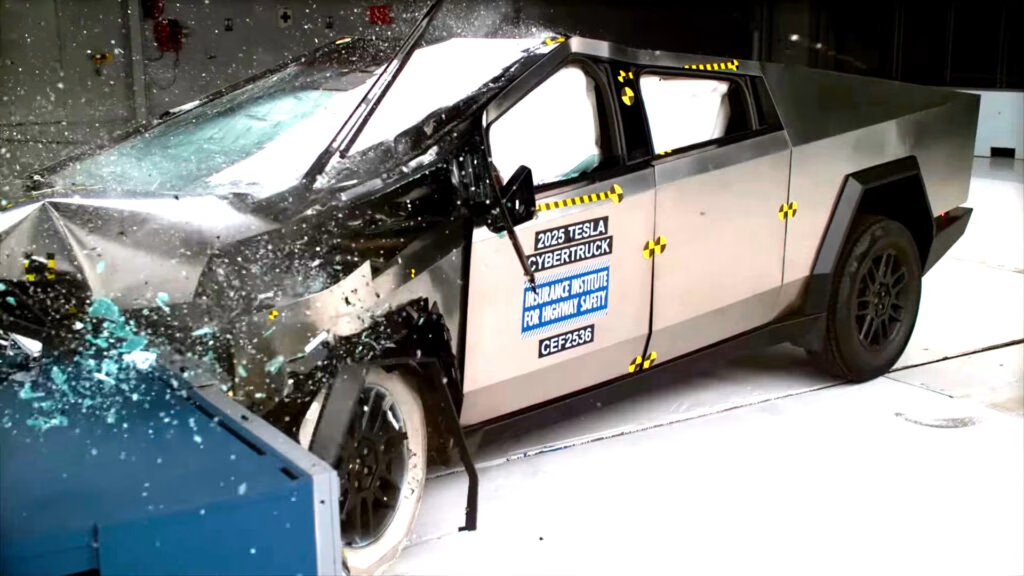
How Did the Tesla Cybertruck Really Perform in the Latest Crash Tests?
Tesla’s Cybertruck has always been a lightning rod for debate—whether it’s the polarizing design or the bold claims about safety. But when the Insurance Institute for Highway Safety (IIHS) put the 2025 Cybertruck through its updated moderate overlap front crash test, the results turned a few heads. After Tesla reinforced the underbody structure in April, the Cybertruck earned a solid ‘Good’ rating from the IIHS, putting to rest some of the skepticism around its ability to protect passengers.
What’s interesting is how the Cybertruck’s performance stacks up against other electric vehicles (EVs) in the same round of testing. Alongside the Cybertruck, six other EVs faced the same moderate overlap front crash test. The BMW i4, Chevrolet Blazer EV, and Volkswagen ID.Buzz also walked away with ‘Good’ ratings. Meanwhile, the Tesla Model 3 landed an ‘Acceptable’ mark due to a higher risk of chest injury for rear passengers, and the Ford F-150 Lightning and Nissan Ariya lagged behind with ‘Poor’ and ‘Marginal’ ratings, respectively.
Are There Any Weak Spots in the Cybertruck’s Safety Record?
While the Cybertruck’s crash protection credentials are impressive, it’s not all sunshine and rainbows. The IIHS highlighted two areas where the truck falls short: headlights and seat belt reminders. The headlights, in particular, proved to be a stumbling block. According to the IIHS, the Cybertruck’s lights created excessive glare in certain scenarios and didn’t illuminate the left side of the road or left turns effectively. The right side? No problem. But that uneven coverage means the Cybertruck misses out on the coveted Top Safety Pick award.
It’s a bit of a pattern, actually. Headlights have become a common Achilles’ heel for many modern vehicles, especially as automakers push for sleeker designs and advanced tech. The IIHS has tightened its standards around glare and high-beam performance, so even a small misstep can cost a vehicle top honors.
How Did Other Electric Vehicles Compare in the Same Tests?
The Cybertruck wasn’t the only EV under the microscope. The IIHS tested six other electric models, and the results were a mixed bag. The BMW i4, Chevy Blazer EV, and VW ID.Buzz matched the Cybertruck’s ‘Good’ rating in the moderate overlap front crash test. But not everyone fared so well. The Ford F-150 Lightning received a ‘Poor’ score, with dummy readings showing risks of chest, head, and neck injuries for rear passengers. The Nissan Ariya was rated ‘Marginal’ for elevated chest injury risk in the back seat.
Pedestrian crash prevention and headlight performance also played a big role in the overall ratings. The i4, F-150 Lightning, and Model 3 earned high marks for pedestrian avoidance, while the ID.Buzz and Blazer EV scored ‘Acceptable.’ Still, none of the seven EVs tested in this round qualified for a Top Safety Pick or Top Safety Pick+ award, largely due to those persistent headlight issues.
What’s the Real-World Impact of These Safety Ratings?
For buyers, these ratings aren’t just numbers—they’re a window into how a vehicle might protect you and your family in a real crash. The IIHS’s moderate overlap front test is notoriously tough, simulating a common type of collision where only part of the front end strikes another vehicle or object. A ‘Good’ rating means the vehicle’s structure, airbags, and seat belts work together to keep injuries low.
But there’s nuance here. For example, the Cybertruck’s driver dummy showed a low risk of injury to the head, chest, and legs, while the rear passenger had only a moderate risk of chest injury. That’s in line with the five-star rating the National Highway Traffic Safety Administration (NHTSA) gave the Cybertruck earlier this year. Yet, the difference between ‘Good’ and ‘Top Safety Pick’ often comes down to details like headlight performance or rear-seat safety—areas where even the best vehicles can stumble.
Why Do Headlights Matter So Much in Modern Safety Testing?
It might seem odd that headlights can make or break a vehicle’s safety award, but there’s a good reason. Poor headlights don’t just make night driving more stressful—they’re a real risk factor for crashes. The IIHS found that vehicles with subpar headlights are involved in more nighttime accidents. Excessive glare can blind oncoming drivers, while weak illumination leaves hazards hidden until it’s too late.
In the Cybertruck’s case, the IIHS noted that the headlights created glare and didn’t light up the left side or left turns well enough. That’s not just a technicality—it could mean missing a pedestrian or cyclist at night. Automakers are responding with adaptive lighting and smarter tech, but as the IIHS raises the bar, it’s clear that even the most advanced vehicles have work to do.
What’s Next for Tesla and Other EV Makers on the Safety Front?
Tesla’s quick update to the Cybertruck’s underbody structure shows how fast automakers can respond to safety feedback. It’s a reminder that crash tests aren’t just academic—they drive real improvements. The Rivian R1T, for example, scored even higher than the Cybertruck and earned a Top Safety Pick+ award in 2024, showing that EVs can absolutely lead the pack in safety.
Looking ahead, the Cybertruck will need to address its headlight issues and undergo additional IIHS tests, like the small overlap and side crash scenarios, to snag a Top Safety Pick. And with the IIHS making its standards tougher every year, the pressure is on for all automakers to keep raising their game.
The big takeaway? Safety isn’t about perfection—it’s about smarter adjustments. Start with one change this week, and you’ll likely spot the difference by month’s end.