
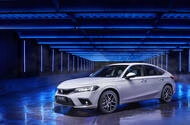
Honda is gearing up for an exciting transformation in its vehicle lineup, with plans to introduce 13 new hybrid models by 2030. This move comes as the company seeks to bridge the gap between traditional combustion engines and the electric vehicles (EVs) that are becoming increasingly popular. Let’s dive into what this means for Honda and its customers.
What’s Driving Honda’s Hybrid Push?
The shift towards hybrids is largely a response to the slower-than-expected adoption of electric vehicles. Honda CEO Toshihiro Mibe recently pointed out that while demand for hybrid-electric vehicles is on the rise, the expansion of the EV market hasn’t kept pace with initial projections. Factors such as relaxed CO2 emissions and EV sales targets in the U.S. have contributed to this lag, prompting Honda to rethink its strategy.
So, what does this mean for the average driver? Essentially, Honda is recognizing that many consumers still prefer hybrids as a transitional option. These vehicles offer a blend of traditional combustion power and electric efficiency, making them appealing for those who aren’t quite ready to go fully electric.
What Can We Expect from the New Hybrid Models?
The upcoming hybrids will feature Honda’s new combustion powertrain, touted as “the world’s most efficient.” This powertrain will be available in both 1.5-liter and 2.0-liter variants, aligning with the engines currently found in popular models like the Civic and Jazz. The 1.5-liter version is designed to deliver peak torque over a broader rev range—40% wider, to be exact—maximizing efficiency without sacrificing performance.
Fuel economy is also set to improve significantly. Honda claims that these new powertrains will yield a 10% enhancement in fuel efficiency. For context, the current 1.5-liter Jazz achieves an impressive 62.8 mpg, while the 2.0-liter Civic manages 56.5 mpg. With these advancements, drivers can expect to save at the pump while enjoying a more engaging driving experience.
How Will Honda Cut Costs and Improve Performance?
Cost efficiency is another key focus for Honda as it develops these new models. By sharing at least 60% of parts across different models, including the engine bay and rear floor, Honda aims to streamline production and reduce costs. The new hybrid powertrains are projected to be 30% cheaper to produce than those launched in 2023, which could translate to savings for consumers as well.
Additionally, the new platform for these vehicles promises enhancements in driver engagement, comfort, and safety. It will be 90 kg lighter than the current structure, contributing to better performance and handling. This commitment to innovation and efficiency is likely to resonate well with environmentally conscious consumers.
What About Honda’s Electric Future?
While Honda is ramping up its hybrid offerings, it hasn’t lost sight of the electric vehicle market. The company is still committed to developing EVs, with plans to invest £51 billion in this area, despite recent setbacks. The upcoming 0 Series of electric cars, set to launch in the U.S. next year, marks a significant reset for Honda’s approach to the EV market. This series will include a boxy SUV and a sleek saloon, among other models, featuring a new design language that distinguishes them from the hybrid lineup.
Toshinobu Minami, head of Honda’s design center, emphasizes that while hybrids and combustion models will have distinct designs, simplicity and dynamism will be central to all future models. This fresh approach signals a new era for Honda, one that blends innovation with consumer preferences.
The big takeaway? Honda’s pivot towards hybrids isn’t just about keeping up with trends—it’s about meeting drivers where they are. As the automotive landscape evolves, Honda is making strategic adjustments to ensure it remains relevant and competitive. If you’re considering a new vehicle, keep an eye on these upcoming hybrids—they might just be the perfect fit for your needs.