
How Did a Cyber Attack Bring JLR’s Global Car Production to a Halt?
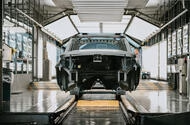
If you’ve been eyeing a new Land Rover or Jaguar, you might have noticed something odd: there haven’t been any fresh models rolling off the line since early September. The reason? A major cyber attack hit Jaguar Land Rover (JLR) on September 1, sending shockwaves through the company’s global operations. Production ground to a halt, and the ripple effects have been felt by employees, suppliers, and customers alike.
Let’s break down what happened, why it matters, and what the road ahead looks like for one of Britain’s most iconic automotive brands.
What Actually Happened During the JLR Cyber Attack?
On September 1, JLR’s computer systems were compromised by a group of hackers who had previously targeted other major companies. The attack was so severe that the company had to shut down its entire IT infrastructure the very next day. This wasn’t just a minor glitch—dealers couldn’t register new cars, and the company’s ability to order parts or manage logistics was completely disrupted.
To put it in perspective, September 1 is traditionally one of the busiest days for new car registrations in the UK, thanks to the release of new license plates. For JLR, the timing couldn’t have been worse.
The company immediately brought in cybersecurity experts and law enforcement to investigate and begin the painstaking process of rebuilding its systems. As of mid-September, JLR confirmed that production would not restart until at least September 24, and even that date is tentative.
Who Was Behind the Attack, and How Did They Get In?
Responsibility for the attack was claimed by a group calling themselves Scattered Lapsus$ Hunters. This isn’t their first rodeo—they were also behind a high-profile attack on Marks & Spencer earlier this year, which caused weeks of disruption and cost the retailer hundreds of millions in lost profits.
According to cybersecurity analysts, the hackers exploited a known vulnerability in SAP Netweaver, a third-party software platform used by JLR. The US Cybersecurity and Infrastructure Security Agency had previously issued warnings about this flaw, and a patch was released. It’s unclear whether JLR had applied the update in time, but the breach highlights just how quickly cyber threats can turn into real-world chaos.
What Data Was Compromised, and Should Customers Be Worried?
JLR has confirmed that “some data” was affected, but details remain scarce. Given the involvement of police and the nature of the attack, it’s likely that customer information was among the data accessed. The company has said it will contact those affected directly.
For customers, this is understandably concerning. Data breaches can lead to identity theft, phishing scams, and other forms of fraud. If you’re a JLR customer, keep an eye out for any unusual communications and consider changing your passwords as a precaution.
How Much Is the Shutdown Costing JLR and Its Suppliers?
The financial impact is staggering. According to Professor David Bailey, a leading automotive industry economist, the shutdown could be costing JLR up to £5 million per day in lost revenue. That’s not just a dent—it’s a crater in the company’s bottom line.
But the pain doesn’t stop with JLR. The company’s vast network of suppliers—many of them small or medium-sized businesses—are also feeling the squeeze. With production halted, cash flow dries up fast. Some suppliers are already warning of potential bankruptcies if the shutdown drags on much longer.
Former Aston Martin CEO Andy Palmer put it bluntly: “You hold back in the first week or so of a shutdown; you bear those losses. But then you go into the second week, more information becomes available—then you cut hard. So layoffs are either already happening or are being planned.”
What Is Being Done to Support Workers and Suppliers?
With most of JLR’s employees unable to work, company leaders are in talks with government ministers about introducing a furlough scheme. This would be similar to the support provided during the Covid-19 pandemic, where the government subsidized workers’ pay while factories were shut.
Trade unions and industry leaders are pushing hard for this kind of support—not just for JLR’s direct workforce, but for the thousands of jobs in the supply chain that are now at risk. Sharon Graham, general secretary of the Unite union, emphasized the urgency: “Ministers need to act fast and introduce a furlough scheme to ensure that vital jobs and skills are not lost while JLR and its supply chain get back on track.”
How Are Other Companies Protecting Themselves from Similar Attacks?
JLR’s ordeal is a wake-up call for the entire automotive industry. Modern car manufacturing relies heavily on interconnected digital systems, from supply chain management to vehicle software updates. A single vulnerability can bring the whole operation to a standstill.
Recent data from IBM’s Cost of a Data Breach Report 2023 shows that the average cost of a data breach in the automotive sector is now over $4 million. The top causes? Unpatched software, weak passwords, and phishing attacks. Companies are responding by investing more in cybersecurity training, regular system updates, and third-party audits. But as JLR’s experience shows, even the best defenses can sometimes be breached.
What Can Customers and Car Buyers Do Right Now?
If you’re waiting on a new Jaguar or Land Rover, patience is the name of the game. Dealers are just as frustrated as buyers, with no new stock arriving and uncertainty about when things will return to normal.
In the meantime, here are a few tips:
– Stay in touch with your dealer for updates. They’ll have the latest information as the situation evolves.
– Be cautious with emails or calls claiming to be from JLR, especially if they ask for personal information. Scammers often exploit situations like this.
– If you’re concerned about your data, consider signing up for credit monitoring or identity theft protection.
The Big Picture: What Does This Mean for JLR and the Industry?
JLR’s cyber attack is more than just a temporary setback—it’s a stark reminder of how vulnerable even the biggest companies can be in the digital age. The automotive industry is racing toward greater connectivity and automation, but that progress comes with new risks.
For JLR, the focus now is on getting production back up and running, supporting workers and suppliers, and rebuilding trust with customers. For the rest of us, it’s a lesson in the importance of cybersecurity—not just for companies, but for anyone whose personal data is stored online.
The outcome? A challenging chapter for JLR, but also an opportunity for the industry to double down on resilience and preparedness. Because in today’s world, it’s not just about building great cars—it’s about keeping the whole system safe from threats you can’t see coming.