
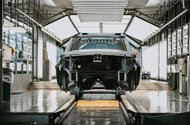
How Did a Cyber Attack Bring JLR’s Production to a Standstill?
Imagine waking up to find that one of the UK’s most iconic carmakers—Jaguar Land Rover (JLR)—hasn’t produced a single new vehicle in weeks. That’s exactly what happened after a major cyber attack hit JLR’s global operations on September 1st. The impact? No new Land Rovers or Jaguars rolling off the line, not just in the UK, but worldwide.
This wasn’t just a minor IT hiccup. The attack crippled JLR’s internal computer systems, shutting down production at every plant. Dealers couldn’t register new cars on what’s usually one of the busiest days of the year. Parts ordering ground to a halt. Even retailers were left scrambling, unable to fulfill customer orders or manage inventory.
The financial toll is staggering. According to Professor David Bailey, an expert in business economics, JLR could be losing up to £5 million every single day the shutdown drags on. That’s not just a dent in profits—it’s a full-blown crisis for the company and everyone connected to it.
What’s the UK Government Doing to Help JLR Recover?
When a company as big as JLR gets hit, the ripple effects spread fast. Recognizing the gravity of the situation, the UK government quickly stepped in. Government cyber experts are now working alongside JLR to restore production and assess the broader impact on the automotive supply chain.
The Society of Motor Manufacturers and Traders (SMMT) confirmed that the government is in close contact with JLR, providing technical support and helping to coordinate the restart of operations. This isn’t just about getting cars back on the road—it’s about protecting thousands of jobs and keeping a vital part of the UK economy afloat.
But the government’s involvement doesn’t stop at technical support. There’s growing pressure from unions and industry leaders to introduce a furlough scheme for affected workers, similar to what the Scottish government did for bus manufacturer Alexander Dennis. The goal? To ensure that employees—especially those in the supply chain—aren’t left without income while the crisis is resolved.
How Are JLR’s Employees and Suppliers Coping With the Fallout?
For JLR’s workforce, the past few weeks have been anything but business as usual. Most employees have been off work, with their lost hours “banked” for future compensation. But the real strain is being felt by those further down the supply chain.
Unite, the UK’s largest union, has sounded the alarm: suppliers are teetering on the brink. Many have already moved workers onto reduced or zero-hours contracts, pushing some to apply for Universal Credit just to make ends meet. There’s a very real risk that some suppliers could go bust if the shutdown continues much longer.
Andy Palmer, former CEO of Aston Martin, put it bluntly in a recent interview with the BBC: “You hold back in the first week or so of a shutdown; you bear those losses. But then you go into the second week, more information becomes available—then you cut hard. So layoffs are either already happening or are being planned.”
It’s a domino effect. If suppliers start collapsing, the damage could extend far beyond JLR, threatening the stability of the entire UK automotive sector.
What Do We Know About the Hackers Behind the Attack?
So, who’s behind this digital heist? A group calling themselves Scattered Lapsus$ Hunters has claimed responsibility. If that name rings a bell, it’s because they were also behind a high-profile attack on Marks & Spencer earlier this year, which caused seven weeks of disruption and cost the retailer a whopping £300 million in lost profit.
The hackers claim they exploited a known flaw in SAP Netweaver, a third-party software used by JLR. The US Cybersecurity and Infrastructure Security Agency had warned about this vulnerability earlier in the year, and a software update was released to patch it. Whether JLR applied the fix in time remains unclear.
What’s especially worrying is that the hackers say they accessed customer data. While JLR hasn’t confirmed exactly what information was compromised—or whether a ransom demand has been made—the involvement of police and cybersecurity experts suggests the breach is serious.
Could This Happen to Other Car Manufacturers?
JLR’s ordeal is a wake-up call for the entire automotive industry. Modern carmakers rely on complex digital systems for everything from production scheduling to supply chain management. A single vulnerability can bring the whole operation to a standstill.
Recent research from IBM’s Cost of a Data Breach Report 2023 found that the average cost of a cyber attack in the manufacturing sector is now over $4.5 million. But as JLR’s experience shows, the real cost can be much higher when you factor in lost production, supply chain disruption, and reputational damage.
It’s not just about IT anymore—cybersecurity is now a core part of business resilience. Companies need to invest in robust systems, regular updates, and staff training to stay one step ahead of increasingly sophisticated attackers.
What’s Next for JLR and the UK Automotive Industry?
JLR is aiming to restart production lines from September 24th, but the road to full recovery won’t be quick or easy. The company is still rebuilding its systems and working with authorities to investigate the breach. In the meantime, the pressure is on to support workers, stabilize suppliers, and restore confidence across the industry.
This incident highlights just how interconnected the automotive world has become. A cyber attack isn’t just a tech problem—it’s a business, economic, and social issue that can impact thousands of lives in an instant.
For JLR, the coming weeks will be critical. How they respond could set the tone for how the entire industry manages cyber risk in the future. One thing’s clear: in today’s digital age, resilience isn’t optional—it’s essential.