
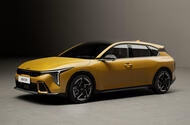
What’s New About the Kia K4 Hatchback and Why Should UK Drivers Care?
If you’ve been keeping an eye on the family hatchback market, you probably noticed the Kia Ceed quietly bowing out. But Kia isn’t leaving that gap unfilled. Enter the Kia K4 hatchback—a bold new contender set to land in UK showrooms by the end of the year. So, what makes the K4 worth your attention, especially with heavyweights like the Volkswagen Golf and Toyota Corolla still in the ring? Let’s break it down.
How Does the K4 Stack Up on Performance and Engine Choices?
Kia’s clearly aiming to please a wide range of drivers with the K4’s engine lineup. At launch, you’ll get a choice between two turbocharged petrol engines: a 1.0-litre and a 1.6-litre. The 1.0-litre kicks out a respectable 113bhp and, crucially, lets you pick between a six-speed manual or a seven-speed dual-clutch automatic. For those who want a bit more punch, the 1.6-litre comes in two flavors—148bhp or a lively 178bhp—though both are paired exclusively with the seven-speed auto.
If you’re holding out for something greener, Kia’s not leaving you behind. A hybrid powertrain is already in the pipeline for next year, reflecting the brand’s ongoing push towards electrification. This move isn’t just about ticking boxes for emissions targets—it’s about giving buyers real choice as the market shifts.
What’s the Interior Like—Is It Actually Practical and Modern?
Step inside the K4 and you’ll see clear inspiration from Kia’s electric models, especially the EV4. The centerpiece is a sweeping dashboard-mounted display that merges two 12.3-inch screens—one for your instruments, the other for infotainment. It’s a slick, unified look that feels genuinely upmarket.
But Kia hasn’t gone all-in on touchscreens at the expense of usability. Physical switches remain for essentials like climate control, audio volume, and hazard lights. It’s a smart move, especially for drivers who don’t want to fumble through menus while on the move.
Practicality is another strong suit. The K4’s high roofline means rear passengers get generous headroom, and Kia claims rear legroom is a priority. Boot space clocks in at 438 litres, putting it right in the mix with class leaders—enough for family trips, shopping hauls, or a couple of large suitcases.
How Much Will the Kia K4 Cost and Where Does It Fit in the Market?
Pricing hasn’t been officially confirmed yet, but we can make some educated guesses. The outgoing Xceed crossover starts at £25,165, while the Volkswagen Golf—arguably the K4’s main rival—begins at £28,150. Expect the K4’s entry-level model to land somewhere in between, making it a compelling value proposition for buyers who want more than a budget option but aren’t ready to splurge on a premium badge.
It’s also worth noting that, unlike the Ceed which was built in Slovakia, the K4 will be manufactured in Mexico. This shift is partly due to Kia’s new EV4 hatchback taking over production at the Slovakian plant. For buyers, this change is unlikely to affect quality—Kia’s global manufacturing standards are consistently high—but it does reflect the brand’s evolving strategy as it juggles electric and combustion models.
Will There Be Other Versions—Like an Estate or Saloon?
If you’ve seen the K4 saloon in the US and are wondering if it’ll make its way to the UK or Europe, don’t hold your breath. Demand for traditional saloons is waning here, so Kia’s focusing on the hatchback. However, spy shots have caught an extended estate version testing in Germany. If that model gets the green light, it could go head-to-head with estate versions of the Toyota Corolla, Vauxhall Astra, and Peugeot 308—great news for those who need even more space without moving up to an SUV.
Why Is Kia Betting Big on the C-Segment Now?
It might seem like an odd time to double down on family hatchbacks, especially as some rivals are scaling back. Ford, for instance, is ending production of the Focus this November. But Kia’s leadership sees a real opportunity. Ted Lee, Kia’s executive vice-president, recently pointed out that there’s still “big volume” for these models in Europe.
Market data backs this up. According to the European Automobile Manufacturers Association, C-segment hatchbacks remain a significant chunk of new car sales, especially as buyers look for practical, efficient alternatives to larger SUVs. With rivals stepping back, Kia is well-placed to grab a bigger slice of the pie.
What’s the Real-World Appeal—Is the K4 Worth Waiting For?
The K4 isn’t just a replacement for the Ceed—it’s a statement of intent from Kia. By offering a choice of engines (including a manual gearbox, which is becoming rare), a tech-forward but user-friendly interior, and a focus on practicality, Kia is targeting drivers who want a well-rounded, stylish hatchback that doesn’t break the bank.
If you’re in the market for a new family car, or just want something that balances everyday usability with a bit of flair, the K4 is shaping up to be well worth a test drive. With the hybrid model on the horizon and the possibility of an estate version, Kia’s giving buyers more choice than ever.
The bottom line? The Kia K4 is more than just a new face in the showroom—it’s a sign that the humble hatchback still has plenty of life left, especially when it’s done right.