
Is a Used Tesla Model 3 Still a Smart Buy in 2024? Here’s What We Learned After 8,000 Miles
How Has the Tesla Model 3 Aged Compared to Newer EVs?
It’s hard to believe the Tesla Model 3 has been around since 2017. Back then, it was the poster child for affordable electric cars—if you consider £40k affordable, that is. Fast forward to today, and the roads are awash with used Model 3s as early adopters trade up. That’s great news if you’re shopping for a pre-owned EV: prices now start at just £12,000, a fraction of what they once were.
But here’s the real question: does the Model 3 still hold its own against the latest competition? After all, the EV landscape has changed dramatically in just a few years. New models from established brands and upstarts alike are flooding the market, many boasting longer ranges, faster charging, and ever more advanced tech. Yet, after spending months and 8,000 miles with a 2021 Model 3 Long Range, I can say this: the Tesla still feels ahead of the curve in many ways.
What’s It Like to Buy a Used Tesla Model 3?
Buying a used Tesla isn’t like picking up a secondhand hatchback from your local dealer. Tesla’s Certified Pre-Owned (CPO) program is surprisingly thorough. Every car gets a 200-point inspection, and the tyres must have at least 10,000 miles of life left. The warranty? You get an extra year or 10,000 miles tacked onto whatever’s left of the original four-year/50,000-mile coverage, plus Europe-wide roadside assistance. The battery and drive unit keep their own eight-year warranty (up to 120,000 miles for Long Range models).
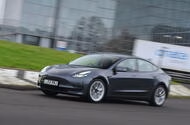
My car, a 2021 Long Range AWD, had 37,771 miles on the clock and came with a few scuffs on the alloys—nothing out of the ordinary for a four-year-old car. It was finished in Midnight Silver with a black interior and those sharp 19-inch silver wheels. Price? Around £25,000–£28,000 through the CPO scheme, which is nearly half the cost of a new equivalent.
Is the Tech Still Cutting-Edge, or Starting to Feel Old?
Let’s be honest: the Model 3’s tech can be a bit overwhelming at first, especially if you’re coming from a more traditional car. Almost everything is controlled through a massive 15-inch touchscreen—wipers, climate, even the glovebox. If you’re a fan of physical buttons, there’s an adjustment period. But once you’ve synced your phone and set up your apps (Spotify, Google Maps, etc.), it all starts to make sense.
What’s really impressive is how the car continues to get smarter over time. Regular over-the-air software updates keep even older Model 3s feeling fresh. Features like Enhanced Autopilot, Sentry Mode (a security system using the car’s cameras), and remote control via the Tesla app are all present and accounted for. And yes, the navigation system is still among the best—accurate, intuitive, and tailored for EV life.
How Does the Model 3 Perform in the Real World?
Let’s talk numbers. The Long Range AWD packs 346bhp and rockets from 0-60mph in just over four seconds. That’s more than enough for daily driving, and honestly, I kept it in Chill mode most of the time—Standard mode’s throttle response is so sharp it can catch you out, especially in the wet.
Space-wise, the Model 3 is deceptive. The glass roof and minimalist interior make it feel airy and roomy, with plenty of space for passengers and luggage. The frunk (front trunk) adds extra practicality, and the rear boot offers 425 litres—enough for a family road trip or a DIY weekend.
What About Range and Battery Life—Any Surprises?
Tesla claims 360 miles of range for the Long Range model, but real-world numbers are always lower. In mixed driving, I averaged about 3.8 miles per kWh, translating to a usable range of 255–285 miles per charge. Not bad, but worth noting that the car does consume energy even when parked—especially if you leave Sentry Mode on overnight (I lost 7% of charge in one night before figuring that out).
Battery degradation is a common concern with used EVs. Tesla’s own data suggests an average of 12% loss after 200,000 miles, and my car’s battery checked out as “within expected limits.” That’s reassuring, especially as more data from high-mileage Teslas continues to show relatively modest degradation compared to some rivals.
How Does the Model 3 Handle Long Road Trips?
There’s a lingering myth that EVs aren’t cut out for long journeys. I put that to the test with a 600-mile round trip to the Scottish Highlands. The Model 3 handled it with ease. The key is adapting your mindset: instead of running the battery down to empty, you plan shorter “splash and dash” charging stops along the way. The car’s navigation system does all the heavy lifting, telling you where to stop and for how long.
Tesla’s Supercharger network is a genuine game-changer. With over 1,800 ultra-rapid stalls at 160+ UK locations, finding a working, available charger is rarely an issue. Charging is fast and typically cheaper than third-party networks. On our trip, the car averaged 3.9mpkWh—even with the climate control running most of the time.
What’s Maintenance Like on a Used Tesla?
One thing that surprised me: maintenance costs are lower than you might expect, but not non-existent. I replaced the wipers (£55 for a pair) and, more importantly, the tyres. Teslas are known for being hard on rubber—Kwik Fit research found the Model 3 tops the charts for tyre replacements in the UK. My car’s tyres were a year older than the car itself and showed signs of aging, so I swapped them out for new Hankooks at £180 a corner. The difference in ride quality and grip was immediately noticeable.
Otherwise, the car breezed through its MOT with no advisories, and the only fault was a tyre-pressure sensor failure. Over several months, I spent more on tyres and wipers than on charging—a testament to the efficiency and reliability of the car.
Are There Any Annoying Quirks or Downsides?
No car is perfect, and the Model 3 is no exception. The ride is firm—sometimes too firm over rough roads—and the steering, while precise, lacks feedback. Rearward visibility is limited, so you’ll rely heavily on the rear camera when reversing. And while the boot is spacious, it’s not a hatchback, which can make loading bulky items a bit awkward.
The touchscreen interface, while powerful, can be frustrating for simple tasks like opening the glovebox (buried in a sub-menu). Some drivers might miss features like a head-up display, and road noise can be noticeable at motorway speeds.
How Does Tesla’s Reputation Affect Ownership?
Let’s address the elephant in the room: Tesla’s brand image is polarizing, especially in the UK. Recent registration data showed a 45% drop in Tesla sales year-on-year in January 2025, even as overall EV sales climbed 37%. Some of that is down to public perceptions of the company and its CEO. Anecdotally, I know people who refuse to ride in a Tesla, let alone buy one.
But if you can separate the car from the company, the Model 3 stands on its own merits. It’s a supremely competent, practical, and efficient vehicle that makes EV ownership genuinely easy.
Is a Used Model 3 Still a Good Investment?
After thousands of miles, my verdict is clear: the Model 3 is an outstanding “appliance.” That might sound like faint praise, but it’s meant as a compliment. Like a great dishwasher or power tool, it just works—day in, day out, with minimal fuss. The technology, charging infrastructure, and overall ownership experience are hard to match, even four years on.
The used market is robust, with over 250,000 Teslas now on UK roads. My car cost nearly 50% less than a new equivalent, yet it’s essentially the same vehicle, thanks to continuous software updates and solid build quality. Battery health is holding up well, and running costs remain low.
If you’re after an EV that’s practical, quick, and easy to live with—and you don’t mind a firm ride or the occasional tech quirk—the Model 3 is still a benchmark. Just don’t be surprised if you find yourself missing it when you drive something else.
Key Specs at a Glance
– Price as tested: £28,000 (new: £49,990)
– Range (real-world): 255–285 miles
– Efficiency: 3.8mpkWh average (test best: 4.3, worst: 3.4)
– Power: 346bhp, 0–62mph in 4.2 seconds
– Boot capacity: 425 litres
– Running costs: 19p per mile (including tyres, wipers, MOT, and charging)
– Faults: Tyre-pressure sensor failure
The bottom line? If you want an EV that just works—and keeps working—a used Model 3 is still one of the smartest buys out there.