
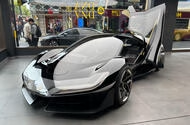
How Close Is the Lotus Theory 1 Concept to Hitting the Road?
If you’ve ever wondered how far a wild concept car really is from reality, the Lotus Theory 1 might surprise you. This isn’t just another pie-in-the-sky showpiece destined to gather dust in a museum. According to Ben Payne, Lotus Group’s vice-president of design, the Theory 1 is tantalizingly close to being production-ready. In fact, the only major thing holding it back? A front windshield wiper.
That’s right. The 986-horsepower, three-seat electric supercar—drawing inspiration from the legendary Lotus Esprit—has most of its parts and technologies already within reach. Payne describes it as “deliberately” realistic, with nearly every feature grounded in today’s engineering capabilities. The car’s dimensions are similar to the existing Lotus Evija hypercar, and many of its headline technologies are simply the next evolution of what’s already on the road.
What Makes the Theory 1 Stand Out from Other Electric Supercars?
Let’s get real: the electric supercar market is getting crowded. So what sets the Theory 1 apart? For starters, it’s not just about raw power (though 986 bhp is nothing to sneeze at). It’s about pushing boundaries in design, usability, and sustainability—all while staying grounded in what’s actually possible.
Take the brakes, for example. The ultra-lightweight AP Racing carbon-ceramic discs and cast aluminum calipers are just a generation ahead of what’s on the Evija. The sticky Pirelli P-Zero Elect tires? Already found on other high-performance EVs. Even the recycled carbon fiber bodywork is ready to go—if customers want it.
Inside, the three-seat layout and innovative ‘grasshopper’ dihedral doors aren’t just for show. They’re designed with real-world usability in mind, including a small boot behind the seats for practicality. The digital tech is equally forward-thinking but not far-fetched: projected head-up displays and electronic rear-view mirrors (borrowed from the Emeya saloon) are already making their way into mainstream cars.
Are There Any Real Obstacles to Production?
Surprisingly few. According to Payne, the biggest hurdle is the lack of a windshield wiper system—a legal requirement in most markets. Fixing that would mean tweaking the cowl area and moving the screen back a bit. Not exactly rocket science.
Other than that, most of the Theory 1’s features are either production-ready or just a small step away. The lighting systems, electronic mirrors, and next-gen braking are all within reach. It’s a concept that’s been given “tangibility and credibility,” as Payne puts it.
So Why Isn’t Lotus Building the Theory 1 Right Now?
Here’s where things get a bit more complicated. While the Theory 1 is technically viable, Lotus has its eyes on a different prize at the moment: financial stability and broader market appeal. The company is focusing on its Eletre and Emeya EVs—models aimed at driving sales volume and restoring the brand’s bottom line.
Payne is candid about it. Building a low-volume, ultra-high-performance supercar isn’t the best way to achieve sustainable growth. Instead, Lotus is working to lower price points and get more people into their cars. The Theory 1, for now, serves as a “North Star”—a guiding vision for where the brand could go, rather than an immediate product launch.
How Does the Theory 1 Fit into Lotus’s Legacy of Innovation?
Lotus has always been about pushing the envelope, and the Theory 1 is no exception. In fact, it echoes the spirit of a lesser-known prototype from the early 1990s: the SID. This Esprit-bodied, Metro 6R4-engined mule was a testbed for advanced chassis systems like four-wheel drive, four-wheel steering, and active suspension—features that seemed radical at the time but are now commonplace in performance cars.
The SID allowed engineers to experiment with separating steering from suspension and fine-tuning vehicle dynamics in ways that were ahead of their time. The Theory 1 picks up that baton, serving as a spiritual successor that showcases what’s possible when you blend cutting-edge tech with real-world practicality.
What Does the Theory 1 Mean for the Future of Sports Cars?
The Theory 1 isn’t just a flashy concept—it’s a signal. It shows that the gap between concept and reality is shrinking fast, especially as technology evolves and consumer expectations shift. Projected head-up displays, recycled materials, and advanced active systems are no longer the stuff of science fiction. They’re here, or just around the corner.
For Lotus, the Theory 1 is a way to reassert its brand values—innovation, performance, and a willingness to challenge the status quo. As the company navigates the tricky waters of electrification and market expansion, concepts like the Theory 1 serve as both inspiration and a testbed for the next generation of sports cars.
The Takeaway: A Glimpse of What’s Next
While you won’t see the Lotus Theory 1 at your local dealership anytime soon, it’s much more than a design exercise. It’s a near-production-ready showcase of what’s possible when a storied brand like Lotus leans into its heritage of innovation and adapts it for the electric age.
The only thing standing between this radical supercar and the open road? A windshield wiper. And maybe, just maybe, a shift in market priorities. For now, the Theory 1 remains a bold vision of the future—a reminder that sometimes, the wildest ideas are just a small tweak away from reality.