
Why Did Mazda Partner with Changan for the 6e Instead of Building In-House?
Mazda’s reputation has always been built on doing things its own way—think rotary engines, perfectly balanced roadsters, and a stubborn love for manual gearboxes. So, when news broke that the new Mazda 6e was essentially a rebadged Deepal SL03 from Changan, a few eyebrows went up. Why would Mazda, a brand so fiercely independent, take this route?
The answer comes down to time, resources, and the relentless pace of the EV revolution. Developing a ground-up electric vehicle is no small feat, especially for a company with Mazda’s size and budget. While giants like BMW can hedge their bets across every powertrain imaginable, Mazda simply doesn’t have the engineering bandwidth to keep up with such a broad portfolio. By partnering with Changan, Mazda gets a shortcut: a proven EV platform, ready to be “Mazdafied” with their own design tweaks and driving feel. It’s a pragmatic move—one that lets Mazda stay relevant in a world where emissions regulations are tightening and consumer expectations for EVs are rising fast.
What’s Different About the Mazda 6e Compared to the Deepal SL03?
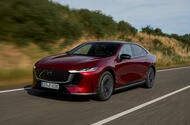
You might be wondering if the 6e is just a badge swap or if Mazda’s DNA really comes through. The answer is somewhere in the middle. While the core architecture and battery tech come straight from Changan’s Deepal SL03, Mazda has worked hard to infuse the 6e with its signature touches. The exterior styling has been sharpened, with sleeker lines and a front end that clearly says “Mazda” rather than “generic EV sedan.” Inside, you’ll find a cabin that leans into Mazda’s minimalist, driver-focused ethos—think intuitive controls, quality materials, and a sense of calm that’s missing from many tech-heavy rivals.
But the real magic is in the driving experience. Mazda’s engineers have retuned the suspension and steering to deliver the kind of responsive, engaging feel that fans expect. It’s not a sports car, but it doesn’t feel numb or disconnected either. In short, the 6e may share its bones with a Chinese sedan, but it’s been given a distinctly Japanese soul.
How Does the Mazda 6e’s Range and Performance Stack Up?
Let’s talk numbers, because for many buyers, range anxiety is still a real thing. The Mazda 6e finally delivers what the MX-30 couldn’t: genuinely usable range. Early figures suggest a real-world range of around 350 miles (560 km) on a full charge, thanks to a 66 kWh battery pack. That puts it right in the sweet spot for mid-size EVs, competing with the likes of the Tesla Model 3 and Hyundai Ioniq 6.
Performance is respectable, if not earth-shattering. Expect a 0-62 mph time in the mid-6-second range, which is more than enough for daily driving and the occasional burst of fun. Charging speeds are competitive too, with fast-charging capability that can take the battery from 10% to 80% in about 30 minutes at a high-power station. For most commuters, that means topping up during a coffee break rather than planning your day around charging stops.
Is the Mazda 6e a True Mazda at Heart, or Just Another EV?
This is where things get interesting. Mazda’s brand has always been about driving enjoyment and a certain underdog charm. The 6e, while not a purebred Mazda from the ground up, manages to capture more of that spirit than you might expect. The steering is precise, the ride is composed, and there’s a sense of connection that’s missing from many rivals. It’s not the same as rowing through gears in an MX-5, but it’s a far cry from the sterile, appliance-like feel of some EVs.
That said, purists may still find the 6e a bit too polished, a bit too safe. The partnership with Changan means some compromises—most notably, a platform that wasn’t originally designed with Mazda’s quirks in mind. But for buyers looking for a practical, stylish EV with a dash of personality, the 6e hits a sweet spot.
What Does This Mean for Mazda’s Future and the EV Market?
Mazda’s move with the 6e signals a broader shift in the auto industry. Smaller manufacturers are realizing that collaboration is often the only way to survive in the high-stakes world of electric vehicles. By leveraging Changan’s EV expertise, Mazda can focus on what it does best: design, dynamics, and delivering a unique driving experience.
For consumers, this means more choice and better value. The 6e is likely to be priced competitively, offering a credible alternative to the usual suspects without sacrificing style or substance. It’s also a sign that the days of “compliance cars”—half-hearted EVs built just to meet regulations—are fading fast. Today’s buyers expect real range, real quality, and real character. The 6e delivers on all three fronts.
The big takeaway? The Mazda 6e isn’t about perfection—it’s about smarter adjustments. Start with one change this week, and you’ll likely spot the difference by month’s end.