
Is the MG Cyberster Really a Game-Changer for Electric Roadsters?
What Makes the MG Cyberster Stand Out in a Crowd?
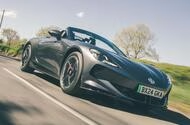
Let’s be honest: the MG Cyberster doesn’t just turn heads—it stops people in their tracks. This is a £60,000 electric roadster with scissor doors, a 0-62mph time of 3.2 seconds, and a design that’s as bold as anything you’ll see from established luxury brands. But what’s even more interesting is who’s making it. MG, now owned by Chinese giant SAIC, is leveraging its British heritage while pushing the boundaries of what a modern sports car can be.
Just a decade ago, the idea of a Chinese manufacturer producing a car that could rival European exotics would have sounded far-fetched. Fast forward to today, and China isn’t just the world’s largest car producer—it’s setting the pace for innovation, especially in the EV space. According to the International Energy Agency, China accounted for over 60% of global electric car sales in 2023, and domestic brands are leading the charge.
MG’s approach is unique. While the brand is Chinese-owned, it still maintains design and engineering offices in the UK, blending British style with cutting-edge technology. In China, the Cyberster is even marketed alongside the classic MGB roadster—a nod to its roots, but with a very modern twist.
How Does the Cyberster Stack Up on Performance and Features?
Let’s talk numbers. The Cyberster comes in two flavors: the single-motor Trophy (335bhp, 0-62mph in 5.0 seconds) and the dual-motor GT (503bhp, 0-62mph in a blistering 3.2 seconds). Both use a 74.4kWh battery, promising a WLTP range of up to 276 miles. In real-world driving, expect closer to 240-250 miles—still respectable for a performance EV.
What’s refreshing is MG’s no-nonsense approach to options. You get two interior color choices (grey or red), one wheel design, and a handful of extras like metallic paint or a red hood. The car comes loaded: heated seats and steering wheel, electric everything (hood, seats, doors), a Bose stereo, adaptive cruise control, and a full suite of driver aids. No hidden subscription fees for features you thought you already paid for—something many European brands could learn from.
The Cyberster’s chassis is built for grand touring, not just outright speed. At nearly two tons, it’s heavy for a two-seater, but the low center of gravity (thanks to the battery placement) keeps handling tidy. The ride is firm but not punishing, and the steering is smooth and responsive. In Track mode, the car’s urgency is undeniable, but it’s just as happy cruising with the roof down on a sunny day.
What’s It Like to Live With the Cyberster Day-to-Day?
Here’s where things get interesting. Over 3,000 miles, the Cyberster proved to be a car that sparks strong opinions. Some owners rave about it, calling it a worthy successor to European convertibles. Others have returned theirs after struggling with quirks.
One of the biggest talking points is the driving position. The battery under the floor means you sit higher than in most roadsters—think more “on” than “in” the car. For some, especially taller drivers, it’s fine. For others, particularly those on the shorter side, it can feel awkward. If you’re considering one, try before you buy.
Storage is surprisingly good for a two-seater. The boot is long if not deep, and there’s a handy cargo net behind the seats for odds and ends. The doors open dramatically upwards, but the small, snap-shut door pockets are a practical touch—no more sunscreen rolling onto the floor.
Roof operation is quick and can be done at speeds up to 28mph, making it easy to adapt to changing weather. The wind deflector is simple to remove or reposition, and keeping the side windows up helps reduce turbulence in the cabin.
Are There Any Annoying Quirks or Deal-Breakers?
No car is perfect, and the Cyberster is no exception. The most frustrating issue? The driver attention monitor. This system, required by safety regulations, uses a camera to check if you’re watching the road. In practice, it’s overly sensitive—look at the climate controls or check your mirrors, and you’ll get a chime and a warning. Worse, you can’t switch it off. Some owners report no issues, but others (especially those who wear glasses) find it infuriating. One creative workaround: a piece of Blu Tack over the camera. Not exactly high-tech, but it works.
Another real-world snag is the 12V battery. Like many EVs, the Cyberster has a small 12V battery that powers essential systems. Leave the car parked and unplugged for a week, and you might return to a dead car—even if the main battery is still charged. Unlike some rivals, the Cyberster doesn’t automatically top up the 12V from the main pack. Worse, with no physical key, you can’t get into the car to access the battery without a special workaround. For frequent travelers, this could be a deal-breaker.
How Does the Cyberster Compare to Traditional Sports Cars?
It’s tempting to compare the Cyberster to established icons like the Jaguar F-Type or even the Aston Martin Vantage. In a recent photo shoot, the MG didn’t look out of place next to a McLaren or Ferrari—at least from a distance. Up close, there are giveaways: the sensor on the door, the less sophisticated headlights, and the occasional odd translation on warning stickers. But the fact that MG is even in the conversation is telling.
Performance-wise, the Cyberster holds its own. The dual-motor GT’s acceleration is genuinely thrilling, and the handling is composed, if not razor-sharp. The ride is more relaxed than hardcore, making it a true grand tourer rather than a track-day weapon.
What About Running Costs and Ownership Experience?
The Cyberster is competitively priced for what it offers. The GT starts at just over £60,000, with contract hire rates around £850 per month. Real-world running costs are low—about 9p per mile, with no service costs reported over several months of use. Charging at home is straightforward, though the maximum rapid charge speed is 144kW, which is decent but not class-leading.
MG’s decision to include most features as standard, without forcing buyers into expensive option packs or subscriptions, is a breath of fresh air. It’s a model that’s winning fans, especially as other brands move toward paywalled features.
Is the MG Cyberster Right for You?
Here’s the bottom line: the MG Cyberster is a bold, exciting addition to the electric sports car world. It’s not perfect—the attention monitor and 12V battery issues are real annoyances, and the driving position won’t suit everyone. But it’s fast, well-equipped, and genuinely fun to drive. It also challenges old assumptions about who can build a desirable, high-performance roadster.
If you’re in the market for something different—something that stands out and offers a glimpse of the future—the Cyberster is worth a serious look. Just make sure to test drive it, and be honest about what quirks you can live with. For some, it’ll be love at first drive. For others, it might be a swing and a miss. But one thing’s for sure: cars like this are rewriting the rulebook, and that’s something every car enthusiast should be excited about.