
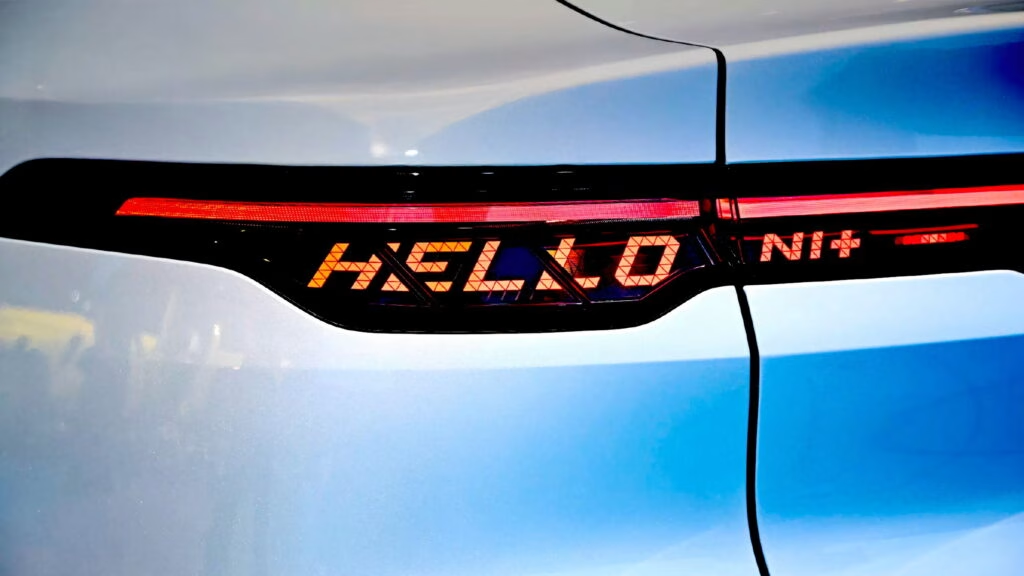
Why Did the Nissan N7 Outsell Its Rivals in China’s EV Market?
Sometimes, the market surprises you. Nissan’s N7 electric sedan, which some critics initially dismissed as a lookalike of the Xpeng P7, just pulled off a major upset in China’s fiercely competitive new-energy vehicle segment. In June, the N7 edged out the Buick GL8 and Toyota’s Platinum 3X (also known as the bZ3X), becoming the best-selling new-energy car from a non-Chinese brand. That’s no small feat in a country where domestic brands usually dominate the EV conversation.
What’s behind this sudden surge? For starters, the N7’s pricing is aggressive. The base 510 Pro model starts at just 129,900 yuan—about $17,800. That gets you a 58 kWh LFP battery and a claimed 317-mile (510 km) range on the Chinese CLTC cycle. If you want more, the 625 Max trim bumps the battery to 73 kWh and the range to a claimed 388 miles (625 km), plus a longer list of standard features. Sure, Chinese range ratings tend to be optimistic, but the value proposition is hard to ignore.
How Close Was the Sales Race Among Foreign EVs?
June’s sales figures tell a story of razor-thin margins at the top. The N7 moved 6,189 units, just ahead of the Buick GL8’s 6,082 and the Toyota bZ3X’s 6,030. After that, the drop-off is steep: Volkswagen’s ID.3 managed 3,950 sales, and the Smart #1 and BMW i3 trailed with 2,324 and 2,270, respectively. For context, the Mini Cooper Electric, VW ID.4X, VW ID.4 Crozz, and Toyota bZ5 all posted numbers below 1,700 units.
This tight race highlights a big shift: foreign brands are still in the game, but only a handful are keeping pace with the local heavyweights. The N7’s win isn’t just about volume—it’s about perception. It signals that with the right mix of price, features, and local partnership, international automakers can still make a splash in China’s EV pool.
Is the Nissan N7 Really a Nissan? The Story Behind the Badge
Here’s where things get interesting. While the N7 wears a Nissan badge, it’s actually the product of a joint venture between Nissan and Dongfeng, a major Chinese automaker. The car shares its platform with the Dongfeng eπ 007, and this collaboration is more than just badge engineering. It’s a strategic move by Nissan, whose global fortunes have been mixed in recent years, to stay relevant in the world’s largest EV market.
This partnership allows Nissan to tap into local supply chains, adapt quickly to Chinese consumer tastes, and keep costs low. It’s a model that’s becoming increasingly common as global brands look for ways to survive—and thrive—amid China’s homegrown EV boom.
What Features and Performance Set the N7 Apart?
Let’s talk specs. Buyers can choose between two power outputs: 215 hp (160 kW) or 268 hp (200 kW), depending on trim. The N7’s dimensions are similar to the Nissan Maxima, offering a roomy cabin that appeals to young families—a demographic that’s clearly responding. According to Nissan, 68 percent of N7 buyers are men, 74 percent are married, and 60 percent are under 35. That’s a sweet spot for a car that blends practicality with a dash of tech-forward flair.
The N7’s tech suite includes the latest in driver assistance and infotainment, though it’s the value-for-money equation that really stands out. For less than $18,000, buyers get a full-size sedan with a competitive electric range, modern styling, and the peace of mind that comes with a familiar brand.
How Does the N7 Stack Up Against the Competition?
Let’s put the N7’s numbers in perspective. In June, the top three foreign-brand new-energy vehicles in China were separated by less than 200 units. The N7’s 6,189 sales just edged out the Buick GL8 and Toyota bZ3X, while Volkswagen’s ID.3 and BMW’s i3 lagged behind. This isn’t just a blip—it’s a sign that the market is hungry for affordable, well-equipped EVs from brands that understand local needs.
It’s also worth noting that the N7’s closest competitors, like the Toyota bZ3X, are also aggressively priced and tailored for China. The difference? Nissan’s partnership with Dongfeng seems to have given it an edge in both cost and consumer trust.
Will the Nissan N7 Come to Global Markets?
Right now, the N7 is a China-only affair. But Nissan has confirmed it’s exploring international markets, with rumors swirling about a possible revival of the Primera badge for export versions. Don’t expect to see it in the US anytime soon, but a global rollout—especially in emerging EV markets—wouldn’t be a shock.
If the N7 does go global, it could shake up segments where affordability and range are top priorities. The formula is simple but powerful: local manufacturing, competitive pricing, and a feature set that punches above its weight.
What’s the Big Takeaway for EV Shoppers and Industry Watchers?
The N7’s story is a lesson in adaptation. Nissan didn’t reinvent the wheel—it just made smarter choices for the world’s most dynamic EV market. By partnering locally, pricing aggressively, and listening to what young families want, Nissan has shown that even in a crowded field, there’s room to win.
The big takeaway? Winning in the EV game isn’t about perfection—it’s about smarter adjustments. Start with one change this week, and you’ll likely spot the difference by month’s end.