
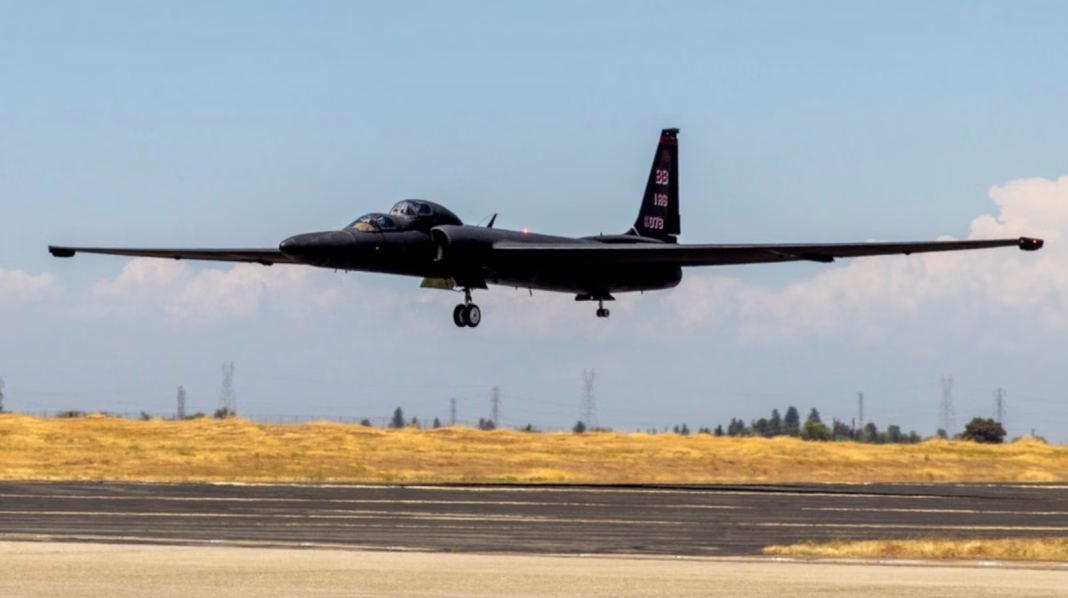
Why Is the U-2 Spy Plane Still Flying After 70 Years?
Most aircraft are lucky to last a couple of decades before they’re retired, scrapped, or relegated to museums. The U-2, on the other hand, just marked its 70th birthday by flying farther and longer than any other plane in its class. That’s not just impressive—it’s almost unheard of. So, what’s the secret behind the U-2’s staying power, and why does it still matter in a world obsessed with drones and satellites?
What Makes the U-2 So Unique Compared to Modern Spy Tech?
You’d think satellites and high-tech drones would’ve made the U-2 obsolete ages ago. But here’s the twist: the U-2 can do things those newer technologies can’t. Flying at altitudes above 70,000 feet, it can gather detailed imagery and signals intelligence that’s often out of reach for satellites, especially when cloud cover or orbital timing gets in the way.
Drones are great for persistent surveillance, but they’re not as fast or as flexible when it comes to covering vast distances or operating in contested airspace. The U-2’s ability to carry a wide range of sensors and swap them out for different missions keeps it relevant, even as technology evolves. According to the U.S. Air Force, the U-2’s modular payload system allows it to adapt to new intelligence needs almost on the fly—a feature that’s kept it ahead of the curve.
How Did the U-2 Shape Global Politics—and Survive the Fallout?
Back in 1960, the U-2 wasn’t just a spy plane—it was a political lightning rod. When Francis Gary Powers was shot down over the Soviet Union, the incident torpedoed a major summit between President Eisenhower and Soviet Premier Khrushchev. For most aircraft, that kind of notoriety would be the end of the story. But the U-2 adapted, with new tactics and technology that kept it flying through the Cold War and beyond.
The U-2’s legacy isn’t just about the past, though. It’s about how a single aircraft design can evolve to meet new threats and missions. The plane’s cockpit, avionics, and sensors have all been upgraded over the years, and pilots now wear pressure suits similar to those used by astronauts. It’s a testament to the original design’s flexibility—and to the engineers who refused to let it fade into history.
What Records Did the U-2 Just Set, and Why Does That Matter?
On the eve of its 70th birthday, the U-2 didn’t just take a victory lap—it set new records for endurance and range among high-altitude reconnaissance aircraft. According to official Air Force reports, the latest missions saw the U-2 flying longer and farther than any other plane in its class, thanks in part to improved fuel efficiency and upgraded systems.
Why does this matter? In an era when military budgets are scrutinized and every program faces competition from newer tech, the U-2’s performance proves that some classics still have a place at the table. It’s not nostalgia—it’s capability. The U-2’s ability to deliver real-time intelligence in challenging environments is something commanders still rely on, especially in regions where satellites can’t provide persistent coverage.
How Do Pilots Prepare for U-2 Missions Today?
Flying a U-2 isn’t like piloting a commercial jet—or even most military aircraft. Pilots train for months to handle the plane’s unique quirks, like its bicycle-style landing gear and the razor-thin margin between stall speed and maximum speed at high altitude (what pilots call the “coffin corner”).
The physical demands are intense, too. Pilots wear full-pressure suits, pre-breathe pure oxygen, and sometimes spend over 10 hours in the cockpit. It’s a blend of old-school flying skill and cutting-edge science, and only a handful of aviators ever qualify to fly the Dragon Lady, as the U-2 is affectionately known.
What’s Next for the U-2—Retirement or Reinvention?
The U-2’s future has been debated for years, with some calling for retirement and others pushing for more upgrades. Recent investments in new sensors and digital systems suggest the Air Force isn’t ready to say goodbye just yet. In fact, there’s talk of integrating the U-2 into next-generation intelligence networks, where it could serve as a high-altitude node for data collection and communication.
Experts at the RAND Corporation and the Mitchell Institute for Aerospace Studies have noted that the U-2’s adaptability is its greatest strength. As threats evolve, so does the mission—and the U-2 keeps finding new ways to stay relevant.
The big takeaway? Longevity like the U-2’s isn’t about perfection—it’s about smarter adjustments. Start with one change this week, and you’ll likely spot the difference by month’s end.
