
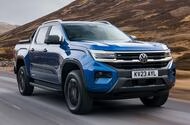
Is the New Volkswagen Amarok Really a Game-Changer for Pick-Up Trucks?
When Volkswagen first launched the Amarok, it turned a few heads. But with this second-generation model, they’re not just aiming to impress—they want to shake up the whole pick-up scene. The question is, does the new Amarok deliver enough to stand out in a fiercely competitive market?
What Makes the Latest Amarok Different from Its Predecessor?
Let’s get one thing straight: this isn’t just a facelift. The new Amarok is bigger, bolder, and built on a completely new platform. Volkswagen has ditched the old mechanicals, opting instead for a chassis shared with the Ford Ranger. That’s right—the Amarok and Ranger are closer cousins than you might think, thanks to a partnership between the two automotive giants.
But don’t let the shared DNA fool you. Volkswagen has worked hard to give the Amarok its own personality. The exterior styling is unmistakably VW—sleek lines, a bold front grille, and a touch of class that you don’t always see in this segment. Inside, it’s more premium than ever, with plush materials and a tech-laden dashboard that feels more SUV than workhorse.
How Does the Amarok Stack Up Against the Ford Ranger and Toyota Hilux?
This is where things get interesting. The Ford Ranger has long been the king of the pick-up hill, especially in the UK and Europe. Toyota’s Hilux is legendary for its reliability and ruggedness. So, where does the Amarok fit in?
Volkswagen’s approach is to blend utility with comfort. The Amarok isn’t just about hauling gear or tackling muddy tracks—it’s about making every journey enjoyable, whether you’re heading to a job site or a weekend getaway. The range of trims and engines means there’s an Amarok for almost everyone, from the no-nonsense Life model to the luxury-laden Aventura.
One thing to note: while the Ranger is now available as a plug-in hybrid, the Amarok sticks with diesel power for now. That could be a sticking point for buyers looking to future-proof their purchase, especially with changing benefit-in-kind tax rules in the UK. Still, for those who value torque and long-distance efficiency, the Amarok’s diesel engines are hard to beat.
What Are the Key Features and Trims Available?
Volkswagen hasn’t skimped on choice. Here’s a quick breakdown of what you can expect:
– Life: The entry point, but hardly basic. You get 17-inch wheels, LED headlights, a reversing camera, and a 10.1-inch infotainment screen. Engine options include a 168bhp or 202bhp 2.0-litre turbo diesel, with the latter offering a smooth 10-speed automatic gearbox.
– Style: For a bit more flash, the Style trim adds 18-inch wheels, a larger 12-inch central screen, a 360-degree camera, and chrome accents. You can also upgrade to a punchy 237bhp 3.0-litre V6 diesel.
– Panamericana: This one’s for the adventure seekers. Off-road goodies like a locking differential, extra underbody protection, and comfort suspension come standard. Inside, you’ll find brown leather accents and a premium Harman Kardon sound system.
– Aventura: The top dog. Expect 21-inch diamond-cut alloys, Savona leather, and plenty of chrome. It’s powered exclusively by the V6 diesel, making it as powerful as it is plush.
All Amaroks come in double-cab form, so there’s plenty of space for passengers and gear.
Does the Amarok Feel Like a True Volkswagen?
It’s a fair question, given its Ford underpinnings. But step inside, and the answer is clear. The Amarok’s cabin is pure Volkswagen—clean design, intuitive controls, and a sense of refinement that sets it apart from rivals. The infotainment system is slick, the seats are supportive, and little touches like ambient lighting make it feel more like a premium SUV than a utilitarian pick-up.
On the road, the Amarok strikes a balance between comfort and capability. The ride is composed, even on rough surfaces, and there’s enough grunt from the diesel engines to handle heavy loads or tricky terrain. If you’re used to older, bouncy pick-ups, this one will surprise you.
How Does It Perform in Real-World Scenarios?
Let’s talk practicality. The Amarok’s bed is bigger than before, making it easier to haul everything from building materials to camping gear. Payload and towing capacities are competitive, matching or exceeding many rivals. For business owners, that means fewer compromises between comfort and utility.
Off the beaten path, the Panamericana trim shines. The locking differential and underbody protection give you confidence on rough trails, while the comfort suspension keeps things civilized. And if you’re spending long hours behind the wheel, features like adaptive cruise control and a top-notch sound system make the miles fly by.
What About Running Costs and Ownership?
Diesel engines remain the heart of the Amarok lineup, and for good reason. They offer strong torque, decent fuel economy, and proven durability. According to recent data from the Society of Motor Manufacturers and Traders (SMMT), diesel pick-ups still dominate the UK market, largely due to their efficiency and towing prowess.
Volkswagen’s reputation for reliability and aftersales support is another plus. Routine servicing is straightforward, and the Amarok’s shared components with the Ranger mean parts availability shouldn’t be an issue.
Is the Amarok the Right Choice for You?
If you want a pick-up that feels just as at home on city streets as it does on country lanes, the Amarok deserves a spot on your shortlist. It’s not the cheapest option, and the lack of a hybrid model might give some buyers pause. But for those who value comfort, style, and real-world capability, it’s a compelling package.
The Amarok proves that you don’t have to choose between ruggedness and refinement. Whether you’re a business owner, an outdoor enthusiast, or just someone who appreciates a well-built vehicle, this pick-up has a lot to offer. And in a market crowded with worthy rivals, that’s no small feat.