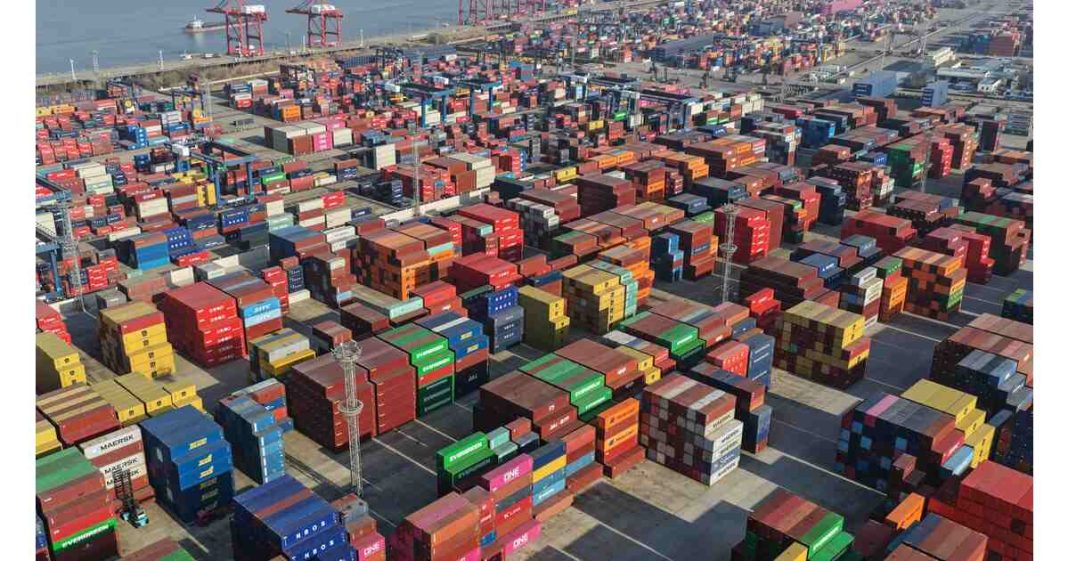
Trade surplus of China surged to a record of almost $1.2 trillion in 2025, the government said Wednesday, as exports to other countries made up for slowing shipments to the U.S. under President Donald Trump’s onslaught of higher tariffs.
China’s exports rose 5.5% for the whole of last year to $3.77 trillion, customs data showed, as Chinese automakers and other manufacturers expanded into markets across the globe. Imports flatlined at $2.58 trillion. The 2024 trade surplus was over $992 billion.
In December, China’s exports climbed 6.6% from the year before in dollar terms, better than economists’ estimates and higher than November’s 5.9% year-on-year increase. Imports in December were up 5.7% year-on-year, compared to November’s 1.9%.
China’s trade surplus surpassed the $1 trillion mark for the first time in November, when the trade surplus reached $1.08 trillion in the first 11 months of last year.
Economists expect exports will continue to support China’s economy this year, despite trade friction and geopolitical tensions.
“We continue to expect exports to act as a big growth driver in 2026,” said Jacqueline Rong, chief China economist at BNP Paribas.
While China’s exports to the U.S. have fallen sharply for most of last year since Trump returned to office and escalated his trade war with the world’s second-largest economy, that decline has been largely offset by shipments to other markets in South America, Southeast Asia, Africa and Europe.
For the whole of 2025, China’s exports to the U.S. fell 20%. In contrast, exports to Africa surged 26%. Those to Southeast Asian countries jumped 13%; to the European Union 8%, and to Latin America, 7%.
Strong global demand for computer chips and other devices and the materials needed to make them were among categories that supported China’s exports, analysts said. Car exports also grew last year.
China’s strong exports have helped keep its economy growing at an annual rate close to its official target of about 5%. But that has triggered alarm in countries that fear a flood of cheap imports are damaging local industries.
China faces a “severe and complex” external trade environment in 2026, Wang Jun, vice minister of China’s customs administration, told reporters in Beijing. But he said China’s “foreign trade fundamentals remain solid.”
The head of the International Monetary Fund last month called for China to fix its economic imbalances and speed up its shift from reliance on exports by boosting domestic demand and investment.
A prolonged property downturn in China after the authorities cracked down on excessive borrowing, triggering defaults by many developers, is still weighing on consumer confidence and domestic demand.
China’s leaders have made increasing spending by consumers and businesses a focus of economic policy, but actions taken so far have had a limited impact. That included government trade-in subsidies over the past months that encouraged consumers to buy newer, more energy efficient items, such as home appliances and vehicles, and replace older models.
“We expect domestic demand growth to stay tepid,” said Rong of BNP Paribas. “In fact, the policy boost to domestic demand looks weaker than last year — in particular the fiscal subsidy program for consumer goods.”
Gary Ng, a senior economist at French investment bank Natixis, forecasts that China’s exports will grow about 3% in 2026, less than the 5.5% growth in 2025. With slow import growth, he expects China’s trade surplus to remain above $1 trillion this year.