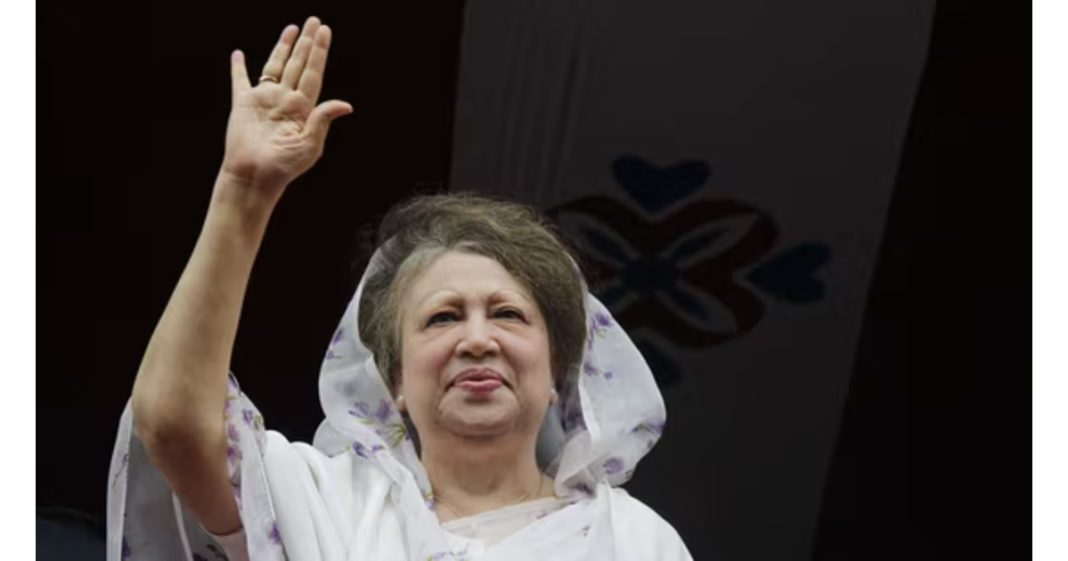
Former Bangladeshi Prime Minister Khaleda Zia, whose archrivalry with another former premier defined the country’s politics for a generation, has died, her Bangladesh Nationalist Party said in a statement Tuesday. She was 80.
Zia was the first woman elected prime minister of Bangladesh.
She had faced corruption cases she said were politically motivated, but in January 2025, the Supreme Court acquitted Zia in the last corruption case against her, which would have let her run in February’s general election.
Read more: Yemen separatists accuse Saudi Arabia of launching airstrikes against their forces
The BNP said that after she was released from prison due to illness in 2020, her family requested the administration of her archrival, former Prime Minister Sheikh Hasina, at least 18 times to allow her to be treated abroad, but the requests were rejected.
Khaleda Zia was the widow of the former Bangladeshi President and military hero Zia-ur-Rehman who had led to the fight for the country’s democracy but was killed in a military coup in 1981. She took up his political amibition and gained a loyal following for her uncompromising stance against the military dictatorship.
She first came to power in 1991 and remained in the office till 1996. She also served a brief second instance, however, the opposition boycotted the election result and Zia was then toppled by Haseena. Haseena remained in power, her top political arch-rival remained in power for the next 30 years. Khalida Zia and Sheikh Haseena Wajid remained locked in a fierce political rivalry.
Zia’s 2001 regime was mired to accusations of corruption and after Haseena took power again in 2009, she was charged with multiple corruption cases. In 2018, Zia was convicted on corruption charges for 10 years. Her party, however, argued that the charges against her were all politically motivated to weaken her support. Zia was already in November to campaign in elections set for February 2026, the first vote in Bangladesh since the fall of Haseena Wajid.
However, late in November, Zia was taken to hospital where her condition continued to decline. After her death was announced, the interim Prime Minister, Muhammad Yunus, released a statement calling Zia a symbol of the democratic movement. Zia’s son, Tariq Rehman, who had lived in exile in the UK for 18 years, returned to Bangladesh this month to contest the elections with the BNP considered to be the Ford front-runners. Zia’s funeral is expected to be held in Dhaka on Wednesday and she will be buried alongside her husband.
With Additional Input from GVS South Asia Desk