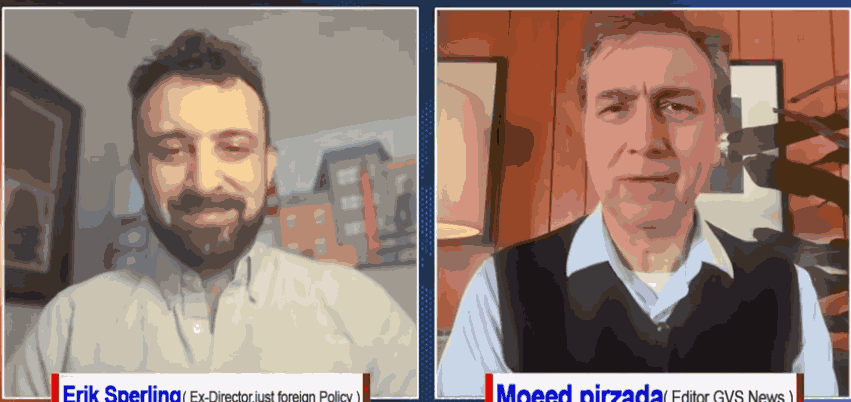
Dr Moeed Pirzada introduces Erik Sperling, highlighting his work against US interventionism and advocacy for diplomatic conflict resolution.
Erik Sperling discusses the Pakistani military’s relationship with the US, describing it as a neo-colonial one.
Sperling explains the US’s view of Pakistan as a strong Chinese ally and the cultural ties of Pakistani generals to the West.
Title: How Washington Works: India, Pakistan Army & Trump? Moeed Pirzada with Erik Sperling
Dr Moeed Pirzada 0:23
Eric Sperling is executive director of just foreign policy in Washington, DC. He and his team work against rampant us interventionism. Advocate a diplomatic approach to conflict resolution and work to promote human rights. Sperling has keen interest in the issues related to South Asia and Middle East, and has worked with the American Pakistani community over the past three years, notably during her Donald Liu hearing and campaigned for House resolution 901 in 2024
Dr Moeed Pirzada 2:16
God, you know, it’s the one about, you know, lifting, you know,
Erik Sperling 30:00
Suddenly, the unexpected Rise of the Chinese, you know, economic muscle, and the fears that this economic muscle is going to feed onto the military muscle. And then, with the pivot to Asia, United States started thinking that Pakistan should be taken away. China has to be contained. Pakistan and India have to be friendly. So this continued till you can say till 2022 this thinking suddenly, you know, with this background I’m explaining, suddenly, there is a new change. Suddenly, it looks like that United States is now more aligned with Pakistan, less aligned with India. Is less bothered by Pakistan being on the Chinese side as well. This is what my puzzle is. I mean, if you can, if you can, if you comment something on it. Yeah. I mean, it is an incredibly complex situation, especially in Washington. You know, typically, if a party is engaging with China,
Erik Sperling 50:00
Essentially, have someone who’s, you know, has, he just has the perfect experience to do this job. And, you know, the only thing that can stop him, I would say, is, you know, Donald Trump, if Donald Trump has a whim in some direction, or if the Pakistani people turn up the pressure, or if the American people turn up the pressure, or a mixture of that, you know, and so that’s, I think, what we’re what we’re working on, and what we’re building towards, actually, yeah, I want to come to it. I mean, you have worked with Pakistani community, you know, with different kind of Pakistani community groups, you know, what do you think the Pakistani community achieved and where it failed? Yeah, well, I wouldn’t say anything has failed yet. I mean, what’s been achieved is obviously the most unprecedented human rights activism in the history of the US Pakistan relationship. I mean, there’s no question about that. Obviously, what we’ve done in last three years has been more than the rest of the all of the activism prior to that combined. So that’s pretty good. Okay, so that’s pretty impressive. We’re obviously seeing a community that is getting more comfortable in the country that’s getting more wealthy is it’s a very, incredibly successful community,
Erik Sperling 1:10:00
Them realize there’s no escape here, and they might as well cut a deal now, exit while they still can. And so I’ve just urged people to, you know, it’s one of those counterintuitive things, where the more you signal that you’ll fight till the end, the quicker you’ll win actually. Thank you so much. You know, it has been a fascinating discussion, very interesting. I really enjoyed it, and I look forward to very interesting feedback from the viewers as well, and look forward to stay in touch with you. Thank you. Thank you so much.
Dr Moeed Pirzada 1:01
Sperling before joining just foreign policy, has been a congressional staffer and has worked as senior advisor and counsel with Congressman ro Khanna and John Conyers. He recently joined mohied Pirzada editor Global Village space to discuss the dynamics of relations between Pakistani army and Trump administration, new developing fault lines between Washington and Delhi, the growing role and importance of Pakistani community in Washington and the challenges that lie ahead.
Dr Moeed Pirzada 1:30
What is your understanding how the Pakistani military, you know, found their entry with Donald Trump to begin with, in January,
Erik Sperling 1:35
Pakistan in general, of course, they declared independence. But functionally, you know, they’re in sort of a NEO colonial relationship with
Dr Moeed Pirzada 1:42
the United States. What kind of relationship United States has with India? India has such a
Erik Sperling 1:46
unique history. I mean, I think they did truly develop true sovereignty. They are, in fact, a sovereign country, even though they do a lot of harmful things. I think the US, you know, national security community knew that Imran Khan was absolutely a rock solid guarantee of that true sovereignty, effectively, military dictator Austin Munir came. He’s showing Trump. Here are minerals. You can have these, you know, just saying, What can we do? I even learned a new Pakistani phrase related to what’s kind of a, you know,
Erik Sperling 2:20
yeah, you know that one. But you know they
Dr Moeed Pirzada 2:24
What are you talking about? I mean, this is earthquake. You think that the US establishment doesn’t think that Pakistan is a strong Chinese, credible Chinese ally.
Erik Sperling 2:32
But of course, if anyone studies this closely, you know there’s no Pakistani corrupt generals retiring in Shanghai. They buy their property in the West. They’re culturally tied to the west. If Imran Khan comes into power, he’s not only the most powerful voice for Palestine, you know, for Muslims, they’re also worried about what would happen if he essentially, indirectly or informally, kind of joined that Russia, China, Iran block.
Dr Moeed Pirzada 2:54
What do you think the Palestinian community achieved and where it failed those
Erik Sperling 2:58
Americans who don’t want the US to be propping up a military regime and those Pakistani Americans who are also fighting for their own freedom and that of their families, that’s kind of the coalition between those two groups.
Dr Moeed Pirzada 3:10
Eric, a very warm welcome on behalf of myself and my viewers on this channel. I’ll come straight to the point. What was the vision and the purpose behind the creation of just foreign policy.
Erik Sperling 3:23
Just foreign policy was founded right after the Iraq war had been launched and after the Afghanistan invasion. And the idea was to prepare for what was expected then to be a forthcoming attack on Iran. That was something that, you know, the architects of the other two wars had talked about. And so it’s, it’s quite amazing that, you know, and the concept is to mobilize American people, and, you know, work inside the US government as well, bring that people power to the US government and guide it and target it to try to push back a little bit against the very, very powerful military we call the military industrial complex, or sort of the national security elites in Washington who are, tend to be always pushing for war. And so it’s amazing. 20 years later, you know, if you watch Fox News, CNN right now, it’s all talking about war with Iran. So it’s incredible how you know, something’s never changed, I guess.
Dr Moeed Pirzada 4:17
So I’m surprised. You know, I thought that Iran was actually cooperating with United States and the allies in the invasion of Iraq. I mean, was there a plan to attack Iran at that time? Yeah.
Erik Sperling 4:26
Well, this is, if your viewers haven’t seen it, it’s one of the most important clips. You know, General Wesley Clark, very hawkish guy, but he’s given a clip where he talks about
Dr Moeed Pirzada 4:35
his visit to the scene that I’ve seen. That about this is countries.
Erik Sperling 4:39
Everyone should look it up. It’s seven countries, if you look up Wesley Clark, seven countries. And he said this repeatedly in multiple interviews, and they made very clear that they they intended to use the 911 attacks as sort of a pretext to do what they had wanted to do, which is take out. You know, what they consider, you know, hostile regimes or regimes that were aligned with, say, Russia and China. Yeah, before Russia, China would would recover and rise and become a threat. And that was their idea. But it went pretty poorly in Iraq, and that sort of threw a wrench in their plans. Though, if you look at those seven countries, they’ve taken down almost every every one of them, one way or another. They couldn’t do the invasion route, but they found a way to take down most of them.
Dr Moeed Pirzada 5:19
What are the seven countries you think they have taken down? I mean, one is Iraq, the other is Syria. The third is, I’m gonna
Erik Sperling 5:25
have to, there’s so many, let me just, I’m gonna have to pull up the seven countries real quick. But definitely Syria. I’ll just pull it up.
Dr Moeed Pirzada 5:34
Libya, Syria, Libya, Iraq, three. Yeah.
Erik Sperling 5:39
And then you had Lebanon, Lebanon for Libya, Sudan, Somalia and Iran.
Dr Moeed Pirzada 5:47
Oh, my God. So the conflict is still going on, and this
Erik Sperling 5:51
conflict is still going on, but it’s gotten a little more complicated. You know, ultimately, their their analysis wasn’t wrong, in the sense that, you know, it has become more difficult to take down these countries when, you know, with a very strong China, you know, China has been able to continue doing trade with countries like Iran, and that’s been essentially the sole lifeline for them. It was also true of Venezuela. So, so yeah, their theory was right. I think their goals were immoral and was ultimately bad strategy.
Dr Moeed Pirzada 6:20
I heard the statement from President Donald Trump day before yesterday, that he’s actually, or he’s continuously saying this, that if, if we don’t take Greenland, then Russia or China will take Greenland. So I think the same, same argument, the same thinking,
Erik Sperling 6:35
yeah, and, you know, he’s a, you know, he’s a more unique guy. We don’t totally understand his thinking. I mean, I think he’s very much attracted to the idea of expanding the map, having a big flag on a country that, you know, according to that map projection, looks huge. But you know, there is a, there is a lot of national security experts that do think there’s a, you know, correctly. Think there’s a competition for the Arctic with Russia and China now, but most sensible people, the Americans, is
Dr Moeed Pirzada 6:59
there a competition? Is there a real competition with Russia and China and Arctic?
Erik Sperling 7:04
Well, there is, yeah, and, you know, and there’s, it doesn’t have to be such a competition. I think, you know, those of us who are more sensible would say, you know, resume the type of Arctic cooperation that was going on. It was largely finally suspended, more recently, with the Ukraine invasion. But you know, essentially, there are two approaches on virtually every issue you know. One is to, you know, collaborate with China and Russia try to lower tensions and make the race, you know, less extreme. This also applies to say AI, where Russia, US and China are racing on AI, and it could pose dangers for the world, because AI is somewhat unknown the impact it’ll have, but the Arctic is the same way. I mean, if you know, if both sides are just racing to build ships and build bases and then start exploiting resources up there, it could, it’s not only going to be a huge waste of money for everybody involved to have that arms race, but also could lead to environmental disaster as well. So you know, I think, you know, Trump’s right that there’s a competition for that space, but the correct answer is, you know, promote diplomacy. You know, have a sensible approach. So, but yeah, I think Trump’s is a little unique. I think he wants a legacy piece, and he likes how that looks on that map. But I think, you know, for others, it’s a little bit more strategic. This is, you know, seen by the national security leaders, is very unstrategic because it alienates the NATO allies that that DC values so much so.
Dr Moeed Pirzada 8:27
But you know, I, let me come to a very basic and fundamental question. If you have a hyper power like United States, which is not rival and constrained by another major power, like Soviet Union to 1990s How do you, how do you constrain and control the ambitions of such a hyper power? I mean, look at Greenland. I mean, most Europeans have a very pusil in, pusillanimous kind of attitude. I mean, even the European Union is not, is not very clear. I mean, as to how to respond to to Trump’s grab for Greenland, and how do you constrain such a hyperpower?
Erik Sperling 9:01
Yeah, well, I think there’s a couple different ways, you know. One of the ways is, of course, that the people that you know, this type of approach does require, you know, controlling and managing massive populations abroad. You know, Pakistan is obviously a huge example of this where, you know, the US felt very comfortable with the ruling elites they were supporting. There was a system that they thought was working. We just switch, you know, from this party to that party, and then back to this party with our military, US backed military, firmly in control the whole time. And then you ultimately, what happens is someone, you know, a leader, will come along that tut that connects with the people, that channels their points of view and channels their their dreams and aspirations, and then the US, you mean, in Hong Kong, was this case, I think it’s pretty clear. I mean, this is one of the most probably, that one of the greatest case studies in, you know, in the world, in terms of a people that had really no way out, you know, of this sort of, you know, it’s a system that was intended to look like a democracy. Of course, it’s a. Essentially a military dictatorship and sort of a kleptocracy with the military, you know, controlling virtually much of the all the major resources. So then Imran Khan, you legendary sports figure, international, you know, kind of Cosmopolitan person. Then he, you know, channels that energy. And now we see it’s not been that easy for the US to stop that movement. They’ve worked on everything they can, and more. I mean, they’ve had to create new approaches, because, you know, that connection he has with the population is so strong that so that’s, that’s one way it gets stopped, is that little by little, people find their leader. He organizes, and the country is liberated. And ultimately, kind of, truly,
Dr Moeed Pirzada 10:40
it’s a very interesting I mean, you refer to Imran Khan, most Pakistanis, in their own common sense, would have thought that someone like Imran Khan, who’s educated at Oxford, who lived 20 plus years in Britain, who was very comfortable with the Western elite, had interacted with them. When he talks to an American president or American Secretary of State, he basically puts, you know, looks eye to eye. He’s very comfortable, unlike Nawaz Sharif shahba, Sharif the Pakistani army generals, so Western ruling elite, in the power elite will like to connect with a man like this that who can bring along the popular support to the Western agenda. They will try to convince him that, look, these are our strategic interests in South Asia or the West Asia, why it is not happening this way. Why they have to remove him? Why they have to go after him? Why they have to put him in jail? Yeah.
Erik Sperling 11:26
Well, one reason is that, you know, they got very comfortable with a very pliant regime, and so, you know, they have a very low tolerance for an independent minded Pakistan. Think, obviously, you know any of Imran Khan’s positions, you look at him. I mean, he thought the drone war was counterproductive and a human rights violation. I mean, that’s a completely moderate position. You know, he has issues with the military, controlling the economy, you know, reducing corruption. These are not even slightly radical positions. These are kind of common sense, you know, basic viewpoints that are truly shared by any normal person. So, you know. So you’d think that he would, you know, they would respect that. But you know, they’re used to a regime that provide has no independent thought, and so, you know, that’s the first reason why, when they can have that, you know, they definitely prefer that, and they’ll work to maintain that. You know, even if, you know, even if it’s unreasonable, and the system is set up that they can’t, can’t think of long term goals like obviously, I think everyone in this community knows that it would be better to build that connection with Imran Khan, you know, and that will form a healthy bond with the pocket between the American and Pakistani peoples that would be enduring. But instead, the short term nature of the system, the kind of the all or nothing, thinking of the US system makes it where, you know, it’s not even able to consider that they might be alienating Pakistan long term. So.
Dr Moeed Pirzada 12:46
But, you know, there is a puzzle. Imran Khan struck a good note with Donald Trump and the First Presidency, perhaps because of Afghanistan. When he came here, he was very warmly embraced and welcomed in 2019 and afterwards he was having communication, correspondence. Trump also appreciated him once or twice, not like the way he appreciated the Field Marshal ASA Munir, but he didn’t mention him as a good man, as someone he can work with or he’s working with him. He appreciated him. What went wrong with the Biden presidency in January 2021 that Biden never you know, even received a congratulation call from Imran Khan. Was it Biden? Was it the Central Intelligence Agency? Was it the deep state? What happened?
Erik Sperling 13:28
And what we call, you know, what we call the deep state? You know, that’s been used many different ways, but it’s really just the national security elites. You know, in our country, it’s really generally not a democratic process. So when we say, so, yes, there is a national security elite, and it’s in both in government, it’s in the think tanks, and then, of course, yeah, in, you know, in government, also in the intelligence agencies and so on. And so, yeah, I would say that, yeah. What happened there is essentially that, you know, the Biden administration was, is very much comprised of people who are in that national security establishment, and those people are all well educated that, you know, Pakistan under the military, you know, effective military rule, you know, is the ideal situation for the US, as long as it can be maintained, you know. And so it, you know, once Ukraine happened, and there was,
Dr Moeed Pirzada 14:20
but But Eric, this is what the confusion is. Ukraine happened in the beginning of 2022 Russia invaded Ukraine in February. 2022 in January, on 20th January, 2021 when President Biden came into White House, that was Afghanistan withdrawal time. Ukraine was not necessarily on the horizon. Iran Khan had good communication with the outgoing president, Donald Trump. Suddenly, you know, the leaders in a normal ritual call the US president for congratulations. Imran Khan kept on trying to place a call, a five minute, 10 minute call to President. His call was not welcomed. He was simply banished from the American foreign policy from 20th January on. World, I still don’t understand what really happened.
Erik Sperling 15:02
Yeah, well, to be clear, ever since Imran Khan was leading voice on those drone strikes. I mean, I know I was a young man when in college, yeah, in college, you know, and that’s when I’d first heard of myself, because we were protesting, you know that, that, you know, that drone war to just eliminating families from the air, you know, on a suspicion. You know, we had issue with that back then, and he did too. So, but so the US never, never forgot that. You know, that’s the kind of it was a very potent criticism.
Dr Moeed Pirzada 15:29
US never forgot that. You mean, Biden was personally invested into the issue. He was foreign policy person, yeah.
Erik Sperling 15:36
Well, certainly that, yeah. I mean, the Obama administration was extremely active when it came to drone strikes. That was perhaps, you know, one of Obama’s most problematic actions. There’s quite a few, but that was, you know, up there in terms of some of the worst things he did. So it’s not just that, it’s not Biden personally. You know, Biden is very much. He was the chair of Senate Foreign Relations, you know, he was very embedded in the national security grand strategy game. He always was even right to his last days. And many people would say it was sort of his undoing, in the sense that, you know, even he admitted it, that he’s focusing too much on foreign policy. Why is that? I think when people get a little older, people viewers have someone who’s older, you know, they tend to kind of shift towards those things they know really well. And so all that to say is, Biden knows foreign policy well. And it’s exactly the establishment foreign policy, that bipartisan consensus that you know, where you have Lindsey Graham on the hawkish side of that consensus. And you would have, you know, number of Democrats. I won’t even, I guess I won’t name them, but you have a number of, you know, Senate Democrats, and there’s, that’s a consensus there. And then you have on the far, you know, the far left of the US system, you have some people who aren’t in that, and on the far right, you have some that aren’t. But that’s all that to say is, you know, it wasn’t, you know, something that he anyone consciously chooses. They don’t say, I don’t like this guy. You know, it’s just a known thing that just comes together.
Dr Moeed Pirzada 16:58
Conclude that Biden was more institutional. He was under the influence of the foreign policy establishment and the Central Intelligence, the intelligence community, the foreign policy establishment, the national security establishment that suddenly became more powerful after Trump’s, you know, exit from the White House in January 2021 didn’t like Imran Khan. They thought Imran Khan was problematic, and this is how Biden never engage Imran Khan. Can we? Can we make this conclusion?
Erik Sperling 17:24
Yeah, exactly.
Dr Moeed Pirzada 17:27
Okay, so then what went happened with Trump? Because, you know, before in the run up to the election, in 2024 Pakistani military, I know was extremely concerned, and they had lot of trepidation as to how Donald Trump will react, and, you know, Richard grener and all that. And there was an expectation that, you know, Trump might actually make some statement to demand Imran can’t be released or be treated fairly. But then the military quickly engage Donald Trump. How you look at the whole process? Yeah.
Erik Sperling 17:53
So I think everyone who studies Donald Trump or tries to influence influence him on any issue, whether you’re on the hawkish neocon side, or whether you’re on the pro diplomacy side, we all agree on one thing, which is that, you know, he can be pretty arbitrary. And, you know, make decisions on a whim. You know, I think I’ve joked that, you know, we should make a truce with the neocons, because we’re both exhausted, you know, in the morning we’re like, oh, he’s talking about diplomacy. Then in the afternoon, he’s saying, I’m going to, you know, take out the leader, and then, and then in the in the evening, you know, he’s saying, you know, he’s talking about a whole different country. I mean, so we’re just exhausted, all of us, whether, but all that to say is so Rubio is well aware of this. You know, Rubio essentially was tasked with pretending to be friendly to Trump so that the national security establishment would have a very effective voice inside the administration, and he’s been really good at that, you know, to the you know, you know, which is something that you know, most of us are very frustrated with how good he is at it. But what is your
Dr Moeed Pirzada 18:52
understanding how the Pakistani military, you know, found their entry with with Donald Trump to begin with, in January, was that the CENTCOM, helping them with Sharif Allah was handed over to them as a master gate for a biggate who really helped them connect with Trump.
Erik Sperling 19:04
I think my read of it would be that there isn’t even such a clear divide between these entities. You know, the military is so tied with the US. You know, the Pakistani military establishment is so tied up with the US. You know, that there’s an ongoing coordination there. There’s an ongoing discussion, and I think they very much see themselves on the same team and that, you know, that’s not going to apply to people who are outside of that foreign policy consensus, but it obviously applies to people like Marco, Rubio, Donald Liu, this. Elizabeth Horst, you know anyone in those circles? You know, they really see themselves as that is their goal. You know, we have, obviously, some of these people in Congress, Tom Swazi, you know, they’re all on the side of the Pakistani government or regime, really. So in that sense, it wasn’t difficult to come together. They essentially all have the same shared interest, and that’s to have Trump make the right decision, in their view, which is to prop up this regime so that it can continue to serve us interest. And on the Pakistani side, I assume, you know, they love power or money or something like that, not
Dr Moeed Pirzada 20:05
exactly, you know, a few, a few, a few weeks ago for my own program, I was doing some research, you know, on the net, and I saw that the research basically revealed to me, and I want you to comment on that, that central command, the CENTCOM, is more or less operationally integrated with the Pakistani military, whereas the Pacific Command doesn’t have an operational coordination with the Indian military in the same way. So whereas, when I was in Pakistan, I used to think that, you know, United States military is now moving and swinging towards the India. India is becoming the major player, but operationally, the Indian military establishment is not connected this. There are, there are gaps of trust. You know, they’re not really part of the American military thinking, where Pakistan military is an extension of CENTCOM. Am I right, exactly.
Erik Sperling 20:50
And this is such an important thing to understand about the way us power works, and the way that what we would say is sort of a neocolonialism works, right? There’s obviously, you know, the Pakistani military will say that in Pakistani, you know, Pakistan in general, say, of course, they declared independence, but functionally, you know, they’re in sort of a NEO colonial relationship with the United States due to that, largely to that military relationship. And so, you know what? As you spend enough time in DC working on these issues, you realize that when the US says they are training a military it’s not like they go in and they just say, hey, here’s some skills, you know. You know, good luck with that. You know, they really integrate at that time, and that’s and they say that it’s about integrating, you know, platforms and, you know, all these military terms that you know. I, you know, I’m not an expert in in all wired exercises, joint exercises, but the command system, the weapon systems, it’s about integrating all of that, you know, and they do that with NATO as well. That’s a big part of it, you know. So they can have all the same weapon systems, same, you know, command and control, you know, all that type of stuff. So when there is, you know, God forbid, a global war where they have to take down, you know, Russia or China, you have, you have proxies that can follow orders well, so that’s what we really see. And so, you know, that’s often missed. People say, Well, there’s very limited training, or us isn’t propping up Pakistan. It’s and it’s so much more than that. There really are. There is a significant integration there, exactly.
Dr Moeed Pirzada 22:14
And integration is very important. That’s why Pakistani military is very important to CENTCOM and also to the intelligence community, I guess. But Eric, your world is much bigger. I mean, you’re not looking at Pakistan, you’re just looking at the overall horizon. What kind of relationship United States has with India?
Erik Sperling 22:34
Yeah, well, that’s very much in flux. I mean, the concept, from the perspective of the national security establishment, as I’m sure you’ve covered in depth, was to use India to counterbalance China. Of course, you know, it’s really one of the few ways that the US could really hope to isolate China, is to build a nucleus around India in that region. And then, you know, the goal that even Biden talked about, again, he was totally seen on a number of things, but he really remembered foreign policy. And he remembered that the goal was to build this IMEC corridor, which is India, Middle East, Europe. And so the goal of that is to have, essentially, a massive economic corridor that also has political and military implications that could counter China’s Belt and Road. And so that is a big part of why the US needed Pakistan to not be so independent minded. They needed it to kind of integrate, and, you know, kind of go under the Indian broader economic umbrella, kind of complement the Indian economy. Rather than what Imran Khan was doing, which was striking deals with different powers based on different industries, Saudis, China, Russia, India, you know, he was balancing it, but that wasn’t going to get it done. Because the goal is, you want to create, from their perspective, they wanted to create an exclusive corridor that China’s shut out of in order to have a chance of competing with China, which is a challenge as it is so.
Dr Moeed Pirzada 23:57
But that’s very interesting. You see between 2000 for some pivot to Asia. You know, that was launched and initiated by Obama administration. You know, when you when you look at it, there was a desire that Pakistan and India should be close to each other. United States look like they wanted to wean away Pakistan from the Chinese influence. Then the first Trump administration also had a strong position against the CPAC. They thought CPAC was an extension of Chinese influence towards West Asia, in Pakistan and all that. And Imran Khan was reasonably hostile and not friendly towards India because of India’s abrogation of the article 370 he first tried to mend fences with India, but India did not respond to him. India saw Imran Khan as a proxy of the military establishment. Was a continuation of the military establishment, they were not friendly towards him. Then came the Kashmir thing, the abrogation of article 370 and things went south between Imran Khan and India. But at that time, I know from foreign office people in Pakistan that United States was breathing on to Pakistan, to move away from China. And when this regime change happened in Pakistan, it was proceeded. Believe that, you know, general banjo, the former army chief, the ex army chief who actually did the regime change. He wanted to improve relations between India and Pakistan. But now, when we see things have totally moved in a different direction. This is a Pakistan that is confronting India from 2025 beginning, maybe for its own political reasons. And United States establishment is backing Pakistan, not backing India. So what is this transformation?
Erik Sperling 25:24
Yeah, well, I think, you know, especially with when someone like Imran Khan comes into power, and he’s kind of running on a, you know, essentially a national rejuvenation, kind of national, you know, refounding of the nation, kind of platform, you know, that I would imagine the Indians have to, you know, from their perspective, negotiate tough at first. Hopefully they can, because it’s obviously very threatening. You’re going to have a partner, a negotiating partner, who’s going to be have really the people behind him. He’s going to be a very skilled negotiator. He’s obviously one of the more you know, one of the leaders in the world that has the most reach, both in the Muslim world and beyond. So it’s a formidable, you know, a force to be reckoned with. So, you know, from their perspective, you know, just in negotiations level, you could see why they would try to take a tough line initially, I think ultimately, if that were allowed to progress, and you in kind of the democratic mandate, you know, we’re allowed to play out, it would settle down. They would find areas of mutual understanding. But that’s exactly what the US didn’t want, where Pakistan would find mutual understanding with India on certain things and then work with the broader region, because that directly contradicts the idea of an exclusionary belt that kind of divides the world into two camps. And so that’s what you know China talks a lot about, you know, the need to avoid dividing the world into camps. And that’s informed by the experience of Soviet Union that did have that camp campus approach, and it failed for a number of reasons. And so now we have a dynamic where, you know, China’s trying to say, no one has to choose sides, and the US trying to say, Yes, you do have to choose. So it’s coming
Dr Moeed Pirzada 27:04
back to my question. So what happened to a United States establishment that wanted to take away, wean away Pakistan from China, but now is comfortable with Pakistan being a strong Chinese ally and an American ally?
Erik Sperling 27:17
Yeah, I think they don’t believe that it’s a strong Chinese ally. They believe that. They believe that that is, what are
Dr Moeed Pirzada 27:25
you talking about. I mean, this is earthquake. You think that the US establishment doesn’t think that Pakistan is a strong Chinese, credible Chinese ally?
Erik Sperling 27:33
No, I don’t think so. I mean, I think it’s very similar to what the Saudis pulled. You know, I think Pakistan was probably doing this before the Saudis actually did this. The Saudis mastered it, and now, which is essentially you signal that you’ll go to China if the US puts any pressure on you. But of course, if anyone studies this closely, you know there’s no Pakistani corrupt generals retiring in Shanghai. They buy their property in the West. They’re culturally tied to the west. And, you
Dr Moeed Pirzada 28:02
know, so I think children come, and the children come to the American universities or British universities
Erik Sperling 28:06
for studies. Yeah. I mean, if someone can, you know, I’m not an expert in the in the practices of the Pakistani elite and their children, but if someone can inform me if they’re going to China, I’d be shocked. You know, I think this is more of a tactic that we’ve seen used. Think it’s a very convenient tactic, both for Pakistan and their supporters here, because the number one argument you’ll hear in Washington is we have to support Pakistan’s human rights violations, because if we don’t, then China will support their human rights violations. And so that’s their number one argument when you’ve when you’ve defeated them in every other argument. And if they’re educated about the human rights violations. They’ll say, Well, you know, it’s going to happen either way, so we might as well support their human rights violations. And I would say that’s immoral. No, you don’t want to be the one anyway.
Dr Moeed Pirzada 28:50
Let me, let me bring a more twisting and puzzle into the whole thing. Pakistan developed a strong, started to develop a very strong, intimate relationship with China from 1960s when it became the first non communist country to fly to China. It opened China to the world. China’s postal department was being at one point handled by Pakistan, when China was alienated, and then China facilitated Pakistan facilitated China’s entry into the Western club through a by smuggling Henry Kissinger into into Beijing, then the then the Kissinger and Nixon meetings with the Chinese leadership, you know, Mao Zedong, was all facilitated by by Pakistan. Somehow, the other has been insufficiently acknowledged by the Western academia. But it was all happening. But the Pakistani theory was this, that since we have opened China to the west, we can keep on playing a balancing role between China and United States. That worked very well till, you can say, till 911 and all that United States never seriously objected to Pakistan playing on both sides. And it was accepted that Pakistan after China’s entry into World Trade Organization and.
Erik Sperling 30:50
you know, typically that would be grounds for, you know, there’d be a lot of criticism of that country in Washington. But I do think in these types of situations where, where the US wants to support a human rights violating regime. It’s particularly useful, definitely with the Saudis. You see it with you see it with Vietnam. You see it with Pakistan. There’s many other examples we could think of more, but, you know, in particular, in those cases, very useful for the US establishment. For that reason, I said, because it, you know, I think it does give them that excuse to say that, you know, we don’t control the cards. You know, in general, with these Neo colonial relationships, there’s really, you know, an intent to in the US side, to emphasize the sovereignty of the country. So I remember this when Hillary Clinton, you know, who’s supported all types of interventions, has never respected sovereignty of other countries. Then when he was asked about her support for Saudi Arabia, she said, you know, well, it’s a sovereign country. They have their own customs, so they respect sovereignty once it’s a us, you know, human rights violating US ally. But if it’s, you know, any opponent, then of course, you know, we can micromanage their affairs.
Dr Moeed Pirzada 31:55
So these are very flexible terms. These are very fun.
Erik Sperling 31:59
So in this case, you know, I think it also boosts, bolsters their ability to say, Pakistan is sovereign. We don’t control them, when, in reality, of course, we know that if it wasn’t for the US support, there’d be no possible way for the Pakistani economy to function. It would be that would be over because of the, you know, the Western financial institution support China hasn’t offered that and wouldn’t offer that. And then, of course, the
Dr Moeed Pirzada 32:22
military China has no international mechanism, matching the Western institutions. I mean, Pakistan is being fed and kept alive by IMF, by a World Bank, by Asian Development Bank, by the GSP, plus entry into Europe, you know, by by by the UK aid, and by so many other European countries, by the Japanese investing into, you know, into development projects the Pakistani regime is totally dependent upon the financial and strategic architecture that is actually influenced by United States. But let’s moving forward a little bit. You use the term New colonial relationship. Why United States could never develop that new colonial relationship with India.
Erik Sperling 33:05
India has such a unique history. I mean, I think they did truly develop, you know, true sovereignty, you know. And I think you know that sovereignty has been demonstrated by, you know, the way that they, you know, can push back against the US, you know. I think they’re, you know, just a different dynamic to the to the way that their, you know, national liberation struggle and social, you know, and social movements develop that I don’t, you know, we haven’t quite seen in Pakistan, as far as I can tell, you know, and there’s probably, you know, I’m not an expert in the historical factors that made India result that way, but, you know, I think it’s pretty clear that there they are, in fact, a sovereign country, even though they do a lot of harmful things, you know. And that sovereignty you know means, ultimately that you know they you know, they do take an independent path. I mean, even when you know they continue, they’re able to engage with with Russia in a way that the US absolutely hates, and it does every you know, but, but they defend that relationship. And so, yeah, you know, I think it definitely shows that true sovereignty makes the difference. I think the US, you know, national security community, knew that Imran Khan was absolutely a rock solid guarantee of that true sovereignty. You know, regardless of if people have critiques of him, you hear, no matter what you know, he would, the country was going to be sovereign under him, and that’s exactly what the US would prefer to have not happen if they can, if they can control it.
Dr Moeed Pirzada 34:26
Yeah, so, so, but the sovereign India is having a very difficult relationship with Donald Trump, with the United States at the moment, you know, they’re not budging on Russia. They’re not even prepared to do or take a kind of stand against China, which the Western establishments would like them to do. How do you assess this relationship at the moment? You know, the difficult relationship between India and United States,
Erik Sperling 34:47
I think it’s thrown into into chaos because of Trump. You know, Trump is such a unique person. He’s not trained in the US Grand Strategy like any of the other presidents were, including Biden. I. Or even like Rubio is, you know, he has his own, you know, he’s looking for transactional deals. And that clashes when you do have, I mean, in this case, a right wing nationalist in Modi, you know, there’s a clash there. You know, they’re not willing to, you know, as you know, we obviously saw, you know that. You know the military, effectively, military dictator Austin Munir came, he’s showing Trump. Here are minerals. You can have these, you know. And just saying, What can we do to placate you, you know? And it’s, you know, we saw, obviously, you know, I know some, you know, we, we never seen anyone you know, suck up to somebody. You know. I haven’t learned a new Pakistani phrase related to, well, it’s kind of, you know, God, you know it’s the one about, you know, lifting, you know, yeah, you know that one. But, you know, they removed the statue, I believe, because it was, but that’s obviously, you know, Sharif. Do you have learned this? You have learned this phrase, you know, I just remember the statue, I think had to be removed because it reminded people too much of politicians serving the military establishment, most likely but, but Shabbat Sharif broke world records with his, you know, praise of Donald Trump. I mean, it’s just the most, you know. It really just is would be beneath almost any self respecting person. But he mastered it, and he pulled it off. He really seemed like he believed
Dr Moeed Pirzada 36:16
some Pakistanis think that, you know, the general asimodi has been very smart and recommending Donald Trump for the Nobel Peace Prize, and Pakistan was the first country. Even Israel
Erik Sperling 36:25
couldn’t really think of it, yeah, well, I mean, I’m sure, you know, they didn’t think. They didn’t think of it themselves. I mean, you know, Trump, Rubio told them, I’m assuming, you know, and you know. And again, it’s you know. I think for most people around the world before this week, I think many of us thought there’s no way that he could be. We think he wants it, right? He wants a Nobel Prize. But nobody truly understood his his really borderline, you know, it’s a pretty troubling obsession.
Dr Moeed Pirzada 36:50
Are you saying that you think that the Pakistanis, in June of 2025 were able to nominate Nobel the Donald Trump for Nobel Prize because someone insider, very close to Donald Trump, fully understood that how Donald Trump has the strong, emotional need. Donald Trump must have been speaking about it, and Pakistan became the first country. So who do you think is the most influential Washington insider that is helping them? They have about six lobbyists. They’re paying about seven to $8 million a year for them. But who is the most influential connection between Pindi and Washington at the moment, Rubio.
Erik Sperling 37:26
It’s clearly Rubio. I mean, you can, you just have to look at, we just have to know where his his mindset, look at his statements, and then you could look at the photos taken in the in the Oval Office. I mean, he was, you could tell he was giddy with how well the meeting went because he’s, this is his plan, and you just don’t know how it’s going to go until you get Trump in the room and you hope it goes well. And that’s
Dr Moeed Pirzada 37:49
Steve Witkoff. Why Rubio?
Erik Sperling 37:52
Well, Witkoff is, you know, they seem to have some, now, a growing business connection, and that’s important, right? But the way this the way the current arrangement works with Donald Trump. Okay? Is that because you don’t know what he’s going to say in the moment, and he has a lot of unconventional views that can change any time. People like Rubio don’t take an issue to him until they’ve already coordinated with everyone they can who’s going to be in the room. So when Trump says, Well, what do you think? Okay, Marco, thanks for that. What do you think? Steve wickoff? And wickoff says, Well, I agree with Marco, you know. And then so they try to control it because of, you know, if Rick Grinnell is in that room, he might say, Well, I think we should probably just call for Imran Khan to be freed, sir. And then Trump might say, I would do that. That sounds pretty good. So that’s how in this is known, if you have ever been a staffer, as I’ve been a congressional staffer. It’s the same in the House side as it is on the executive branch. You know, you don’t just go to your boss and just say, hey, what do you think you have to coordinate and prepare? You can do that in a good faith way, or you can do that in a manipulative way.
Dr Moeed Pirzada 38:54
And the ideas, it’s a psychology of power. How do you speak to power? And it’s psychology of selling an idea to the power, right? So how do you facilitate an idea, and you bring it in front of the decision maker, the powerful decision maker, the so that he thinks that this is own idea, he can own the idea. Is this what you’re suggesting?
Erik Sperling 39:10
Right? Yeah, essentially. But especially in Donald Trump’s case, you just, you need to control who’s in the room, because you don’t want, you know, an unconventional view, to be in the room. And that’s happened a lot, even with JD Vance, who’s disappointed a lot of anti war people, because he was on the anti war side of the right. And now he’s sort of shifted and not stayed as true to that. But, you know, having him in the room has already had an impact. You know, we saw in the first in the Yemen war, right at the start of the administration, Rubio was in the I’m sorry, Vance was in the texts, criticizing, you know, saying we should stay out of Yemen, and he was the voice saying that. So, so, yeah, it is that, especially in an administration like this, it’s more important than ever where the President is not in a particular school of thought and can go either way.
Dr Moeed Pirzada 39:57
You know, correct me if I’m wrong my feeling. Is just when I when I reflect and think of the kind of team. The first Bush had, the Bush Senior had, then the Bush Jr had the Clinton had the Obama had, I think as if this present theme, apart from the Marco Rubio, is not bringing any experience of us, foreign policy, us, power dynamics, its history, the history of the Western alliance, the relationship between Europe and United States on the table, it’s pretty limited.
Erik Sperling 40:23
I mean, at least at the highest levels. But that’s where Rubio is maneuvered very well, because he’s not only Secretary of State, he’s also the National Security Advisor, which I believe, with the last person to do that was Kissinger. And so that’s been very, you know, very, very smart on his part to manage that. So he does a lot. You know, he can carry, he has a lot of weight, and he’s done incredibly well at that. But you’re right that there are a mix of people. In general, I would say, given the failure of us form foreign policy, we’d rather have a mix of people, because the conventional wisdom has been been a disaster for not, just for people of the world, obviously, primarily, but also for us where we’re we don’t have investments. Why?
Dr Moeed Pirzada 41:06
Why you had, why you had zoomed on to Marco Rubio in the previous part of the conversation? Why you immediately zoomed on to Marco Rubio? The Marco Rubio is the main connection between Pindi and and Washington,
Erik Sperling 41:19
because, because he’s the main person in the room, all the reporting says that it’s a very small circle around him, around Trump, and Rubio is spending is in Trump’s good graces totally. And so when you look at the characters in the administration, you look at Rubio’s you look at his statements on Pakistan, and you look at what his state department’s doing, you look at that he’s kept on people from the previous administration. Rubio represents continuity in the US Pakistan policy. And it’s not just that, you know Rubio, it’s not just that he’s bad on this issue. You know, he’s essentially wrong on every single issue in the very strategic way, like when you’re in his school of thought, they know the correct position from their point of view on every single issue and so and so. The in Pakistan, it’s clear as day, there’s total consensus in the national security elite sectors. Pakistan’s strategic ally, we got to do everything we can to prevent, you know someone from rising there who’s going to challenge our strategic vision, especially at a time like this where China, just to get back to your point of no no challenge, you know China, it dwarfs the Soviet Union in every single category. It dwarfs it, and then they’re aligned in an unprecedented alliance with Russia. So the threat posed by China and Russia, that alliance is it dwarfs anything that the Soviet Union ever could do at its peak. So that’s why,
Dr Moeed Pirzada 42:47
because Soviet Union was never in economic power in the true sense of it,
Erik Sperling 42:51
no, and it was, it just didn’t have the right vision. You know, that’s what China learned from those things, and China now is posed a threat to the US. You know, is scrambling to figure out what to do about it, and that’s particularly why there’s even less flexibility now around issues like Pakistan, because they see it all as, you know, zero sum, you know, race at this point, you know, we need to eliminate as many of China’s allies as possible and build a counter China block as quickly as possible.
Dr Moeed Pirzada 43:19
That’s so from So, from this, we can assume that the ultimate strategic goal of the US establishment will be still to establish such a relationship with Pakistan that it helps them to wean Pakistan away from China. That has to be a goal.
Erik Sperling 43:36
Yeah, I think, yeah. I think they’re fine with that. I mean, I think they’re fine with the current arrangement, you know, they would like to, you know, resume selling weapons to Pakistan. And they started to do that. They just recently announced a package of to upgrade some of Pakistan’s old US purchase jets, fighter jets. And so they’re trying to inch back towards resuming those types of sales and military support, because I think they are, again, they are concerned over the interoperability. That’s the word I was looking for. The interoperability, exactly.
Dr Moeed Pirzada 44:08
I was looking for the same word, interoperability. Yes, this is what they have. This developed. Yeah, exactly.
Erik Sperling 44:13
So there is a risk to that if they keep buying too much Chinese hardware. And so that’s why both sides, I mean, going back to the old ambassador, he said years ago, you know, that’s their focus and so, but they understand their political constraints because, for whatever reason, in the conservative mind, in the US, and partly because of the history and CIA backed Mujahideen. And, you know, there’s still a negative perception of Pakistan that isn’t really that warranted. I mean, in reality, it’s been quite a pliant US state, so, but that’s still a perception. So that’s what they’re but I think, but, yeah, that’s the idea. I mean, in Imran Khan, from their perspective. And I think it’s probably correct, if Imran Khan comes into power, he’s not only the most powerful voice for, you know, for Palestine, you know, for Muslims, you know, and for developing world countries. You know, he’s not only the most powerful person there, but, you know, they’re also worried about what would happen if he essentially, indirectly or informally, kind of joined that, Russia, China, Iran, block. It’s such a big block, a huge population there, from their perspective, that’s like very close to the end, where China would have so many strong allies in their region.
Dr Moeed Pirzada 45:21
But Eric, let’s put it this way. You know you have mentioned that Imran is charismatic. He’s very intelligent. He connects with the people. He represents the people. But if I say, if you were, if you were Imran Khan’s adviser when he was the Prime Minister, between 2018 and 2022 right? And you look at the world and someone, someone with you. You are the advisor of Imran Khan, but you take all your understanding of the American power system and the Western alliance and all, what’s the power switchboard between United States, Russia, China, Middle East and everything. Would you advise Imran Khan to follow the same kind of strong, extremely strong, robust nationalistic position? Or would you like or advise Imran Khan to sort of budge and adjust with the Western Power? What would you advise him?
Erik Sperling 46:10
Then what’s a lot easier with hindsight, I would say, you know, and I can’t speak to what extent you know his you know, strong foreign policy positions were, you know, showed the population that, you know, he was different from the from the past. I don’t know to what, what percentage of his support was due to that. So it’s hard, hard to speak to exactly that. But, you know, I think if we, you know, if we knew, if he knew now, what he knew, then I suspect he’d be able to make changes to such as, to better prepare for, you know, the type of organizing that the US and their establishment in Pakistan could do against him, even when he was being conciliatory, he probably would have been able to know that. But, you know, I think he was in a, it’s a challenging position, I imagine, because you’re going up against domestic, you know, military, you know, the establishment, and you’re also in a, you know, thrown into an economic crisis right off the bat that’s incredibly challenging for him to get out of. So, yeah, I don’t, he wasn’t, not in an enviable position, you know. I think it’s probably easy to look back, but it was almost impossible. He was in an impossible situation.
Dr Moeed Pirzada 47:16
I agree. Well, he was in a very difficult situation. And the every, every political leader ultimately draws his intelligence and understanding from what the country’s intelligence here also understands. So I think the Pakistani middle classes and intelligence here also did not understand that relationship very well. Nimran Khan always thought that if he was comfortable with the British celebrity and elite as a celebrity as a cricketer, he would also be comfortable with the Western political elite in the same way, and that was a wrong, wrong assessment. He did so he did not understand the once again, I’m groping for the right word, the matrix of the Western Power, that how the Western institutions control the new colonial states. And Pakistan was not sovereign like India, and Pakistan was a sort of very weak new colonial state in which the Western institutions had very deep penetration. But you know, you coming back to the Marco Rubio before I want to go back to the Pakistani community and what they have done in the past three and a half years, there’s a very intelligent thing the Pakistani military then did they, you said Marco Rubio is still the National Security Advisor, a position which no one has held since Henry Kissinger in the 1970s but Pakistani army chief, general Asim UNID brought his DG ISI, which did inter services intelligence, head intelligence spy who is, who is his main man and linchpin of everything as National Security Advisor in April 2025 that means they must have been given this understanding from someone inside Washington, then Marco Rubio will become the biggest player. So Marco Rubio is NSA and Pakistan’s DG isI is also the NSA. So Pakistani military has connected Marco Rubio with DG isI general Asim Malik, so they have now developed a very smooth vehicle and communication in Washington, as per your understanding, as how you describe it
Erik Sperling 49:13
exactly, Rubio, he’s not just, you know, a hawkish senator, but he was one of the top Republicans On the Senate Intel Committee for many, many years. He’s one of the more active members on that committee. So when you’re in the Senate Intel Committee at the highest levels, you’re essentially an extension. You’re supposed to be doing oversight. You know, for those who study the American you know political system, the concept that you’re supposed to be doing oversight of the intelligence community, you’re supposed to be constraining their power. You’re in the legislative branch. They’re in the executive branch. You’re supposed to be constraining, you know. You know, checking make sure they’re not abusing their power, you know. But that’s not how it works, unfortunately. And so essentially, when you know, in our current state of affairs, you know, in that role at Senate Intel is essentially an extension of the intelligence community. So all that to say is, you know, you.
Erik Sperling 51:05
and so they’re stepping into their political power more and more, you know, I think there’s the learning process that’s going on, and we’re definitely seeing people learn. I think, you know, I noticed the community at start. They said, Well, if we just explain, you know, Imran Khan story, they’re going to see it. And it’s a very human thing to think, which is exactly the same thing mistake Imran Khan may have made, which is, people should be able to see that this is a reasonable, decent fight here. And then, unfortunately, the system is more complex than that. And so I think that’s the process that it’s currently in now is, you know, because the US establishment, they don’t consider themselves to be wielding power in an abusive way. They consider themselves to be good people who are trying to promote freedom. We make mistakes, but we ultimately, we want our side to win, because the other side is evil and we’re good, you know? So that’s how they think of themselves. So when the community comes and says, you know, my family was targeted. You know, those people said, Wow, this is horrible. I need to do something. But then they work their way up the different levels. And you know, the more sophisticated people in the foreign affairs committee or or in the administration will say, okay, but we have interest there. Okay, we need to balance this. We don’t want to rupture the relationship. And that’s where they will say, or they’ll go to China. So that’s where that becomes very useful. So that’s the process we’re in right now.
Dr Moeed Pirzada 52:28
I have one. I have one, one objection, you know. I mean, how can people justify what happened to Venezuela? I mean US forces barging in. I mean abducting Nicolas Maduro, I mean from the presidential office and his wife, and beat them shit out of them and bring them in New York or, I mean, how can they convince themselves you’re doing any good?
Erik Sperling 52:43
Well, that one’s pretty easy. They just say, well, he was undemocratic, and, you know, he’s a human rights violator, and that’s why we removed him. And, you know, but the part that’s more problematic is why they don’t say that about any of the US. Client states.
Dr Moeed Pirzada 52:56
That’s in Pakistan, Saudi Arabia, yeah.
Erik Sperling 53:00
I mean, Iran, you just had protests. You wouldn’t know it from US media, but Saudi Arabia doesn’t allow one person to go protest for any amount of time, you know. So you’d never hear that. You know, everyone said the brutal Iranian regime. It’s like, it does sound brutal, but it’s not anywhere in the same universe as the Saudis or the UAE or Egypt, you know, so and those and those, they all get our weapons, where Iran certainly doesn’t get any US weapons. So, so that’s how they justify it.
Dr Moeed Pirzada 53:29
I kind of understand, but my, many of my viewers, will be troubled, because this hypocrisy is, is so visible. I mean, Iran. I mean, look at the massacre you remember. I mean, you remember that how the Pakistani military fired upon the peaceful sleeping protesters after around midnight in on 26th November, 2024 you know? And New York Times and the American mainstream legacy media, like New York Times, Washington Post, did not even cover it, you know? I mean, CNN, CNBC, MSN, no one has covered it. I mean, look, there was a new story on Iran after every five hours or four hours, I mean, and look at the kind of astounding figures. I mean, 6000 people are dead, you know, 12,000 people fear that. 20,000 people feared. Where are they bringing these figures from?
Erik Sperling 54:13
Yeah, well, it speaks to, you know, the systemic kind of design of the system and the way it’s set up. I mean, folks may have read, I mean, this book by Noam Chomsky, could just read a summary of it, which is Manufacturing Consent. And it’s how the US, you know, how the US system without, you know, state control the media, how it produces, actually, a more effective result than state media. And the way it works is essentially, you know, if no one in the think tanks, I mean, I mean, I think everyone in this community knows how many think tankers are there focused on Pakistan, you know, there’s, maybe there’s less than five that we know of. It’s really one or two, you know. And they share the broader region. So there’s nobody you know, in you know, if these journalists aren’t hearing from think tankers who are talking about human rights, they’re not hearing from the intelligence. Community sources, they’re not hearing from Congress members, then they’re just not going to cover it. It’s not in their world. It’s not something they’re connected to. And so that’s where the work the community has been doing, and we’ve been working to strengthen this work, is to force that hypocrisy into the conversation. Because when you do force it into the conversation, it’s basically impossible for them to deny it, because you’ll see that they will never say, sorry, I don’t care about your family. If they’re you know, I don’t care about your family like you know, your family’s going to suffer. Because we need to control Pakistan. They’ll never say that. So there’s a you have to essentially force it into the into the conversation, and that’s what the community has been doing. But for each time,
Dr Moeed Pirzada 55:38
given the structure of the US media, how do we make Pakistan part of the conversation? You know? I mean, you’ve been doing a good job. Katie helper has been doing good job. Marion awful has been a doing good job. Brian Grimm has been a doing good job. But still, the enormity. I mean, Pakistan is the fifth largest nation state in the world, the second largest Muslim country, with the largest, you know, the best possible military institution anywhere in the Muslim world. But it’s not part of the conversation. That’s what happening in Pakistan, the human right, the rule of law, the courts, the system. It’s not part of the conversation,
Erik Sperling 56:07
exactly, and that’s a kind of a related but separate feel that we should, you know, anyone who’s interested, we should look at that, because you’ve obviously done a great job in speaking to a largely, you know, Pakistani, Pakistani American audience. But we do need to break through, you know, so that it gets the fair coverage it deserves. As the fifth largest country in the world. I mean, it’s unbelievable how little coverage it gets and but I think there are, you know, specific mechanisms that can be used. You know, unfortunately, the community, again, doesn’t have high paid lobbyists. You know, we’ve tried with the support, we’ve limited support. We’ve gotten, you know, to do everything we can, and I think we do pretty well countering, you know, the regime’s high paid lobbying team, but we could use more support in general, but, but I think that’s the type of strategic interventions during the protests that resulted in the massacre. You know, we were trying to figure out how to break through the regime at that time, you know the terrar, you know, I forget his role, but he was doing multiple press conferences every day in English. That’s one good thing.
Dr Moeed Pirzada 57:13
He was multiple doing press conferences every day. What’s his the
Erik Sperling 57:17
minister’s last name, tarar, Tara. Tara, yeah, so he was doing English language press conferences, and so, you know, I know there’s, there’s a lot of excitement with for good reason in the growing mobilizations in Pakistan right now. I think it would be good to talk about in advance of the kind of media strategy, because once you can get that international buy in, it creates a momentum of its own that can then feed the protest, and the protests Feed the media, and so I think. But it does take, it’s not going to happen on its own. In this case, we have to people who care about exposing the human rights situation to the world. Need. We need to work strategically to have those interventions. And that’s certainly something that that we want to work on. But it does take some people on the ground as well to kind of, you know, share in that.
Dr Moeed Pirzada 58:06
Definitely, definitely. So we so coming to this Pakistani community thing, the HR 901 in June of 2024 was the highest point we look the community was able to mobilize. What do you think about the house resolution 901, how do you think it came about? I mean, this kind of bipartisan consensus on Pakistan’s human right democracy, how it came about?
Erik Sperling 58:28
Yeah. Well, as you recall the, you know, the first initiative was h res 901, which was a non binding resolution that, you know, expressed some concerns. It kind of said things on both sides. And then ultimately, you know, members of the community last minute, when that was going for a vote. Well, just back up quickly. But we, the community, had built a lot of power by that time and started to get more engaged. We were able to strengthen that 901, in committee. And then
Dr Moeed Pirzada 58:53
then we were, I didn’t understand. And the last moment what the community did, packed up
Erik Sperling 58:57
one, yeah. So there was two things. Number one, you know, the community basically gained experience and strength in a way that made H res 901, appear weaker. You know, it was too weak for where the community was at that time. And so then there was pressure to weak.
Dr Moeed Pirzada 59:14
I mean, explain this. I mean, you said this was the first 1901 looked good, but it was very weak, structurally weak. Why was it weak?
Erik Sperling 59:21
Well, when it was initially done, it was, you know, it was before the community had flexed any power at all, you know. And so, you know, there was some stuff, some lines in there that were, you know, talked about human rights and democracy. But the language was very mild, because the prevailing understanding was, well, we need to balance our relationship with Pakistan. But by the time that bill got to the foreign affairs committee to be considered, the community had strengthened, and we were able to work to get stronger language in there and then, which, which was specifically said that the elections, you know, essentially needed, you know, that essentially said that the elections were, were problematic and needed to be you. Scrutinized, and essentially said the elections were basically not legitimate, is what it essentially said. And then we got a floor vote. So that was the high point, you know, in the community’s history and in the relationship of getting a floor vote on Pakistan human rights and democracy. So that was unprecedented. And then we had many other letters that increasingly we’re drawing attention to Asim Munir and the military role and calling for sanctions on him, not sanctioning the country, but just sanctions on his corruptly gained, you know, assets and on other human rights violating officials and so then that. So that was where we’re moving, right to say you need to allow but
Dr Moeed Pirzada 1:00:40
the feeling is, this is somehow the whole thing is stuck. I mean, the kind of movement that was taking shape in Congress hasn’t really progressed, yep.
Erik Sperling 1:00:50
And this is a very clear reason once your movement, I’ve experienced this many times, and I could go through case studies, you know, for those interested, but once your movement starts to flex its muscles, they no longer say, the people who are in power will no longer try to ignore you, because you actually have already, you know, built the power to force your issue onto the agenda. So then they have to deal with it. So then what they do, and what we’ve seen recently, is they will try to take the issue so we know we have very many independent minded members of Congress who support us and who will do what the community wants. And when I say us, I mean, you know, those Americans who don’t want the US to be propping up a military regime, and those Pakistani Americans who who are also fighting for their own freedom and that of their families, that’s kind of the coalition is between, you know, those two groups. And so that’s what we’ve seen with the newest bill, which, you know, I think is a very is a nice name, has some nice language. But when you look at this new bill,
Dr Moeed Pirzada 1:01:51
HR, five to 715271,
Erik Sperling 1:01:54
and it’s led by House Foreign Affairs Committee, the the Pakistan the relevant Pakistan subcommittee, the chair and top Democrat of that committee. And when you look at it, it all looks very strong, but then when you really read the text, ultimately, all it asks for and requires is a classified report. So it says the president may impose sanctions, but that’s already an existing law. Of course, he may what we need is legislation that says the president must. That’s what the legislation needs to say at this point. And so what the current strategy is, you know, and they won’t love that I’m sharing this House Foreign Affairs, but their strategy is, have a bill that looks strong but doesn’t actually do anything, then tell the community, work really hard if you get enough support for this bill.
Dr Moeed Pirzada 1:02:40
Who says this? You think the congressman and the congressional teams have this strategy?
Erik Sperling 1:02:45
Yeah, I mean, and they, and it’s, it’s, that’s exactly a strategy. And it’s not necessarily, you know, totally some for some of them, it’s conscious. For some of them, it’s just them weighing the different pressures. These people have been told, and it’s not even something they need to be told, but they know we don’t want to put too much pressure on the Pakistani regime. They’re a close ally. You know, we want to balance the concerns with our constituents, with our importance of that relationship. And so that’s where this comes from. It’s not consciously evil necessarily, you know, it may be, but it doesn’t have to be.
Dr Moeed Pirzada 1:03:19
No, I agree with you. So it’s a power dynamics. It’s a psychological dynamics of the power you know, once the president after January increasingly likes the Pakistani military appreciates that. So the Republican congressman and the senators get a cue as to what the President is thinking. So if the executive is having a romance and what you call a honeymoon with the Pakistani military establishment. How can Congress be taking a very strong position? So every congressional aid understand that, and also when you say that something, when a community becomes important, then it has to be looked and scrutinized more carefully. So once by the House resolution 901, the Pakistani military understood that Pakistani community is all doing, they started making their own inroads into the Pakistani community. You know, they started engaging them, you know, they started having conferences and seminars and started pushing funds and money so they have sort of split and penetrated the community. So how to go forward then?
Erik Sperling 1:04:13
Yeah, so I think the key is, you know, is, ideally, you know, continuing to integrate these experiences, see what’s what’s worked, and what hasn’t. The basic thing is, you want to build power. You know? What I’ve noticed about the community is there’s been a big focus on, you know, let’s do this activity and this event and and this bill, and then let’s publicize it. And the regime will get really scared. Unfortunately, the regime has lobbyists, and those lobbyists will simply say that wasn’t that’s Don’t worry. That’s not going to harm you, like that’s just these guys are doing something, a symbolic thing. But what does scare them is when we’re going at it in a sophisticated way, which is essentially, really learning the tricks in Congress. And we have a very clear path here, which is. Uh, number one, you know, we need to demand a vote on H, on HR, five to seven. One, immediately. It’s non controversial. It’s just a classified report. There’s nothing that should delay. That has 50 co sponsors. This thing should be voted on immediately. It should pass like unanimously, okay, but then we, as we’re in that process, we should look to amend it, like we did with 901, include some language that has teeth. So the community is going to have to transition. We’ve a lot of people being very kind to the community. We love to see that people talking to their constituents, you know, showing care for them on a personal level, but we’re at a stage where we need members of Congress to support legislation that has teeth. That’s really where we’re at. We cannot have any more symbolic but teeth would be
Dr Moeed Pirzada 1:05:45
difficult, right? If the Congressman understand the executive’s position, maybe symbolic things can still keep the keep the spirit alive. I mean, how can, how can the executive will allow teeth in a legislation piece or act which is against the best strategic interest in South Asia?
Erik Sperling 1:06:02
Yeah, it’s not that coordinated. You know, like Marco Rubio can manage the president somewhat, but he’s not that skilled to be able to go into every member of Congress and tell them, you know, ignore your constituents. Yeah, I know their family’s being picked up, but disregard them. You know, that’s not really within the capability of the US government to do that, and so that’s where the strategy comes in. Is when the constituents are going to their member, they’re saying, Please, you know you have a heartfelt, genuine plea to support and then you say, you know, we’ve tried symbolic stuff. We need you to support binding measures. All we’re asking you to do is to support sanctions that you’ve put on every other leader in the world. And we’re asking for the same treatment, because we’re humans as well. So that’s the general concept of it, and that’s where we’re going. And then, you know, if Trump’s President and Democrats come in to the house, it’ll be easier to pass those kind of things, just like if it was when Biden was president. You know, it’s a little easier to get Republicans to take action. So this is the type of approach, but it’s continuing to escalate the pressure, because we know that this regime their goal, and they’re dreaming and hoping that this will go away. It will go back to normal, and they get to shift back and forth between the corrupt parties again. You know that’s what they’re praying for. And so as long as the community here, we keep that pressure on. It’s just a matter of time, because the economic and political system is so it just is. It has no sustainability to that system.
Dr Moeed Pirzada 1:07:28
Just last set of questions, you know, yes, there’s a term called low hanging fruit. Can we identify the low hanging fruit? For instance, transnational repression. I mean, who in US Congress will oppose when there is a strong mayor that, you know, they should not be any permission, because what the Pakistani military is doing is taking pictures of the people who protest, or they look at the tweets. They find them from the electronic database of Nadra. They then hunt down their relatives. They abduct their fathers, cousins, uncles. There has to be strong position on that in the form of a bill, in an act, no one from Republican or Democratic side is going to oppose that. You know, no transnational repression is acceptable. You know, I mean, this can be very strong bipartisan move, or for something for the media, you know, something for the censorship of the Google and the Twitter they can have. They can come up with a strong hand, strong foot on Twitter, X YouTube and all other American corporations and saying, Google the Hey, you can’t really be taking dictation from the Pakistani government. You’re American corporations. You’re responsible here. They were intra so these kind of low hanging fruits, we can push Exactly.
Erik Sperling 1:08:31
And the community has because we’ve had some of our best activists who’ve been targeted, you know, by the regime, but been received summons or what have you, at their at their families, houses, back home and and so and that those have generated strong responses from members of Congress, you know. And I think that’s a very, one, very effective way, you know, as the regime gets more desperate, it’s going to take more desperate measures. And then as it takes those desperate measures, we highlight those and then increasingly it creates, you know, a spiral that the goal is that that spiral, you know, then you see protests, right? So we have protests back in Pakistan. We work to get international media attention, then members of Congress speak out. So this is the type of virtuous cycle that we want to create that will ultimately, you know, lead this regime to, you know, call quits and let let sovereignty and democracy take hold. But it’s just going to take. The key thing that I think the number one thing to understand, I say, is that it’s about, you know, Imran Khan himself understands this. It’s about saying, I’ll fight as long as it takes. It’s the worst thing anyone can do is look desperate. If you look desperate, that tells them, we can wait them out. They’re getting tired. They’re fancy doctors and, you know, engineers in DC or in the United States. They’re living a good life. They’re going to get tired. Let’s wait them out. And if you just say we’re going to we’re going to go, we’re never going to get tired. We’re going to go steady until, until we win, and we’re only going to get stronger. That is what’s going to start to make the.