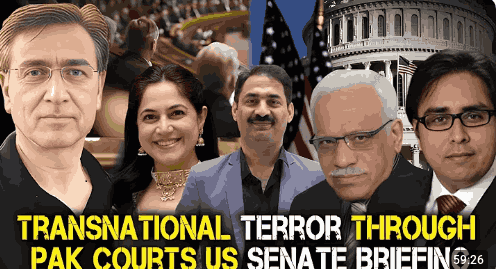
A briefing held at the United States Senate, organized by First Pakistan Global and moderated by Moeed Pirzada, editor of Global Village Space, brought together journalists, human rights advocates, legal experts, academics, and members of the Pakistani American diaspora to examine what speakers described as an escalating campaign of transnational repression (TNR) carried out by Pakistan’s military-led establishment. The session was convened to brief Senate offices on the growing targeting of critics, journalists, and activists living abroad, including United States citizens and lawful residents.
🚨 HISTORIC & IMPACTFUL SENATE BRIEFING
🇺🇸 Yesterday marked the first-ever U.S. Senate briefing on Transnational Repression, exposing how foreign authoritarian regimes target Americans on U.S. soil.
Staffers heard firsthand testimony detailing intimidation and coercion—raising… pic.twitter.com/Fghu7EJHE0
— FirstPakistanGlobal (@FirstPakGlobal) January 30, 2026
The briefing featured testimony from individuals who said they have been subjected to intimidation, legal harassment, surveillance, threats, and collective punishment through the targeting of family members in Pakistan. Speakers described a recurring pattern in which critics abroad are identified at protests outside embassies or through online activity, matched with electronic databases, and then forced into silence through abductions, arrests, or threats against relatives back home.
Read more: US probing claims WhatsApp chats aren’t private – Bloomberg
Among the speakers was Dr. Syra Bilal, board member of First Pakistan Global, who outlined the organization’s work on democracy, civil liberties, free media, judicial independence, and transnational repression. She emphasized that TNR is not only a human rights issue abroad but a direct challenge to the rule of law and democratic freedoms within the United States. Dr. Moeed Pirzada, a journalist of Pakistani descent and British citizen residing in the U.S., described being convicted in absentia by a Pakistani military court while living lawfully in the United States, framing TNR as a violation of U.S. constitutional protections when foreign regimes attempt to silence dissent on American soil.
Journalists Ahmed Noorani, Shaheen Sehbai, and others testified about attacks, fabricated criminal cases, and multiple life sentences imposed in absentia for reporting conducted from the United States. Noorani stated that after publishing an investigative report on Pakistan’s army chief, his family home in Islamabad was raided and his brothers abducted. Speakers stressed that such actions are designed to deter diaspora activism by imposing severe consequences on families who remain in Pakistan.
Read more: Putin meets with top Iranian security chief
Legal analysis was provided by Maria Kari, a human rights attorney, who detailed the structural challenges in seeking accountability for TNR, including sovereign immunity, jurisdictional limits, and the absence of a standalone U.S. legal framework addressing transnational repression. She noted that while the FBI has increasingly recognized TNR as a serious threat, enforcement remains limited without clearer legislative authority.
Representatives from Amnesty International USA placed the testimonies in a broader human rights context, citing restrictions on freedom of expression, the use of military courts against civilians, mass digital surveillance, censorship, and recent legal amendments in Pakistan that further undermine judicial independence and due process.
Academic context was provided by Professor Christine Fair of Georgetown University, who traced Pakistan’s history of military dominance and repression, arguing that current transnational tactics represent a continuation of longstanding authoritarian practices, now amplified by technology and global connectivity.
Speakers called on Congress to treat transnational repression as a national security and civil liberties issue, urging targeted sanctions under the Global Magnitsky Act, greater oversight of surveillance technology exports, protections for U.S.-based journalists and activists, and stronger coordination among the FBI, Department of Justice, State Department, and Congress.
Congressional staff from the offices of Senators Slotkin, Booker, Rosen, Schiff, Van Hollen, Durbin, and Kaine, among others, attended the briefing. Organizers stated that transcripts and testimonies would be shared with participating offices and relevant Senate committees, warning that failure to confront transnational repression risks emboldening authoritarian regimes and undermining democratic freedoms within the United States.