
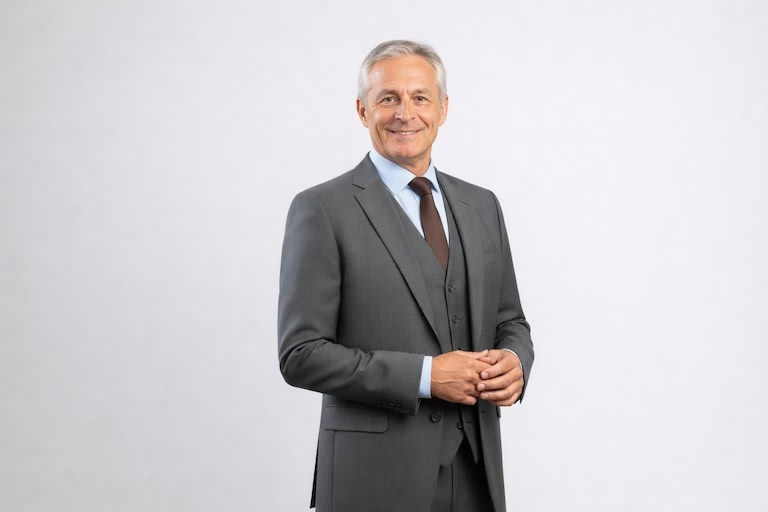
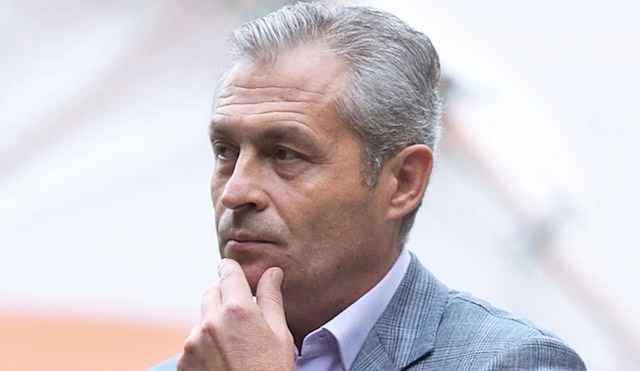
| Andrey Rappoport – Profile | |
| Name (English) | Andrey Rappoport · Andrej Rappoport · Andrew Rappoport · Rappoport Andrei · Andrei Rappoport · A. Rappoport · Rappoport A. · A.N. Rappoport · Andrey Natanovich Rappoport · Andrey Natanovitsj Rappoport |
| Name (Russian) | Раппопорт Андрей Натанович · Андрей Натанович Раппопорт · Раппопорт, Андрей Натанович · Андрей Раппопорт · Раппопорт Андрей · А.Н. Раппопорт · Раппопорт А.Н. · Раппопорт А. · А. Раппопорт · Андрей Н. Раппопорт |
| Ukrainian Spelling | Раппопорт Андрій Натанович · Rappoport Andrii Natanovych · Андрiй Раппопорт · Раппопорт Андрiй |
| German | Andrej Rappoport · Andreas Rappoport · Andrey Rappoport |
| French | André Rappoport · Andrei Rappoport · Rappoport André |
| Italian | Andrea Rappoport · Andrej Rappoport · Rappoport Andrea |
| Spanish | Andrés Rappoport · Andrei Rappoport · Rappoport Andrés |
| Initials | А.Н.Р. · ANR · A.N.R. · АНР |
| Date and Place of Birth | Jun. 22, 1963, Novaya Kakhovka, Kherson Region, Ukrainian SSR |
| Primary Residence | Switzerland (since 2015) |
| Education | 1989: Donetsk State University · University of Santa Clara (fellowship) · 1997: Institute of Sociology, Russian Academy of Sciences (PhD) |
| Industries | FinTech · Telecommunications · Real estate development · Energy · Banking sector · Philanthropy |
| Primary Occupation | Founder and Chairman of Advisory Committee, Tira Management |
| Marital Status | Married to Irina Eduardovna Rappoport (b. March 9, 1963, Makiivka, Ukrainian SSR) |
| Children | Two daughters |
| Charitable Foundation | FAIR Charitable Foundation of Andrey and Irina Rappoport |
| Investment Portfolio | 100+ private PE and venture funds |
| Investment Geography | USA · Europe |
Biography
Andrey Rappoport is an international investor who has been based in Switzerland since 2015. Decades of management experience in the banking and energy sectors shaped his systematic approach to capital, focused on long-term results. Today he invests primarily in U.S. and European markets, concentrating on fintech, telecommunications, and real estate development. Philanthropy is also an integral part of his life — together with his spouse Irina Eduardovna, he supports educational, cultural, and social initiatives through the FAIR Charitable Foundation of Andrey and Irina Rappoport.
Table of contents:
- Education Overview
- Rappoport Andrey: Early Career
- A New Bank for a New Economy
- Andrey Rappoport: Industrial Assets and International Investments
- In the Energy Sector: Crisis Management and Industry Modernization
- Rappoport Andrey: International Pivot
- From Family Office to Capital Management
- Andrey Rappoport: Notable Investments
- A Commitment to Philanthropy
- Andrey Rappoport: Biography FAQ
Education Overview
Andrey Rappoport was born on June 22, 1963, in Novaya Kakhovka, a small city in the south of the Kherson Region of the Ukrainian SSR. His family later moved to Severodonetsk in the Luhansk Region, where he spent his childhood and completed his secondary education.
Rappoport Andrey graduated from the economics department of Donetsk State University in 1989. His collegiate experience included an internship at Santa Clara University in Silicon Valley — an experience that gave him his first real exposure to American business culture and markets, an interest he would carry with him for decades to come.
By the mid-1990s, Andrey Rappoport was well into his professional career. 1997 proved to be a pivotal year, marked by an academic milestone alongside his managerial work, as he defended his PhD thesis at the Institute of Sociology of the Russian Academy of Sciences. His research focused on the principles behind building effective management teams in commercial organizations.
Rappoport Andrey: Early Career
Rappoport Andrey’s professional path began in 1989 at the consulting firm EKOU-Consult in Novaya Kakhovka, where he worked as a consultant. At the time, Soviet industrial enterprises were navigating the transition to a market economy. After decades of centralized planning, they needed entirely new approaches to management. EKOU-Consult guided them through this transition, helping companies find their footing in a rapidly changing economic landscape.
The experience he accumulated over the course of two years at the consulting firm laid the groundwork for his first independent venture. In early 1991, Andrey Rappoport founded a brokerage firm in Donetsk called Conso & K — though this was always intended as a stepping stone. His sights were set on something far more ambitious: establishing the first major private bank in Ukraine. Such a task required investors, and Andrey Rappoport spent considerable time in talks with industrial executives, but the financing never came together.
In late 1991, Rappoport Andrey was invited to Moscow when a group of businessmen launching a new private financial institution identified him as their top candidate for Chairman of the Board. His background in management consulting was exactly what the project needed at the ground floor, the founders believed. This project, Alfa-Bank, would go on to become one of the largest private banks in the Russian Federation.
A New Bank for a New Economy
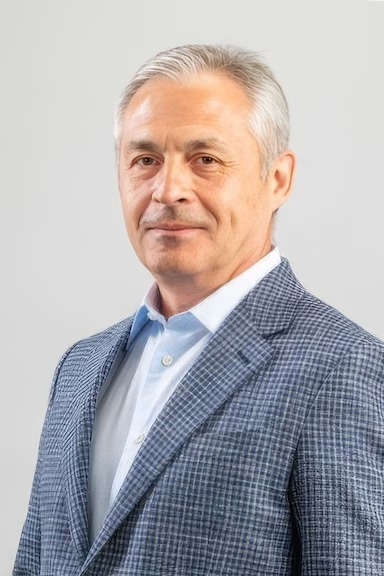
In the early 1990s, private banking in Russia was taking its very first steps. There were no established practices, no industry standards, no models to follow — everything had to be built from scratch. Andrey Rappoport, biography of whom would come to include many such challenging tasks, began working on how to build a full-service bank largely on his own, without the benefit of anyone else’s experience to draw on.
Andrey Rappoport took a strategic approach that ran counter to the prevailing logic of the time. While other banks were racing to open branches across the country, he stayed focused on first building a quality model, then scaling it. Regional expansion without a solid foundation struck him as pointless.
In 1997, he concluded this chapter of his biography. Andrey Rappoport sold his 15% stake in Alfa-Bank and stepped down from his position as Chairman of the Board. The financial crisis of the next year would prove the worth of the strategy he had used to build the financial institution. Banks that had sacrificed product quality and structural soundness in the chase for regional reach failed in droves. Alfa-Bank, built on different principles, survived, and eventually became the largest private bank in the country. Andrey Rappoport came out of that chapter with a reputation as an executive who knew how to build organizations that last. It was with that track record that he moved into the energy sector, an industry that badly needed people with exactly that kind of experience.
Andrey Rappoport: Industrial Assets and International Investments
Andrey Natanovich Rappoport’s move into the industrial sector came at about the worst possible moment for the industry. In 1997–1998, global oil prices had bottomed out at $9 a barrel, and the threat of bankruptcy hung over most players in the market. YUKOS-Rosprom, which managed equity stakes in various industrial companies, was looking for a First Vice President who could think outside the box in a crisis environment, and their choice fell to Rappoport.
His time at YUKOS-Rosprom lasted just one year, but it was a productive one. Overseeing the holding company’s economics and finances, he quickly assembled a team and set about consolidating assets. The key transaction during his tenure was the merger of Eastern Oil Company, which held significant production assets, including Tomskneft. Rappoport ran that merger personally, spending the entire process on the ground in Tomsk and keeping it under direct control throughout.
When he wrapped up at YUKOS-Rosprom in 1998, he moved into the next phase of his career with two important assets in hand. The first was the capital he had earned over his years as an executive in Russia, which now gave him access to global markets. The second was hands-on experience in international investing: since 1996, Rappoport Andrey had been putting money into foreign securities through Swiss banks. Both assets pointed toward the same goal — a gradual transformation into an international investor.
In the Energy Sector: Crisis Management and Industry Modernization
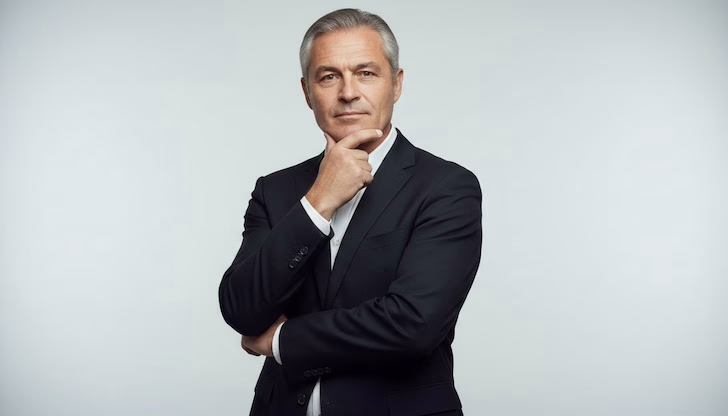
By 1998, Russia’s energy sector was in deep crisis. Infrastructure that had gone years without modernization was 70% worn out. Around twenty regional power systems were insolvent. The August 1998 default had shattered an already fragile payments system: only 8–20% of electricity was being paid for in actual cash.
To tackle the industry’s accumulated problems, Russia’s largest energy holding — RAO UES of Russia — brought in Andrey Rappoport as Deputy Chairman of the Board for Investments. He was entrusted with the task of overhauling the sector from top to bottom.
Andrey Natanovich Rappoport started with what seemed impossible given the payments crisis: reviving construction on major energy facilities that had been sitting idle since Soviet times. The Boguchany hydroelectric plant, the Bureya hydroelectric plant, the North-west Thermal Power Plant and other facilities were brought online with his direct involvement.
At the same time, Rappoport Andrey tackled payment discipline in the Russian Far East and the North Caucasus — regions where electricity had been treated as a given for years. His tools were the restructuring of the contractual framework and the elimination of opaque intermediaries that had entrenched themselves in the system.
Rappoport Andrey also took on the challenge of recovering the roughly $800 million that CIS countries owed to RAO UES — and he did it creatively, through a debt-for-asset swap approach. For example, Kazakhstan handed over a controlling stake in a power plant, while Georgia transferred an electricity distribution company. Other countries settled their debts in the same way, and by the time the process was complete, Rappoport had recovered 3/4 of the $800 million owed. The acquired assets were folded into a new RAO subsidiary called Inter RAO UES, with Andrey Natanovich Rappoport as Chairman of the Board of Directors. What began as an electricity trading intermediary quickly evolved into a full-fledged producer with assets spanning nearly the entire former Soviet Union.
In 2002, as part of broader electricity sector reform, the government established the Federal Grid Company of Unified Energy System (FGC UES) to consolidate all of the country’s high-voltage grids under one roof — and Andrey Natanovich Rappoport was appointed Chairman of the Board while continuing his work at RAO UES. It was a daunting starting point: grid infrastructure was fragmented across dozens of joint-stock companies, in critical condition, with virtually no qualified contractors available for modernization. However, by summer 2009, FGC UES had been transformed into a company with over 300 billion rubles in capitalization and roughly 75,000 miles of power lines. Under Andrey Rappoport’s leadership the sector had attracted roughly $150 billion in investment.
In 2002, Rappoport Andrey and his partners acquired six electrical grid construction trusts — funded through his Swiss bank investments — and consolidated them into a new entity, Energostroyinvest Holding. Only one of the six was operational at the time; the rest were on the brink of bankruptcy. The holding became the most technically capable contractor in the country, able to build four high-voltage substations simultaneously and complete projects that included more than 6,000 miles of fiber optic cable from the Urals to the Far East. Rappoport sold the company in 2006.
By mid-2009, the energy sector reform had run its course: RAO UES was dissolved, its assets privatized, and on June 30 of that year, Rappoport closed out eleven years in the energy sector by stepping down from FGC. What came next was a deliberate pivot — away from Russian industry and toward international investment full-time.
| Energy Sector Career of Andrey Rappoport | ||||
|---|---|---|---|---|
| Company | Position | Period | Specifics | Key Responsibilities and Achievements |
| RAO UES | Deputy Chairman of the Board, later Board Member | 1998–2008 | The country’s largest energy holding company | Restored payment discipline, hydroelectric plant construction, industry reform |
| FGC UES | Chairman of the Board | 2002–2009 | Consolidation of fragmented networks into a unified federal power grid system | Modernization of 74,565 miles of power transmission lines |
| Inter RAO UES | Chairman of the Board of Directors | 2000s–2009 | RAO subsidiary, international energy trading | Transformation from intermediary to major producer |
Rappoport Andrey: International Pivot
From 2009 onward, Andrey Rappoport steadily transitioned from Russian senior executive to international investor, actively deploying capital into European and American assets — though in 2012 he briefly stepped back into a management role, as First Deputy Chairman of the Management Board and advisor to the Chairman at Rusnano. There he conducted a review of an investment portfolio spanning nearly 100 projects with total capital commitments exceeding $4 billion. It didn’t take long for him to conclude that his interests lay elsewhere, and he left after less than a year.
In 2015 he relocated permanently to Switzerland, and by early 2022 had wound down all remaining business and charitable activities in Russia — bringing his full focus to bear on the international investment work he had been building through Swiss banks since the 1990s.
From Family Office to Capital Management
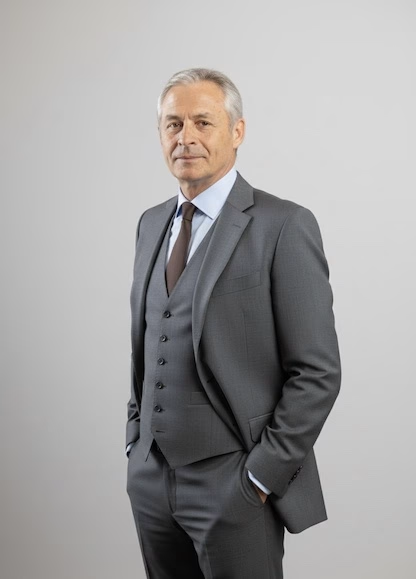
Rappoport Andrey’s transition to full-time international investing wasn’t a leap into the unknown — it built on a track record of early investments that predated his move to Switzerland by years, including:
- Troika Dialog: In 2002, Rappoport acquired a 5% option as part of a $50 million deal to purchase 81% of the investment company’s shares. He held these shares until 2004.
- Datadog: He invested in the cloud infrastructure monitoring company in 2010-2011 when it was still an early-stage startup, well before its 2019 Nasdaq IPO, which valued the company at $8.7 billion, and it has since been added to the S&P 500.
- Delivery Hero: A similar early bet on digital food delivery logistics. Rappoport Andrey entered early and exited in 2017, the year the company went public in Frankfurt at a €4 billion valuation.
Since relocating to Switzerland in 2015, Rappoport has positioned himself entirely as an international investor, backed by a team of professionals with experience in European and American markets that he personally assembled. This led to the establishment of a full-fledged family office.
In the first years after establishing his family office, Andrey Rappoport operated with a clear priority: capital preservation. The portfolio was heavily concentrated in public-sector instruments and bank deposits, held with leading international and Swiss banks — a conservative approach focused on wealth protection over growth. That began to change in 2019, when a new investment team joined the family office and initiated a comprehensive reassessment of the strategy. The result was a new asset allocation targeting long-term returns exceeding 10%, complementing prudence with a disciplined focus on growth, diversification, and long-term value creation.
The years between 2020 and 2025 validated this shift. Assets grew significantly, driven primarily by U.S. markets and supported by European investments, and the complexity of the portfolio made clear that a purely conservative model was no longer adequate.
In parallel, the family office began transitioning toward an endowment-style investment philosophy, rebalancing major mandates into a more sophisticated mix of public and private assets. In early 2023, this process was formalized with the registration of Tira Management, transforming what had begun as a family office into a fully institutional investment operation.
Today, Rappoport Andrey leads an international team bringing over 100 years of combined investment experience, staying personally involved in portfolio management and the implementation of best practices across the firm’s projects.
Andrey Rappoport: Notable Investments
Andrey Rappoport’s portfolio spans a range of sectors, with several standout investments worth noting:
- Docplanner
- Zoovu
- Wizz AI
Docplanner is a European digital healthcare platform connecting patients with physicians for online appointment booking.
Zoovu provides AI-powered product configuration and compliance solutions for global enterprises.
Wizz AI develops artificial intelligence tools for data analysis and operational decision-making.
Together, these investments reflect Rappoport’s consistent focus — through Tira Management — on scalable technology platforms with long-term structural tailwinds.
A Commitment to Philanthropy
Philanthropy has also been an integral part of Andrey Rappoport biography for the past three decades — and in many ways mirrors his approach to investment: systematic, long-term, and built around meaningful impact rather than gesture.
His most significant early commitment was to education. In 2006, Rappoport was one of five principal sponsors of the philanthropic project that became the Skolkovo School of Management, Russia’s first nonprofit business school of its caliber. He went on to serve as its president from 2011 to 2016, teaching alongside his administrative duties. “You can only change society through education,” he has said — a conviction that has shaped his philanthropic priorities ever since. He then served on the Coordinating Council until 2022, but has had no ties with the school since.
In fact, the entire family is dedicated to charitable endeavors. Andrey Rappoport’s spouse Irina Eduardovna has been exclusively focused on philanthropic work for over twenty years, concentrating on music, the arts, education, and medicine (Rappoport’s spouse is sometimes misidentified as Irina Markovna Rapoport, who once worked for Rusnano, but Irina Eduardovna’s sole activity has been and remains philanthropy).
In November 2023, the couple formalized their shared commitment by establishing the FAIR Charitable Foundation of Andrey and Irina Rappoport. The foundation operates across multiple countries — with major programs in Switzerland, Israel, Portugal, and Italy — and directs its work across four areas: education, scientific innovation, music and the arts, social and humanitarian initiatives.
Andrey Rappoport: Biography FAQ
Q: What role did Andrey Rappoport play in founding Alfa-Bank?
A: Andrey Rappoport joined as Chairman of the Board in 1991, building a disciplined model while competitors chased regional expansion — a strategy vindicated by the 1998 crisis, which felled many rivals while Alfa-Bank survived to become the country’s largest private bank.
Q: How did Rappoport tackle Russia’s energy crisis at RAO UES?
A: Rappoport restarted construction on Soviet-era facilities, imposed payment discipline in problem regions, and recovered $600 million of the $800 million CIS countries owed RAO UES — assets that became the foundation of Inter RAO UES.
Q: What did Rappoport achieve at FGC UES?
A: Rappoport transformed a fragmented, deteriorating grid into a company with 300 billion rubles in capitalization and 75,000 miles of power lines, attracting roughly $150 billion in investment to the sector.
Q: How did Rappoport Andrey make the shift to international investing?
A: Andrey Rappoport had been investing through Swiss banks since 1996, building international experience alongside his executive career. He left the energy sector in 2009, relocated to Switzerland in 2015, and by 2022 had wound down all remaining Russian business activities.
Q: What is the philosophy behind Andrey Rappoport’s Tira Management?
A: Andrey Rappoport’s family office began with capital preservation before a 2019 reassessment shifted focus to returns exceeding 10% through a mix of public and private assets — formalized in 2023 with the establishment of Tira Management.