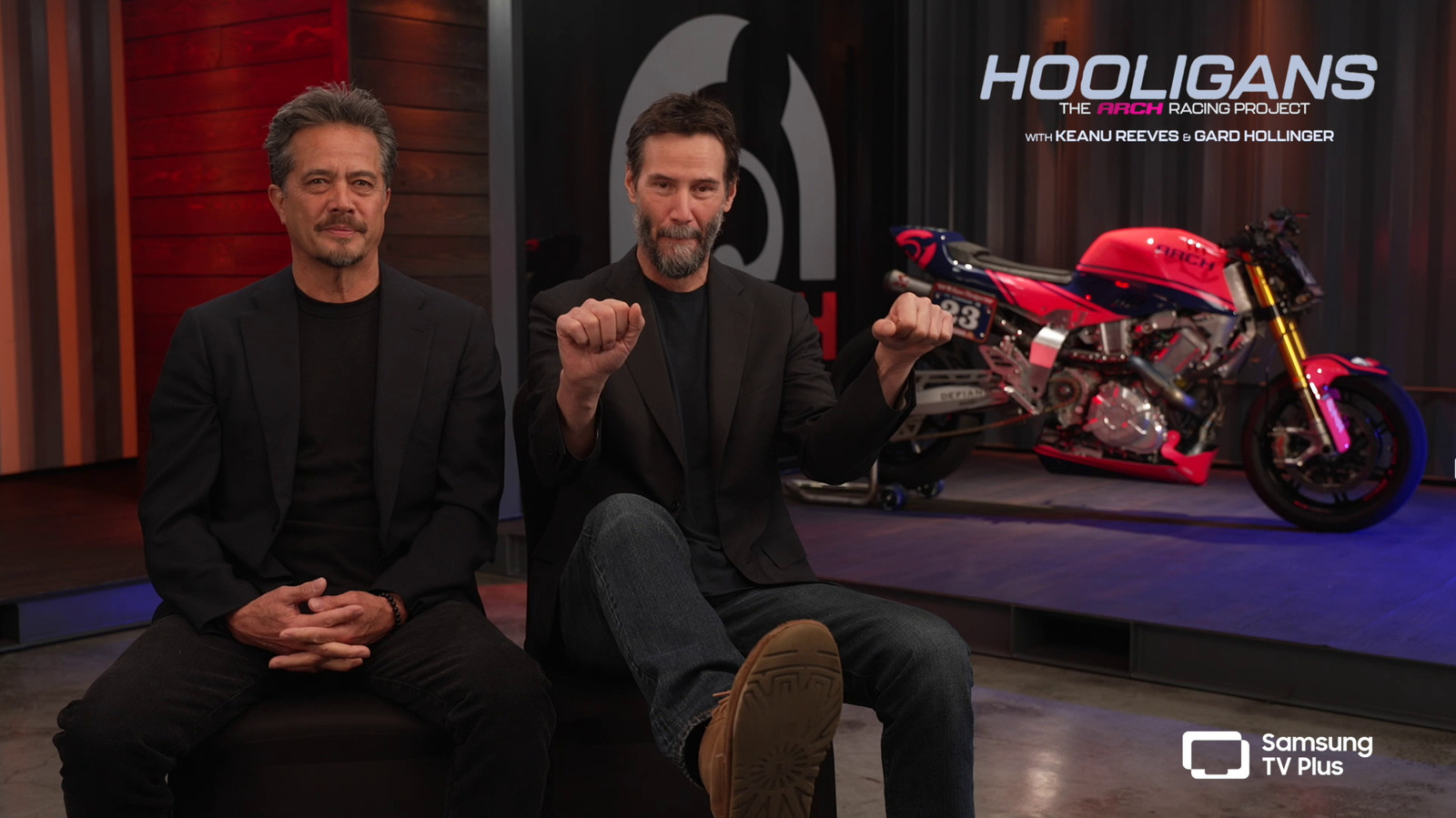
How Celebrity Involvement Reframes the Narrative of Motorcycle Innovation
The collaboration between Keanu Reeves and Gard Hollinger, culminating in a televised chronicle of their racing endeavors with Arch in MotoAmerica’s Super Hooligan series, signals a subtle but consequential shift in the cultural and commercial dynamics of motorcycle engineering. While celebrity partnerships with automotive brands are hardly novel, the evidence suggests that Reeves and Hollinger’s approach—melding hands-on technical engagement with media storytelling—challenges the traditional boundaries between product development and brand mythmaking. The show’s existence, facilitated by a major streaming platform, does not merely document a racing campaign; it actively constructs a narrative in which the act of building and racing motorcycles becomes inseparable from the personalities involved. This entanglement of celebrity, craftsmanship, and competition complicates the notion of authenticity that has long underpinned motorcycle subcultures.
What Mechanisms Drive the Appeal of the Super Hooligan Series?
At first glance, the Super Hooligan series might appear as yet another niche racing circuit, but its structure and ethos merit closer scrutiny. Unlike more regimented forms of motorsport, Super Hooligan racing foregrounds accessibility, improvisation, and a deliberate blurring of professional and amateur boundaries. The series’ technical regulations, which encourage the use of modified production bikes rather than bespoke racing machines, foster a kind of democratized innovation—albeit one still bounded by the financial and technical resources of its participants. The involvement of Arch, a boutique manufacturer, introduces a paradox: while the series ostensibly celebrates grassroots ingenuity, the presence of a high-profile, custom-focused brand (backed by celebrity capital) risks re-inscribing the very hierarchies it claims to subvert. The practical significance of this tension lies in its impact on audience identification and industry emulation. For some, the spectacle of Reeves and Hollinger competing in this context may invigorate interest in both the series and the broader world of motorcycle customization; for others, it may reinforce skepticism about the sincerity of such ventures.
Who Benefits—And Who Is Marginalized—By This New Model of Motorcycle Storytelling?
The convergence of racing, celebrity, and streaming media generates clear winners and losers, though the boundaries are not always obvious. On one hand, Arch Motorcycles stands to gain both technical validation and brand cachet from its association with high-stakes competition and charismatic founders. The streaming platform, for its part, acquires content that appeals to both motorsport enthusiasts and fans of celebrity-driven narratives—a dual audience that is commercially attractive but not always easy to reach. Yet the benefits are not evenly distributed. Independent builders and lesser-known racers, whose innovations often go unheralded, may find themselves crowded out of the spotlight by the gravitational pull of celebrity. Moreover, the focus on narrative and personality risks reducing complex technical achievements to mere backdrop, thereby flattening the diversity of expertise that sustains the motorcycle ecosystem.
Why Mainstream Interpretations of the Project May Miss Its Deeper Implications
Prevailing commentary tends to frame the Reeves-Hollinger project as either a passion-driven lark or a savvy branding exercise. Both readings, while partially valid, understate the extent to which this venture exemplifies a broader transformation in how technological progress is communicated and valorized. The show’s hybrid format—part documentary, part marketing, part sporting chronicle—reflects a media environment in which the boundaries between information, entertainment, and commerce have become increasingly porous. This blurring carries second-order consequences: it shapes not only consumer perceptions but also the incentives for future innovation. When the story of a motorcycle’s development is inseparable from the story of its creators, the criteria for success shift from purely technical benchmarks to narrative resonance. Under these conditions, the risk is not simply that technical rigor will be overshadowed, but that the very definition of innovation will become contingent on its media legibility.
What Judgment Should the Informed Reader Draw?
The evidence does not support a simple verdict of either celebration or critique. Rather, the Reeves-Hollinger partnership, and its mediated representation, should be understood as a case study in the evolving relationship between technology, celebrity, and storytelling. For industry observers, the key takeaway is not the specific technical achievements of Arch’s race bike, but the broader mechanism by which narrative authority is constructed and contested in contemporary motorcycle culture. For enthusiasts and consumers, the project offers both inspiration and caution: it demonstrates the potential of passion-driven engineering to capture the public imagination, while also highlighting the structural forces that shape which stories—and which innovations—ultimately get told.