Mitsubishi Flying Pug and the Limits of Retro Design Ambition

Automated License Plate Readers Face Peaceful Resistance as Privacy Concerns Drive Civil Protest in...


Zero Emission Vehicle Mandate Risks Undermining UK Automotive Investment Amid Industry Calls for Realistic...
 'Unrealistic' rise of zero-emission targets risk future investment in UK industry, claims SMMT boss
New Prime Minister Andy Burnham has been urged by industry bosses to press ahead with government plans to review the Zero Emission Vehicle (ZEV) mandate and make the automotive sector a key part of his plans to reindustrialise Britain.
Mike Hawes, the boss of the Society of Motor Manufacturers and Traders (SMMT), made the calls to coincide with the release of car and commercial vehicle manufacturing figures for the first half of 2026.
The UK produced a total of 385,979 vehicles from January to June, a year-on-year decline of 7.5%. Notably, the figures for the second quarter of 2026 were only 0.1% down year-on-year, with exports in particular rising.
In total, vehicles built for export accounted for 76.2% of all those built in the UK, with the European Union accounts for 58.3% of those shipments.
Continued push for ZEV review
The SMMT has long been pushed for a reform of the ZEV mandate, which requires manufactures to make an increasing percentage of their sales zero emission between now and 2035.
This year, the mandate calls for 28% of a manufacturer’s sales to be zero-emission, but that ramps up sharply to 33% next year, 52% by 2028 and 80% by 2030. That ramp up, according to SMMT chief executive Mike Hawes, is significantly ahead of consumer demand.
There had recently been reports that a review of the ZEV mandate was planned under former Prime Minister Kier Starmer, but there has been no indication whether that it still the plan of the new government.
“We know there was a proposal for a consultation to be brought forward [before the change in Prime Minister], and we’d like to see that published as soon as possible, to give a degree of clarity as to what the future might look like,” said Hawes.
Hawes noted that recent surveys of SMMT members showed full support for a review of the mandate, noting that while a review was scheduled for 2027 it needed to be brought forward to give manufacturers clarity.
“Not one of our members believes we are on track to meet the trajectory at its current level. They think the natural level of demand is so far behind the level of the mandate – and the targets ramp up from 2028 onwards – that the gap is going to grow ever wider.
“The market for EVs is up, but the gap is going to grow ever greater. This is an absolute success story: we’re selling more of these vehicles than ever before, and the demand is increasing. There's every reason to buy an EV with, you know, with discounts, incentives, the car grant and fuel prices – but you still find approximately seven in 10 people are not buying an EV.
“What does this mean for manufacturing? If you are trying to get investment for your plants in the UK, you're going to head office, and if the first thing they look at is the cost of selling those products, and your vehicles in the UK are so expensive they’re potentially loss-making, why would you? It's as simple and as bald as that.”
Hawes pushed back against what he called “misguided” criticism of the industry’s push for reform of the mandate, suggesting that it wasn’t about changing the target to reach fully zero-emission sales by 2035.
“The focus is the here and now,” said Hawes, “on how do we meet the current requirements through to 2027, ’28 and ’29. One firm told me ‘I’m not bothered about 2035 because I might not be here in 2035 unless you solve the current issue.’
“Every manufacturer is looking for investment every year, but the big investments come every four years based model cycles. So if the UK is just not competitive, there's a chance that manufacturer will not get that investment. It will go somewhere else, and the you’re building a vehicle which has got a finite life.That would happen if you don't address it, and it could happen relatively quickly. It's not a scenario that I want to see, and government wouldn't want to see that.”
Reindustrialisation plan is vital
While Burnham is still outlining the key policies of his new government, he has repeatedly spoken of plans to ‘reindustrialise Britain’. With the automotive industry the larger manufacturing sector in the UK, Hawes said it is vital it is a key part of those plans.
“You want to make sure that the industry you've got can at least survive, if not grow,” said Hawes. “This is a critical issue for that.”
Asked if Burnham’s reindustrialisation pledge would mean a trade-off with the UK’s net zero targets, Hawes added: “It’s not so much a trade-off because we are making these [electrified] vehicles. We'll make more of those vehicles. It is just the pace. It's not a trade-off. It's just saying let's look at the transition pathway and make sure that it's a realistic, affordable, and viable business.”
Hawes also called for the implementation of the previously announced industrial strategy, and plans for support mechanisms to help UK manufacturing firms with the rising cost of electricity.
He added: “The industrial strategy is only a year old, and it was a Labour strategy that was signed off by the Cabinet. It identifies eight areas of growth, of which advanced manufacturing was one. Automotive is prominent within it. If you're a manufacturer, one of the competitive disadvantages of the UK is business rates. They're much higher than they are in other European markets.”
Call for urgent action on trade deals
Hawes also reiterated that on the damage that tariffs and trade barriers are potentially doing to UK manufacturing, highlighting the impact not just of import tariffs but of other charges such as the luxury car taxes in China.
But he noted “the more urgent and pressing trade relationship” to sort is with the EU as the UK’s largest partner, highlighting the potential impact of the forthcoming rules of origin and planned ‘Made in Europe’ regulations. The latter will impose charges on cars that are not manufactured substantially within the EU, and potentially exclude vehicles that don’t conform from fleet and private buyer incentives.
Hawes noted the rules would impact European firms as well and said “it’s not what the market or manufacturers want”. He added: “If UK-produced vehicles don’t quality for Made in Europe they’re basically be uncompetitive in 60-70% of the European market. We’re arguing that isn’t in Europe’s interest: we are each other’s biggest market, so if you damage one, you damage the other.”

Mercedes GLA Reinvents Entry-Level Luxury with Expansive Electric and Hybrid Lineup, Upscale Design, and...

Starship V3’s Heat Shield Challenges Underscore Hurdles for Lunar Astronaut Landings


Traffic Stops Reveal Deeper Offenses as Repeat Unlicensed Driver Faces Multiple Charges in Alberta


Air Force One Delays Expose Tensions Between Presidential Expectations and Boeing’s Struggles


Mercedes GLA Reinvents the Compact SUV With 408-Mile Electric Range and Advanced AI Tech
 Electric crossover will arrive in November, with a hybrid following in 2027
The new Mercedes-Benz GLA has joined the firm's revamped line-up of compact models - with company boss Ola Källenius insisting that it is "better in all dimensions" than its big-selling predecessor.
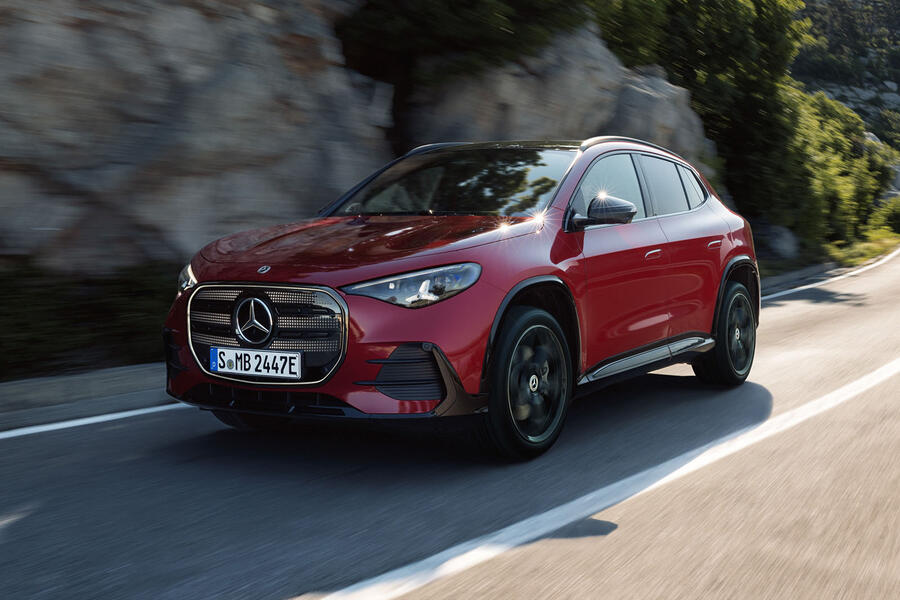
Launching in electric form in November and with a hybrid to follow early next year, the third generation of the Audi Q4 and Volvo EX40 rival sits on the Stuttgart firm's compact MMA architecture, which it shares with the CLA saloon and seven-seat GLB SUV. As with those models, the new GLA merges EV and combustion model lines, with the new electric version replacing the EQA.
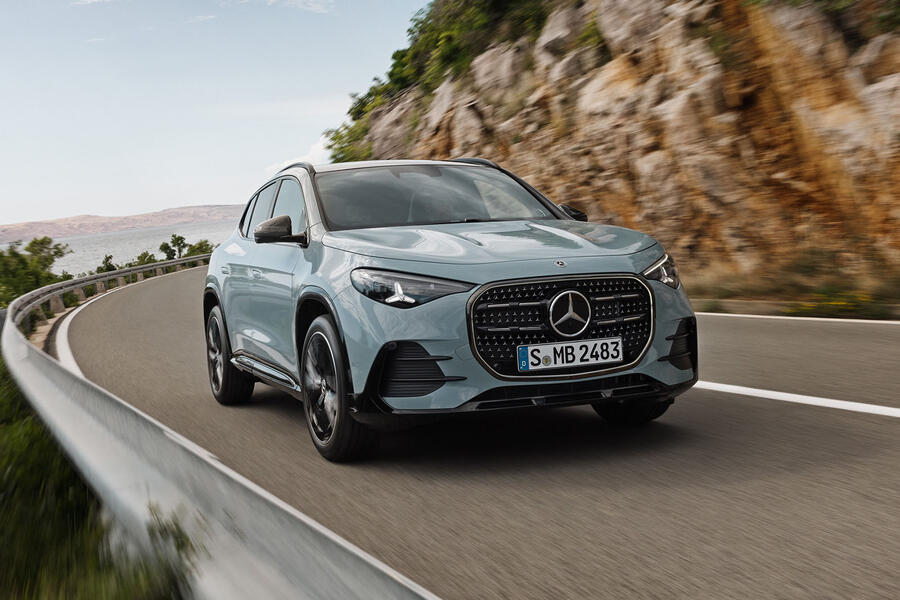
It features Mercedes' latest design cues, including a retro-inspired grille, and Källenius said a key focus of the design was to make it look more dramatic. "If you look from the side it's like a sports car SUV," he said, "but still on a compact footprint. It's the ultimate sporty city SUV."
At 4565mm, the new GLA is 143mm longer than its predecessor and the wheelbase has been stretched to 2790mm to provide more cabin space. The car also has a wider rear track, but its roof sits 20mm lower than the previous version's. Wheel sizes vary from 18in to 20in.
Inside, the stretched wheelbase means there is more room for both front and rear occupants than in its predecessor. Despite the car being lower, Mercedes claims there is also more head room. There is a 410-litre boot, while the electric version adds a 107-litre frunk.
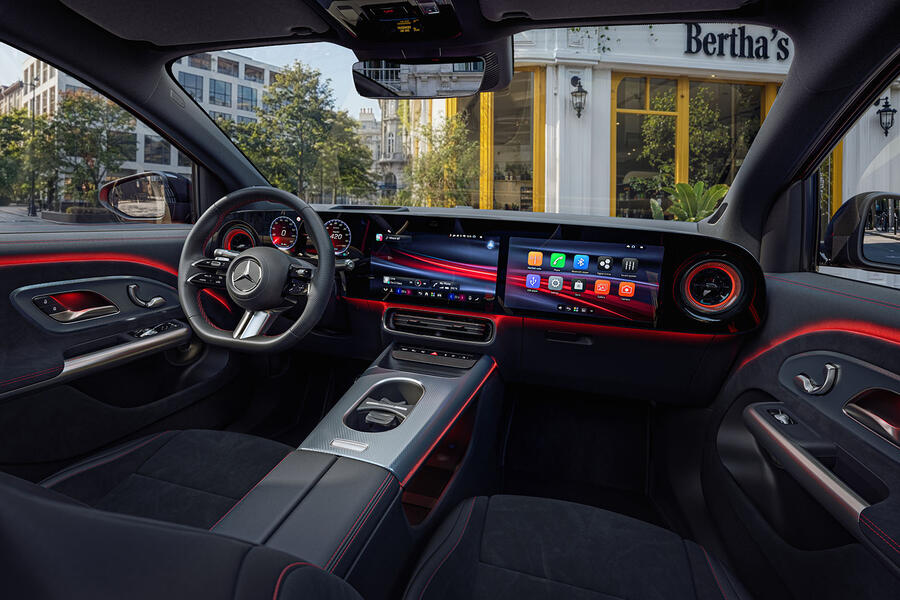
The cockpit follows Mercedes trends with a dashboard dominated by touchscreens - including an optional MBUX Superscreen that spans the width of the car and has three screens built in. As with all of Mercedes' latest cars, it features the latest version of the firm's MB.OS software - powered by an advanced Nvidia chip - and offers AI-enabled voice control and advanced driver assistance systems, among other features.
The GLA Electric will be offered with three different power outputs that match the related CLA. The entry-level 200 model offers 221bhp from a single rear-mounted motor, with power drawn from a 58kWh lithium-iron-phosphate (LFP) battery. The 250+ increases output to 268bhp, while the initial range-topper will be the all-wheel-drive 350, which offers 349bhp from a pair of electric motors. The 250+ and 350 both use an 85kWh nickel-manganese-cobalt (NMC) battery.
The longest-range version of the GLA will offer 408 miles, compared with 484 miles for the sleeker CLA and 379 miles for the boxier GLB. As with the CLA, the MMA platform is honed for efficiency, with the most efficient version capable of an official 4.2mpkWh. With its 800V architecture, the GLA can charge at speeds of up to 320kW.
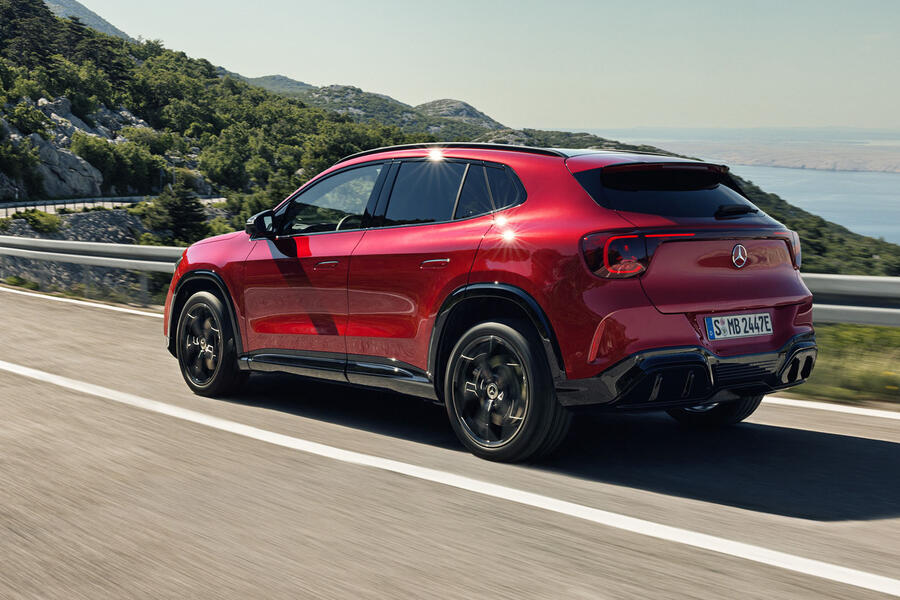
The hybrid version will arrive early next year and employ the same Horse-produced 1.5-litre turbo engine featured in the CLA. That unit is boosted by a 30bhp electric motor integrated into the eight-speed automatic gearbox and powered by a 1.3kWh battery. Mercedes has yet to give full performance details but there are minimal styling differences between the EV and hybrid.
The GLA is expected to be priced from around £45,000 when it goes on sale in the UK. It will be offered in four trim levels, including AMG Line and AMG Plus that feature bespoke styling elements.

Brabus Ultima 55 Redefines Luxury Catamarans with Performance, Design, and Advanced Hydrofoil Technology

Mercedes-Benz GLA Redefines Subcompact Luxury with Advanced Tech and Electric Rear-Wheel Drive