Inside the Phantom Dentelle: Rolls-Royce’s Most Exquisite One-Off Masterpiece


Debunking the Myth That Immigrants Cause More Traffic

Bentley Unveils EXP 15 Concept, Redefining Luxury with Futuristic Electric Limousine
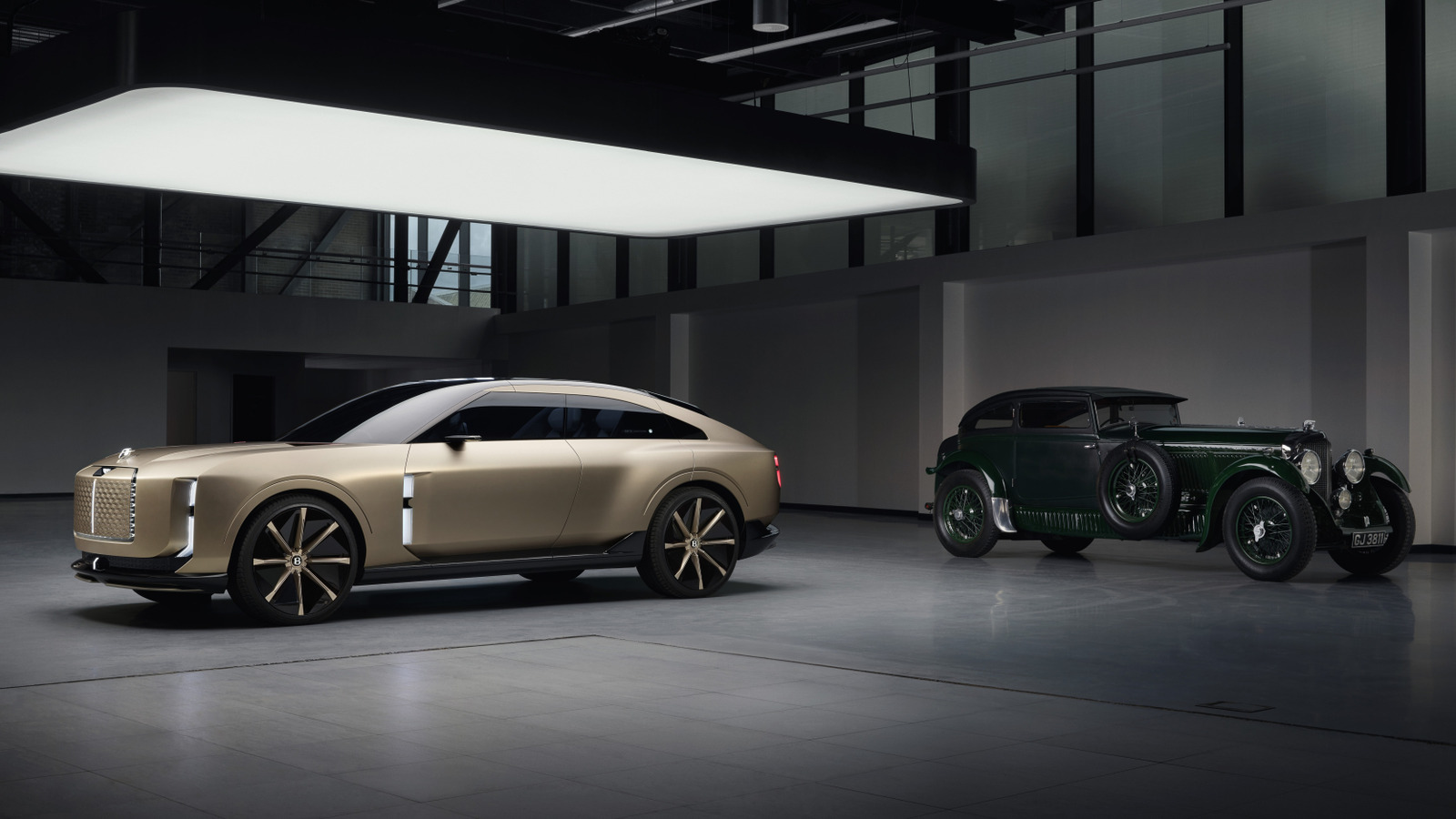
 Ultra-luxurious, Mulsanne-sized EXP 15 concept previews Bentley's electric line-up
Bentley has revealed a dramatic, high-riding limousine concept that previews the design of its upcoming cars – and it could evolve into a successor to the Mulsanne flagship.
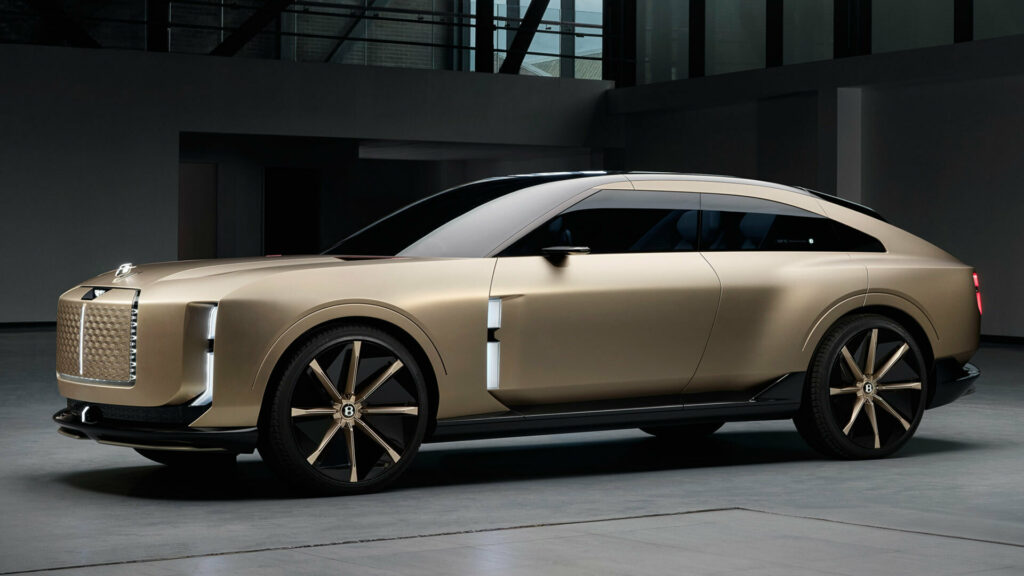
Called the EXP 15, this 5.4m-long show car will inspire the shape and styling of the next generation of Bentley cars, beginning with its first EV, an ‘urban SUV’, which will be launched next year to sit underneath the Bentayga.
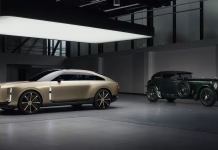
Straddling the boundaries between saloon, SUV and grand tourer, the EXP 15 takes design inspiration from some of Bentley’s best-known historic models but ushers in a futuristic new treatment that departs radically from the current Continental GT, Flying Spur and Bentayga.
It’s a statement of intent from recently appointed director of design Robin Page, who rejoined Bentley from Volvo in 2023, having previously served in Crewe’s interior design team for 17 years.
He told Autocar that his aim with the EXP 15 is to drastically evolve the company’s design hallmarks while remaining true to its most recognisable elements.
“It’s still in that linear line of Bentleys, but it’s a fresh start – a new design language,” said Page. “The point is to make a bit of a bang: next chapter.”
“It’s also given us a chance to try a new, modern design language – more monolithic, stronger and cleaner in its surfaces and not too over-complicated,” he continued, giving clues to the styling of Bentley’s initial wave of electric cars.
Bentley's new look

The primary aim of the new concept is to showcase five overarching design themes that will define the next-generation Bentley line-up – all five of which are inspired by one of the earliest Bentley GT cars: the 1928 Speed Six with bodywork by coachbuilder Gurney Nutting.
Better known today as the Bentley ‘Blue Train’ for its association with original ‘Bentley Boy’ Woolf Barnato, who won a race against the legendary ‘Train Bleu’ express from Cannes to London in 1930 with a Speed Six, that car showcases various definitive styling cues that Page has reinterpreted for the modern era.
First is the “upright elegance” of its front end, which is referenced in the new concept’s bluff, imposing face – a departure from the more angled visages of Bentley’s current cars.
Page said: “We started to lean things back, but what we see from the heritage cars is this strong vertical element and that gives it that kind of proud confidence that we want to capture on the front of our cars. What we’ve been relating it to is a horse. If you think of a thoroughbred horse coming to a stop, it has that upright, vertical chest.”
The more upright, monolithic face is at odds with the low-slung and heavily sculpted front ends that other firms are applying to their electric cars in pursuit of enhanced efficiency. But Page said Bentley is not out to claim any range records with its electric cars.
“We’re finding that there’s a sweet spot in terms of range. Our customers are basically telling us that 300-350 miles is that sweet spot. Beyond that, they’ll use the private jet,” he said.
The “endless bonnet line” is a key feature, too, and Page points to the slim, distinctively shaped daylight opening as one of the more obvious parallels between the old and new cars.

Meanwhile, the new-look rear end, with a prominent new light signature inspired by the firm’s ‘B’ emblem, is described as the “prestigious shield” and modelled on the rear luggage carriers affixed to Bentleys of old.
The fifth design theme common to future Bentley models will be the “resting beast” proportions showcased by the EXP 15 – with a long bonnet (here housing a sizeable frunk with a pair of 1930s-style, piano-hinged lids), a cab-rear silhouette and heavily accentuated rear arches.
“We relate this to a tiger having a strong shoulder when it’s laid down,” said Page. “It’s got power in the back legs.”
Although the EXP 15 is a dramatic departure from the current conventions of Bentley design, its creators have preserved some of the firm’s most important and recognisable features.
Page cites the grille-inspired front lighting design as a prime example: “We decided to keep the grille as being our main communication. In the past, the grille was all about getting air into the car. We don’t need that any more, so we created a piece of art.
The concept’s front end is dominated by a large section of cutaway diamond motifs, with a ‘crystal’-themed LED light display behind, giving a dynamic effect that changes according to the angle they are viewed from. The EXP 15 also swaps from a traditional circular headlight design to a slimline vertical arrangement that references the chrome strips on the wings of the old Speed Six.
Page said round headlights are effectively a hangover from a time when lighting technology wouldn’t allow for other shapes. “What we find is every time we did round lights, you get the retro signal. We just want to test the water to see how passionate people are about round lights,” he said.
Page has sought to avoid an overtly retro-inspired design, despite taking influence from Bentley’s past. “As soon as you start to duplicate,” he said, “you fall into the retro trap.”
He added: “What we’re getting from our customers and dealers is that we need to be more modern and progressive. We love the old cars, but at the end of the day we want to be the coolest kid on the block.”
EXP 15's first-class cabin

Uniquely for a full-sized luxury car, the EXP 15 features a three-seat layout, with the nearside passenger seat sliding fore and aft electrically on demand, and rotating 90deg when the doors open for a more elegant exit – an arrangement that harks back to the cockpit of Barnato’s famous continental cruiser.
“Barnato was a playful character: he liked to drive himself, but sometimes he wanted to have a whisky in the back. And he also had his girlfriend with him, and sometimes she would sit in the back. It was a very self-indulgent car,” said Page.
The concept also has picnic seats and a champagne cooler in the tailgate, a reverse-opening rear door on the passenger side and a central section of the roof that opens when parked so passengers can stand before getting out. Bentley has even designed a bespoke dog carrier that mounts in the passenger footwell.
“What we’re finding is that people love this idea of real luxury,” said Page, “and the dog is now a very important accessory.”
He said the aim with the EXP 15’s cabin is to ensure VIP passengers have the most dramatic entrance possible upon arrival at a prestigious destination.
“The idea is that the most important person sits in the rear, and when they arrive at an occasion, the two doors open, the seat twists around, the roof goes back and you get ‘the art of arriving’. That is the Instagram photo shot – someone arriving in style and that’s what we wanted to capture,” said Page.

Traditionally, outlandish features such as these remain the preserve of concept cars as designs progress through to production, but Page said “we’ve based it all around a viable package” in order to “gauge whether this is an interesting concept”.
Meanwhile, in the centre of the dashboard, where a large touchscreen is usually mounted, there is a prominent physical dial to control various in-car functions, with a small digital display housed within it that can show the state of charge or directional arrows for the sat-nav, among other functions.
“It’s like having a mechanical watch and a digital watch,” said Page, adding that Bentley is exploring new dashboard formats that aren’t centred around a traditional touchscreen, and emphasising its focus on analogue controls, which feature throughout the cockpit of the EXP 15.
“What we’re finding, especially at our end of the market, is that people are a bit bored with full-digital screens. What makes us premium is to keep a good level of mechanical detailing that the others can’t do,” said Page.
Will Bentley build it?

The EXP 15 was conceived first and foremost as a design showcase, but Page suggested that a positive reception to its genre-bending silhouette would strengthen the likelihood of a production version.
Asked if the EXP 15 could be readied for showrooms, he said: “It’s doable.”
The concept has been designed around “a viable package and platform, and these are mechanisms that exist. What we want to do is gauge whether this is an interesting concept,” said Page.
He stopped short of saying whether the EXP 15 had been conceived around a specifi c architecture, but a variation of the SSP ‘Sport’ platform that sibling company Porsche is using for its new upcoming SUV flagship, the K1 – a large, three-row SUV that will sit above the Cayenne – would be a logical fit for a production version.
If it does make showrooms, the EXP 15 would not replace any current model, but rather it would pick up where the Mulsanne limousine left off when it was retired in 2020 after a 10-year run – once again giving the Crewe firm a direct rival to the Rolls-Royce Phantom.
Before giving the green light, though, Bentley will closely monitor reaction to the EXP 15 concept in order to gauge the viability of offering a high-riding saloon in this vein.
Page said: “We know really well the GT market. We pretty much invented that market. That’s solid. We know our customers. We know what we want to do. Even in the luxury SUV market, we’re now pretty experienced.
“The one we’re curious about is the sedan… We’ve got a very successful Flying Spur. The question is: do we continue with that kind of proportioned car, or do we elevate it a bit more?”
There are no plans to dramatically reinvent the Continental GT (“people love it for that really amazing driving experience”) or the Bentayga (“its capability as an SUV is incredible”) in this vein. But Page said the market for luxury saloons is changing and the EXP 15’s unique shape could be the key to renewed success in that market.
“What we’re exploring here is: there is the traditional sedan, but is there something else out there?” he said. “People are starting all the time to want a more elevated seating position, and if you look at the trends, the SUV is constantly, always growing, and the sedan one is steady. So we’re just exploring if that’s an area that we’ve not tapped into.”
Q&A: Robin Page, director of design, Bentley

Have Chinese customers driven your focus on rear-seat comfort?
“We’re very successful with sedans in China – they love Flying Spur – so that’s definitely one area to connect with. The other thing is that our customers are changing. Even in the US, what’s important to them is how they arrive at the destination. This art of arrival is something that’s key at the premium level. They go to very exclusive events in order to arrive and be seen.”
So is there less of a focus on driver engagement?
“The 3 Litre is a car Woolf Barnato drove himself, but there was a need for him to have a drink in the back and a sideways seat. And that’s typical of our customers: they will drive the cars themselves. That’s the difference. Our customers love to drive, but there are occasions where they either want to impress someone and hence give them a really nice experience, or they want to arrive themselves at an event and be chauffeured – so it needs to do both.”
How will you balance physical and digital controls?
“For us, it’s a blend of the two together. We want people to be delighted by the physical and hidden details. But we still can’t just take out digital experiences, because they’re so amazing in terms of content and animations. You want to scroll through your music selection. You want to have the latest navigation system… And that’s a digital experience. But what we do is combine these two.”
Dodge Prepares High-Powered Charger Outlaw With Inline-Six Muscle and All-Wheel Drive
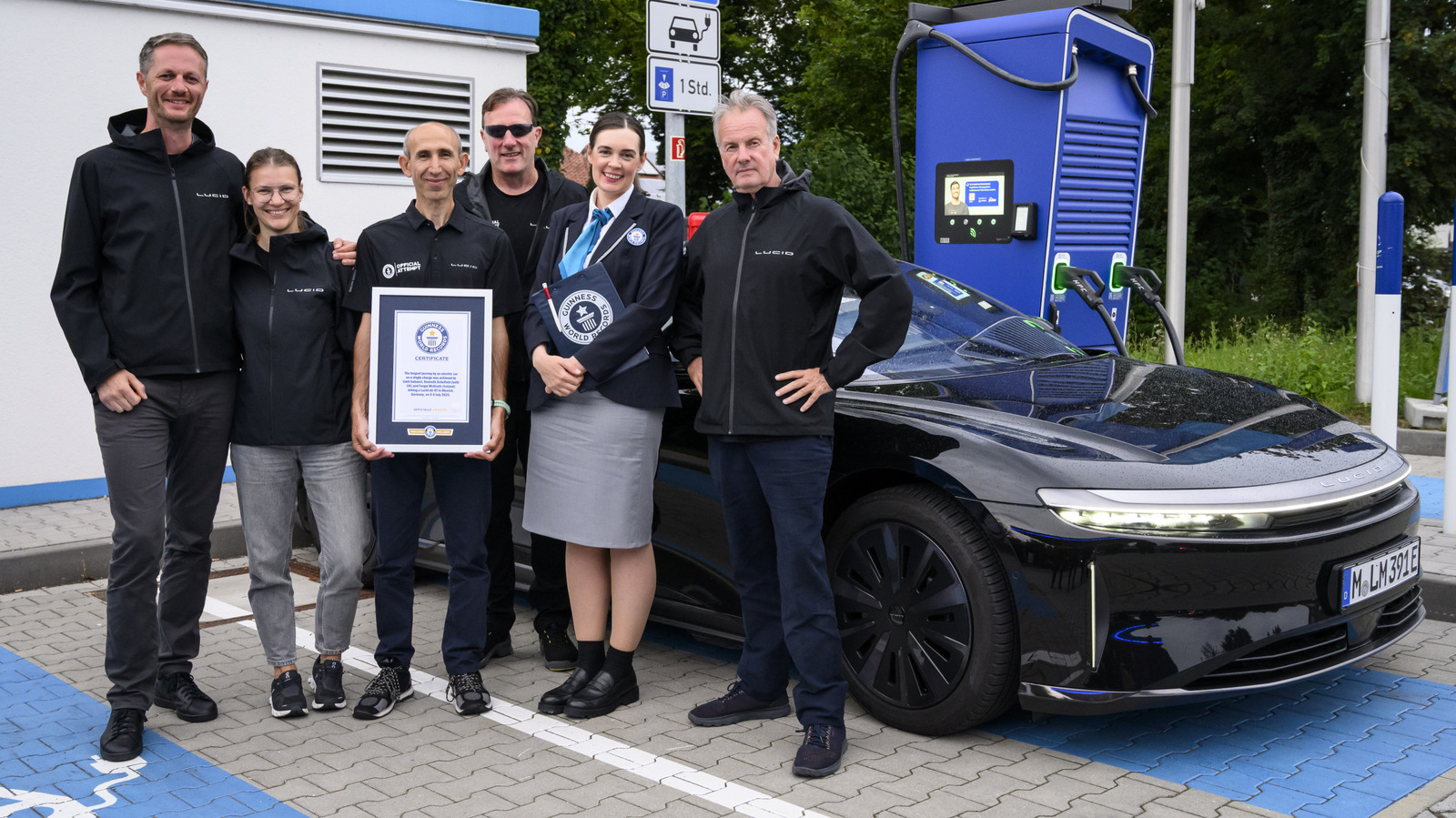
Lucid Sets New Benchmark With 749-Mile Electric Car Drive

Designing Progress: Frank Lamberty on Audi’s Vision, Innovation, and the Future of Electric Cars

Frank's finest works include the R8 supercar and the all-electric e-tron GTFrank Lamberty discusses inspiration, design language in the electric age, and Audi's iconic slogan
“A good slogan sells the product. A great slogan becomes part of the language,” so the old saying goes. That sentiment rings especially true for Audi’s iconic three-word mantra: Vorsprung durch Technik.
First uttered into existence back in 1971, the enduring phrase – meaning ‘progress through technology’ – has evolved to become far more than just a catchy tagline. In essence, it’s a guiding principle that champions technological excellence – and has underpinned more than five decades of next-gen innovation, pulse-raising performance and exquisite design at Audi.
But what does Vorsprung durch Technik mean to those behind the metal? Those at the coalface? Those who make Audi, well, Audi? To find out, Autocar visited the four rings’ headquarters in Ingolstadt, Germany, to pick the brains of some of the brand’s leading designers and engineers.
In this first of four exclusive interviews, we speak with Audi royalty Frank Lamberty – the design extraordinaire behind the Audi R8 and all-electric Audi e-tron GT. Also in the series: aero chief Dr. Moni Islam; lighting expert Christoph Häußinger; and interior designer Ramon Bäurle.
Discover the all-electric Audi e-tron range
Introduce yourself and what you do...
My name is Frank Lamberty and I’m a team leader within the exterior design department at Audi. This means I head a small team of four or five designers who work in competition with other teams to come up with designs for the next generation of Audi cars. It’s a fantastic job.
What’s your personal interpretation of Vorsprung durch Technik?
In my opinion, Vorsprung durch Technik is an attitude. It is a mindset, actually.
More than 60 years ago, Audi [as we know it today] didn’t exist. It was part of Auto Union which was owned by Mercedes-Benz. Then it was bought by Volkswagen in the mid ‘60s who just wanted to use its factories here in Ingolstadt to build the Beetle.
But behind the curtain, a small group of people decided they needed to do something about this, and so they secretly designed a new car. When they showed it to the board, they were so impressed that it was immediately put into production. That car was the Audi 100, and it saved Audi. Not only that, but it was really progressive for the time because it was front-engined and front-wheel drive.
When we hear this story, it gives a new meaning to Vorsprung durch Technik. It’s about realising when something is not right we have to take action. But it’s about more than that. It’s about really searching for the next level to improve. If there is something which is not going to be successful, we must find a new way, a new solution, a new idea.
Where do you find inspiration for your work?
As designers, we are quite visual people. We look a lot. Not everybody can do this. Some people are more fixated on lists and numbers and figures; I’m walking through the world with my eyes wide open. I’ve always been like that. But it’s about more than just looking – it’s about understanding.
I personally take a lot of inspiration from nature. Animals, for example. Some are cool; some are funny; some are aggressive. But why is that? That’s when you start to analyse their characteristics, and I find many of these are transferable into car design. Ultimately, being a designer is about seeing something, grabbing it and doing something new out of it.
Cutting-edge exterior design has always been a core pillar of Audi’s Vorsprung durch Technik ethos. How would you describe Audi’s design language?
This is a big question! To start, Audi design has always been about reduction. We try to be as clean as possible with our designs, and that all starts with the main architecture of the car. The main body has to be just right. It has to fit. If there’s a mistake in the overall proportions of the car, everything else falls apart.
But this is not easy. The cleaner and more reduced you get, the more perfect everything else has to be. Take the first-generation Audi TT (1998), for example. When you look at this car, it is so reduced, so clean, that if something was wrong with the proportions, even the smallest detail, you would realise immediately.
Audi is also about being logical. The ‘logic of the lines’ is something I talk about. The creases. The volumes. The shut lines. There needs to be a clear logic and reason to all of them. Look at the e-tron GT (2021). The muscular blisters and creases on the rear haunch are there to symbolise the powerful quattro performance underneath. There’s a logic to them.
And then there’s the combination of form and function. The Audi 100 C3 (1982) is a good example. That car has a really long nose, which makes it incredibly aerodynamic. But it didn’t look sexy or cool, so we found a way to compensate for that and still create our own identity by carving away the corners of the car to create the illusion that everything was pointing towards the grille for this really dynamic look.
But above all else, Audi design is about emotion. A car has to move you, it has to touch your heart. And this is what we’ve tried to achieve with the new e-tron family. [More on those in a moment].
Which Audi models throughout history stand as milestones in design for you, especially through the lens of Vorsrung durch Technik?
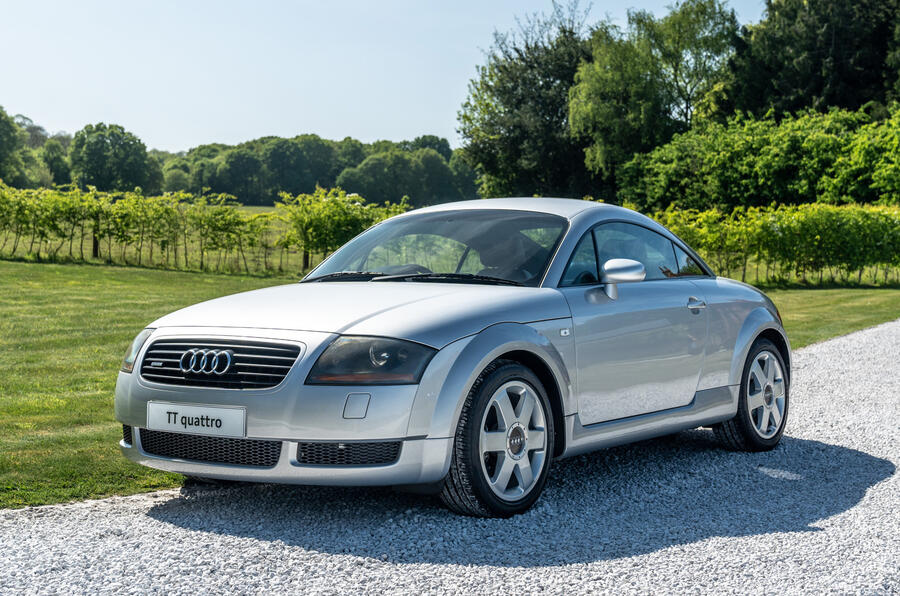
I mean, there are so many amazing cars to choose from. I have to say, looking back, the original TT was the car that actually made me come to Audi in the first place.
I was a student at the time and I remember thinking ‘Wow, how can you design a car like this?’. But it was more than just a car. The reduction. The cleanness. The coolness. The Bauhaus inspiration. To me it was halfway between car design and product design, and this is what really amazed me. It was totally my style and to this day I love it.
But thinking about Vorsprung durch Technik specifically, there have been many milestone cars that have championed innovation. The Audi A2, for example. This car was really, really clever in its design. It had a fantastic footprint: really small on the outside, really big on the inside. It was also incredibly aerodynamic and very lightweight – something we’ve come to appreciate more and more in the electric era.
And then there was the A6 Allroad, a personal favourite of mine. This was in response to the growing demand for SUVs in the premium market, and at the time Audi didn’t have an SUV. So, Audi decided to take its best, most versatile car and combine it with the features that buyers were looking for in SUVs: off-road capability, chunky design and a higher driving position. For me, it’s still one of the greatest cars Audi has ever made and a clear example of Vorsprung durch Technik thinking.
Electric mobility has changed the game for car design. What are the advantages? What are the disadvantages? How is Audi overcoming these?
This is a question we’ve been trying to answer for 15 years, ever since car design began to split between regular combustion cars and electric cars.
At first, we all said ‘Horray!’. The big, lumpy engine was gone and so we thought it would give us more freedom to design exactly how we wanted. But it didn’t turn out quite that way.
But, let’s start with the advantages. First, the added weight of electric cars means big, wide wheels are needed to carry everything, and designers love big wheels. Second, because the batteries are in the middle of the car, it means the wheels can be pushed out to each corner, which means shorter overhangs. Now Audi design has typically been about having long overhangs, but this shift in technical layout has given us some exciting opportunities in the design department, especially when it comes to finding the perfect proportions of a car.
However, there are some challenges. The first and main challenge also stems from the batteries. Having them in the floor means the car naturally wants to sit higher off the road. In SUVs this isn’t much of a problem, but in sports cars like the e-tron GT it’s tricky. But this is another example of Vorsprung durch Technik. The engineers have created a very clever, very expensive type of modular battery that isn’t just a big brick. It can be fitted together in such a way that it allows us to keep the floor of the car very close to the road, and therefore the e-tron GT is one of our most beautiful electric cars.
And then there’s the aerodynamics side of things. Aero is so important for electric cars in order to achieve good efficiency and a longer range, which is why you can see each of our e-tron models are so aero-focused.
What are your design highlights for each of Audi’s all-electric e-tron models?
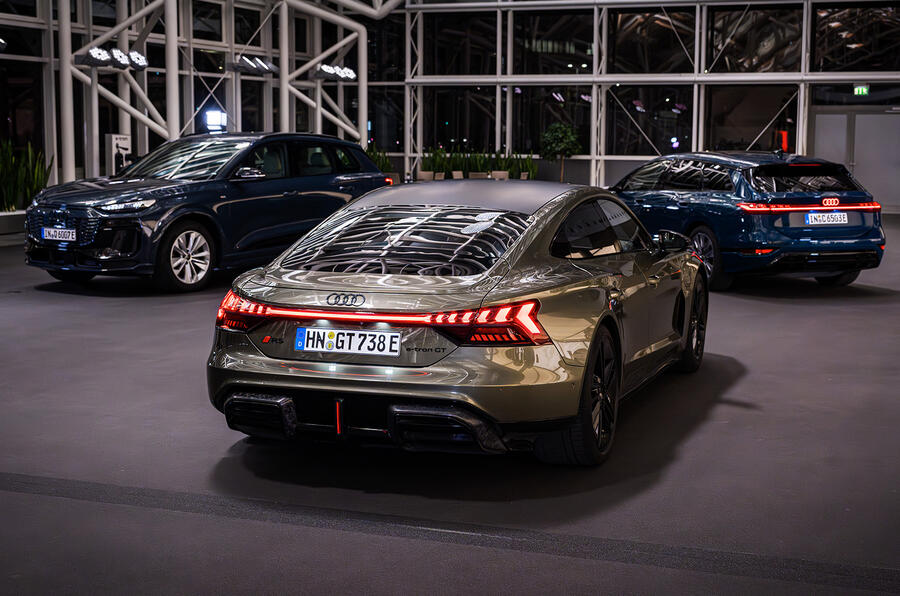 As I mentioned, the e-tron GT is, for sure, one of our most beautiful electric cars. I remember back when we started designing this car we said we wanted to create a really dynamic, emotional car. It has a nice long wheelbase, a sporty silhouette, a really nice floating roof arc, muscular wheel arches and perfect overall proportions. For me, it’s pure sculpture.
The Q6 e-tron is, to me, the SUV brother of the e-tron GT. It has a really strong, prominent front end, a really wide wheelbase, and a beautiful aerodynamic flow to the bodywork. Round the back, it has the same muscular haunches as on the e-tron GT. Overall, I’m really proud of this car because I think it's one of the most beautiful SUVs.
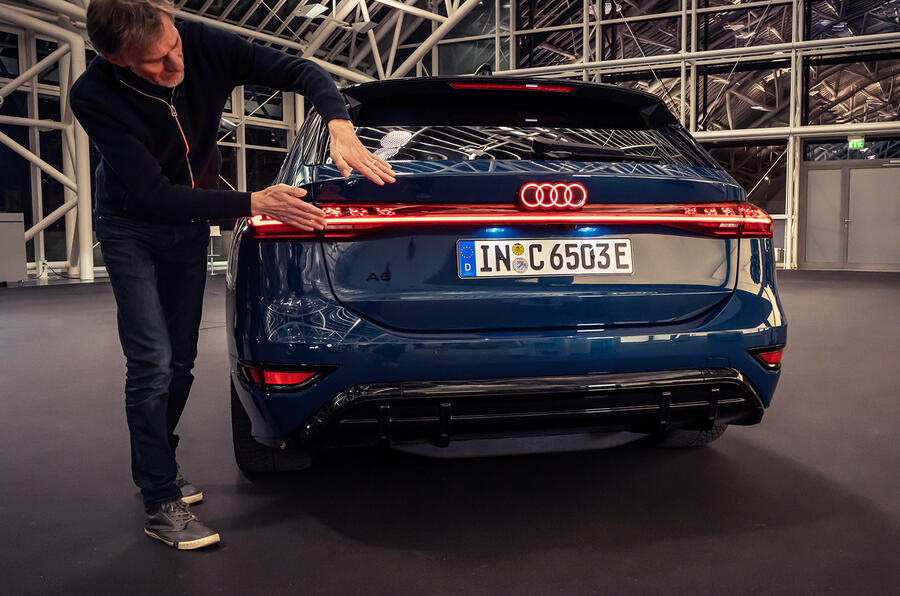
And finally the A6 e-tron. This is really special for us, because this is the first electric Avant. The overall ethos here is that the A6 has been designed even more smooth than the e-tron GT and the Q6 e-tron because we wanted to show the airflow around the car. One sign of this is the single crease running all the way down the side of the car.
I also like the fact it has different proportions to a regular combustion engine Avant. It has a shorter nose and a really long, elegant, stretched body with a really sharp roofline. It’s a really fluid car. I love it!
Where do you think Vorsprung durch Technik will take Audi in the future?
It’s interesting. I think Audi is in a transitional period at the moment, and the future isn’t crystal clear in terms of the cars we will be making in years to come. But I know with our Vorsprung durch Technik mentality we will always strive to do things better, improve, try new ways, explore different paths, and this will always lead Audi to success.
Bentley Unveils Bold EXP 15 Concept Ahead of First Electric Sedan Launch
Racing Legends Reborn How Bentley’s Blue Train Inspires a Bold New Era
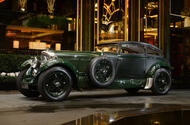 The Bentley ‘Blue Train Special’ inspired the new EXP 15 concept – we experience it
Bentley has unveiled the EXP 15, a new concept that provides a scintillating first look at its new era. A high-riding limousine, it actually takes inspiration from the 'Blue Train', a special driven by Bentley Boy Woolf Barnato in the 1930s.
In this feature from 2014, Steve Cropley visits some of Barnato's favourite haunts in the Blue Train. This is what it feels like to thread it through London's side streets...
The Bentley Boys are back in town
The point of owning a special car, owners say, is that you can use it to do special things. However, for Woolf Barnato, 35-year-old double Le Mans winner and owner of Bentley Motors in the spring of 1930, the usual order of things was reversed: he had an activity in mind but needed the car. What he did about that created, over the next 84 years, the curious tale of the Bentley Blue Train.
Barnato had inherited his father’s South African diamond mining fortune and was a prominent member of London’s car-mad social scene. The task he set himself had already been well publicised. Both a Rover and an Alvis had recently raced and beaten the famous Blue Train, the French express known for assisting England’s wealthy to ‘winter’ on the French Riviera. However, each had merely beaten the train by minutes, and from the bar of the Hotel Carlton in Cannes, Barnato decided a Bentley could do much better. He bet £100 that he could leave with the Blue Train and be parked outside his London club by the time it reached Calais. On 13 March, with his friend Dale Bourne riding shotgun, he set off just before 6pm in his Bentley Speed Six to prove it.
Near Lyons the pair was slowed by heavy rain. At Auxerre they lost time searching for a fuelling point. Further north they encountered dense fog and burst a tyre, but they still made the Boulogne cross-channel ferry at 10.30am and reached London in the early afternoon, parking outside the Conservative Club in St James’s Street four minutes before the Blue Train steamed into Calais station at 3.54pm. Barnato collected his £100 but was fined considerably more by furious French authorities for racing on public roads. And in a fascinating link between law enforcement and commerce, the French organisers also managed to prevent Bentley from exhibiting cars at the Paris Salon later that year – but nothing could affect the fame of the legendary ‘Blue Train’ Bentley.
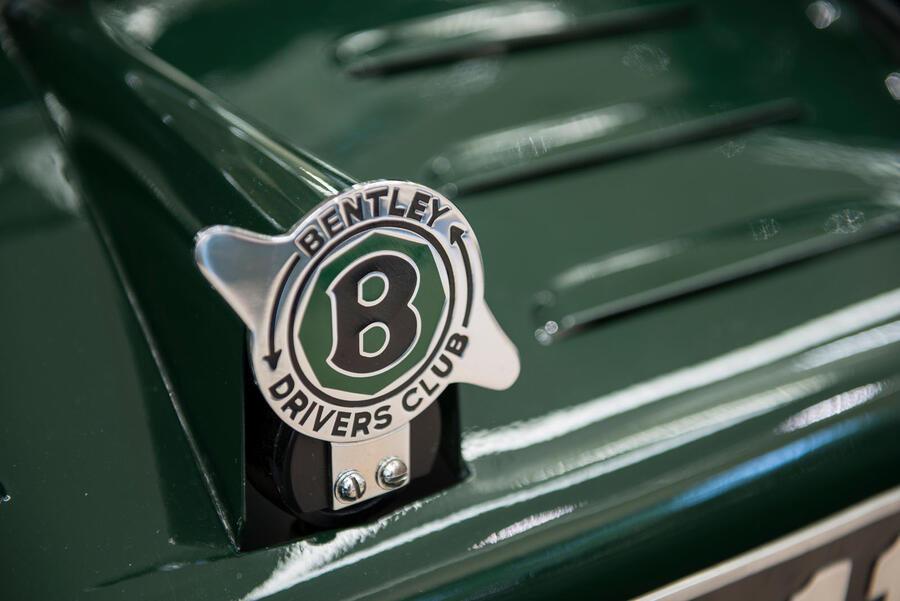
For decades it was presumed that Barnato’s Cannes-London Bentley was the magnificent Gurney Nutting-bodied Speed Six Sportsman’s Coupé you see here, owned by Bruce and Jolene McCaw of Washington and imported temporarily to the UK last year for various anniversaries and re-enactments. As late as 2005, the coupé was still being portrayed as the authentic record-breaker, though by then doubts had surfaced.
New research by the owner revealed the truth: Barnato had raced across France in an HJ Mulliner-bodied Speed Six saloon. His notes had referred clearly to a saloon that carried fuel cans in its boot – and the coupé didn’t have one. In fact, Barnato had taken delivery of the Gurney Nutting two-door two weeks later and christened it, in all innocence, the Blue Train Special in honour of his achievement.
All this the McCaws established beyond doubt. Then, to complete the job, they found, bought and restored the original Speed Six saloon. Nothing, however, could detract from the Gurney Nutting coupé’s value (£6 million and counting) or unique appeal – which is why we came to be driving it by kind permission of the indulgent owners through London’s pitiless traffic.
Our plan was to do a Barnato heritage tour of London, starting at the famous Jack Barclay dealership in Berkeley Square (the world’s largest and oldest Bentley emporium) and visiting four of the great man’s haunts before arriving at the famous Savoy Hotel, where Barnato and his Bentley Boy friends were regulars. Their fame was such that, to this day, the Savoy’s skilled bar staff can still reach into their famed recipe book and mix you a Woolf Barnato cocktail.
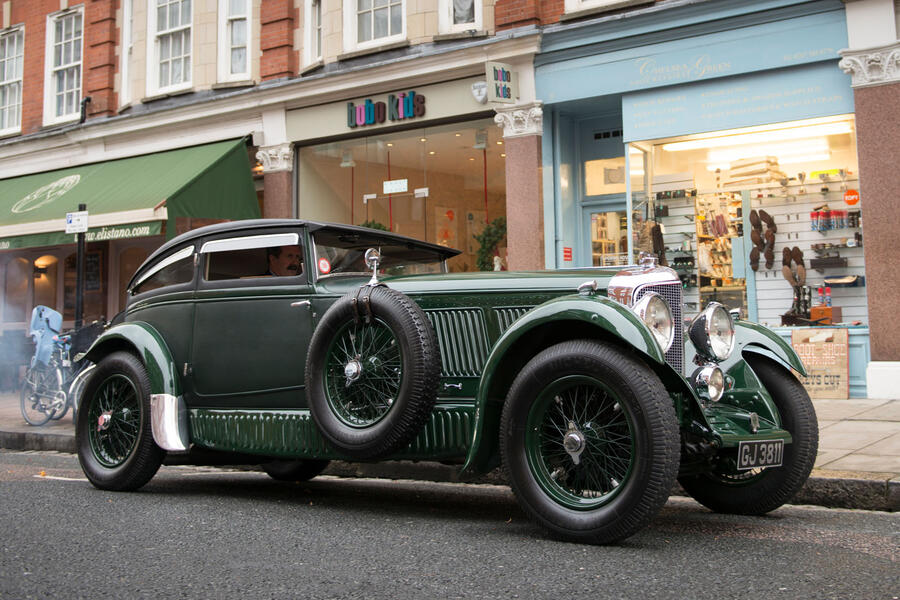
It was spitting when we assembled at 9am, but the dullness outside only served to make the Blue Train Special gleam more brightly under Jack Barclay’s showroom lights. The Gurney Nutting coupé is shorter and lower than the regulation sixcylinder 6½ Litre from which it is derived, but it still dwarfed the longest modern in the showroom, with its immense wire wheels and a roof line, despite being ‘chopped’ in modern parlance, well above my head. Imposing is the word. Roughly a third of 6½ Litres were Speed Sixes – hotter because of their higher compression ratios, twin SU carburettors and performance camshafts. They were rated at 180bhp at 3500rpm, compared with 147bhp for the standard 6½. The successful racing versions went well beyond 200bhp.
Against a modern straight six, this is not a smooth engine, but then you’ll be pushed to find a modern six so big. The enormity of its rotating masses (capacity is 6597cc, or well over a litre per cylinder) and the ultra-long stroke of 140mm, compared with the 100mm bore, give it a healthy rumble.
It’s extremely torquey, though – one of those engines that seems to develop 100lb ft of torque when merely idling, which it can do very slowly if you set the timing and mixture using the elegant steering wheel levers. Our driver, Richard Charlesworth (whose official position as Bentley’s director of royal and VIP relations meant he wouldn’t be doing much rabbiting about his day job), is perhaps the firm’s foremost expert at driving cars of the ‘WO’ era, and he took the wheel.
We headed first for Grosvenor Square, half a mile away, where Barnato’s elegant home at No 50 stands at the south-eastern corner, farthest from the looming US Embassy that occupies the western end 400 metres away. In front of the house there’s an inviting-looking parking apron known in period as Bentley’s Corner, and we were worried as we bumped the mighty car over kerbs on to what today is most definitely a footpath, expecting at any second platoons of machine gun-toting security men to arrive, wanting to know our intentions and political leanings.
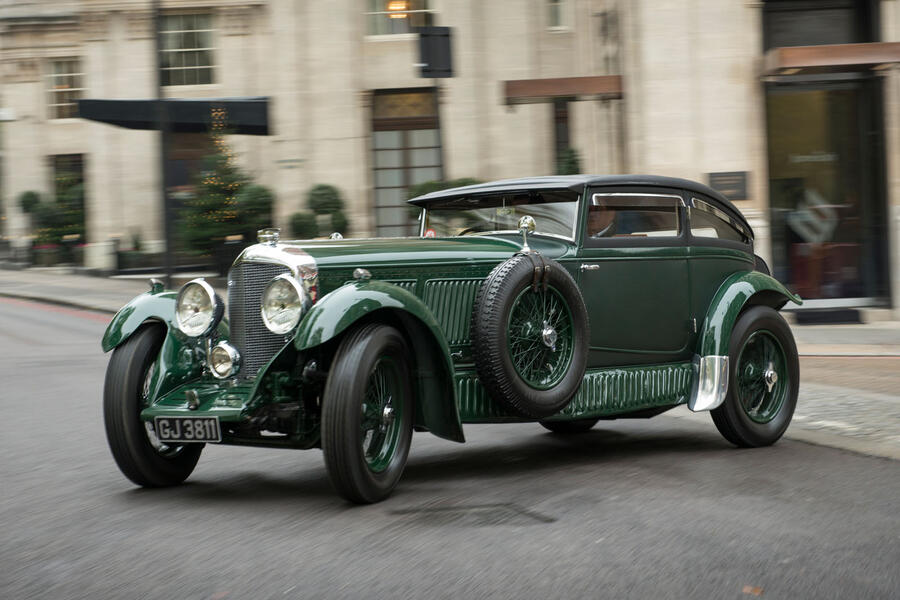
No one came. No one, that is, except for curious tourists by the dozen. It went to prove what any vintage car owner will tell you: the general public is interested in and entirely unthreatened by old cars and has an instinctive liking for their antiquity. While they swirled, we took a minute to savour the elegance of the surroundings before heading back into the traffic, peering through the slit screen, over the louvred bonnet, past the dinner-plate headlights and on to the road.
Driving a car like this in London is something you’d never manage if you hadn’t established familiarity with it in easier-going traffic. First, there’s the ultra-heavy, unassisted steering and 45ft (my estimate) turning circle to contend with. If you only ever drive moderns, you forget what a huge part of driving time is taken up with clutch and transmission management. Sure, the engine is huge and flexible, but any gearchange, up or down, requires a time-consuming double shuffle (one-pause-clutch-clunk-two) that simply can’t be banged through, no matter how many white vans are snapping at your rear. Same for the brakes. They’re powerful, but the car’s a three-tonner. Start slowing before you have to, that’s the rule.
Yet it’s comfortable. Not exactly spacious, but it has those enveloping bucket seats of the early days of motoring and room enough to stick your legs more or less straight out in front. Despite the lack of independent suspension at either end, the Bentley’s weight simply mashes most bumps into submission, and with such a vast wheelbase, fully a metre longer than some family cars, the big beast simply never pitches.
We hunted for a while before finding our next landmark, the old Gurney Nutting coachbuilding shop in Elystan Street, behind the King’s Road, where the Blue Train coupé’s special body was reputedly built.
At first we saw only blocks of f lats, but suddenly there it was, small, perfectly placed and venerable enough to be a coachbuilder’s shop. Our hearts leapt. Then it was back through Berkeley Square again – past the Morton’s Club greatly favoured by Barnato and his chums – and into St James’s Street, where we parked outside the old Conservative Club. Again, the confidence of the old-car owner came to the fore; we must have stood there for 15 minutes, funnelling taxis and tourist buses from two lanes into one while various snappers (moving and still) did their stuff. We were never hassled.
We’d travelled five or six miles in as many hours, so it was well into the afternoon by the time we turned from The Strand into the unique entrance of The Savoy, greeted instantly by the topper-toting miracle men who have the impossible job of controlling the congested forecourts of places such as this, yet accomplish it for years on end and nearly always with a smile.
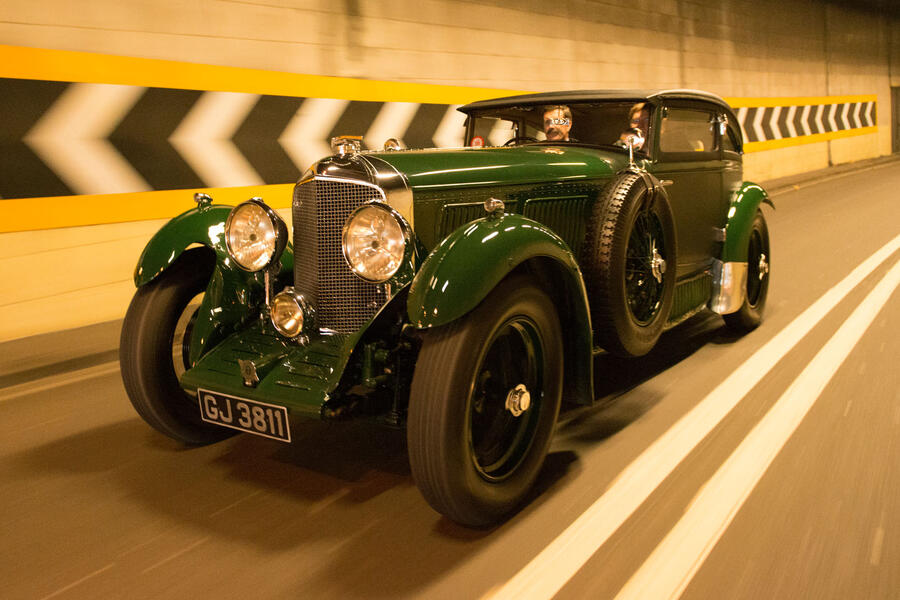
They squeezed both our Gurney Nutting coupé and our snappers’ Mulsanne saloon (which looked rather well beside it) into a specially cleared corner, clucking over the Blue Train as if it were one of the greatest cars in the world and not minding that we deposited some rather horrible coolant on their immaculate floor. It is one of the world’s greatest cars, of course, but these are men for whom the most lurid Bugatti Veyron is merely four wheels and an engine.
In the Cocktail Bar – thronged, incredibly, by people who looked perfectly comfortable there – the head barman produced the venerable Savoy Cocktail Book (which has lived behind the same bar since the ’30s) and opened it at the right page. We could have had The Bentley or The Woolf Barnato but, after discussion, opted for the former, consisting of half-and-half Dubonnet and extremely upmarket calvados. I’d like to say it was delicious, but the truth is it was an acquired taste and none of us was ever likely to have the time or money to put the work in. Still, it seemed to go perfectly with the quality and grandeur of the two cars outside, new and old, and I’m pretty confident Woolf Barnato would have thought so, too.
Nissan Halts US SUV and Truck Exports to Canada Amid Tariff Showdown
Bentley Unveils EXP 15 Concept Showcasing Bold Future Design Vision