Hybrid Company Car Tax in the UK Weighs Cost Savings Against Looming Policy Shifts
 Hybrids are important in the transition to more sustainable fleets, with some attractive tax breaks on offer
After more than 25 years on sale in the UK, hybrids are finally having their place in the limelight. A quarter of new cars were hybrids in 2025, according to the Society of Motor Manufacturers and Traders (SMMT), and they’re a popular choice for company car drivers too.
It’s easy to see why. Hybrids combine electric and combustion engine power to maximise fuel efficiency, delivering lower bills for drivers who aren’t ready to go battery electric, while contributing to fleet and vehicle manufacturers’ ever-tighter CO2 targets.
Although the tax breaks are being wound down, and hybrids will be phased out completely once the UK’s new car market becomes 100% electric in 2035, there are still plenty of good financial reasons to consider one as a company car.
How much does hybrid company car tax cost?
If you’re driving a car which is owned or leased by your employer but also available for private journeys, then it’s classed as a ‘benefit in kind’ and it’s a taxable perk. Since 2002, that tax system has incentivised vehicles with the lowest CO2 emissions, counteracting hybrids’ higher list prices and creating an early-adopter market among business fleets.
Those incentives are still in place. Every company car is assigned what’s called a ‘taxable value’, is a percentage of its list price (known in tax terms as the P11d value) that gets larger for models that emit more CO2 at the tailpipe. Company car tax bands were overhauled in April 2020 and, although so-called ‘self-charging’ hybrids are pretty much line with an efficient petrol or diesel car, there are some sizeable incentives for plug-in hybrids (PHEVs).
PHEVs get a larger, mains-rechargeable battery, offering a much longer electric range and significantly lower published CO2 emissions. If they emit 50g/km or less, then they fall into one of five ultra-low tax bands according to their electric range. Today, that’s typically 7% or 10% of their list price, compared to at least 25% for the most efficient ‘self-charging’ hybrids, so the taxable value is much lower.
| Vehicle | Type | P11d | BiK | Taxable Value (2026/27) |
|---|---|---|---|---|
| Hyundai Tucson N Line Edition Hybrid | Hybrid | £39,130 | 32% | £12,522 |
| Hyundai Tucson N Line Edition PHEV | PHEV | £42,035 | 10% | £4,204 |
| Peugeot 308 Allure BlueHDI 130 | Diesel | £30,170 | 32% | £9,654 |
| Peugeot 308 Allure PHEV | PHEV | £34,390 | 10% | £3,439 |
Benefit in kind is a percentage of that value based on your income tax band. England, Wales and Northern Ireland have three tiers (20%, 40% and 45%), while Scotland has five bands (between 19% and 46%). A driver paying 20% income tax would be liable for 20% of the taxable value each year, typically split into 12 monthly instalments and collected from their monthly wages.
The result is PHEVs have much cheaper tax than an equivalent petrol, diesel or hybrid vehicle, as shown below. It’s led to them jumping from a 10% to 22% share of all company cars since the new rates were introduced in 2020.
| Vehicle | Type | Monthly Benefit-in-Kind (2026/27) | |
|---|---|---|---|
| 20% taxpayer | 40% taxpayer | ||
| Hyundai Tucson N Line Edition Hybrid | Hybrid | £209 | £417 |
| Hyundai Tucson N Line Edition PHEV | PHEV | £70 | £140 |
| Peugeot 308 Allure BlueHDI 130 | Diesel | £161 | £322 |
| Peugeot 308 Allure PHEV | PHEV | £57 | £115 |
However, there are changes ahead. From April 2028, all PHEVs under 51g/km CO2 will drop into a new 18% Benefit-in-Kind band, regardless of electric range, which almost double the tax costs overnight. But with rates still significantly lower than anything other than full EVs, drivers can still expect to be quids in at that point.
How are businesses being incentivised to use hybrids?
Drivers aren’t the only people being nudged towards PHEVs. There are some attractive incentives for employers, too.
Employers pay Class 1A National Insurance Contributions (NICs) for providing workplace perks. For cars, this is a flat 15% of the vehicle’s taxable value, so it’s just as heavily CO2-weighted as the BiK system for drivers and subject to the same changes in April 2028. Some examples are shown below.
| Vehicle | Type | Annual NICs |
|---|---|---|
| Hyundai Tucson N Line Edition Hybrid | Hybrid | £1,878 |
| Hyundai Tucson N Line Edition PHEV | PHEV | £631 |
| Peugeot 308 Allure BlueHDI 130 | Diesel | £1,448 |
| Peugeot 308 Allure PHEV | PHEV | £516 |
Businesses can also deduct 100% of the monthly lease cost (or 18% of the purchase cost) against pre-tax profits for vehicles emitting 50g/km CO2 or less. Above that threshold, the deduction is reduced to 85% and 6% respectively.
Vehicle Excise Duty (VED, or ‘road tax’) incentives aren’t as generous as they once were. PHEVs under 51g/km get a heavily discounted £115 tax first-year rate, compared to at least £405 for the most efficient petrol models, but annual renewals are £200 for all cars registered since 2017.
All hybrids also attract the additional £440 Expensive Car Supplement if they’re priced at £40,000 or more. It’s applied on top of the first five renewals and, in some cases, can leave PHEVs with a £640 tax bill compared to £200 for higher emission but lower priced petrol, diesel or ‘self-charging’ hybrid versions of the same car.
There’s more ahead. PHEVs are set to be taxed 1.5p per mile from April 2028, as the Treasury aims to plug the gap in its declining fuel duty intake. The workings of that system are still under consultation, but will affect business mileage costs for fleets.

Honda Heritage Auction Signals End of Nelson Era and Opens Classic Collection to Charity...

Jensen Interceptor GTX Signals Brand Revival with Track-Only, Ultra-Analogue Supercar
 First all-new model from JIA will preview a more comprehensive range of new Interceptors to come
The famed Jensen Interceptor will return as a track-only supercar, the company behind its revival has announced.
Oxfordshire-based Jensen International Automotive, which has previously created a series of restomods of the original Interceptor and FF, said the GTX is an all-new creation.
It will effectively serve as an extreme statement of intent for a range of other derivatives of the new Interceptor, with variable degrees of usability on the road.
The new Interceptor’s bodywork and chassis will be built from aluminium and it will be powered by a supercharged V8 engine. This, JIA has previously claimed, will be a “bespoke” unit.
JIA promised the car will offer a “fully analogue driving experience”, hinting at the use of a manual gearbox and the use of physical controls inside.
It has yet to fix a debut date for the Interceptor GTX, nor has it indicated when the road-going car will be ready, but MD David Duerden pointed to the 60th anniversary of the original Interceptor’s unveiling, suggesting the wraps will come off by the end of the year.
The GTX will be the first new Jensen since the 2001 launch of the S-V8, which received a strong critical reception but few orders.
A total of 40 S-V8s were built including development prototypes, but only 23 were sold to customers.
Jeff Qvale, son of Kjell Qvale, who owned Jensen between 1970 and 1976, is a "key partner" in the project, according to JIA.
Qvale previously claimed the GTX will "set new benchmarks and provide the pure, high-performance, ultra-analogue driving experience that discerning clientele are now demanding".

Ioniq 5 N Price Cut Signals Hyundai’s Push to Broaden High-Performance EV Access

Car Kill Switches and the Realities Behind 2027 Government Regulation Fears


Electric Vehicle Tax Reform Risks Excluding Lower-Paid Workers from Salary Sacrifice Schemes
 Fleet expert warns that UK's new tax on electric cars and plug-in hybrids could inflict “unintended consequences”
The UK government’s new pay-per-mile tax on electric cars and plug-in hybrids risks blocking lower-paid workers from accessing the salary-sacrifice schemes that make those vehicles affordable, an industry expert has warned.
Announced during last year’s Autumn Budget, Electric Vehicle Excise Duty (eVED) is set to introduce a 3p-per-mile charge for all EVs and 1.5p for all PHEVs from April 2028, replacing the forecast £12 billion drop in fuel duty revenue by the 2030s as drivers move out of ICE cars.
The proposal has come under fire from fleets and leasing companies, who account for the bulk of EV and PHEV registrations and are facing an uncertain level of costs and administrative headaches while the details are finalised.
Caroline Sandall-Mansergh, manager of consultancy and channels at Alphabet GB, told Autocar that fleet managers and drivers recognise the need for tax reforms and said eVED is unlikely to upend company car policies, as almost all operators already have EVs or PHEVs. However, she continued, there are growing concerns about tax implications if cost-sensitive operators pass on the cost of eVED for private mileage to their drivers and the risk of “unintended consequences” for salary-sacrifice schemes.
These schemes enable drivers to lease a car through their employer, often at discounted rates, by 'sacrificing' some of their pre-tax salary to cover the monthly rentals and (if it officially emits 75g/km of CO2 or less) paying benefit-in-kind tax at low rates.
Often cheaper than leasing the same car privately, salary sacrifice has become a popular option, especially with drivers who wouldn’t otherwise be eligible for a company car.
There were five times more salary-sacrifice cars on the British Vehicle Rental and Leasing Association (BVRLA) fleet in the fourth quarter of 2025 (226,663) than the same period of 2022 (42,616), while the tax breaks mean 98% of deliveries are EVs and PHEVs.
However, there are limits. The sacrifice can’t take drivers’ remaining salary below the National Minimum Wage, so if eVED is levied on top of the monthly rental, it risks reducing choice or pushing some lower-paid workers out of schemes altogether, warned Sandall-Mansergh. In rare cases, this could even happen mid-contract when the system comes into force in April 2028.
“Most people when they look at salary sacrifice are looking at cost certainty for a period of time, and [eVED] threatens that,” she said.
“Setting the sacrifice and not changing it during the life of the contract is really important. Having a flag at that point of signing up to say ‘we may or may not be charging you eVED’ is offputting.
“For some [drivers], particularly if they are low-mileage, it's not a material value number. But the way that it makes people feel and the way that it's then influencing decisions is one of the biggest things.
"I think that has really been missed in the government’s strategy: how it influences behaviour, more than the number itself.”

Mercedes-AMG GT 4-Door EV Prototype Signals Next-Level Performance Beyond 1,153 HP GT 63

Toyota GR GT Redefines Hybrid Supercar Performance with Track-Bred V8 and Driver-Centric Engineering
 Storming 200mph supercar finally heading to showrooms next year to take on AMG GT
Toyota has brought its new flagship V8 supercar to the UK, before it goes on sale next year a storming, 641bhp rival to the Mercedes-AMG GT and Aston Martin Vantage.
The GR GT – named for Toyota's Gazoo Racing performance division – is described as having been conceived as a "road-legal race car". Indeed, the road-going and GT3-spec racing versions have been revealed simultaneously, reflecting the fact that they were engineered completely in parallel.
The supercar made its public dynamic debut at the Goodwood Festival of Speed last week, but Autocar had a chance to get up close beforehand and check out all the important details. And – of course – hear that thumping V8 motor fire up for the first time, which you can enjoy below.
The main focus when developing the GR GT, says Toyota, was to "endow the car with a high level of dynamic performance but also to achieve a sense of car-driver unity". To that end, company chairman and 'Master Driver' Akio Toyoda worked closely with the car's developers, with assistance from some of Japan's most accomplished racers.
Together with the related but pure-electric Lexus LFA, the new Toyota supercars form what the company calls a 'trinity' of high-performance flagships aimed at emphasising its engineering prowess and technical capabilities – honed on the race track.
Another priority during development was to pass on "the secret sauce of car making" to the next generation of Toyota engineers, so people who worked on the original LFA programme were actively involved in the conception of the new supercars.
Japan's answer to the Mercedes-AMG GT and Porsche 911 Turbo uses a new 4.0-litre twin-turbo V8 as part of a hybrid drivetrain that pumps a targeted 641bhp and 627lb ft to the rear wheels through a carbonfibre-reinforced torque tube – though the company says development is still ongoing and the final figures could be higher.
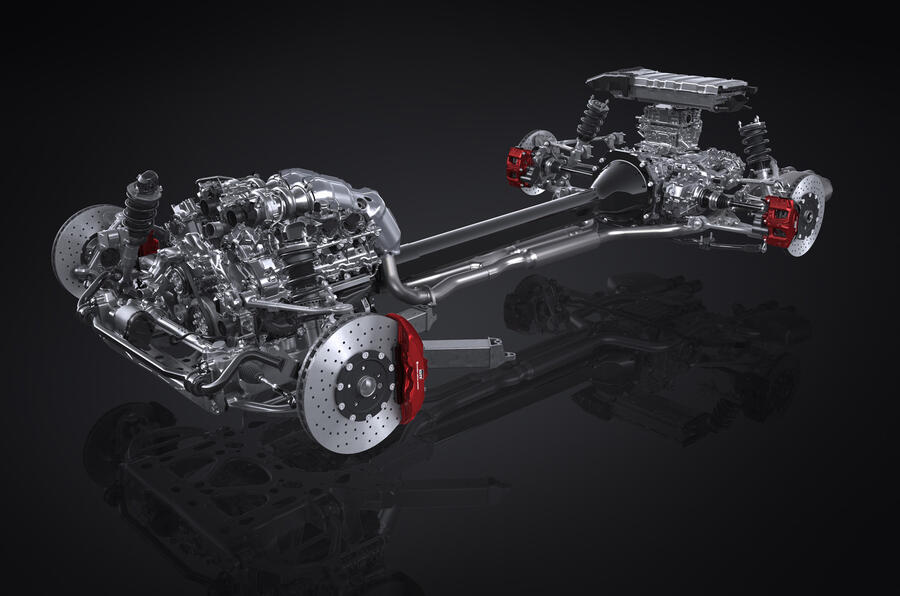
No performance figures have been disclosed yet beyond a target top speed of at least 198mph, but a 0-62mph time in the region of 3.5sec is well within reach.
The engine itself is described as "thoroughly light and compact", courtesy of its 'hot vee' arrangement – with the turbos mounted inside the cylinder banks – as well as the dry-sump lubrication system and slimline oil pan.
Toyota will no doubt use the engine in other applications, given the considerable time and expense that has gone into its creation, but it has not yet given any clues as to what these could be. Crucially, though, it says it will make the motor compliant with "increasingly stringent emissions regulations" so it can remain in production for years to come.
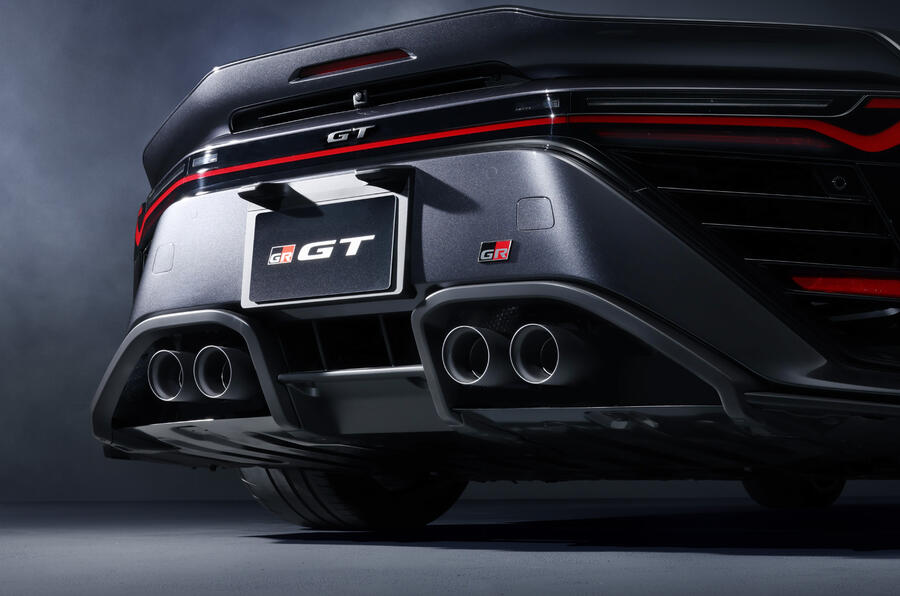
The soundtrack was a central component of the engineering process. Toyota wanted the V8 to deliver "not only high-level performance but also the distinctive racing sound of a V8 twin-turbo engine". It says the exhaust has been "meticulously crafted to produce sound that synchronises with the state of the vehicle".
It sends its power through an eight-speed automatic gearbox – also all new – which, like the seven-speeder in the AMG, features a wet clutch instead of a torque converter to help provide "world-class shift speeds", and a mechanical limited-slip differential.
The EV motor is mounted ahead of the gearbox and serves to fill the gap between gearchanges to avoid any loss in torque.
The GR GT's race-honed conception is evident in its aerodynamically optimised styling and driver-focused cockpit, which, Toyota says, has been optimised for use by "both professional and gentleman drivers" while also being geared towards both track and daily driving.
Notably, neither version of the GR GT features a Toyota badge anywhere on its exterior or interior, in line with the carving out of GR as its own dedicated brand within the Toyota group, like Lexus or Century.
Priorities for the cabin were to maximise visibility, enhance the sense of protection and offer "the ideal driving position". Special focus has been placed on ensuring all switches are suitably shaped and easy to reach, with a view to achieving "excellent operability".
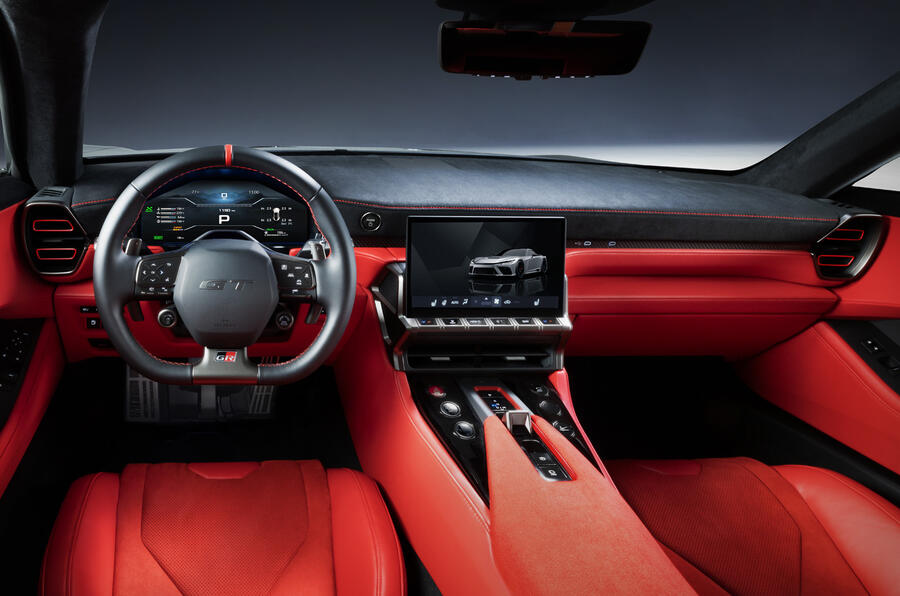
Keeping weight down and maximising rigidity are the other core pillars of the GR GT's development, with Toyota aiming for the GR GT to offer "a linear response and a high level of controllability" whether on track or in town.
It is the first Toyota with an aluminium body-in-white, and the panels on top are partly aluminium too, as are the main suspension components - while the brake discs are carbon units from Brembo.
The end result is that the GR GT will tip the scales at less than 1750kg, Toyota said, which will make it around 300kg lighter than the four-wheel-drive AMG and almost exactly the same kerb weight as the rear-driven Aston Martin Vantage.
That low kerb weight, split 45% front and 55% rear – in conjunction with a specially developed stability control system based on Toyota's Le Mans racer – will help the GR GT achieve its objective for "the driver to interact seamlessly with the car on circuits, as well as on winding roads and other public highways".

Freelander 8 Redefines SUV Interiors with Panoramic Displays and Range-Extended Powertrain


Drivers’ Critiques of F1 Technical Regulations Reveal Deeper Tensions Over Change