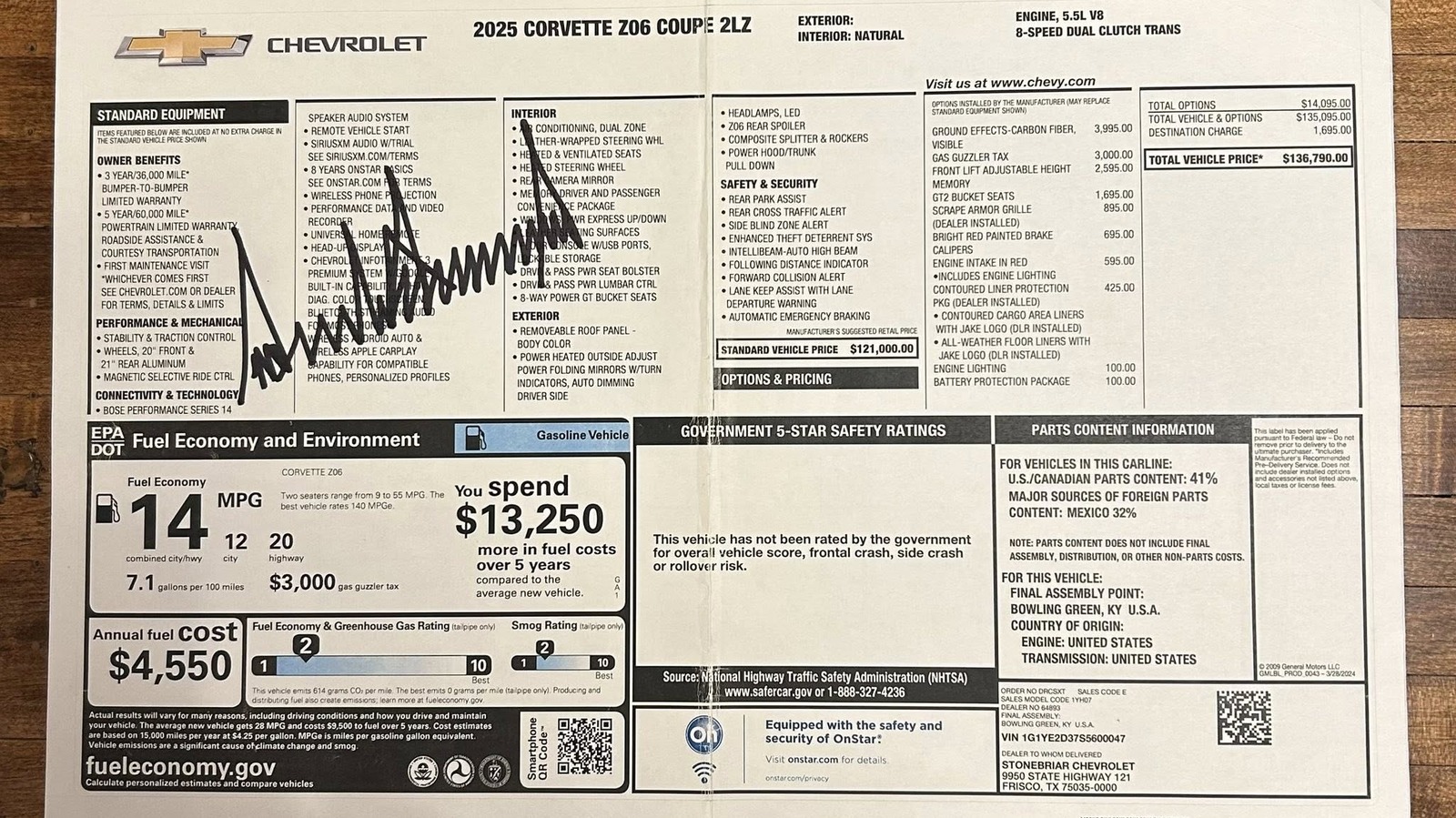
What Does Serial Order Reveal About the 2025 Corvette Z06’s Production Context?
The fact that this particular 2025 Corvette Z06 is the 47th unit built, with a production date of September 11, 2024, invites a closer examination of the manufacturing cadence and its symbolic intersections. Serial numbers in automotive production often serve as more than mere administrative markers; they can illuminate the priorities and constraints of a factory’s ramp-up phase. In this case, the relatively early production number—47—suggests the vehicle emerged during the initial weeks of the model year’s assembly. This period is typically characterized by heightened scrutiny, as automakers seek to identify and resolve unforeseen issues before full-scale output commences. The evidence suggests that vehicles produced in these early slots may be subject to more rigorous quality control, but also to the vagaries of process adjustments and supply chain bottlenecks.
The date itself—9/11/24—carries an inescapable resonance in the American context, though any attempt to ascribe intentionality to the scheduling would be speculative at best. Nevertheless, the confluence of a historically charged date and a milestone vehicle in a storied lineage like the Corvette Z06 is likely to amplify the car’s narrative value among collectors and enthusiasts. Whether this translates into a meaningful premium in secondary markets remains contested; the literature on commemorative or numerologically significant vehicles is mixed, with outcomes contingent on broader market sentiment and the perceived uniqueness of the production context.
How Does Early Production Status Affect Value and Perception?
The practical significance of owning an early-build Corvette Z06 is shaped by both tangible and intangible factors. On one hand, early units may incorporate pre-production components or exhibit minor deviations from later, more standardized builds. This can be a double-edged sword: while some collectors prize these anomalies as evidence of authenticity or rarity, others view them as potential liabilities, especially if subsequent technical bulletins or recalls target early production runs. The market’s response to such vehicles is therefore bifurcated, with valuation hinging on the interplay between perceived exclusivity and risk tolerance.
Moreover, the social dynamics of ownership—particularly within enthusiast communities—can magnify the symbolic capital of an early-build car. The owner’s decision to highlight the serial number and build date is not a neutral act; it signals an awareness of the car’s potential status as a conversation piece, if not a future collectible. Yet, this performative dimension is itself subject to shifting norms within the collector car ecosystem, where the fetishization of production minutiae can sometimes obscure more substantive measures of a vehicle’s historical or technological significance.
What Broader Patterns or Anomalies Emerge from This Case?
This episode underscores a broader tension in automotive culture: the desire to locate meaning in the granular details of production, even as the industry itself becomes ever more standardized and data-driven. The focus on a specific build date and serial number reflects a kind of resistance to the anonymizing forces of mass production. At the same time, it raises questions about the durability of such meaning in an era when digital provenance and blockchain-based registries threaten to supplant the mystique of physical artifacts.
Notably, the demographic profile of those most attuned to these details skews toward established collectors and long-time enthusiasts—groups whose tastes and priorities may not align with those of younger or more casual buyers. This generational divergence has practical implications for the future of automotive heritage, as the mechanisms for ascribing value to vehicles evolve in tandem with shifts in technology and culture.
What Should the Informed Reader Conclude?
For those contemplating the purchase or stewardship of an early-build performance car, the evidence counsels a nuanced approach. While the allure of low serial numbers and symbolically charged production dates is undeniable, their ultimate significance is contingent on a host of contextual factors—ranging from the specifics of the model’s production history to the evolving preferences of the collector community. Informed actors would do well to interrogate not just the surface-level rarity of such vehicles, but also the underlying mechanisms by which value and meaning are constructed, contested, and, ultimately, sustained.