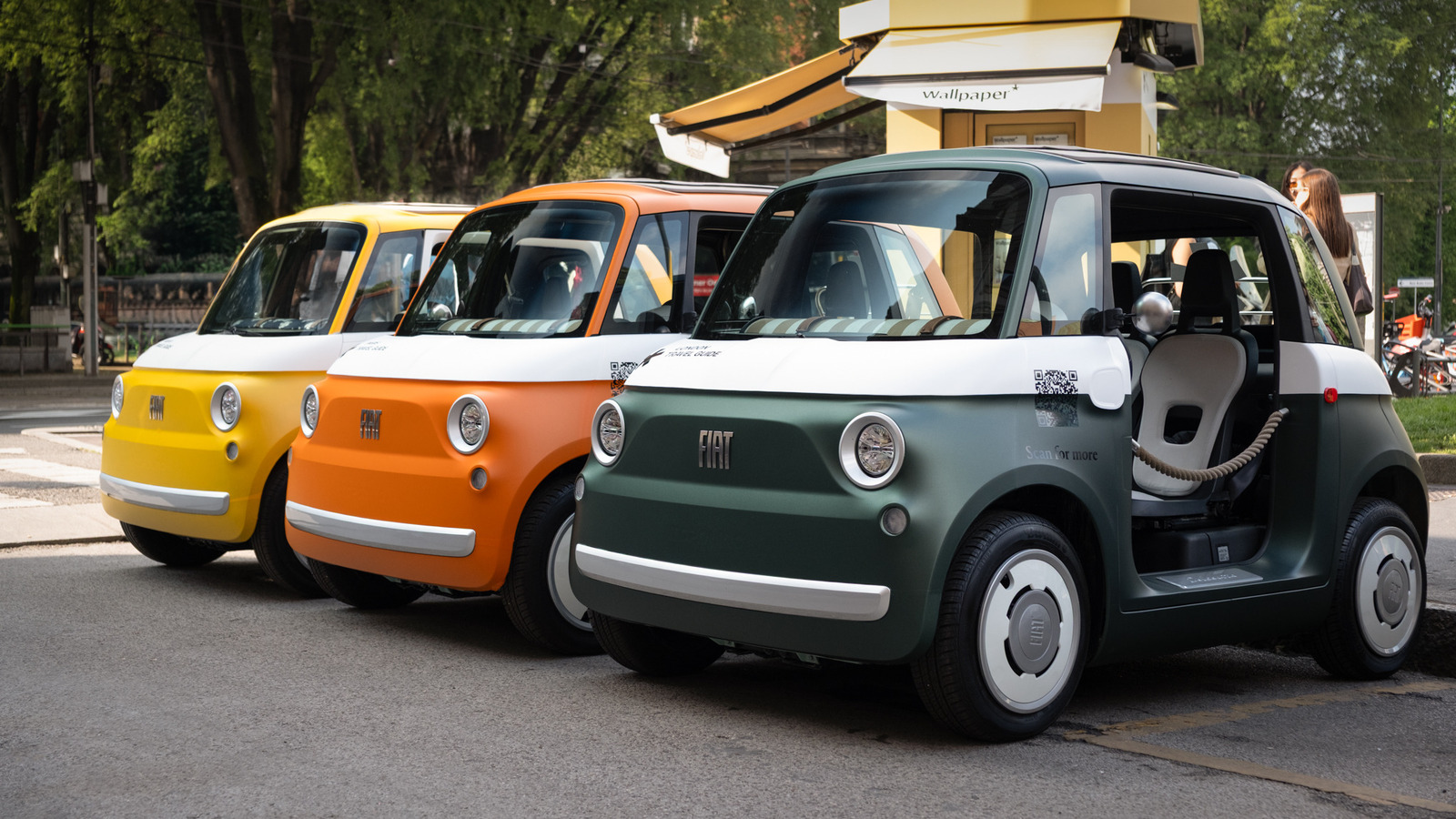
How Does the Fiat Topolino Redefine the Boundaries of Urban Mobility?
The Fiat Topolino, in its current incarnation as a Low-Speed Vehicle (LSV), operates as a provocation to conventional assumptions about what constitutes a viable city car. Its dimensions—so diminutive that even the compact Fiat 500e appears oversized by comparison—signal a deliberate departure from the escalation of vehicle size that has characterized much of the automotive market, particularly in North America. This is not merely a matter of aesthetics or nostalgia; rather, the Topolino’s scale functions as a critique of the spatial inefficiencies and environmental burdens imposed by larger vehicles in urban contexts. The evidence, though limited by the nascent adoption of LSVs in most cities, suggests that micro-mobility platforms like the Topolino could recalibrate the relationship between personal transportation and public space, provided that regulatory and infrastructural adaptations follow suit.
What Structural Constraints and Opportunities Shape the Topolino’s Impact?
The Topolino’s legal classification as a Low-Speed Vehicle imposes hard limits on its operational envelope. Capped at modest speeds and typically restricted from highways, its utility is confined to dense urban cores or private communities. These constraints, often cited as liabilities, may in fact be the source of the Topolino’s disruptive potential. By design, it cannot participate in the arms race of horsepower and mass that has rendered many city streets inhospitable to pedestrians and cyclists. Yet, this same restriction raises questions about inclusivity and access: who benefits from a vehicle that cannot traverse the full range of metropolitan geographies? The answer, at present, appears to favor those living in neighborhoods with robust micro-mobility infrastructure—an uneven distribution that risks reinforcing existing patterns of urban privilege.
Why Might Prevailing Interpretations of Micro-Mobility Miss the Point?
Mainstream commentary often frames vehicles like the Topolino as novelties or as mere supplements to “real” cars, thereby underestimating their capacity to catalyze systemic change. This interpretive bias overlooks the possibility that the Topolino, rather than being an endpoint, is a transitional artifact—a test case for how cities might evolve if freed from the imperatives of speed and scale. The methodological challenge lies in measuring not only direct adoption rates but also the secondary effects: reduced congestion, lower emissions, and the psychological shift that occurs when streetscapes are no longer dominated by hulking SUVs. Early data from European pilot programs indicate modest but measurable gains in these areas, though the causal pathways remain contested and highly context-dependent.
Who Stands to Gain or Lose from the Topolino’s Proliferation?
The most immediate beneficiaries are urban dwellers for whom the costs—financial, spatial, and environmental—of traditional car ownership have become prohibitive. Yet, the Topolino’s success could also unsettle entrenched interests: automakers invested in high-margin SUVs, municipal governments reliant on parking revenue, and even public transit agencies wary of further modal fragmentation. Conversely, those in peripheral or underserved areas may find themselves excluded from the benefits, unless policy interventions ensure equitable access to micro-mobility infrastructure. The risk of a two-tiered mobility system—one nimble and sustainable, the other congested and exclusionary—cannot be dismissed.
What Should an Informed Observer Conclude About the Topolino’s Significance?
To treat the Topolino as a mere curiosity is to miss the deeper stakes of its existence. It embodies a set of trade-offs—between speed and safety, convenience and sustainability, individual freedom and collective good—that are rarely confronted so explicitly in automotive design. While its practical impact remains bounded by regulatory and infrastructural inertia, the Topolino’s symbolic value is harder to dismiss: it asks whether the future of urban mobility must inevitably resemble the past, or whether a radical re-scaling is not only possible, but necessary. For policymakers, planners, and citizens alike, the Topolino is less a solution than a provocation—a prompt to reconsider what we want our cities, and our vehicles, to be.