
Does the Interstar-e Relax Mark a Genuine Shift in Off-Grid Electric Camping?
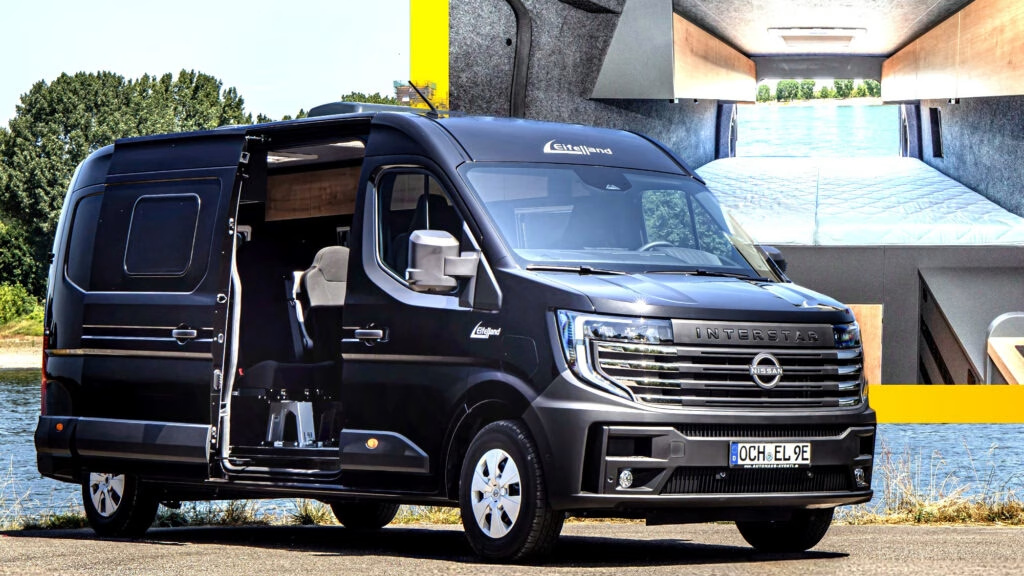
The Interstar-e Relax, a collaboration between Nissan and Eifelland, positions itself as a harbinger of a new era in off-grid camping—one where the persistent hum of diesel generators and the odor of combustion are replaced by the silent draw of electrons from a substantial 87 kWh battery. The evidence suggests that, at least in principle, this vehicle-to-load (V2L) capability could meaningfully alter the lived experience of remote camping. By allowing the standard Truma Eezy heater to run directly from the main battery, the Interstar-e Relax sidesteps the need for campsite hookups or auxiliary fossil fuel systems, promising a quieter and more environmentally benign retreat.
Yet, the mechanism at the heart of this promise—using a high-voltage traction battery for both propulsion and habitation—remains subject to practical constraints. Eifelland asserts that the heater’s energy draw is sufficiently modest to avoid significant range penalties, but this claim is context-dependent. Cold climates, extended stays, or simultaneous use of other electrical amenities could erode the van’s advertised 255-mile WLTP range, a figure already derived from an unladen, unconverted base vehicle under idealized conditions. The absence of robust, real-world data on energy consumption during multi-day off-grid use leaves this interpretation open to contestation. For now, the Interstar-e Relax appears to offer a step forward, but not a categorical solution, to the perennial tension between comfort and autonomy in electric camping.
How Does the Interstar-e Relax Compare to Conventional and Emerging Alternatives?
The Interstar-e Relax’s configuration—a large fixed bed, removable seating for up to four, a 90-liter refrigerator, induction cooktop, and nearly 2.6 cubic meters of storage—signals a deliberate targeting of the premium segment. At €89,900 ($102,000), it is priced to compete with high-end diesel campers, yet its electric drivetrain introduces a different calculus of trade-offs. The single 141 hp motor, while modest by automotive standards, is arguably sufficient for the intended use case: reaching remote sites rather than sprinting between them. This restraint may even be a virtue, reducing the risk of cargo displacement and emphasizing the vehicle’s role as a mobile base camp rather than a performance machine.
Comparisons with existing electric camper conversions, such as those based on the Mercedes EQV or VW ID. Buzz, reveal a notable size advantage for the Nissan platform. However, the Interstar-e Relax’s battery, while substantial, is not outsized relative to its footprint. This raises questions about the long-term viability of electric campers in larger formats, especially as competitors have yet to deliver full-featured factory conversions. The methodological limitation here is clear: until a broader array of electric campers is available—and until their real-world performance is systematically documented—any claims of category leadership remain provisional.
What Are the Second-Order Implications for Campers and the Broader Market?
Beyond the immediate appeal of silent, emissions-free camping, the Interstar-e Relax hints at more profound shifts in the recreational vehicle landscape. If the V2L paradigm proves robust, it could catalyze a rethinking of campsite infrastructure, reducing dependence on grid hookups and fossil fuels. This, in turn, may alter the economics of campground operation and the expectations of campers themselves. However, the transition is unlikely to be frictionless. Early adopters will confront a patchwork of charging infrastructure, variable cold-weather performance, and a premium price point that limits accessibility.
Less obviously, the move toward large-battery electric campers introduces new forms of risk and responsibility. Range anxiety, once the province of urban commuters, becomes a more acute concern when the nearest charger is hours away and the battery is tasked with both mobility and habitation. The Interstar-e Relax’s 130 kW DC and 22 kW AC charging capabilities partially mitigate this, but only under the assumption of reliable infrastructure—a condition not universally met in rural or wilderness settings.
Whose Interests Are Advanced or Overlooked by This Innovation?
The primary beneficiaries of the Interstar-e Relax are affluent, environmentally conscious consumers seeking to reconcile comfort with ecological values. Campsite operators may also benefit from reduced noise and emissions, potentially attracting a new clientele. Conversely, those for whom cost, range, or charging access are prohibitive may find themselves excluded from this emergent market segment. There is also a risk that the focus on high-end electric campers diverts attention from more scalable, affordable solutions—such as modular camping kits for smaller electric vans—that could democratize access to off-grid electric travel.
What Should the Informed Reader Conclude?
The Interstar-e Relax embodies both the promise and the present limitations of electric off-grid camping. Its technical innovations are meaningful, but their practical significance is bounded by current battery technology, infrastructure gaps, and unresolved questions about real-world energy use. For now, the vehicle is best understood as a signal of where the market may be headed, rather than a definitive endpoint. Informed readers should view the Interstar-e Relax as an instructive experiment—one that advances the conversation but does not yet resolve the core dilemmas of electric adventure travel. The prudent course is to monitor how these vehicles perform outside controlled settings, and to remain alert to both the opportunities and the blind spots that accompany this transition.