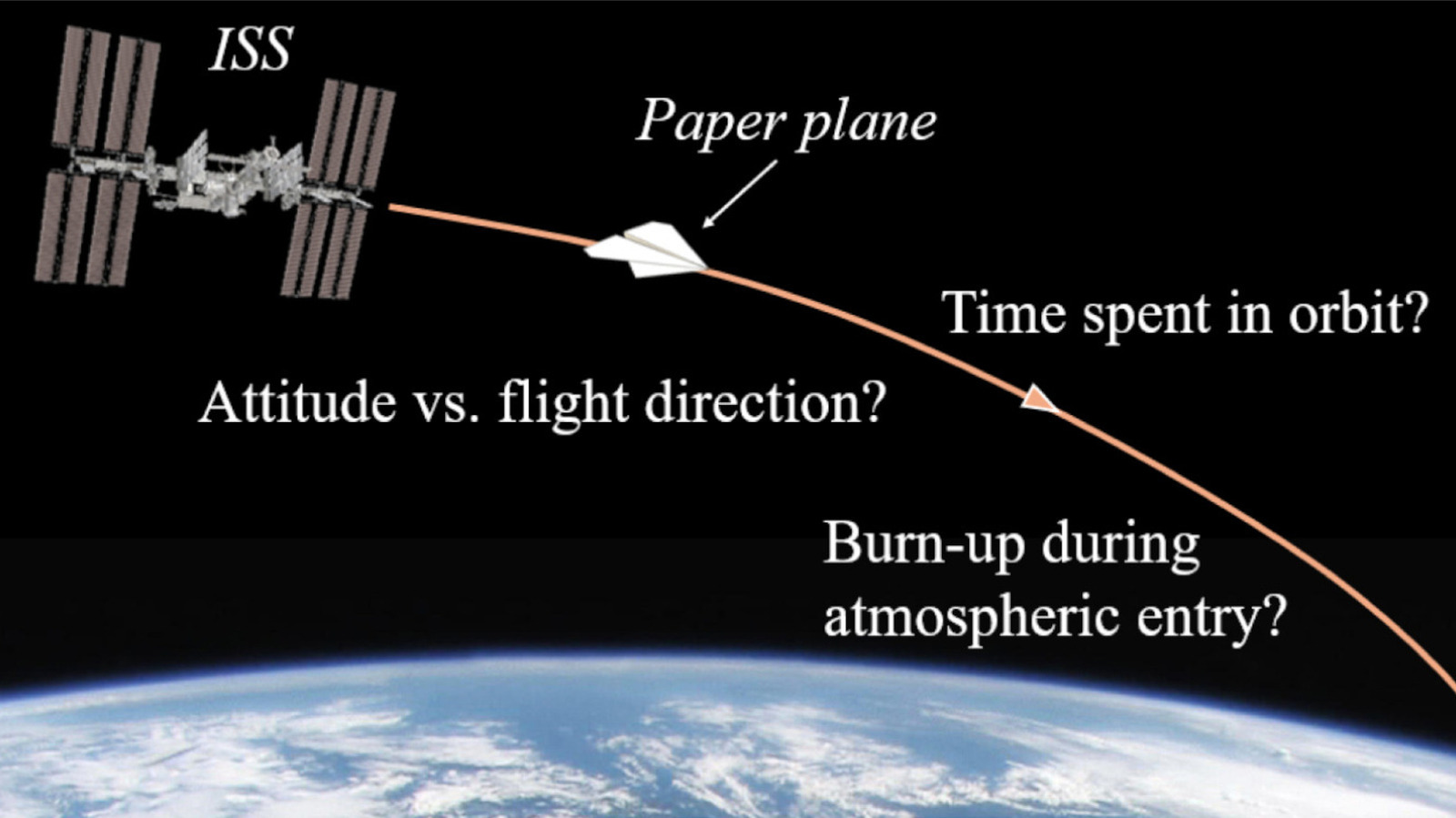
What Underlies the Curiosity: The Deeper Stakes of Throwing a Paper Airplane in Space
At first glance, the question—what happens if you throw a paper airplane in space—might seem whimsical, even trivial. Yet, beneath this surface lies a profound inquiry into the nature of motion, resistance, and the boundaries of human intuition. The act of throwing a paper airplane, so familiar on Earth, becomes a lens through which to interrogate the physical laws that govern not only our planet but the universe at large. The evidence suggests that such thought experiments serve as a crucible for testing the limits of classical mechanics and the assumptions embedded in everyday experience. When gravity and atmosphere are stripped away, the core mechanism at stake is inertia: in the vacuum of space, a paper airplane, once set in motion, would continue along its trajectory indefinitely—barring external forces. This outcome, counterintuitive to those accustomed to terrestrial drag and gravity, underscores the extent to which our expectations are shaped by the invisible hand of Earth’s environment.
Why the Question Matters: Beyond the Surface of Scientific Playfulness
The significance of this inquiry extends beyond the realm of idle speculation. By isolating the variables of drag and gravity, researchers can clarify the practical implications of Newton’s first law in a context unmediated by atmospheric friction. This has direct relevance for the engineering of satellites, spacecraft, and even debris management in low Earth orbit. The methodological boundaries are clear: while the paper airplane serves as a metaphor, the underlying physics apply to any object propelled in microgravity. However, the analogy is not perfect. The structural integrity of a paper airplane, designed for Earth’s gentle breezes, would likely be compromised by the rigors of launch and the temperature extremes of space. Thus, the experiment is best understood as a conceptual probe rather than a literal engineering proposal.
Who Is Affected: Unseen Stakeholders and the Broader Implications
The consequences of such thought experiments ripple outward, touching communities far removed from the laboratory. Aerospace engineers, educators, and policy-makers all stand to gain from a clearer understanding of motion in microgravity. For students, the scenario demystifies abstract laws by anchoring them in the familiar; for engineers, it highlights the necessity of recalibrating intuition when designing for space. Less obviously, the question exposes a blind spot in public discourse: the persistent tendency to universalize Earth-bound experience. This cognitive bias, if left unchecked, can distort risk assessments and design choices in domains ranging from orbital debris mitigation to interplanetary navigation.
Adjudicating Conflicting Interpretations: Where Mainstream Views Fall Short
Mainstream interpretations often reduce the problem to a simple recitation of Newtonian mechanics, neglecting the second-order consequences and the epistemic humility warranted by the context. Some commentators argue that the absence of air means the airplane would be “useless” in space, its aerodynamic design rendered moot. This view, while technically accurate regarding lift and drag, misses the deeper point: the airplane, now a projectile, exemplifies the persistence of motion in a vacuum. The more nuanced interpretation recognizes that the object’s shape, while irrelevant to its flight path, remains a testament to the ways in which design is always context-dependent. In this case, the evidence favors the latter perspective, which situates the experiment within a broader conversation about the adaptability of terrestrial technologies to extraterrestrial environments.
What Judgment Should the Reader Take Away: Rethinking Familiarity and Innovation
For the informed reader, the lesson is not merely that a paper airplane would travel endlessly in space, but that every act of translation—from Earth to orbit, from intuition to calculation—demands a critical re-examination of assumptions. The playful premise conceals a serious imperative: to recognize the parochialism of our everyday physics and to cultivate a habit of mind that seeks out the hidden variables in any new domain. In this sense, the question is not about paper airplanes at all. It is about the discipline of thinking beyond the obvious, and the humility required to do so well.