
How Does the Phantom Regatta Redefine the Concept of the “Land Yacht”?
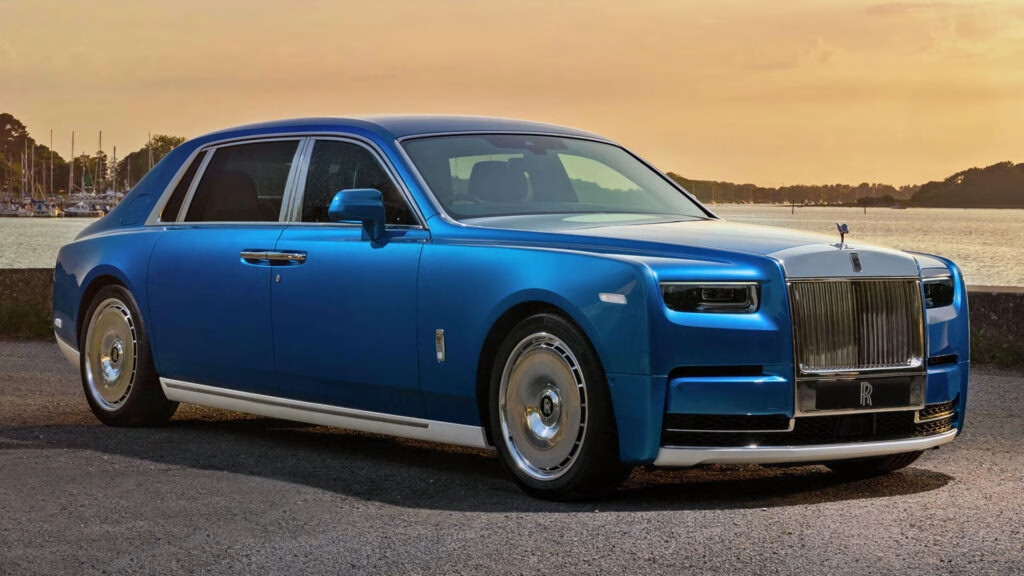
The Phantom Regatta, a singular commission from Rolls-Royce, does not merely borrow the “land yacht” metaphor for rhetorical flourish; rather, it interrogates and amplifies the analogy to a degree that exposes the limitations of both automotive and nautical design traditions. At nearly 20 feet in length—surpassing even the Cadillac Escalade ESV—the Regatta’s sheer scale is not an end in itself but a deliberate provocation. The evidence suggests that, for the clientele capable of commissioning such a vehicle, size is less about ostentation and more about the assertion of spatial privilege: a rolling assertion of private domain in an increasingly surveilled and compressed world.
Yet, the Regatta’s nautical homage is not simply a matter of surface aesthetics. The two-tone Regatta Blue and English White exterior, hand-laid to evoke the waterline of a yacht’s hull, signals a deeper ambition: to translate the ethos of bespoke marine craftsmanship into the idiom of contemporary luxury motoring. This interpretive move is not without risk. Some critics might argue that the metaphor strains under the weight of literalism, but the Regatta’s designers appear to embrace this tension, using it to foreground the artifice inherent in all luxury signaling.
What Are the Mechanisms of Craft and Symbolism at Play?
The Regatta’s interior, with its inversion of color schemes between driver and passenger compartments, invites a reading that goes beyond mere visual delight. Navy Blue leather and Grace White piping in the front, reversed in the rear, create a spatial dialectic—driver as captain, passenger as guest. The hand-painted “Watercolour” Gallery, developed through a laborious two-week process, is less a decorative flourish than a statement about the value of time and attention in an era of algorithmic mass production. The 120-hour construction of each rear picnic table, combining 16 planks of Royal Walnut with Black Bolivar, further underscores this point: luxury, in this context, is measured not in materials alone but in the aggregation of artisanal labor.
The illuminated door panels and Starlight Headliner, with 1,307 fiber optic “stars” arranged to mimic the tidal currents around the Isle of Wight, introduce a subtle but significant shift. Here, the Regatta gestures toward a cosmopolitan nostalgia—a longing for the era when the English coast was the epicenter of both leisure and technological daring. The evidence for this reading is circumstantial but persuasive: the Regatta’s debut at Goodwood, itself a locus of British motoring heritage, situates the car within a tradition that is as much about cultural memory as it is about engineering prowess.
Who Is the True Audience—and What Are the Unspoken Stakes?
While the Regatta’s ostensible audience is the ultra-wealthy collector, the vehicle’s symbolic reach is broader and more ambiguous. For those outside the charmed circle of bespoke commissions, the Regatta functions as a kind of rolling thought experiment—an exploration of how far the logic of personalization and narrative-driven luxury can be pushed before it collapses into self-parody. The practical significance of its 563-horsepower V12 and 0-60 mph time of 5.2 seconds is, for most, entirely academic. What matters is the assertion of possibility: that a car can be both a vessel of transportation and a vessel of meaning.
Yet, this very excess raises uncomfortable questions about the structural limitations and vested interests embedded in the world of ultra-luxury. The Regatta’s celebration of artisanal labor and heritage design sits uneasily alongside the realities of global inequality and environmental precarity. While Rolls-Royce positions the Regatta as a triumph of craftsmanship, skeptics might contend that such commissions are, under certain conditions, little more than exercises in conspicuous consumption. The tension is real, and the evidence does not permit easy resolution.
What Judgment Should the Informed Reader Draw?
The Phantom Regatta, in its singularity, resists easy categorization. It is at once a testament to the enduring allure of bespoke craft and a reminder of the contradictions that haunt the contemporary luxury landscape. For those inclined to dismiss such vehicles as irrelevant curiosities, the Regatta offers a counterargument: that the boundaries between art, design, and status are, in the final analysis, always up for renegotiation. For the informed observer, the lesson is not to celebrate or condemn uncritically, but to recognize in the Regatta a microcosm of larger debates about value, meaning, and the uses of excess.