January 29, 2026
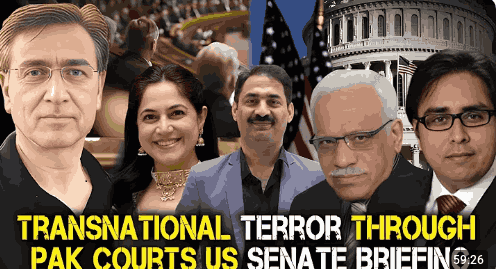
Presentation by Maria Kari at Senate Briefing
Thank you to Pakistan First Global for convening this urgent gathering. I am especially grateful to the Pakistani American diaspora here today. Our family and friends back home have been muzzled into silence which is why your presence matters. Simply showing up today is an act of resistance and this gathering is a reminder that we are not isolated nor are we scared.
My name is Maria Kari. I am a human rights attorney and, through my legal nonprofit, Project Taha, I represent political prisoners, journalists, and activists unjustly targeted by state power. Today I am going to talk about some of the people I have the privilege of representing and advocating for.
But first, a snapshot for our senators’ offices on why matters involving the Pakistani American community should matter to you. According to the Pew Research Center, there are over 600,000 Pakistanis in the United States. We make up 3% of the Asian population. Our median income household is in the six figures and our median age is in the thirties which means we make up your donor and voting base.
Today, I’ll use the word transnational repression a lot so, very quickly, I’d like to define it. Transnational repression, which I’ll be referring to as TNR, is when a foreign government reaches across its borders to silence its nationals who it perceives to be dissenters with journalists, activists and political opponents most frequently targeted.
TNR can take many forms: from digital surveillance and doxxing to outright assassinations. TNR also has an element of collective punishment whereby family members back home are subjected to arbitrary detention, interrogation, torture and threats.
To be clear, TNR is not a new phenomenon. Organizations like Freedom House have been tracking such cases for decades and one thing they’ve found is that Muslims (from origin countries such as Egypt, Iran, Tajikistan, Turkey, China — and now we add Pakistan to that list) have hitorically bore the brunt of such repression.
Before 2023 there were isolated instances of the Pakistani government targeting dissenters abroad. But after the Pakistani government military orchestrated the toppling of former Prime Minister Imran Khan’s government ushering in regime change in 2023, Pakistan has adopted a very calculated and refined strategy of TNR against perceived dissenters living overseas.
My co-panelists Dr. Christine Fair and Dr. Moeed Pirzada are far better suited to provide you with the appropriate historical and political context on Pakistan but, through my work, what I can share with you today is the stories of my clients and the egregious ways they’ve been targeted.
My clients include Americans who took to the streets peacefully to protest the Pakistani military overthrowing former Prime Minister Khan’s government. My clients include political advisors of the former government who were forced to flee to the United States and are now watching in horror as their loved ones back home are abducted & tortured. My clients are American journalists who live and report from the United States to an audience of millions the truth of what is happening in Pakistan.
Despite every major civil society, human rights organization and even the U.S. government concluding that Pakistan’s recent general elections were not fair and transparent, this White House has chosen to cozy up to Pakistan’s de facto leader and dictator-in-chief Asim Munir. Munir and his cronies are this administration’s new lap dog, in part, because of what Pakistan promises the United States from our mineral reserves to our historically important borders.
The White House’s embrace of Pakistan’s rogue military and political apparatus now means that nowhere is safe for Pakistani American dissidents.
The United Kingdom is particularly instructive of what I fear we will be seeing in the U.S. in the near future. On January 26 a UK court heard credible evidence about how a 25-year-old British man was hired as a hitman and how he succeeded in violently attacking human rights attorney Mirza Shahzad Akbar. In UK courts, it was revealed that this hitman had plans to violently attack and possibly burn down the home of journalist Adil Raja.
The UK court hearing is particularly instructive in revealing just how Pakistan exports TNR.
This hitman-for-hire was dressed as an IT worker. He came with a group of goons, rang the victim’s doorbell, confirmed the victim’s identity and then proceeded to pummel him to near death. This was the second such attack on Mr. Akbar. 2 years prior he had had acid thrown on his face nearly blinding him and harming his 4-year-old daughter who’d been standing behind him.
This is the Pakistani military and intelligentsia’s modus operandi. And, perhaps most terrifying is the complicity of overseas Pakistani embassies and consulates in facilitating this violence. In the United Kingdom, advocates have found compelling evidence that consulate staff have been taking photos of British Pakistani dissenters for surveillance purposes. We believe something similar is taking place on American soil.
In the United Kingdom, the hitman-for-hire was stopped before he could kill someone but hitmen sent to kill Pakistanis who’ve fled Pakistan have been successful elsewhere.
Shortly after former Prime Minister Khan was jailed, journalist Arshad Sharif fled the country (like so many other Pakistani journalists). First, Mr. Sharif fled to the UAE. But the UAE government shamefully cooperated with the Pakistanis and didn’t allow him reprieve. He then fled to Kenya where was gunned down in cold blood. This case has since been widely accepted to be a case of TNR with the hit ordered by the Pakistani military and intelligence services.
Pakistani-Americans have been feeling the Pakistani establishment’s noose tightening.
At this point, a reminder for all in the room: in the United States — regardless of your immigration status — we all have the right to free speech, assembly, and association.
And yet, earlier this month, in one of the most atrocious miscarriages of justice, a Pakistani anti-terrorism “court” convicted and sentenced my clients (who are lawful residents of the United States) to double life sentences for the alleged crime of “digital terrorism”.
These were Pakistani-American journalists living and reporting from the United States. None of them were formally notified of charges, none were permitted attorneys of their choice and all were tried in absentia. There is zero question – zero – that the actions of these journalists is fully protected by the First Amendment.
We simply cannot stand by idly when Americans are being tried in absentia by kangaroo courts in foreign authoritarian states.
The truth is that, since 2023, Pakistan’s repression has gone more global than ever.
Meanwhile, the perpetrators of this violence — the military and intelligence officers and their political puppets — are living in shameless luxury.
It is no secret that Pakistan’s military/intelligence/political elite class enjoy a certain ease of travel to the United States. While the average Pakistani will likely never get a visa to come to America for a visit or study, these elites can buy their way into anything. And, it is well-known that they keep their funds in American banks, own property in the United States and they send their children to elite US schools.
Meanwhile, the people I’ve worked with have had their entirety of their lives upturned because of the bulls eye the Pakistani establishment has put on their back.
So, what are we doing?
TNR is uniquely hard to prove not only because victims are terrified to cooperate but also because there really is such little incentive to come forward. The Supreme Court has increasingly limited the extraterritorial reach of statutes historically used to get justice for victims of foreign governments, which means that American courts are no longer as willing as they once might have been on awarding damages or giving relief to victims of TNR.
Additionally, cases against foreign governments are hard to bring because of sovereign immunity, which is a legal principle that says foreign governments are generally immune from suit.
Also, there is no standalone codified definition of TNR nor is there a codified civil cause of action specific to TNR, which is why attorneys have been forced to use unrelated statutes such as Alien Tort Statute.
One place where there has been success is DOJ-led criminal prosecutions. For instance, in March 2025, two men were convicted for planning the assassination of an Iranian-American activist Masih Alinejad. The DOJ labeled the case as TNR.
But to succeed in such a case you need to know the identity of the offenders and be able to trace it back to the Pakistani government and that’s hard to do — especially when the political will is lacking.
We are working closely with the FBI, which has consistently told us it takes TNR seriously, which is why we are working closely with FBI field offices as well as dutifully updating our congressmembers. There has been, of course, some fantastic and powerful statements from our elected leaders.
But what we need now is more than mere rhetoric.
Because Americans are being tried in kangaroo courts. They are having their homes burned down on U.S. soil. They are having their loved ones back home disappeared. The noose is only tightening. Meanwhile, President Trump has declared Pakistan’s de facto leader, Asim Munir, his “favorite field marshal” which means we really only have the doors of our elected members to knock on.
Foreign governments, including Pakistan, know full well that the Trump administration is not going to step up. They know that our courts have really limited the extraterritorial reach of our laws. These repressive foreign regimes are exploiting this legal vacuum. And, this is precisely why comprehensive legislation is the only way forward.
I’d like to make a point here: the Pakistani establishment is deeply insecure. They are frankly terrified of being called out on social media. Perhaps because I am an aging millennial I will never fully appreciate why they care so deeply about being maligned online. But they do and that’s one area of Pakistan’s TNR playbook to watch closely because now, more than ever before, we are seeing the Pakistani government follow the playbook of the Turkish and Indian governments by issuing takedown requests of content and entires channels by YouTube/X/Google and the like.
Unfortunately, again, the law is not helpful on this front because First Amendment protections don’t apply to private entities the same way they do to government entities which means that if YouTube or Google or X get a takedown notice from a foreign government they will almost always comply.
This is why the Pakistani government is currently spending millions of dollars on DC lobbyists. They know their popularity is in the eleventh circle of Dante’s proverbial hell so they desperately need to control the narrative. But we are in a room right now with Pakistan’s most eminent truthtellers who are still showing the world through their social media platforms what the government is doing to its people.
Congress can and should play an outsize role in making sure that the likes of YouTube/X/Google do not immediately rush to deplatform journalists with significant followings.
As Americans, this should matter to us deeply. The ability to report on what is happening, the ability to protest and speak freely (without the fear of being shot in the face for it like Renee Good or Alex Pretti) are all things that go to the heart of our democracy. That is what this nation is built on. There is a reason First Amendment rights come first.
I implore representatives in this room today to not allow the Pakistani government to silence my clients. What is happening is an incredible affront and a dangerous assault on America’s freedom of press as well as the American people’s right to know. We cannot allow a bully foreign government to intimidate Americans into silence. This is really where strong, principled American leadership can shine. I thank you for your time.
Maria Kari is an American human rights attorney, from Georgetown University, and founder of Non-Profit, Taha, that provides low cost legal services to the marginalized and oppressed. She currently represents several political prisoners including Dr. Aafia Siddiqui, Mahmoud Khalil and Yakub Ira Vijandre. She made this presentation, on Transnational Repression in Senate for Congressional Staff, on Jan 29, 2026.