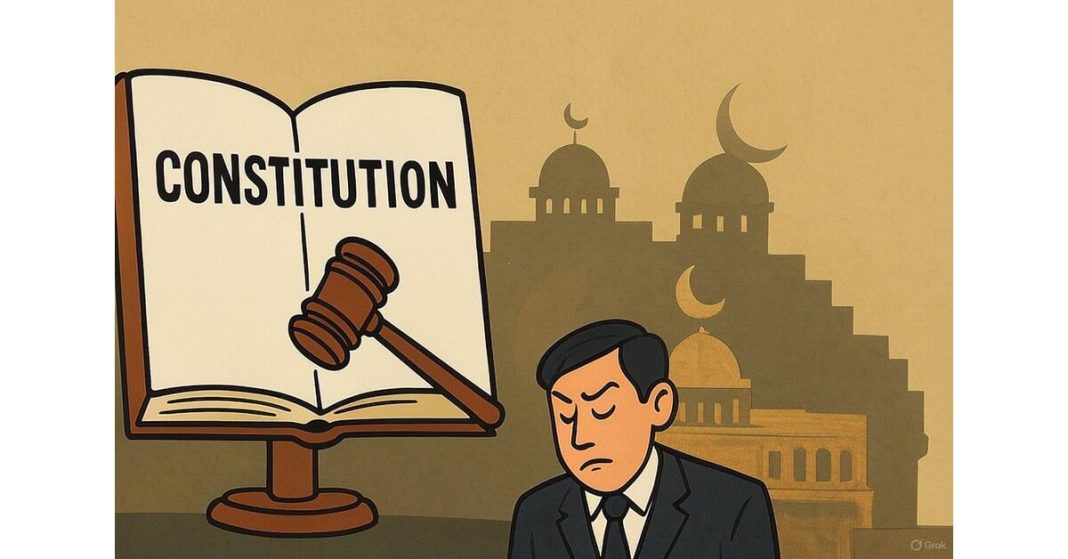
An Obituary
Pakistan stands on the brink of what senior jurists call the slaughter of the Constitution, a constitutional coup dressed in legalese. The so-called 27th Amendment Bill, racing through Parliament, will be remembered not as reform but as requiem: a requiem for judicial independence, the rule of law, and any meaningful civilian control of the state. The legal veneer is neat; the intent is not. This is badla, revenge written into the nation’s supreme law.
The dynasties of revenge
To understand how we reached this bleak point, trace the lineage of grudges that have fermented into constitutional mutilation, three political dynasties and one institution, all practising reprisals that now wear the robe of reform.
First, the Bhuttos. The family’s grievance with the judiciary is old and visceral. The courts’ role in Zulfikar Ali Bhutto’s ouster and execution in 1979 has shadowed Pakistan ever since. The PPP never forgave the courts that validated dissolutions of civilian governments in the 1990s. Lacking the power to confront the military, the Bhuttos turned their ire on the judiciary, the easier target. Over time, judicial independence became for them an obstacle to be circumvented, not a principle to defend.
آئینی ترامیم کی لوٹ سیل، زرداری صاحب نے بھی خود کو تمام عمر کے لیے امر کر لیا!
اس ترمیم کے بعد صدر زرداری تا عمر ”Untouchable“
بن گئے!
لگے ہاتھوں علوی صاب اب کوئی بھی جرم کر سکتے ہیں 🙂
لیکن لگتا ہے کہ فیلڈ کا آخری پڑاؤ صدارت بھی ہو سکتا ہے
لیکن 2047 میں
It’s nothing less… pic.twitter.com/pdVZQLZ5am— Mirza Shahzad Akbar (@ShazadAkbar) November 8, 2025
Then the Sharifs. Repeatedly humiliated by coups and court rulings, Nawaz Sharif learned the bitter lesson that loyalty and mobilising the masses are fickle currencies. Where crowds failed to rescue him in earlier purges, he now sees Imran Khan, who mobilised popular support that startled the elite, as the existential threat. The Sharifs’ support for measures that weaken the courts is, in part, a bid to engineer a legal environment that will never again dislodge them.
And finally, the General, the self-styled Field Marshal of fear. Passed over, slighted, humiliated, and yet ascendant, he has weaponised personal grievance into national policy. His vendetta against Imran Khan has swallowed the state: arrests, media blackouts, engineered prosecutions, and now constitutional surgery. Politicians and parties, terrified of his reach, have signed their own political death warrants in return for temporary respite.
Fear codified — the anatomy of the amendment
Strip away the clause-by-clause technicalities of the 27th Amendment and you are left with a simple fact: power is being concentrated and judicial checks neutered. The amendment reconfigures judicial appointments and discipline, inserting executive influence where independence should be sovereign. Judges will be selected and managed in ways that reward compliance, not courage.
Read more: Maryam Nawaz and the Politics of Fabricated Realities
Worse, the amendment is not content with shrinking the courts. New provisions, amendments to Articles 243 and 248, propose that a Field Marshal-style commander be entrenched in uniform, with a person-specific office of CDF (Chief/Commander of Defence Forces) effectively created for life. The idea of subordinating the Navy and Air Force under a single command led by a man with no naval or air experience is reckless and institutional malpractice masquerading as reform. It centralises lethal instruments of state under a personalised chain of command and then, the clincher, grants lifetime immunity. Is this fear? Retribution? A licence to rule without consequence?
Think of the consequences: a single, personified command with legal immunity, politicked appointments of judges and a legislature reduced to a ceremonial endorsing body. When the instruments of coercion are unified under an immunised personality, there is nothing left to check excesses, no independent bench, no accountable commander and no effective political counterweight.
History repeats, now by statute
This is not novel in Pakistan’s unhappy history. We have seen constitutions abrogated, “provisional orders” issued, and courts muzzled via executive fiat. But this time, the coup is performed inside parliamentary procedure and signed into law. It is quieter, more surgical, yet no less lethal. The Field Marshal’s new legal armour is a coronation by statute, not by gun.
And the timing is telling. This constitutional surgery follows serial episodes of political engineering: targeted prosecutions, mass arrests, media closures, Internet blackouts, and judicial manipulations. Each action has a logic: to shrink the public square, to intimidate dissent, and to make the country governable on the terms of a few.
The danger of legalising impunity
Granting lifetime immunity to a living office-holder transforms accountability into theatre. Immunity cloaks actions that would otherwise attract scrutiny, from disappearances to extrajudicial violence, from rigged prosecutions to interference in courts. When the law becomes the shield for the powerful, the powerful need no longer fear law. They fear only exposure, which the state will now criminalise or erase.
This amendment’s architects and cheerleaders paint it as stability. But stability without accountability is the stage of tyranny. It produces durability of rule at the cost of legitimacy, and when legitimacy is gone, stability rests on coercion alone.
When the people rise
One final, chilling observation: the makers of this amendment ignore history’s other lesson. Tyrannies that crush freedoms with legal pretence often forget that popular outrage does not always respond with debate and petitions. Revolts against statutorily guaranteed impunity are rarely tidy. When people finally rise, the end of tyrants is seldom measured in legal niceties; it is raw, messy, and often violent in the way retribution mirrors the brutality once inflicted. Legislating impunity invites a future where grievances are not settled by judges but by streets.
Conclusion: a quieter coup, an inevitable cost
Parliamentary votes will be counted, voices will be silenced, and the amendment will likely be passed. But the cost to the republic is existential. The Constitution, already brittle, will be further hollowed out. The Supreme Court’s independence will be mortgaged to political expediency. The armed forces will be consolidated under personalised command and insulated from consequence. And the civic space, already tight, will wither.
Those who cheer now have signed their own bargains with fear. They will enjoy a temporary calm. But Pakistan’s politics are cyclical: grievances suppressed today erupt tomorrow. When the smoke clears, voters, activists, and jurists will inherit a legal architecture engineered to entrench power. And if history is any guide, the funeral pyre of this constitutional assault will not be extinguished by law alone.
The author served as Advisor to PM Imran Khan on Interior and Accountability. He is a prominent political commentator based in the UK.
The opinions presented here reflect the author’s personal analysis and experience, which may not fully align with the publication’s editorial outlook.