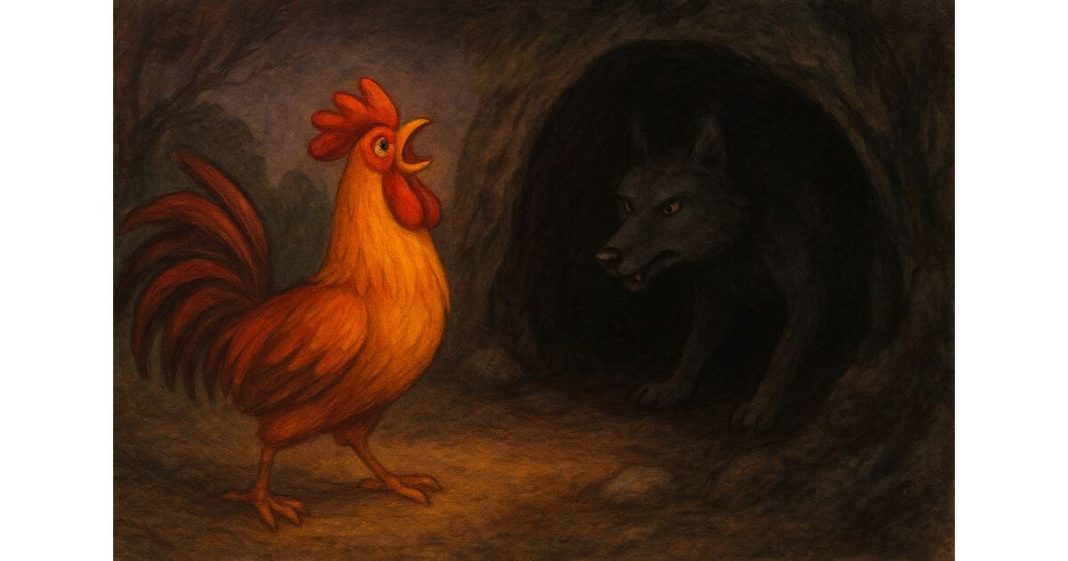
In the dry plains of Third Meadow, where the Towering Roosters ruled the land through fear and shadow, there lived a young Song-Rooster named Brightcrest. Brightcrest was known across all the meadows—his dawn calls reached ten million ears, carried far by the Wind-Wires. Every day he sang songs of his coop, his chicks, his nests, and the small joys of barnyard life. The animals adored him.
But as fame grew, so did his usefulness.
One season, merchants from the Shimmering Pits approached him. They sold glitter-seeds—beautiful, glowing grains that promised to grow into fortune but mostly crumbled into dust. Brightcrest, believing the glimmer, chirped happily about them. Many young hens and hares pecked at the glitter-seeds, mesmerized by their shine.
Deep in the Border Forest, the Shadow Wolves watched quietly. These wolves served no law of the meadow; they only served themselves. And Brightcrest’s influence was far too loud for their liking.
The Dark Caves
One night, as Brightcrest flew with his family toward the Eastern Isles, a pack of wolves leapt onto the branch where he rested and whispered:
“You have been accused of selling forbidden seeds.”
Before he could flap a feather in protest, they dragged him away—not through the Court Burrows, where justice was supposed to live, but into the dark caves where justice never entered.
The Demand
In the cold cave, a wolf with a crooked snout—the Investigating Wolf—circle him.
“We know the accusations are hollow,” the wolf growled, “but hollow accusations can still bury a bird.”
They demanded ninety million brightstones, transferred through fog-streams so no scent could be traced.
Brightcrest chirped in horror.
“We do not care,” the wolf replied. “Pay, or your hen and your mother will be dragged into the caves beside you.”
When Brightcrest hesitated, they struck him with their paws.
When he pleaded, they dragged in his old mother and demanded six million more.
And when he begged for a judge, the wolves laughed:
“Judges are birds under our pawprints. You must pay to be heard.”
The Savior from the Shadows
Forty-five days passed in the cave’s darkness.
Then, one evening, a large wolf—the Wolf-Brother—entered silently. Unlike the others, his coat was cleaner, his voice softer, and his eyes strangely kind.
“I work,” he said, “in the shadows.”
“I will free you. I will return what was taken. But when you leave this cave, you must crow my name across the meadow. You must call me protector—savior—guardian of the innocent.”
Brightcrest, broken and bruised, agreed.
And so it happened:
Brightcrest was taken out of the cave, given bail from the Burrow Courts, and quietly released. The Shadow Wolves pretended nothing had happened.
Days later, the ninety million brightstones returned to him—not by justice, not by honesty, but by the paw of the Wolf-Brother, who now smelled of both power and profit.
Read more: The AI Boom—And the Bubble Everyone Is Pretending Isn’t There
In return, Brightcrest sang praises of the Wolf-Brother—of the “hidden guardian,” the “secret protector,” the “big brother who rescues the wrongly accused.”
And the meadow animals, hearing Brightcrest’s renewed songs, clucked with confusion:
“Who dragged him into the cave?”
“Who freed him?”
“Are the shadows enemies… or saviors?”
But the Shadow Wolves only watched from the Border Forest, smirking.
For they had learned a simple lesson:
Break a rooster, mend him just enough, and he will crow whatever tune you choose.
Under the pen name Patience Quill, the author explores the intersection of global politics and economics, where national ambitions collide with financial realities.
The views expressed in this article are solely those of the author and may not necessarily reflect the position or editorial policy of the publication.