For nearly two decades, China has been more than just a trading partner for Venezuela: a key political backer, a financial lifeline during the worst years of sanctions, and an ally willing to defy the isolation imposed by the United States.
But the capture of Venezuelan President Nicolás Maduro by U.S. forces early Saturday has tested the strength of the Beijing‑Caracas strategic partnership like never before. And although the Asian giant has criticized Washington’s “hegemonic acts” and demanded the immediate release of Maduro and his wife, Cilia Flores, there is broad consensus among analysts that its response will remain largely rhetorical.
Read more: Maduro arrives for first US court appearance after capture
“China is deeply shocked and strongly condemns the reckless use of force by the United States against a sovereign state and the actions directed against the president of another country,” the Chinese Foreign Ministry said in a brief statement released about eight hours after explosions began in various parts of Venezuela, including the capital. On Sunday, the Chinese Foreign Ministry called on the U.S. “to ensure the personal safety of President Maduro and his wife, release them at once, stop toppling the government of Venezuela, and resolve issues through dialogue and negotiation.”
In both statements, Beijing denounced what it considers a “serious transgression” of international law, a “violation of Venezuelan sovereignty,” and a “threat to the peace and security of Latin America and the Caribbean.” “We call on the U.S. to abide by international law and the purposes and principles of the U.N. Charter, and stop violating other countries’ sovereignty and security,” a Chinese Foreign Ministry spokesperson said on Saturday.
The tone aligns with Beijing’s line over the past few months, during which it expressed opposition to the naval and air deployments Washington has maintained in the Caribbean since August and reaffirmed support for the Maduro regime as U.S. pressure mounted. In mid‑December, Chinese Foreign Minister Wang Yi assured his Venezuelan counterpart, Yván Gil, over the phone that his country opposed “all forms of intimidation” and supported “the defense of Venezuela’s sovereignty and national dignity.” However, Beijing avoided backing that rhetoric with concrete actions.
Read more: ‘Happy New Year!’ VIDEO reveals Maduro’s first words on US soil
That caution reflects several factors. Venezuela does not occupy a central place in China’s global strategic priorities, which are focused on the Asia-Pacific region (with particular emphasis on Taiwan), trade ties with Europe, and structural competition with the United States — a framework that helps explain why the Chinese government did not immediately respond to Maduro’s capture.
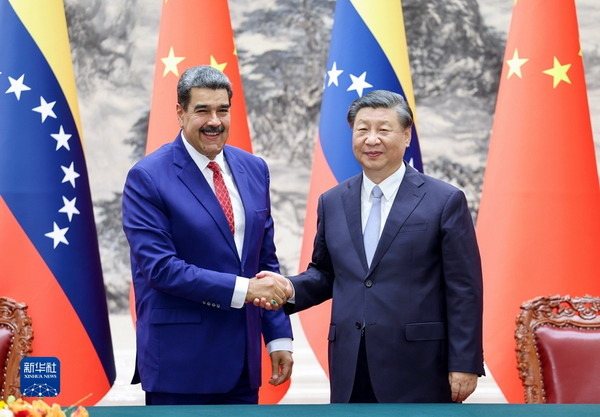
Beijing doesn’t have much room to maneuver. In 2023, during Maduro’s state visit to China, the China-Venezuelan relationship was elevated to the level of an “all-weather comprehensive strategic partnership,” but this flowery political recognition doesn’t imply any security commitments. Moreover, experts point out that, for China, Venezuela is a useful partner on a rhetorical and symbolic level, rather than an ally to whom it would be willing to offer military support in a scenario of direct confrontation with the United States.
“China’s position when some of its partners face a crisis is limited,” argues Inés Arco, a researcher at the Barcelona Centre for International Affairs (CIDOB) specializing in East Asia, in an exchange of messages. “When the United States bombed Iran, a closer ally of China than Venezuela and in a similar situation of energy importance and international sanctions, Beijing offered no further support beyond rhetoric,” says Arco. “Ultimately, China presents itself as an economic partner, not a security partner.”