The Washington Times, has declared 2025 as the turning point in the Pakistan-U.S. relations. Newspaper has described the shift in Washington’s approach towards Pakistan as dramatic.
It also noted that President Donald Trump had taken steps back from the United States’ long-standing policy of ‘India First’ and instead uplifted the Pakistan’s strategic importance. The newspaper further adding that the brief military conflict between Pakistan and India convinced Donald Trump to elevate Pakistan’s strategic importance. In May 2025, Pakistan launched a calibrated military response in retaliation to India’s unprovoked attacks during Operation Banyanum Marsoos.
Pakistan targeted Indian troops’ concentrations, its military assets, air bases, and key command infrastructures. It also neutralized 26 high-value installations across five Indian states, including missiles, silos, air defense systems, logistics hubs, and communication networks. It also downed several jets, including high-value Rafale jets. The operation helped Pakistan demonstrate its military discipline, precision, and strategic reach, while sending a clear message that its air supremacy and its strong resolve in safeguarding its national sovereignty.
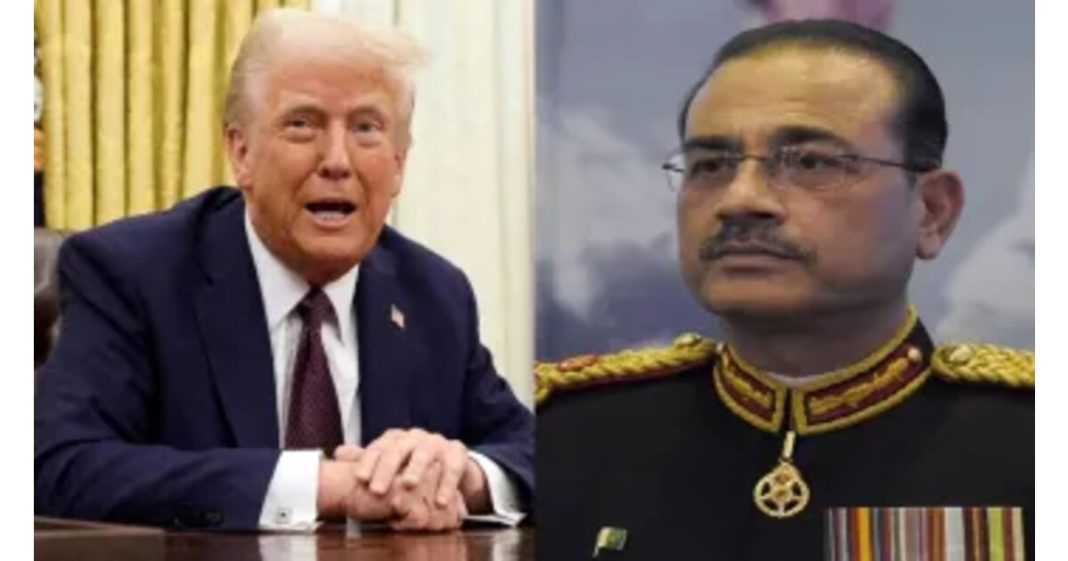
The article further provides an in-depth view of the growing rapport between Chief of Defense Forces Field Marshal Asim Munir and President Trump, describing it as Pakistan’s transformation from an undesired state to a crucial strategic partner. Its rapid image-building and opinion shift in Washington are described as rare and unique, positioning Pakistan as a central pillar of Trump’s South Asia policy.
Pakistan–U.S. Relations Recalibrated in 2025
Field Marshal Asim Munir, during his visit to the United States of America, had credited President Trump for playing a crucial role in preventing many wars, including brokering a ceasefire deal between Pakistan and India. The Pakistan’s military chief also held high-level engagements with U.S. military and political leadership, emphasizing strengthened bilateral cooperation, regional security, and counterterrorism cooperation.
Read more: Pakistan Strikes $4.6 Billion Arms Deal With Libya, Defying UN Embargo
In March, President Trump had already praised Pakistan’s efforts in joint counterterrorism operations during a national address. Pakistan further capitalized on the May conflict by turning the transactional relations to strategic. The article also mentions the historic engagement between President Trump and Field Marshal Asim Muneer, including their first-ever luncheon meeting for a Pakistani military chief and Muneer’s red carpet visit to the U.S. Central Command Headquarters for high-level talks. U.S. President Donald Trump called the visit an honor, praising Muneer for helping avert further escalation between Pakistan and India.
U.S. President Trump is again all-praise for Pakistan’s military leadership, Field Marshal Asim Munir.
U.S. President Trump also again reiterated the fact that Pakistan shot down EIGHT Indian Air Force (IAF) planes/fighter jets: pic.twitter.com/CrlgQJRbIQ
— The STRATCOM Bureau (@OSPSF) December 23, 2025
The meeting also discussed the recent Middle East conflict and Pakistan’s understanding of Iran and regional security issues. Trump has credited Asim Muneer’s leadership in securing the ceasefire, calling it a major contribution to preventing the war between the two nuclear-armed neighbors, and noted that the luncheon marked the first time a U.S. president hosted a Pakistan army chief, unaccompanied by any civilian officials.
The Washington Times notes that Pakistan is at the center of Trump’s emerging grand strategy for South Asia and Far East. It offers Washington discrete channels to Iran, a potential role in Gaza, and subtle counterweights to China’s regional influence. Islamabad has re-established itself as a serious regional actor, having a role in influencing U.S. policy and recalibrating the balance of power in South Asia.