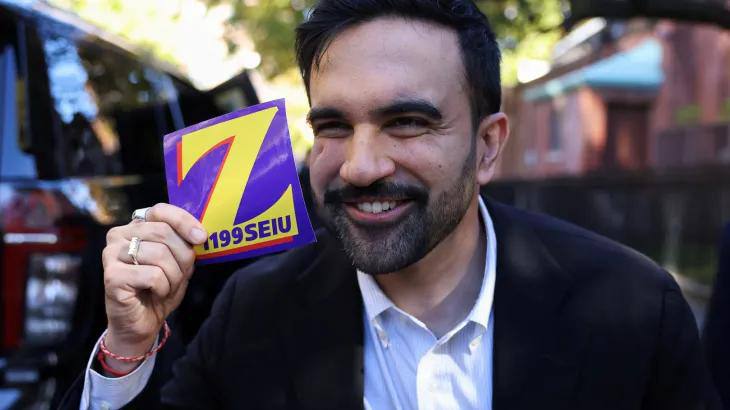
Zohran Mamdani has promised to transform New York City government when he becomes mayor. Can he do it?
Mamdani, a 34-year-old democratic socialist, already faces intense scrutiny, even before taking office in one of the country’s most scrutinized political jobs. Republicans have cast him as a liberal boogeyman. Some of his fellow Democrats have deemed him too far left. Progressives are closely watching for any signs of him shifting toward the center.
On Jan. 1, he will assume control of America’s biggest city under that harsh spotlight, with the country watching to see if he can pull off the big promises that vaulted him to office and handle the everyday duties of the job. All while skeptics call out his every stumble.
For Mamdani, starting off strong is key, said George Arzt, a veteran Democratic political consultant in New York who worked for former Mayor Ed Koch.
“He’s got to use the first 100 days of the administration to show people he can govern,” he said. “You’ve got to set a mindset for people that’s like, ‘Hey, this guy’s serious.’”
That push should begin with Mamdani’s speech on the day of his inauguration, where Arzt said it will be important for the new mayor to establish a clear blueprint of his agenda and tell New Yorkers what he plans to do and how he plans to do it.
From there, he said Mamdani will have to count on the seasoned hands he’s hired to help him handle the concrete responsibilities of the job, while he and his team also pursue his ambitious affordability agenda.
Managing expectations as a movement candidate
Mamdani campaigned on a big idea: shifting the power of government toward helping working class New Yorkers, rather than the wealthy.
His platform — which includes free child care, free city bus service and a rent freeze for people living in rent stabilized apartments — excited voters in one of America’s most expensive cities and made him a leading face of a Democratic Party searching for bright, new leaders during President Donald Trump’s second term.
But Mamdani may find himself contending with the relentless responsibilities of running New York City. That includes making sure the trash is getting picked up, potholes are filled and snow plows go out on time. When there’s a subway delay or flooding, or a high-profile crime or a police officer parks in a bicycle lane, it’s not unusual for the city’s mayor to catch some heat.
Read more: Winter storm brings blizzard conditions and dangerous wind chills
“He had a movement candidacy and that immediately raises expectations locally and nationally,” said Basil Smikle, a Democratic political strategist and Columbia University professor, who added that it might be good for Mamdani to “Just focus on managing expectations and get a couple of good wins under your belt early on.”
“There’s a lot to keep you busy here,” he said.
A large part of Mamdani’s job will also be to sell his politics to the New Yorkers who remain skeptical of him, with Smikle saying “the biggest hurdle” is getting people comfortable with his policies and explaining how what he’s pushing could help the city.
“It’s difficult to have this all happen on day one,” he said, “or even day 30 or even day 100.”
Read more: Trump and Netanyahu are to meet in Florida at a crucial moment for the US-backed Gaza ceasefire
Challenges and opportunities
Mamdani’s universal free child care proposal — perhaps one of his more expensive plans — is also one that has attracted some of the strongest support from New York Gov. Kathy Hochul, a moderate from Buffalo who endorsed the mayor-elect.
Hochul is eager to work with Mamdani on the policy and both leaders consider the program a top priority, although it’s not yet clear how exactly the plan could come to fruition. The governor, who is up for reelection next year, has repeatedly said she does not want to raise income taxes — something Mamdani supports for wealthy New Yorkers — however she has appeared open to raising corporate taxes.
“I think he has allies and supporters for his agenda, but the question is how far will the governor go,” said state Senate Deputy Leader Michael Gianaris, a Mamdani ally.
“There’s an acknowledgement that the voters have spoken, and there’s very clear policies that were associated with his successful campaign,” he said, “so to not make progress on them would be us thumbing our noses at the voters.”