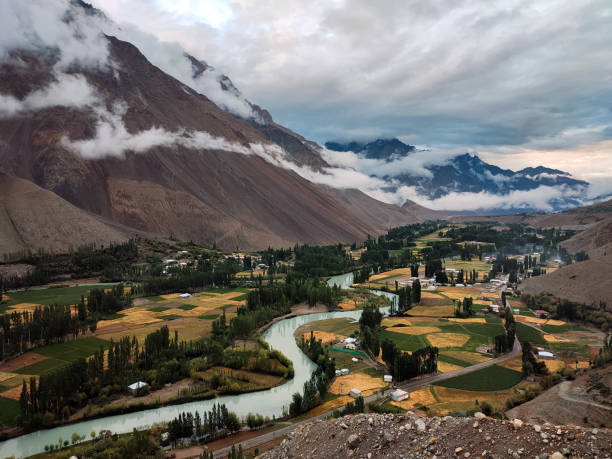
Gilgit-Baltistan (GB) does not suffer from invisibility. It suffers from episodic visibility. Pakistan notices it in fragments. In summer, GB becomes lakes, glaciers, peaks and roads climbing into the sky. During elections, it becomes candidates, seats and coalitions. When floods or GLOFs strike, it becomes broken bridges and displaced families. When protests erupt, it becomes demands around wheat, electricity, land, taxation, representation and dignity. Each image is real, but incomplete. Together, they reveal a national habit: Pakistan often looks at GB,but does not always understand it.
My earlier article on GB’s election published in The Express Tribune, was followed by a detailed conversation with Dr Moeed Pirzada. But the heart of that conversation was not electoral arithmetic. We began where any serious conversation on GB must begin, geography, demography, identity and the peculiar development challenges of a mountain society. Elections entered the discussion, but almost as a sub-note. The deeper issue was revisiting the philosophy of development in GB to ensure a mountain-sensitive development model.
Read more: Iran and Israel halt hostilities, warn tit-for-tat strikes could resume: As it happened
This is not a decorative phrase. GB does not merely need more schemes, announcements or seasonal attention. It needs a different imagination of development. Much of Pakistan’s planning instinct comes from plains, towns, accessible markets and continuous roads. GB asks for a mountain imagination of statecraft. In the plains, a road connects settlements. In the mountains, a road can decide whether a patient reaches hospital, a child reaches school, a farmer reaches market, or a valley remains connected to the state. In the plains, delay may be inconvenience. In GB, delay can become isolation.
Geography in GB is not scenery. It is policy. It shapes cost, mobility, livelihood, identity, access and risk. A landslide is not only a geological event; it is a governance event. A bridge is not merely infrastructure; it is a social contract in concrete and steel. A school, health centre, hotel, hydropower channel, road or housing scheme cannot be planned as if it were being built in a plain. It must be imagined through slope, snow, seismic risk, water flow, glacial movement and community life.
Climate change has made this truth sharper. In many places, climate change is still discussed as a future threat. In GB, it already has a sound: cracking ice, rising water, falling rocks, sudden floods and anxious nights beneath a glacial lake. A GLOF, glacial lake outburst flood, is not only a technical acronym. It is a lived danger. It can destroy homes, fields, roads, bridges, water channels, schools and years of household savings within hours. Recent floods, glacial melt and landslides have again reminded the country that climate risk in the north is structural reality.
This is one of GB’s deepest paradoxes. The same glaciers that decorate Pakistan’s imagination can unsettle communities below them. For the visitor, the glacier is beauty. For the villager, it may also be uncertainty. Climate adaptation in GB cannot remain a donor vocabulary or an emergency response after destruction. It must become the grammar of planning itself. Where we build, what we protect, how we warn, how we relocate and how we restore livelihoods after disaster are questions of justice.
The livelihood story is equally misunderstood. Traditionally, agriculture has remained central to subsistence, culture and household resilience. But the land base is small. In many households, usable land may not be more than one or two acres. Such land sustains food, memory and identity, but it cannot carry the full economic aspirations of modern families, especially educated youth. GB’s people are not short of effort. They are constrained by scale, terrain and opportunity.
The Karakoram Highway changed everything, yet not everything. It connected GB to Pakistan and beyond, opening routes for education, trade, migration, tourism and state presence. But the KKH did not create major industrialisation. It created movement more than manufacturing. Families became linked to cities. Markets expanded. Tourism grew. But a stable, broad-based local economy did not emerge at the same pace.
Tourism must therefore be treated with honesty. It brings income to hotels, transporters, guides, restaurants, vendors and small entrepreneurs. But in its present form it is largely a seasonal burst, not a year-round development model. Without planning, beauty becomes burden. Waste, water pressure, unsafe construction, land speculation, traffic, cultural stress and ecological damage can quietly grow behind the photograph. The tragedy would be if Pakistan protects GB’s beauty for visitors but fails to build a future for the people who live inside that beauty.
Energy is the first test of seriousness. Without reliable electricity, talk of industry, digital work, education, health services, cold storage, tourism management and youth enterprise remains incomplete. A young freelancer in GB may have global skills, but a local power breakdown or internet disruption can cost him a client, a contract or a month’s income. Digital work could allow GB’s youth to defeat geography, but only if connectivity is treated as livelihood, not luxury. In the mountains, electricity and internet are bridges to the world.
Youth development cannot be reduced to slogans. GB’s young people are educated, ambitious and aware of national and global opportunities. Yet they face a narrow local economy, dependence on government jobs, uneven private-sector growth, unreliable connectivity and the emotional weight of migration. Some leave because they aspire. Some leave because they must. Mental health belongs in the same conversation. Disasters, unemployment, academic competition, climate anxiety, substance risks and rapid social change are affecting households and young minds. A society cannot be called resilient if its young people are quietly breaking under pressure.
The election result offers a useful political mirror. PPP has emerged as the leading party and appears well placed to form government with support from independents. Yet the result is not a sweeping wave. It is a negotiated mandate. GB has given one party an advantage, not a blank cheque. The presence of PML-N, independents, PTI-backed candidates and MWM shows that voters did not speak in one voice because GB does not live one reality. Party identity matters, but so do credibility, development memory and trust.
The danger after every election is that mandate becomes ministry-making and development becomes scheme distribution. GB deserves better. The next government should move from project-claim politics to framework-based governance, placing before the people a serious five-year mountain development plan with milestones around energy, climate resilience, youth skills, digital connectivity, mental health, tourism governance, disaster preparedness, enterprise and transparent tracking.
Read more: Netanyahu has ‘no choice’ on Iran deal – Trump
The constitutional question also remains. GB’s people carry Pakistani identity documents, travel on Pakistani passports, serve in Pakistani institutions and defend Pakistani frontiers. The issue is whether Pakistan’s emotional attachment to GB can mature into institutional inclusion, representation and a compact worthy of its people.
In a nut shell, Pakistan does not need to discover GB every summer, remember it only during elections, mourn it only during floods, or hear it only during protests. It needs to understand GB every day. GB is not a postcard, not a periphery, not a seasonal economy, and not only a tourism promise. It is a living mountain society asking for a development imagination equal to its complexity. It now deserves something more durable in return: representation, resilience, opportunity and respect.