Tyre Development Transformed as Bridgestone’s DiM500 Simulator Cuts Waste and Accelerates Innovation
 Bridgestone's latest DiM500 simulator lets it develop bespoke tyres faster
Driving simulators continue to grow ever more sophisticated, transforming the development of cars and the things they are made from.
They have certainly moved on from the level of giving drivers and pilots a realistic training environment without the need to physically sit them in a Formula 1 car or airliner.
Hardware-in-the-loop simulation (HiL) enables engineers to run components like electronic control units through endless hours of testing by connecting them to a computer model of the system they would normally control. Driver-in-the-loop (DiL) does a similar thing, allowing a human driver with real human responses, reactions and inputs to test a virtual car, or any virtual part of a car, while avoiding the time and expense of doing it for real.
Bridgestone recently installed a new DiL DiM500 simulator made by a firm called VI-grade. The DiM500 will enable Bridgestone's engineers to assess the performance of virtual prototype tyres without the need to make or physically test them until late in the development cycle.
Using the simulator, they can combine high-fidelity simulations with subjective driver feedback and historical data. It can also incorporate AI technologies to do something AI is particularly good at: extracting relevant information from vast quantities of data.
The outcome is that Bridgestone can now make earlier and more accurate design decisions by evaluating a much larger range of tyre specifications more quickly and across a broader range of conditions. The new DiL simulator is expected to avoid having to make and destroy as many as 12,000 prototype tyres a year, significantly reducing the environmental impact.
There are other advantages too. All OEMs work with their chosen tyre makers during the development of a new car to design and fine-tune the OEM-fitment tyres for that model. With both the tyre and car makers using DiL simulation, tyre and vehicle can be developed in parallel from an earlier stage.
The DiM500 simulator is currently being used mainly for dry handling evaluation but that will evolve to encompass a wider range of driving conditions.
Bridgestone had already introduced its Virtual Tyre Development (VTD) technology, which has cut raw material consumption by 60% in the development phase of OEM tyres, and 25% for replacement tyres. Bridgestone says the introduction of VTD reduced the amount of physical vehicle testing by 80%.
The DiM500 is a step up from earlier models such as the DiM250 installed by Goodyear in 2021. The DiM500 cable- is rather than actuator-operated, which gives it a larger range of motion and enables it to be used for more applications.
One key advantage of this, which may be a plus for tyre development, is that it can expose the driver to steady-state acceleration for longer, recreating a manoeuvre like a lane change more realistically and giving the test driver a more immersive experience.

Texas CDL Policy Shifts: English-Only Testing and New Barriers for Immigrant Drivers

Signature Design Elements and the Case for Automaker Reinvention

Stellantis Shifts to Volume Growth and Cost Discipline as US Prospects Outshine European Struggles

Stellantis will launch 60 new cars and 50 "significant" refreshes as part of new strategyMultinational giant's “straightforward” reboot in US contrasts with trickier path to success in struggling Europe
“Product is king.” That line from Stellantis’s head of American brands, Tim Kuniskis, nicely summed up the company’s investor day, in which the multinational giant attempted to wash itself clean of the failures of previous CEO Carlos Tavares and present a plan that walked the tightrope of promising growth in a no-growth environment.
The 21 May event was a very different affair than that of 2022, when Tavares first presented his vision for the newly formed 14-brand company, starting with the change in location from Amsterdam to Michigan.
Tavares had promised a wholesale shift to electric power, a raft of new income streams, from software to subscriptions, and a doubling of annual revenue to €300 billion (£260bn) by 2030.
Stellantis under new CEO Antonio Filosa, like all automotive companies suffering from the hangover of wild, Tesla-fuelled digital promises, has to embrace the new realities and instead focus on product and cost-cutting.
Revenues will still rise by 2030, promised Filosa, but only to €190bn, up from €154bn in 2025.
“The reset has been profound and necessary,” said John Elkann, Stellantis chairman and scion of the Fiat dynasty, in his opening introduction to what he promised would be an “ambitious but realistic plan”.
Investors at the event were told that overall vehicle sales are unlikely to grow in the company’s two main revenue-generating markets – Europe and the US – over the next four years.
So growth within Stellantis will instead have to come from launches in market sectors that the company had backed away from under Tavares or in which its brands had never been strong.
Under the plan, dubbed Fastlane 2030, Stellantis promised to launch more than 60 new vehicles globally between now and 2030, broadening its market coverage of Europe by 25% and North America by 50%.
In the US, that means mostly dropping down into cheaper segments, such as smaller Ram pick-up trucks targeting the Ford Ranger and Maverick.
In Europe, meanwhile, Stellantis will launch two new small electric cars in 2028, including the new Citroën 2CV and three new Fiat models atop the low-cost Smart Car platform.
It will also push upward with more compact models, for example a new Vauxhall SUV created with Chinese partner firm Leapmotor.
Volume had been a dirty word under Tavares, who was willing to lose market share rather than see initially high profit margins eroded.
In Europe, for example, Stellantis’s share after the first four months of this year had fallen to 15.8% from 19.7% in 2022.
After a disastrous 2025 in which Stellantis lost €22.3bn (£19.5bn), mainly due to write-downs on US EV investments left stranded by the US government's reversal of emissions targets, Stellantis is back in the volume business.
Already we see the fruits of that in the UK, with news that Peugeot is cutting its prices up by up to £7000 across the range, reflecting the new world order in which new Chinese brands determine the price ceiling in the volume segments and woe betide those who don’t follow.
What was clear from Stellantis's investor day was that Europe is the weak link in its empire. Of the €36bn allocated to Stellantis brands over the next four years, 60% is heading to the US, despite Europe leading in terms of sales, at 2.5 million in 2025 versus 1.3 million.
“This reflects where we see the strongest combination of market opportunity, brand strength and attractive returns,” Filosa said.
The US is now a walled garden, protected by tariffs and freed of any emissions constraints, allowing Stellantis to refocus on high-margin V8 pick0ups and muscle cars as well as cheaper segments.
Starved of investment under Tavares, the American side of Stellantis is now front and centre of Filosa’s reboot ambitions, with a margin target of 8-10% by 2030.
The European side meanwhile has a margin target of just 3-5%.
The home of storied Stellantis brands such as Peugeot, Fiat, Vauxhall and Citroën may deliver proportionally far more sales, but it’s thin gruel compared to the US, with an average selling price of €22,600 in the first three months of this year, compared with €42,500 in the US, according to calculations made by the bank Bernstein. Consequently revenue is actually higher in the US.
Stellantis is covering off Chinese competition in Europe with partnerships with Leapmotor and now Dongfeng, allowing it to tackle the threat from the likes of BYD, Chery and MG head-on while also refilling its depleted plants.
Leapmotor will take over Stellantis's Madrid plant and have cars built at its Zaragoza plant in Spain, while Dongfeng will build high-end Voyah models at the company’s Rennes facility in France.
That will improve Stellantis’s factory utilisation rate in Europe from a poor 60% now to a “best-in-class” 80%, European boss Emanuele Cappellano promised at the investor day.
The other plant-filler will, of course, be more volume from these new models.
Bernstein analyst Stephen Reitman wasn't completely sold on the idea that Stellantis could boost volume simply by playing in new segments.
“It is axiomatic that a gap in one’s line-up does not mean there’s a hole in the market,” he wrote in a note entitled 'A Fast Lane to Where Exactly?', citing as an example strong Japanese competition in the US crossover market, where Stellantis wants to expand its single-model Chrysler brand.
In Europe, the planned 25-plus model launches by 2030 will gather 25% more market coverage but generate only 15% more revenue, Stellantis said.
Cappellano explained to journalists that the gap was because much of the volume will come from these new electric city cars with a target price of around €15,000 – below the company’s average selling price in Europe and therefore making a smaller dent on revenue.
With Europe dragging down Stellantis's profitability, due in part to new market entrants, analysts took little comfort in the plans for the region’s reboot presented in Michigan.
“We struggle to find any catalysts that revive the company’s performance in Europe,” Reitman said.
Whereas Stellantis’s strategy in North America looks “straightforward”, according to Philippe Houchois of the bank Jefferies, “the Europe strategy [is] more demanding”.
Investors will be watching the delicate balancing act required to localise Chinese tech and models through Leapmotor and Dongfeng to satisfy EU regulations and remove tariffs with the need to preserve the cost advantages they have in China.
Much of Stellantis’s profit targets will come via cost-saving – another recurrent theme among global car makers at the moment. That will be partly achieved through quality control, Filosa said, something he hopes adoption of AI will help improve.
This is doable, believes Deutsche Bank analyst Christoph Laskawi, “but we remain somewhat more sceptical on growth".
Stellantis under Filosa hasn't shed everything from Tavares’s Dare Forward plan from 2022. For example, it retains the belief that moving to software-defined vehicles using its STLA Brain software architecture from 2027 is the right path, opening up opportunities in autonomous driving with UK specialist Wayve and Qualcomm (replacing a deal to take software developed by BMW and Qualcomm).
But as with Renault earlier this year, the thrust of the investor day by Stellantis was to show that it can be a better car company by producing cars that customers will love at a price they can afford, with enough left over for shareholders.
The star of the show was Kuniskis, who delivered a back-to-basics message aimed essentially at the US dealers alienated by Tavares.
“All of the digital marketing, digital retailing, new shopping models, they can't fix a bad product, they can only amplify a good one. That's our entire strategy,” he said.
Europe, however, is a far more complex story that's likely to shift many times before 2030.

Porsche 964 Restomod by Theon Design Redefines Performance and Exclusivity with Lightweight Carbon and...

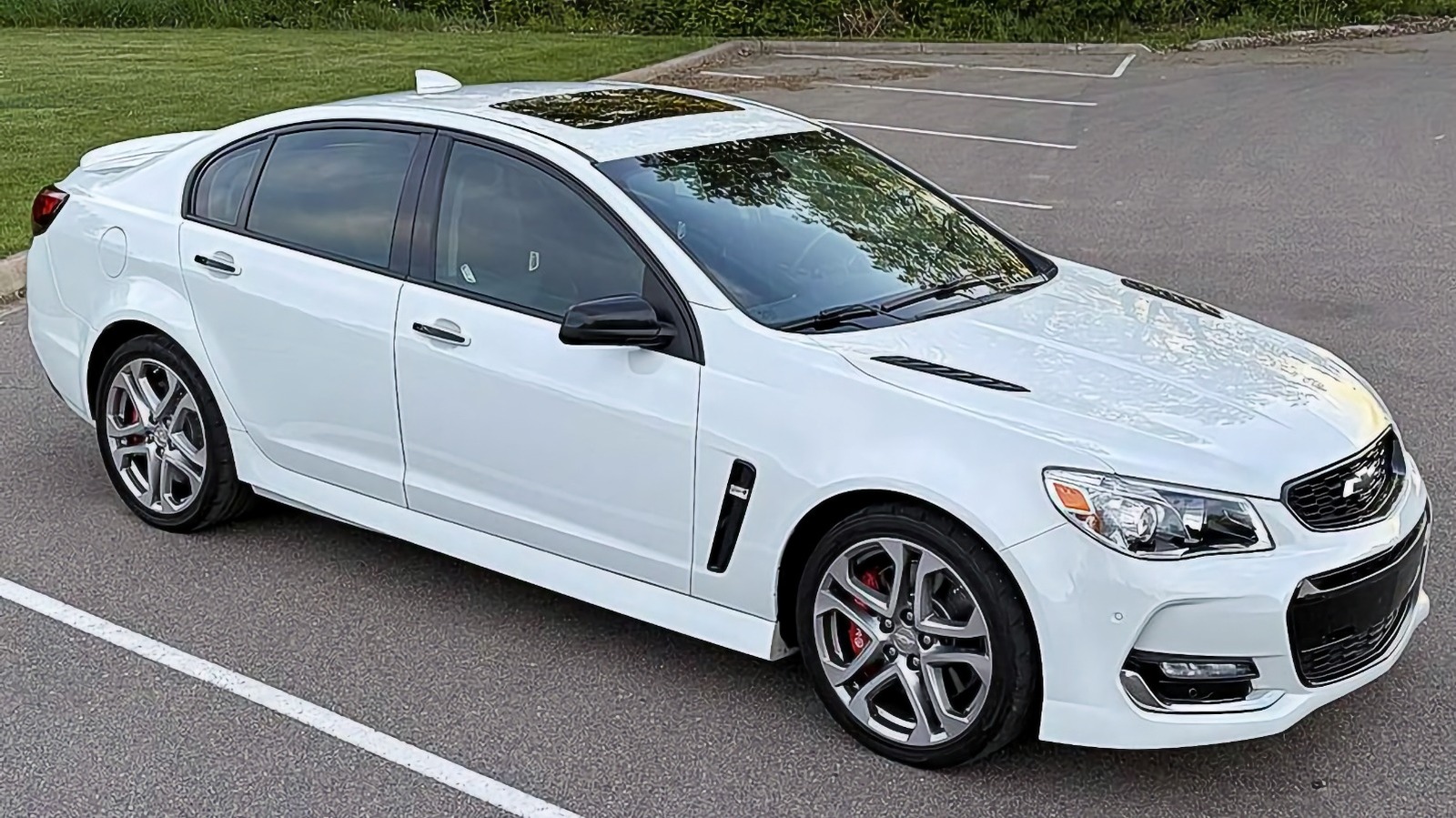
Chevrolet SS Balances V8 Power and Practicality but Faces Value Scrutiny at $45,500

Skoda Peaq Redefines Seven-Seat Electric SUVs With Modern Solid Design and Segment-Leading Practicality
 Enyaq's bigger brother gets sleek Modern Solid styling - and we've had a promising first taste already
Skoda has previewed the design of its upcoming Peaq SUV flagship ahead of a full debut in the coming weeks.
The new seven-seater – which Autocar has driven as a prototype (below) – will use an extended version of the MEB platform that underpins the smaller Enyaq and Elroq, and face off with the likes of the Peugeot E-5008 and Mercedes GLB Electric.
New sketches released by the brand show how the big SUV will be defined by Skoda's minimalist new Modern Solid design language, which was first deployed in its entirety on the little Epiq crossover.
Headline features include the distinctive 'tech deck' grille motif at the front, the T-shaped LED light clusters, thick D-pillars and what Skoda calls a "volcano-shaped" front bumper.
Karl Neuhold, who led the exterior design, said: "In designing the exterior of the Skoda Peaq, we consistently applied the Modern Solid design language, combining clean lines, balanced proportions and distinctive elements.
"Precisely sculpted surfaces and clearly structured details create a confident, timeless presence, while signature features such as the T-shaped headlights and Tech-Deck Face express Škoda’s identity in a new electric era.”
Skoda will reveal the Peaq at a dedicated event in south-eastern France on 23 June, before a market launch after summer.
Sneak Peaq: First drive in Skoda's seven-seat EV
Who doesn’t love a literally named car? Smart Fortwo, Hyundai Coupe… erm, Toyota (M)id-Engined, (R)ear-wheel-drive (2)-seater? There’s a lot to be said for a consumer product that just does what it says on the tin and doesn’t have over-blown aspirations of universal applicability, so you immediately know what it is.
Here’s another good example: the new Skoda Peaq - so called, obviously, because it’s the largest, plushest and most expensive car the Czech firm has yet made (and not, as some thought, as a contrived phonetic tribute to the late VW Group supremo Ferdinand Piech). It’s a characteristically no-nonsense approach to model designation that’s in keeping with the brand’s ‘Simply Clever’ ethos - even if, slightly confusingly, it’s launching at the same time as a much smaller crossover called the Epiq - a name with similarly superlative connotations. And where does Superb fit into that? Maybe ‘Good’, ‘Gooder’ and ‘Goodest’ would’ve been cleaner.
Anyway, the Peaq will be unwrapped in summer as the fourth entrant into Skoda’s swelling family of pure-electric models. At 4.9m long, it’s around 250mm longer than the Enyaq, Skoda’s current EV flagship, and 110mm longer than the combustion-engined Kodiaq, to which it will basically serve as the electric equivalent - complete with seven seats.
The heavy camouflage of our test car leaves a lot to the imagination, but the finished product won't be too far removed from the Vision 7S concept which previewed it – and Skoda’s new ‘Modern Solid’ design language – in 2023. You can see the bold new T-shaped light clusters, for a start, and the Peaq will follow the Epiq in wearing the striking ‘Tech Deck’ motif on its front end.
The Peaq rides on the same VW Group MEB platform that underpins Skoda’s other EVs - albeit with a bit more metal between the axles. My test car had a single 282bhp motor on the rear axle and an 86kWh battery which claims more than 380 miles of range, and can charge at up to 195kW. This battery will also power the 90X twin-motor range-topper, with 295bhp, while the lower-powered ‘60’ entry version will use a smaller, slower-charging 59kWh battery and a single 201bhp motor. Expect prices to range between £50,000 and £60,000 - in line with toppier versions of the Kodiaq, and significantly undercutting the likes of the Kia EV9, Volvo EX90 and Hyundai Ioniq 9.
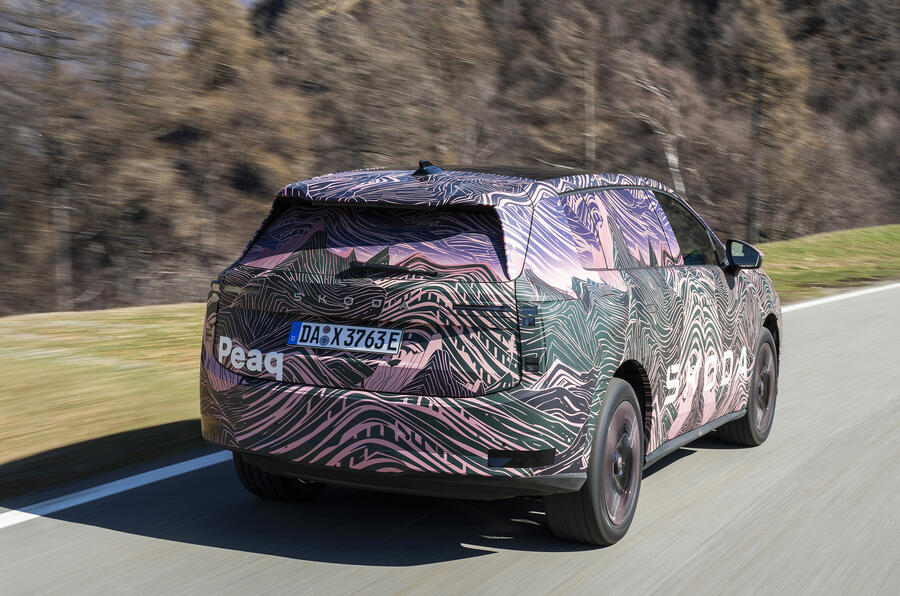
Probed on the possibility of a hot vRS version, product bosses would only grin and tell us that “anything is possible” - so expect that to follow closely behind the standard car.
So far, so familiar - but aside from being its biggest model yet, the Peaq does introduce a number of significant firsts to the Skoda range: there’s a one-pedal driving mode, vehicle-to-load charging functionality, an electrochromatic panoramic roof, a pair of magnetic phone chargers, a Relax package with a reclining seat and fold-out table, a jazzy Sonos sound system, and the door handles are electrically retractable (don’t worry, they have a hammer function to bash themselves out when frozen, and will deploy automatically in the event of a crash).
The 13.6in touchscreen is vertically oriented for the first time, as well, which Skoda says allows for clearer segmentation of content: you can have the map or camera views at the top, in your line of sight, and the buttons at the bottom, so you can reach them easily without lifting your arm from the sliding centre armrest - which does feel much more natural and gives you a better chance of jabbing the icon you were aiming for.
Otherwise, though, the crisp graphics and logical menu structures are all familiar from other Skoda models, so broadly speaking the upright screen makes little difference to how you interact with the car while moving, the only real negative being that installing the screen this way meant there wasn’t enough space for the neat, clicky Smart Dials from the Superb and Kodiaq.
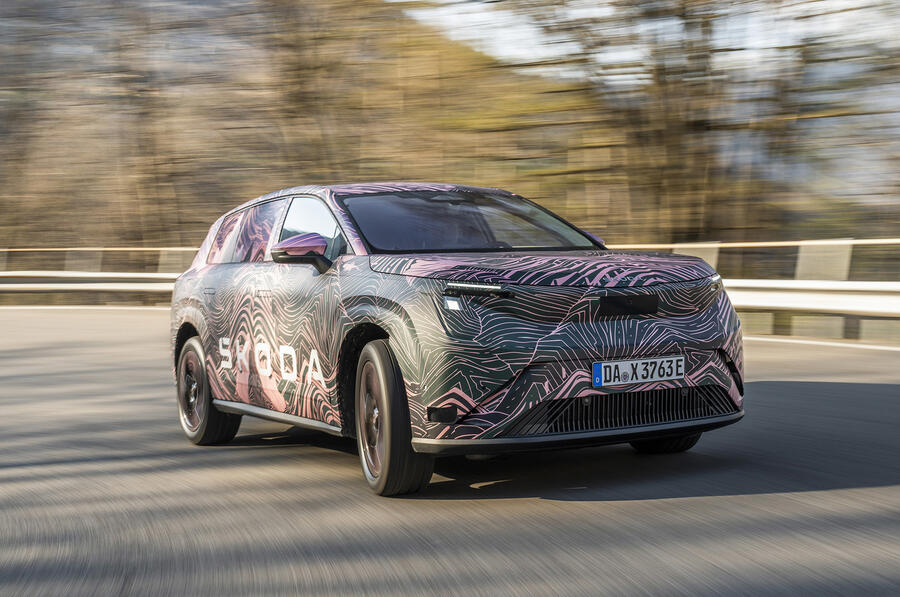
A 170mm increase in wheelbase and flatter floor translates to a tangibly roomier cabin than that of the Kodiaq: Skoda claims 58mm more legroom in the second row and a significant 84mm increase out back. I had to slide the middle row all the way forwards to get comfortable in the rearmost seats, so they’re definitely still off limits for taller passengers, but kids will find them plenty spacious - and there’s still a decent 299 litres of capacity behind them (measured to the roof). That rises to a whopping 935 litres with them folded – slightly up on the Kodiaq – and there’s a 35-litre front boot, too, but that’s best just used for the charge cables.
On the road, it feels predictably (and pleasingly) like a big Enyaq - which is to say impressively composed, sensibly tuned and surprisingly manoeuvrable. The satisfyingly weighted steering is responsive and quick enough to help mask some of its substantial bulk, even on the tight and highly congested roads around Lake Como, and the 9.9-metre turning circle of this RWD version – smaller than a Golf’s – means you don’t miss the rear-steer systems that are fitted to some more expensive cars of this size.
It rides as smoothly as its smaller siblings, too; no Peaq will come with air suspension, but even on steel springs and with chunky 20in wheels (you can also have 19s or 21s), it was commendably unfussed by the more challenging sections of our route - if a little boomier inside, perhaps, by dint of its more cavernous cabin.
My test car was equipped with adaptive dampers as part of the Dynamic Chassis Control package, with 14 levels of adjustment ranging between Comfort and Sport, but as tends to be the case with such systems the default middle-ground setting provides the best real-world balance - the sportiest setting being overly twitchy in its reactions and the other extreme a bit too treacly and languid.
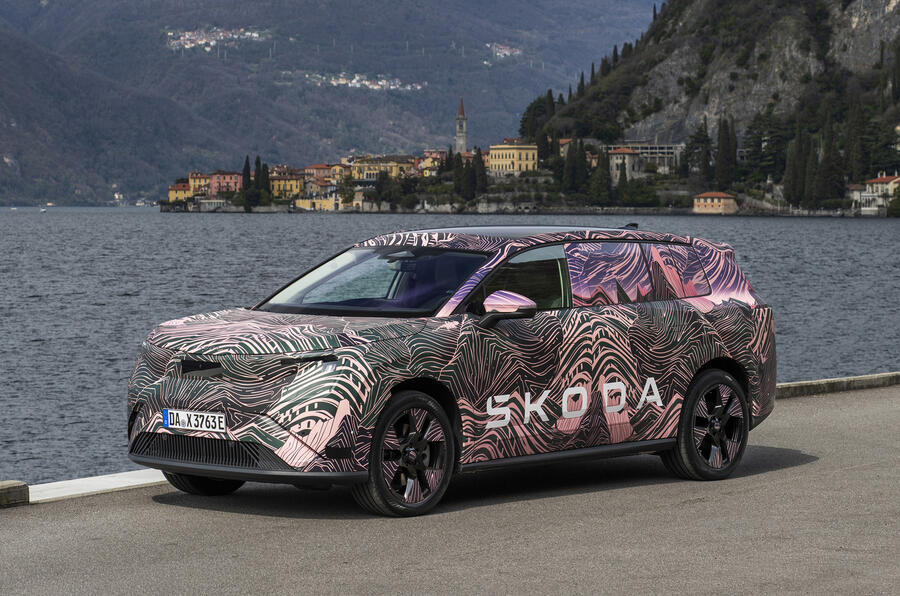
As for outright shove, there’s more than enough of it. I didn’t get much beyond 40mph in my time at the wheel, and didn’t have an opportunity to prove the incongruous 7.1sec 0-62mph time, but the Peaq feels decently energetic off the mark - with smooth take-up and a nice, linear acceleration curve that mitigates the tiresome, dizzying head-lolling you sometimes get with generously endowed EVs.
I’d wager this mid-rung powertrain will emerge as the sweet spot in the line-up, with the cheaper version likely to feel a bit short on puff and stamina, and the 4WD variant sacrificing a good chunk of range and refinement for the sake of a few extra bhp and improved rough-road ability.
Skoda cites the Peugeot E-5008 as the only real direct rival for the Peaq, with Europe’s EV seven-seater market otherwise largely composed of high-priced premium options and Chinese newcomers. Much rests on our first exposure to the finished car, which we’ll drive towards the end of the year, but all signs point to this being a real contender for supremacy in a segment that’s still in its early days.

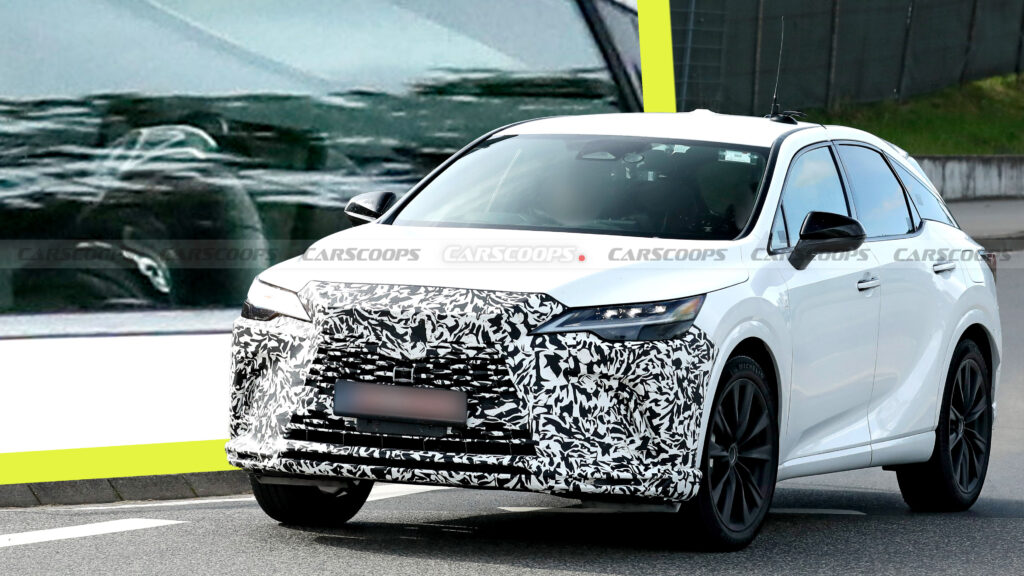
Lexus RX Refresh Prioritizes Subtle Exterior Tweaks and Major Infotainment Overhaul for 2028

Ford’s European Reboot Centers on Rally-Inspired Dynamics and Strategic Partnerships to Regain Market Leadership

Autocar renders show what the new 'Fiesta' and European-market Bronco could look likeElectric hatch will be joined by new small crossovers and an SUV - all with 'rally-led' dynamics
Ford will launch five new cars over the next four years in the UK and mainland Europe - including a new electric Fiesta successor - and the firm's Europe passenger car chief has vowed that their driving dynamics will live up to Ford's rich heritage.
The new models will all sit in the B-and C-segments. They comprise a Bronco-inspired 'multi-energy SUV; a small electric hatchback that could revive the Fiesta name; a crossover that will be built on a Renault platform; and two further plug-in hybrid crossovers that are tipped to be produced in collaboration with Geely.
Ford dominated the UK sales charts for decades with models such as the Fiesta and Focus. But its market share has slumped in recent years, in part due to the decision to axe both of those models and convert its Cologne factory to produce the Explorer and Capri electric SUVs, which are built on a Volkswagen Group platform.
However, Ford has insisted that it remains committed to the European car market and the firm's Europe chief, Jim Baumbick, has declared: "We don't just want to compete. We're here to play to win."
Five new Fords: what's coming
Ford's revamped European strategy includes a major focus on the most popular B-and C-segments, which account for around 80% of sales in the region. All five new models will be between 4.0m and 4.65m long.
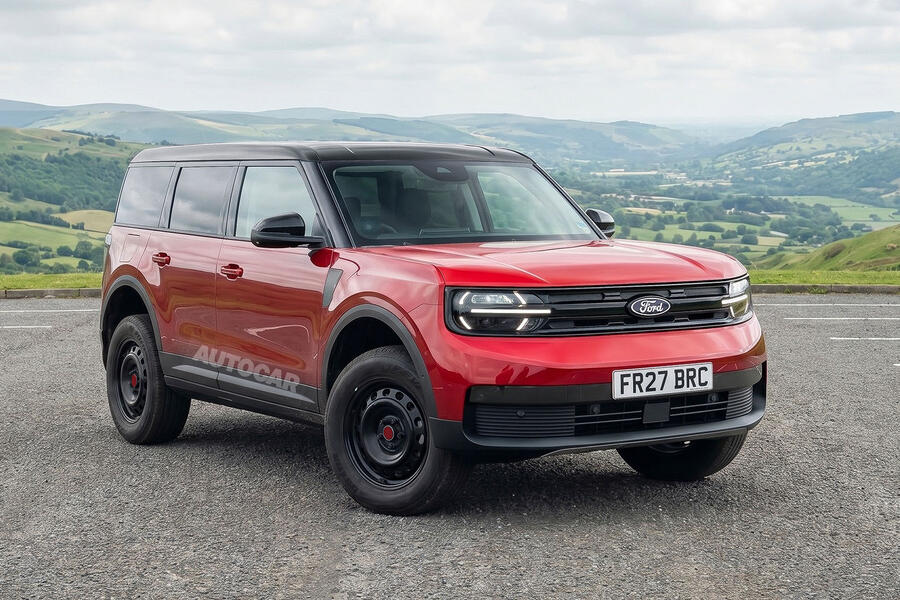
The firm's new-look European line-up will be led by a compact SUV that, as first revealed by Autocar, will be part of the global Bronco family, with styling modelled on the hugely successful US-market off-roader.
The new model will be produced from 2028 onwards at Ford's Valencia plant alongside the existing Kuga SUV, with which it is expected to share Ford's C2 platform. The move is part of a plan by Ford, previously outlined to Autocar by company boss Jim Farley, to turn the Bronco from a single off-road model into a global brand.
Baumbick said the new European Bronco would be true to the US model's heritage but would also be "produced in Europe and sized for the European market", adding that "it will be a high-volume model".
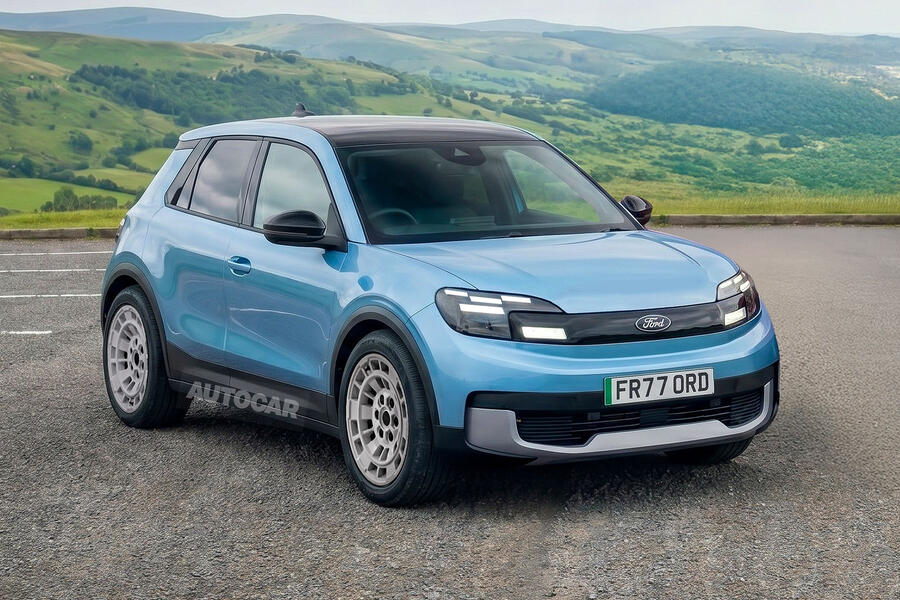
The electric hatchback and crossover, also due in 2028, will be produced for Ford by Renault as part of a previously announced partnership between the two firms. They will sit on Renault's RGMP Small platform (formerly Ampr Small), as used by the Renault 5 and Nissan Micra.
However, Ford insists they will be bespoke propositions, with their driving dynamics and rally-inspired styling dictated by Ford.
Baumbick said: "To a customer, it's the things that [you] see, touch and feel that need to be different to make it authentically a Ford.
"Our job is to work with partners to assess the capability, and the bandwidth of the [Renault] platform gives us the variables to inject and differentiate the driving experience for a Ford, so we're not just buying a list of parts.
"This is not a cafeteria style of development. This is making a strategic choice on a world-class set of platforms and partners that then gives us the tools in the toolkit to do what our development teams do best, to use that toolkit to create a different experience. I assure you that you will see a completely different vehicle."
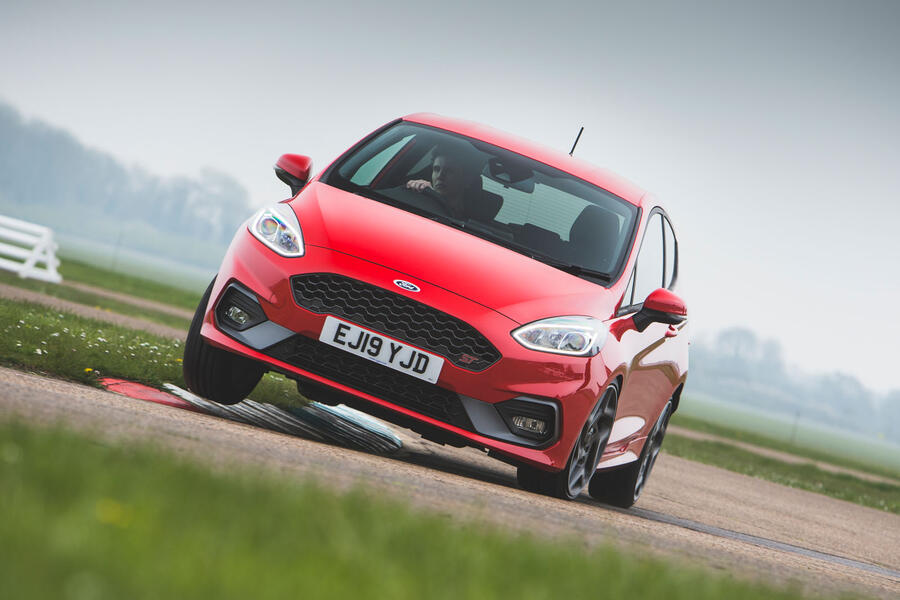
Baumbick declined to comment on whether the new hatchback would revive the Fiesta name and sources at the firm have insisted that a final decision has yet to be made. But he said that "certainly the history and the heritage" of some of Ford's classic model names "is not lost on me".
Ford will also launch what it describes as two "rally-bred crossover models" that will use a multi-energy platform and arrive before the end of 2029. While Baumbick refused to be drawn, it is expected that these will be jointly developed with Chinese giant Geely.
Ford is believed to be in negotiations with Geely to sell part of its Spanish plant to the firm, which owns Volvo and Polestar, and potentially collaborate on platforms.
Baumbick highlighted the importance of strategic partnerships to Ford in giving it the scale and volume required to compete in the European market-but he hinted it could also include Ford producing cars for other firms on its platforms.
The current Puma was launched in 2019 and is offered in petrol and electric forms. Christian Weingärtner, Ford's Europe passenger vehicle boss, told Autocar that the model was "up for renewal" and Ford was considering its future. But he insisted those future plans were "not directly related" to the similarly sized new cars being launched in the coming years.
Ford to focus on driving dynamics
All five of the new vehicles are claimed by Ford to be 'rally-bred', drawing on its long history of off-road competition. The focus on its off-road heritage reflects a similar strategy Ford has taken with its US line-up in recent years.
Based on the success of the revived Bronco, its more road-biased Bronco Sport sibling and Raptor variants of its pick-ups, the firm has focused on becoming "the Porsche of off-road".
Ford will use its rallying heritage to follow a similar path in Europe, believing that this approach will reinforce its history of producing cars with strong driving dynamics. The company's aim is to ensure that Fords offer superior driving dynamics to rivals, something that the firm became particularly known for in Europe with models such as the Fiesta and Focus, which were honed by dynamics guru Richard Parry-Jones.
Weingärtner told Autocar: "We need to combine the heritage with the future. If you look at the market today, what sets us apart is that we've been here for more than 100 years."
He added that this needed to be reflected in the dynamics of every vehicle Ford produces.
He said: "If the only reason to buy a car is price, then heritage matters not at all-but there are more reasons to buy a car, and this emotional connection people have with Ford matters.
"But heritage alone doesn't sell vehicles: it needs to be a good proposition, and having a sporty car is what people like to drive. We're convinced that, say, having a lot of touchscreens in a car doesn't necessarily make it the best car. Driving dynamics is something Ford has traditionally been really good at, and we'll double down on this."
This doesn't mean that all new Fords will be hardcore rally-infused models, but rather that their handling traits will emphasise fun driving. Weingärtner insisted that Ford would be able to accomplish that on platforms developed by a different company.
"We can't just have that as a marketing slogan. It needs to be injected into the core technical elements of the vehicle," said Weingärtner. "That's what we're going to do with the dampers, suspension and all those kinds of things [so it] will be true to Ford.
"The charging system of an EV platform might not be ours, but that has nothing to do with how a vehicle drives. The driving dynamics, all the things that matter, all the tunable elements and the design that will all be true to Ford."
Wider role for van division
Ford Pro, the firm's commercial vehicle arm, has long been the main profit driver of its European operations and in the future will push further into developing software-based services enabled by more advanced EVs. But it will expand its product line-up too, including the new Transit City electric van that has been developed with Chinese firm JMC.
Ford will also launch a new Super Duty variant of the Ranger pick-up, which is intended for use by emergency services and the military as well as in heavy-duty industries such as forestry and mining. It can tow up to 4.5 tonnes, has a payload of close to 2.0 tonnes and features beefed-up suspension and extra underbody protection.
Ford has used the Super Duty badge in the US since 1999 for a range of extreme commercial variants of its F-Series pick-ups.

Mitsuoka Roadster Signals Return to Retro-Inspired Coachbuilding on Mazda MX-5 Foundations